42Views 0Comments
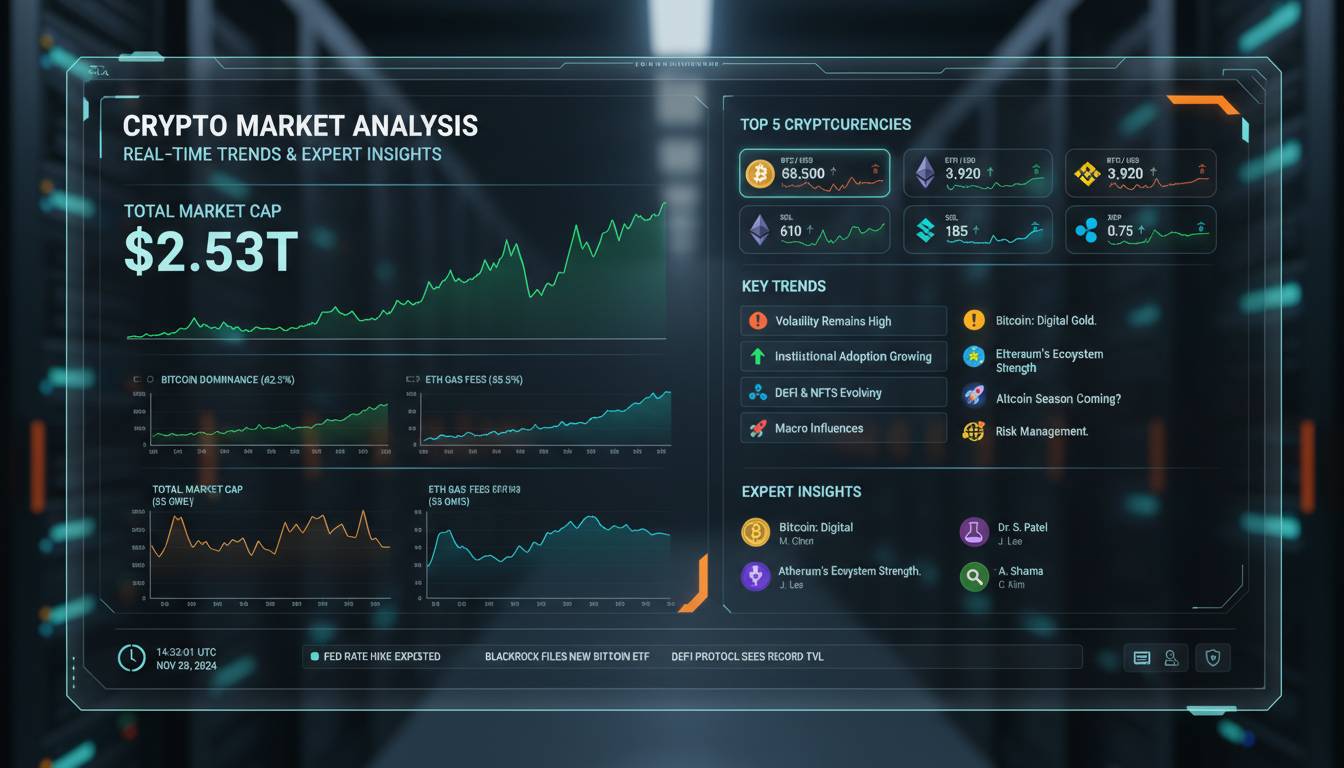
Crypto Market Analysis: Real-Time Trends & Expert Insights
The cryptocurrency market evolves quickly, bringing new opportunities and new risks for investors, traders, and institutions. As digital assets become part of mainstream finance, understanding what drives prices and sentiment matters more than ever. This report looks at where the market stands, what’s shaping it, and what to watch going forward.
Current Market Overview
The crypto market has held up well in recent weeks, with total market capitalization around $2.1 trillion in early 2025. Bitcoin still dominates, holding about 52% of total crypto value. Ethereum remains the top smart contract platform.
Trading volumes have jumped on major exchanges, with 24-hour spot trading regularly above $100 billion. More institutions are participating, and retail interest has grown since the SEC approved spot Bitcoin ETFs in the US.
Volatility is still higher than traditional assets, but it’s steadier. The Cboe Volatility Index for Bitcoin has come down from its highs, suggesting the market is maturing. That said, geopolitical tensions, regulatory news, and macroeconomic shifts still move prices significantly.
Key Drivers of Market Movement
Several basic factors are driving crypto prices right now. Macroeconomic conditions, especially Federal Reserve interest rate decisions, heavily influence how investors feel about risk assets like digital currencies.
The link between traditional markets and crypto has gotten stronger. When stocks drop, crypto tends to drop too—though the moves are often bigger in the crypto space.
Regulation is a major driver of sentiment. The SEC’s recent enforcement priorities have given some clarity, though the rules keep changing. The EU’s MiCA framework sets up a comprehensive approach that other countries might follow.
Supply dynamics still matter for Bitcoin. The next halving will cut miner rewards in half, reducing new supply. History shows halvings have preceded price increases, though that doesn’t guarantee it happens again.
Institutional Adoption and Market Maturation
Big money has reshaped the crypto market. Major financial institutions now offer clients crypto products through regulated channels and custody services. This brings more liquidity, better price discovery, and more market integrity.
Asset managers with trillions under management are adding crypto allocations, seeing it as a way to diversify. Pensions and endowments are interested too, though many are still testing the waters or keeping allocations small.
The derivatives market has grown fast. Perpetual futures and options let traders hedge and take positions without holding the underlying assets. This has made price discovery more efficient and reduced premiums in spot markets.
Custody has improved a lot. Licensed custodians now offer institutional storage with insurance and regulatory compliance—the security that large investors need.
Technical Analysis Perspectives
Technical analysts are watching key support and resistance levels. On the daily chart, Bitcoin has support above $60,000, with resistance at $75,000 and $85,000. Volume data shows buying interest when prices dip, meaning demand is still there.
The market has broken out of its previous trading range. Breakouts above key levels have generated more activity, though analysts say to wait for volume confirmation before taking positions.
On-chain data offers more perspective. Bitcoin on exchanges has dropped, suggesting investors prefer to hold their own coins. This is often seen as bullish, since it means less selling pressure.
Network activity looks healthy—transaction volumes and active addresses are growing, showing more people are using the chains. Developer activity remains strong, with protocol upgrades continuing despite price swings.
Regional Regulatory Landscape
Regulation differs widely across countries, creating a patchwork for global players. In the US, clarity remains elusive, with multiple federal agencies claiming jurisdiction over different crypto activities.
State-level rules keep developing. Some states are more crypto-friendly than others, and this uneven landscape has pushed some companies to base operations in friendlier jurisdictions, though major exchanges comply across all states.
Internationally, Singapore, Switzerland, and the UAE have become crypto hubs with clear rules that protect consumers while supporting innovation. Japan has comprehensive regulations. The EU’s MiCA provides a single approach across member states.
This regulatory split creates challenges for businesses operating globally, but also opportunities where frameworks are clear.
Future Outlook and Emerging Trends
Several trends will likely shape crypto going forward. Layer-2 scaling solutions are solving throughput problems, which could enable new use cases and better user experience.
Central bank digital currencies are advancing. Several countries are pushing forward with digital currency projects. While CBDCs aren’t the same as decentralized crypto, they could change how people think about digital money and drive adoption.
AI and blockchain are starting to overlap. Projects exploring AI-driven trading, decentralized AI infrastructure, and tokenized AI services are getting attention, though many are still early.
DeFi has matured. Protocols have become more resilient after earlier crashes. Total value locked has recovered, though competition for users remains fierce.
Environmental concerns still affect how people see crypto. There’s growing demand for renewable energy-powered mining and sustainable blockchain solutions. Major networks have pledged to cut carbon footprints, though progress varies.
Conclusion
The crypto market keeps growing, innovating, and adapting. Volatility remains, but the fundamentals supporting digital assets are stronger. Institutional participation has brought more legitimacy and better infrastructure. Regulatory frameworks are taking shape in major markets.
For anyone considering crypto investments, understanding how macro factors, regulation, and technology interact is essential. The market offers real opportunities for those who navigate it carefully, but risk management and research should guide every decision.
As crypto matures, staying informed about developments and trends will matter for long-term success in this space.
Frequently Asked Questions
What factors most significantly influence cryptocurrency prices?
Prices respond to supply and demand, macro conditions, regulation, sentiment, tech developments, and institutional adoption. Major cryptos also move on news, geopolitical events, and changes in traditional markets.
How does institutional adoption affect cryptocurrency markets?
Institutions bring more liquidity, better trading infrastructure, and stricter compliance. This generally means less volatility over time, improved price discovery, and more market legitimacy. But it also means crypto prices may move more in line with stocks.
Is cryptocurrency a safe investment?
Crypto carries big risks: wild price swings, regulatory uncertainty, tech problems, and losing access to funds. Only invest money you can afford to lose completely. Do your homework first. Diversification and risk management matter.
How do regulatory changes impact cryptocurrency markets?
Regulation announcements can move prices a lot. Clear rules are usually seen as positive because they add legitimacy. Restrictive measures often trigger sell-offs. Crypto is global, so regulatory news from the US, China, or the EU can shift sentiment worldwide.
What are the key metrics used in cryptocurrency analysis?
Key metrics include market cap, trading volume, circulating supply, network activity (active addresses, transaction counts), on-chain data (exchange reserves, holder behavior), technical indicators (moving averages, RSI), and fundamentals (developer activity, institutional adoption, regulatory news).
How often should I review my cryptocurrency portfolio?
It depends on your strategy. Day traders check daily. Long-term investors might review monthly or quarterly. During volatile periods or after big news, more frequent monitoring makes sense.