112Views 0Comments
Solana Price Prediction: Bullish SOL Forecast & Key Levels
Solana remains a focus for cryptocurrency traders and investors watching its price movements. The blockchain’s architecture and expanding ecosystem of applications have made it a significant player among Layer-1 blockchains. This article looks at the factors shaping Solana’s price, current market conditions, and the technical and fundamental elements traders examine when evaluating SOL’s direction.
The cryptocurrency market is volatile, with digital assets experiencing significant price swings. Solana, ranked among the top cryptocurrencies by market cap, has shown both resilience and volatility. Understanding what drives Solana’s price requires looking at network adoption, technological developments, competitive positioning, and broader market sentiment.
Understanding Solana’s Market Position
Solana positions itself as a fast blockchain. The network combines proof-of-history with proof-of-stake, allowing up to 65,000 transactions per second theoretically. This capability has drawn developers and projects to build on Solana, creating an ecosystem that includes decentralized exchanges, NFT marketplaces, lending platforms, and gaming applications.
SOL, the native token, serves several functions. It powers transactions, enables staking for network security, and facilitates governance. The token also works as a medium of exchange within Solana’s DeFi ecosystem. More users interacting with Solana applications increases demand for SOL, which can affect its market value.
Analysts compare Solana to other high-performance blockchains, looking at transaction throughput, uptime, developer activity, and user adoption. These comparisons affect investor sentiment and trading decisions. Competitors include Ethereum, Avalanche, Polygon, and other Layer-1 and Layer-2 solutions, each with different advantages and trade-offs.
Technical Analysis and Price Dynamics
Traders use technical analysis tools to study historical price patterns, support and resistance levels, and various indicators for assessing potential price movements. Common approaches include moving averages, Relative Strength Index (RSI), MACD histograms, and Fibonacci retracement levels. These tools help traders identify potential entry and exit points.
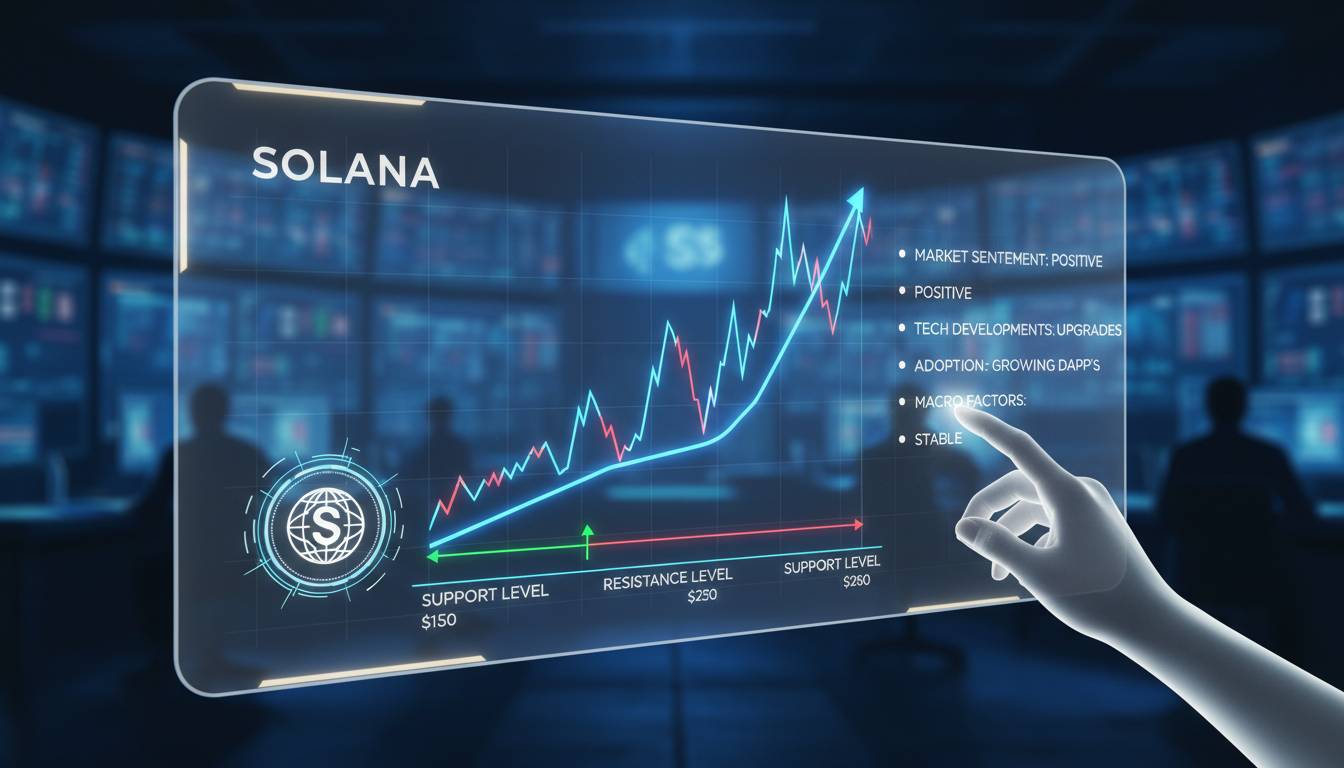
Support levels are price points where buying pressure has exceeded selling pressure, creating floors for price declines. Resistance levels are areas where selling pressure has prevented further price increases. Analysts study these levels to identify breakout opportunities or consolidation phases.
Volume analysis helps understand price movements, as trading volume indicates the strength behind price moves. Higher volume during price increases suggests stronger bullish momentum, while high volume during declines may indicate intensified selling pressure. Traders monitor volume trends to confirm price movements and spot potential trend reversals.
Market structure analysis examines overall trend direction, whether Solana is making higher highs and higher lows in an uptrend or lower highs and lower lows in a downtrend. Understanding market structure helps traders align strategies with prevailing trends while staying alert to potential changes.
Fundamental Factors Driving Solana’s Value
Fundamental analysis extends beyond price charts to examine underlying factors that may influence long-term value. Network metrics show ecosystem health, including total value locked (TVL) in DeFi protocols, unique active addresses, transaction volumes, and developer activity. These metrics help assess whether the network is growing and gaining adoption.
Partnerships and institutional adoption are significant factors. When major companies or financial institutions announce support for or integration with Solana, it often generates positive sentiment and may attract capital. Enterprise partnerships can validate the technology and expand its reach beyond crypto-native users.
Regulatory developments significantly impact crypto markets, including Solana. Clear regulatory frameworks can encourage institutional investment and adoption, while restrictive regulations may limit growth. Market participants monitor regulatory announcements and legislative developments affecting digital assets globally.
Tokenomics, including supply mechanics and token distribution, influence perceived value. Solana has a capped maximum supply of approximately 489 million SOL, providing scarcity compared to inflationary alternatives. Understanding token unlock schedules and distribution patterns helps investors assess potential supply-side pressures on pricing.
Market Sentiment and External Factors
Cryptocurrency markets are sensitive to broader market sentiment, particularly risk appetite among investors. During periods of monetary easing and low interest rates, risk assets including cryptocurrencies often benefit from increased investment flows. Tightening monetary policy or risk-off sentiment can pressure cryptocurrency prices.
Macroeconomic conditions including inflation rates, economic growth, and geopolitical developments influence investor behavior across asset classes. Crypto markets have shown increasing correlation with traditional risk assets, particularly during market stress. Understanding these broader dynamics helps contextualize Solana’s price movements within the larger financial landscape.
Media coverage and social media sentiment also influence cryptocurrency price movements. Positive coverage in mainstream financial media can attract new investors, while negative coverage may generate selling pressure. Social media platforms serve as real-time sentiment indicators, with analysis of discussions around Solana providing insights into market mood.
Institutional involvement in crypto markets has grown substantially, with major financial institutions offering custody, trading, and investment products. This institutional participation brings increased capital and legitimacy but also introduces new dynamics as large-scale investors execute strategies that may differ from retail traders.
Risk Considerations and Investment Perspective
Investing in cryptocurrencies carries substantial risks that potential investors must carefully consider. Price volatility remains extremely high compared to traditional financial assets, with single-day moves of 10% or more occurring periodically. This volatility can result in significant gains but also substantial losses.
Technical failures or security breaches could negatively impact Solana’s value proposition. The network has demonstrated strong performance, but past incidents including network outages have highlighted potential vulnerabilities. Investors should assess the network’s track record and ongoing development efforts.
Competition from other blockchain platforms presents ongoing challenges. The crypto ecosystem evolves rapidly, with new technologies and platforms regularly entering the market. Solana must continue innovating to maintain its competitive position against established rivals and emerging challengers.
Regulatory uncertainty represents a persistent risk factor. Governments worldwide continue developing regulatory frameworks for cryptocurrencies, with outcomes ranging from supportive to restrictive. Regulatory changes could significantly impact Solana’s operations and value.
Looking Ahead: Factors to Monitor
The outlook for Solana depends on numerous factors that market participants should monitor. Network development milestones, including technology upgrades and feature releases, may influence both functionality and investor sentiment. The growth of the Solana ecosystem, measured by application launches and user adoption, provides important signals about long-term viability.
Competitive developments within the blockchain industry require ongoing attention. How Solana positions itself relative to Ethereum’s scaling solutions, Avalanche’s subnet architecture, and other competitors will influence its market share and growth trajectory.
Broader cryptocurrency market conditions will likely continue influencing Solana’s price. Bitcoin’s behavior often affects altcoin performance. Monitoring Bitcoin’s price movements and market dynamics provides context for understanding Solana’s potential direction.
Macroeconomic conditions and regulatory developments will likely remain significant factors. Changes in monetary policy, economic conditions, or regulatory frameworks could substantially impact risk asset performance, including cryptocurrencies.
Frequently Asked Questions
What factors most influence Solana’s price movements?
Solana’s price is influenced by network adoption and usage metrics, broader cryptocurrency market sentiment, technical developments and upgrades, institutional investment flows, competitive positioning against other blockchains, regulatory announcements, and macroeconomic conditions. These factors interact to create the price dynamics observed in SOL trading.
Is Solana a good investment for beginners?
Cryptocurrency investments carry substantial risk due to price volatility. Beginners should thoroughly research the technology, understand the risks, and only invest what they can afford to lose. Diversification across multiple assets rather than concentrating in a single cryptocurrency is often recommended. Consulting with financial advisors familiar with digital assets can provide personalized guidance.
How does Solana compare to Ethereum?
Solana and Ethereum serve similar purposes but use different technical approaches. Solana offers higher theoretical transaction throughput and lower fees per transaction, while Ethereum benefits from greater network effects, more established developer ecosystem, and scaling improvements through Layer-2 solutions. Both platforms have distinct advantages depending on use case requirements.
What is the maximum supply of Solana?
Solana has a maximum supply of approximately 489 million SOL tokens. The token distribution has included initial minting, token sales, and ongoing inflation rewards for staking. Understanding supply mechanics helps investors assess potential scarcity and inflationary pressures on the token.
How can I use technical analysis for Solana trading?
Common technical analysis approaches for Solana include examining support and resistance levels, trend analysis using moving averages, momentum indicators like RSI, volume analysis to confirm price movements, and chart pattern recognition. Traders often combine multiple indicators to develop trading strategies while managing risk through position sizing and stop-loss orders.
What risks should I consider before investing in SOL?
Key risks include extreme price volatility, potential network technical issues or outages, competition from other blockchain platforms, regulatory uncertainty, liquidity risks, and the speculative nature of cryptocurrency investments. Thorough due diligence and risk management practices are essential for anyone considering cryptocurrency investments.