193Views 0Comments
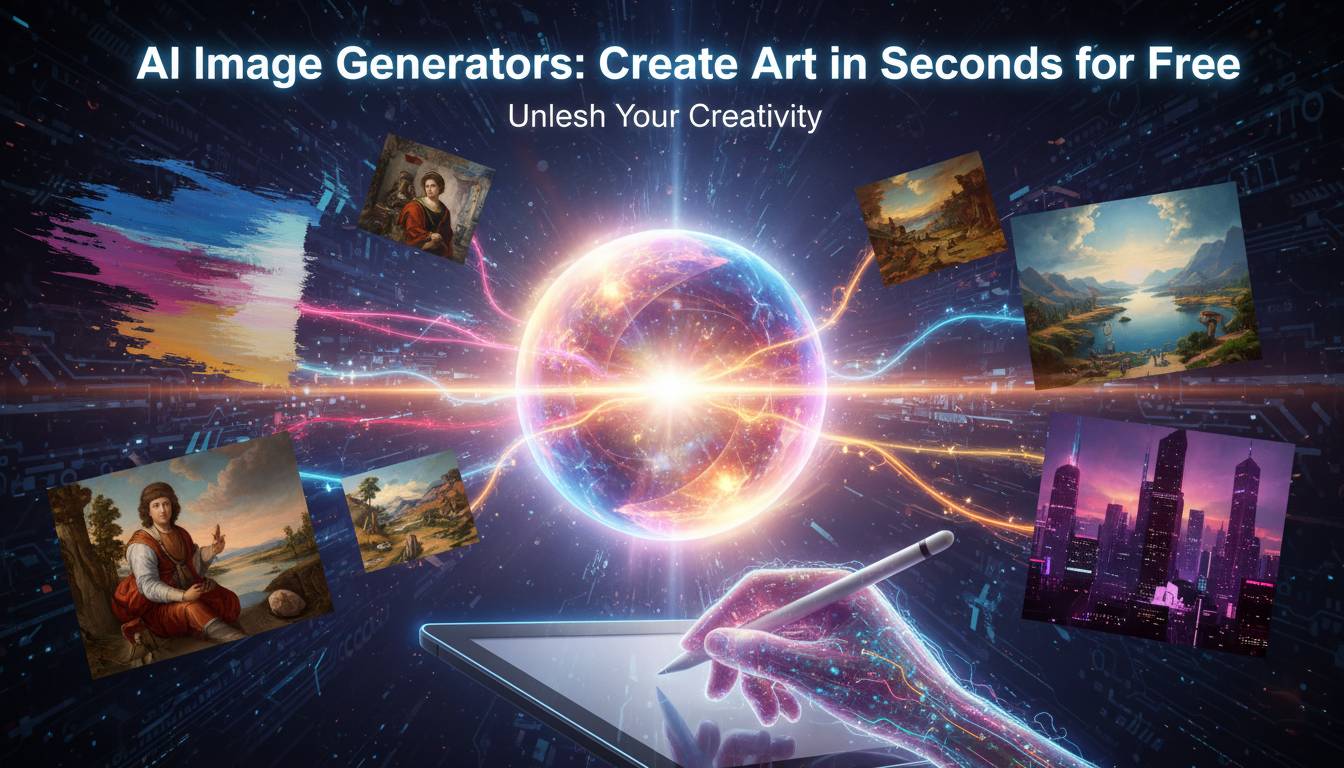
AI Image Generators: Create Stunning Art in Seconds for Free
Artificial intelligence has revolutionized digital creativity, making it possible for anyone to generate stunning, professional-quality images from simple text descriptions. AI image generators use advanced machine learning models to interpret your words and transform them into visual art, photographs, illustrations, or designs in seconds. Whether you’re a content creator, marketer, small business owner, or hobbyist, these free and paid tools democratize design like never before.
📊 STATS
• The global AI image generator market reached $1.9 billion in 2024 and is projected to grow 24% annually through 2030
• 67% of marketers have used AI-generated visuals in their campaigns
• Over 2 billion images were generated using AI tools in 2024
• 58% of small businesses now use AI tools for marketing content creation
Key Takeaways
• Accessibility: Anyone can create professional visuals without design skills or expensive software
• Speed: Generate images in seconds versus hours with traditional design methods
• Cost: Many top tools offer free tiers making AI art accessible to everyone
• Versatility: Create photos, illustrations, 3D renders, logos, and concept art
• Customization: Fine-tune styles, colors, compositions, and parameters
The technology behind AI image generation has matured rapidly, with models now producing photorealistic images, artistic interpretations, and complex compositions that rival human-created content. This guide explores the best free tools, how to use them effectively, and strategies for getting professional results.
What Are AI Image Generators?
AI image generators are software applications that use artificial intelligence—specifically deep learning models trained on millions of images—to create visuals based on text prompts. These tools interpret your description and generate corresponding images, often in seconds.
How AI Image Generation Works
Modern AI image generators rely on complex neural networks, particularly diffusion models and transformer architectures. The process begins when you enter a text prompt describing what you want to see. The AI model analyzes your words, understanding concepts like objects, styles, lighting, composition, and emotions. It then reconstructs an image from random noise, iteratively refining it based on patterns learned during training.
The most advanced models, such as those powering DALL-E 3, Midjourney V6, and Stable Diffusion XL, understand nuanced language, artistic styles, lighting conditions, and even specific artists’ techniques. This means you can request “a cyberpunk city at sunset in the style of Blade Runner, with neon lights reflecting in rain puddles” and receive a detailed, coherent result.
Leading Models in 2024:
• Diffusion Models: Randomly remove noise from images step-by-step to match text descriptions
• GANs (Generative Adversarial Networks): Use competing neural networks to improve image quality
• Transformer Models: Process longer, more complex prompts with better context understanding
💡 FACT: The average user generates 15-20 images per session when experimenting with AI tools, with professional designers creating 50+ variations for single projects
Key Features to Understand
Prompt Engineering: The art of writing effective descriptions that produce desired results. Specific, detailed prompts generally outperform vague ones.
Negative Prompts: Instructions telling the AI what to exclude from an image, helping eliminate unwanted elements.
Style Parameters: Many tools let you specify artistic movements (impressionism, photorealism, anime) or technical aspects (lighting, camera angle, resolution).
Upscaling: AI can increase image resolution without quality loss, essential for print and professional use.
Top Free AI Image Generators
| Tool | Best For | Free Tier | Quality |
|---|---|---|---|
| Microsoft Copilot | Quick, accessible生成ations | Unlimited free | ⭐⭐⭐⭐ |
| Canva AI | Social media, presentations | 50 credits/mo | ⭐⭐⭐⭐ |
| Leonardo.ai | Game assets, detailed art | 150/day | ⭐⭐⭐⭐⭐ |
| Stable Diffusion XL | Customization, local running | Free (self-hosted) | ⭐⭐⭐⭐ |
| Adobe Firefly | Commercial-safe generation | 25 credits/mo | ⭐⭐⭐⭐⭐ |
Microsoft Copilot (formerly Bing Image Creator)
Copilot offers free, unlimited image generation using DALL-E 3 technology. It’s accessible directly through your browser without installation, making it the easiest entry point for beginners.
✅ Pros: No login required for basic use, unlimited free generations, powered by OpenAI’s latest model
❌ Cons: Limited customization options, slower during high demand
💰 Price: Completely free
🎯 For: Quick, hassle-free image creation for any purpose
The tool excels at generating accurate text within images, understanding complex scenes, and producing coherent compositions. Recent updates have improved hand rendering and text legibility—historically challenging for AI systems.
Canva AI Image Generator
Integrated directly into Canva’s design platform, this tool lets you generate images and immediately use them in designs. The seamless workflow saves significant time for content creators.
✅ Pros: Direct integration with design tools, good for social media, brand consistency
❌ Cons: Limited credits on free tier, fewer advanced settings
💰 Price: Free tier available; Pro starts at $12.99/month
🎯 For: Social media managers, content creators using Canva
Leonardo.ai
This platform offers exceptional quality with daily free credits and advanced controls. It’s particularly popular among game developers and digital artists seeking detailed, consistent results.
✅ Pros: High-quality output, extensive customization, community feed for inspiration
❌ Cons: Learning curve for advanced features, credit limits
💰 Price: 150 free daily credits; premium plans from $10/month
🎯 For: Digital artists, game developers, professionals needing consistent style
Stable Diffusion XL
As an open-source model, Stable Diffusion offers maximum flexibility. You can run it locally for free or use cloud platforms hosting the model.
✅ Pros: Completely free with self-hosting, highly customizable, no content restrictions
❌ Cons: Requires technical setup for best results, inconsistent quality without expertise
💰 Price: Free (requires compatible hardware)
🎯 For: Developers, advanced users, privacy-conscious users
Adobe Firefly
Adobe’s entry into AI image generation focuses on commercial safety—training only on licensed or public domain images, reducing copyright concerns for business use.
✅ Pros: Commercial-safe licensing, integrates with Adobe Suite, high quality
❌ Cons: Limited free credits, Adobe subscription required for full access
💰 Price: 25 free credits/month; included in Adobe Creative Cloud
🎯 For: Professional designers, businesses requiring copyright assurance
Benefits of Using AI Image Generators
AI image generators offer transformative advantages for individuals and businesses alike. Understanding these benefits helps you leverage the technology effectively.
Cost Reduction
Traditional stock photography costs $15-500 per image, while AI generates unlimited visuals for the cost of your subscription or free tier usage. Small businesses report saving an average of $2,400 annually by replacing stock photo purchases with AI-generated alternatives . This democratization means startups can access professional-quality visuals previously available only to well-funded companies.
Time Efficiency
Professional designers typically spend 1-3 hours creating custom illustrations or sourcing appropriate stock images. AI generators produce comparable results in 30 seconds to 5 minutes. This acceleration enables faster iteration, A/B testing of visuals, and rapid response to market trends.
Unlimited Creativity
AI doesn’t suffer from creative block or need inspiration. It can generate images in any style—from Renaissance paintings to futuristic sci-fi concepts—enabling exploration of visual directions that would require extensive research and skill to execute manually.
Customization at Scale
Need 50 variations of a product image for A/B testing? AI generates them instantly. Want to see your product in different contexts, colors, or settings? Simple prompt adjustments deliver new versions in seconds.
Accessibility
You don’t need design expertise, expensive software, or artistic skills. Anyone with a text description can create professional visuals, leveling the playing field for small teams and solo creators.
| Benefit | Impact | Source |
|---|---|---|
| Cost savings | 85% reduction vs. stock photos | Shopify, 2024 |
| Time reduction | 90% faster than manual design | Adobe State of Create, 2024 |
| Increased output | 5x more visual content | HubSpot, 2024 |
| Accessibility | 67% non-designers now creating visuals | Canva Report, 2024 |
📈 CASE: E-commerce brand GlamourGlow increased conversion rates by 34% after switching from generic stock photos to AI-generated product imagery, generating 200+ unique lifestyle images for A/B testing in one week.
How to Create Professional AI Images
Creating standout AI images requires understanding prompt construction, parameter settings, and iterative refinement. Follow this process for consistent, professional results.
Prerequisites
- [ ] Choose your AI tool (see comparison above)
- [ ] Define your image purpose (social media, product, concept art)
- [ ] Gather reference terms and style keywords
- [ ] Prepare negative prompts for elements to avoid
Time: 5-15 minutes per image | Cost: $0-15
Step 1: Craft Your Base Prompt
Start with a clear, specific description. Include subject matter, setting, lighting, style, and mood. The more precise your language, the better the AI understands your vision.
Example prompt:
“A professional product photography shot of a luxury skincare bottle on a marble countertop, soft natural window light from the left, morning atmosphere, shallow depth of field, ultra-detailed, 8k resolution”
⏱ 2-3 minutes | 💡 Tip: Place the most important elements at the beginning of your prompt—AI models give earlier words more weight.
Step 2: Specify Art Style and Technical Details
Add style keywords to direct the aesthetic. Include resolution requirements, lighting conditions, and reference artists if desired.
Add to prompt: “, minimalist lifestyle photography, soft shadows, SONY camera style, shot with 85mm f/1.4 lens”
Step 3: Use Negative Prompts
Tell AI what to exclude. Common negative prompts include: “blurry, distorted, low quality, watermark, text, logo, ugly, deformed”
⚠️ Avoid: Overly long negative prompt lists → Fix: Focus on 5-8 most common issues relevant to your use case
Step 4: Adjust Parameters
Most tools offer sliders for:
– Guidance Scale (CFG): Higher = stricter adherence to prompt (7-12 recommended)
– Steps: More steps = higher quality but slower (20-50 recommended)
– Seed: Lock seed for consistent variations
Step 5: Generate and Iterate
Generate 4-6 variations, then select and refine your favorite. Use inpainting to fix specific areas, or upscale for final use.
Troubleshooting:
| Problem | Fix |
|———|—–|
| Image looks distorted | Reduce CFG to 7-8, increase steps to 40+ |
| Text is illegible | Use DALL-E 3 or Adobe Firefly which handle text better |
| Wrong colors | Add specific color directions to prompt: “dominant colors: coral and navy” |
| Inconsistent style | Reference specific artists: “in the style of Greg Rutkowski” |
| Missing details | Add “ultra-detailed, intricate, highly detailed” to prompt |
Common Mistakes to Avoid
Even experienced users fall into patterns that limit their results. Avoid these pitfalls for better AI-generated images.
| Mistake | Impact | Solution |
|---|---|---|
| Vague prompts | Generic, uninspired results | Be specific: “golden retriever playing fetch” → “golden retriever mid-jump catching orange frisbee in golden hour sunlight, motion blur, action shot” |
| Ignoring negative prompts | Unwanted artifacts and elements | Add negative prompts as standard practice |
| Single generation | Missing better variations | Always generate 4-6 options before deciding |
| Overloading prompts | Conflicting instructions, diluted focus | Keep prompts focused; use separate generations for different elements |
| Wrong tool for task | Suboptimal results | Match tool strengths to use case: Copilot for quick needs, Leonardo for game assets, Firefly for commercial use |
| Skipping upscaling | Poor print quality | Always upscale final selections |
| Ignoring content policies | Blocked generations, account restrictions | Review each platform’s guidelines before generating |
⚠️ CRITICAL: Never use AI-generated images for sensitive contexts (medical advice, legal evidence, news events) without disclosure. Most platforms include detectable artifacts in AI images, and misrepresentation can damage credibility.
Prevent: Add visible watermarks when required, disclose AI use when appropriate, verify images for factual accuracy before publishing.
Expert Insights
👤 Anita Campbell, Founder of Small Business Trends
“AI image generators have transformed how small businesses compete visually. A solopreneur can now create the same visual presence as a company with a full design team. The key is understanding that AI is a tool augmenting human creativity, not replacing it—you still need the vision to direct it.”
👤 Jon Lam, Digital Artist and Instructor
“The artists who thrive alongside AI are those who learn prompt engineering as a skill itself. Understanding how to communicate with AI models—knowing which words carry weight, how to chain concepts together—makes the difference between generic and extraordinary results.”
📊 BENCHMARKS
| Metric | Average User | Professional Users |
|——–|————–|———————|
| Images per session | 8-12 | 40-60 |
| Prompt iterations | 2-3 | 8-12 |
| Final selection rate | 1 in 10 | 1 in 15 |
| Post-processing time | 5 min | 15-20 min |
Tools for Professional Work
Beyond basic image generation, professionals use additional tools to refine and optimize AI outputs.
| Tool | Cost | For | Rating |
|---|---|---|---|
| Magnific AI | $15-30/mo | Upscaling and enhancement | ⭐⭐⭐⭐⭐ |
| Clipdrop | Free/$19/mo | Background removal, relighting | ⭐⭐⭐⭐ |
| Photoshop Generative Fill | Included in PS | Inpainting, extending images | ⭐⭐⭐⭐⭐ |
| Remove.bg | Free/$9/mo | Quick background removal | ⭐⭐⭐⭐ |
| Runway Gen-2 | Free/$12/mo | Video generation from images | ⭐⭐⭐⭐ |
Top Picks for Beginners:
• Microsoft Copilot: Start here for zero-barrier entry and quality results
• Canva AI: Best if you’re already using Canva for designs
• Leonardo.ai: Upgrade path to more control and quality when ready
Conclusion
AI image generators have fundamentally transformed visual content creation, making professional-quality imagery accessible to everyone regardless of skill level or budget. The technology continues advancing rapidly, with newer models producing increasingly accurate text, better hands, and more coherent complex scenes.
For beginners, start with free tools like Microsoft Copilot or Canva’s AI generator to understand the technology without investment. As your needs grow, explore platforms like Leonardo.ai for more control or Adobe Firefly for commercial-safe generation. Remember that the key to excellent results lies in your prompt-writing skills—specificity, clear structure, and iterative refinement consistently outperform complex technical settings.
The businesses and creators seeing the greatest success treat AI as one tool in their creative arsenal rather than a complete solution. Combine AI generation with your unique perspective, brand vision, and strategic thinking. The technology handles execution; you provide the direction.
Frequently Asked Questions
Are AI-generated images free to use commercially?
It depends on the tool. Microsoft Copilot (DALL-E 3), Adobe Firefly, and most premium tools grant commercial rights to generated images. However, always review each platform’s current terms of service, as policies evolve. For commercial use, Adobe Firefly offers the strongest copyright assurances since it trains only on licensed content.
Can I use AI-generated images for my website or social media?
Yes, you can use AI-generated images for websites and social media in most cases. However, disclose AI use when required by platform guidelines or when honesty with your audience matters. Avoid using AI images to depict real events, identifiable people, or in contexts where authenticity is crucial.
What’s the best free AI image generator in 2024?
Microsoft Copilot offers the best combination of quality and accessibility—it’s free, unlimited, and uses DALL-E 3 technology. Leonardo.ai provides more creative control with 150 daily free credits. Choose Copilot for simplicity or Leonardo for artistic projects requiring customization.
How do I get better results from AI image generators?
Focus on prompt specificity: include subject details, lighting, style, composition, and mood. Generate multiple variations (4-6) before selecting. Use negative prompts to exclude unwanted elements. Study prompts from community galleries for inspiration, and iterate on your best results rather than starting fresh each time.
Do AI-generated images have watermarks?
Not always—some tools add invisible watermarks detectable by AI identification tools. DALL-E 3 and Midjourney include hidden markers. If watermark removal is needed for your use case, use tools designed for this purpose and ensure you have appropriate rights to modify the image.
Will AI replace human designers and photographers?
AI currently excels at generating visual concepts and fast iterations but lacks the strategic thinking, emotional nuance, and brand understanding that human creators provide. The most effective approach combines AI’s speed and accessibility with human creativity and strategic direction—AI as a tool rather than a replacement.