129Views 0Comments
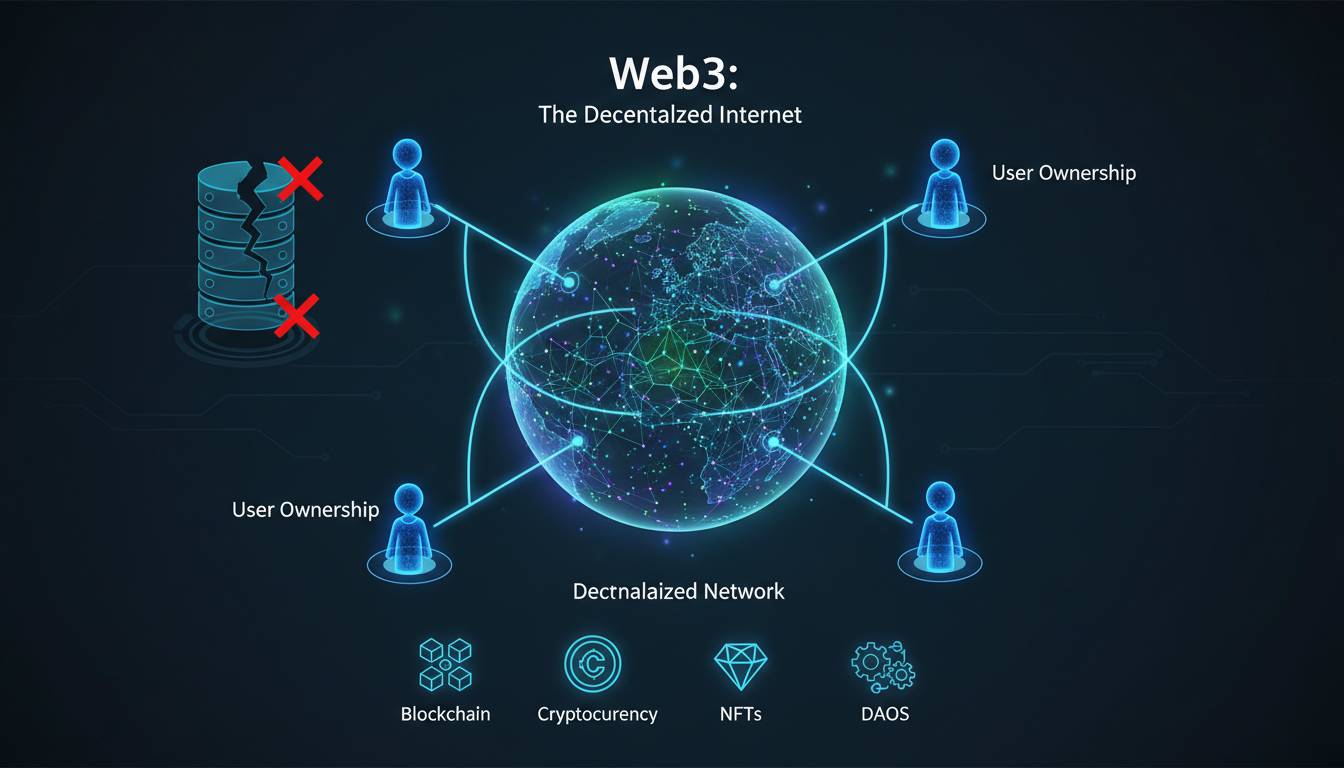
Web3 Meaning: The Decentralized Internet Explained Simply
Web3 represents the next evolution of the internet—a shift from centralized platforms controlled by tech giants to a decentralized network where users own their data, digital assets, and online identities. Built on blockchain technology, Web3 enables peer-to-peer transactions, decentralized applications (dApps), and new economic models through cryptocurrencies and tokens. Understanding Web3 meaning is essential for anyone looking to navigate the future of digital technology, whether you’re an investor, developer, or curious user seeking to understand how the internet is transforming.
📊 STATS
• The global blockchain market is projected to reach $1.2 trillion by 2030
• Over 400 million people worldwide own cryptocurrency as of 2024 (Chainalysis)
• Major corporations including Meta, Google, and Microsoft have invested over $30 billion in Web3 initiatives since 2022
• The decentralized finance (DeFi) sector maintains over $100 billion in total value locked
Key Takeaways
• Web3 meaning: The third generation of the internet built on blockchain, emphasizing decentralization, user ownership, and peer-to-peer interactions
• Core technologies: Blockchain, cryptocurrencies, smart contracts, and decentralized applications
• Main difference from Web2: Users become owners rather than products; no single company controls the platform
• Current state: Early adoption phase with growing mainstream interest and investment
• Investment consideration: High volatility and regulatory uncertainty remain significant factors
The transition from Web1 to Web2 marked a shift from read-only static websites to interactive social platforms. Now, Web3 transforms users from passive participants into active owners. This fundamental change in internet architecture promises to redistribute power from centralized corporations to individual users, creating new opportunities for digital entrepreneurship, creativity, and financial inclusion.
What Is Web3? A Clear Definition
Web3, short for Web 3.0, refers to the third generation of internet services designed to create a decentralized, blockchain-based online ecosystem. At its core, Web3 meaning encompasses a vision of the internet where users control their own data, identity, and digital assets without relying on intermediaries like banks, social media companies, or other centralized institutions.
The Three Eras of the Internet
Web1 (1990-2005): The early internet consisted mainly of static, read-only websites. Users consumed content created by a small number of publishers. There was minimal interactivity, and no user accounts or personal data collection. Companies like AOL and early Yahoo dominated this era.
Web2 (2005-present): The social web introduced user-generated content, social media, and interactive platforms. However, this came at a cost—users became the product, with companies harvesting personal data for advertising revenue. Google, Facebook (Meta), Amazon, and Apple became gatekeepers controlling vast amounts of user information.
Web3 (2020s-future): The decentralized web aims to return control to users through blockchain technology. Instead of storing data on centralized servers owned by corporations, information exists across distributed networks. Users can verify transactions without intermediaries and own unique digital assets through non-fungible tokens (NFTs).
Core Components of Web3
Blockchain Technology: A distributed ledger that records transactions across many computers. Once data is recorded, it becomes extremely difficult to alter, creating trust without requiring a central authority.
Cryptocurrencies and Tokens: Digital currencies that operate on blockchains, enabling peer-to-peer financial transactions without banks. Tokens also represent ownership in decentralized projects and grant access to specific platform features.
Smart Contracts: Self-executing programs stored on a blockchain that automatically enforce agreements when predetermined conditions are met. These eliminate the need for middlemen in contracts, from rental agreements to insurance claims.
Decentralized Applications (dApps): Software applications built on blockchain networks rather than traditional servers. These applications run automatically and remain operational as long as the underlying blockchain exists.
Decentralized Identity: Users control their digital identities through cryptographic keys rather than usernames and passwords managed by companies. This gives individuals ownership over their personal information.
💡 STAT: Over 2.5 million Ethereum smart contracts have been deployed as of 2024, powering thousands of decentralized applications across finance, gaming, and digital art sectors.
How Web3 Differs from Traditional Internet
The fundamental distinction lies in data ownership and control. In Web2, when you create content on a social media platform, the company owns that content and can modify, delete, or monetize it without your permission. In Web3, content creators own their work through blockchain-based proof of ownership. When you purchase a digital asset like an NFT, the blockchain permanently records your ownership in a way that cannot be arbitrarily revoked.
How Web3 Works – The Technical Foundation
Understanding Web3 meaning requires grasping the technical infrastructure that makes decentralization possible. Unlike traditional applications that run on centralized servers, Web3 applications operate across peer-to-peer networks.
Blockchain Fundamentals
A blockchain is a distributed database shared among network nodes. Each “block” contains a group of transactions, and these blocks connect chronologically forming a “chain.” This architecture ensures transparency—anyone can verify transactions on public blockchains—while maintaining security through cryptographic hashing.
When you make a transaction on a Web3 platform, it gets broadcast to the network. Miners or validators (depending on the blockchain’s consensus mechanism) verify the transaction is legitimate. Once confirmed, it gets added to a block and becomes permanent on the distributed ledger.
Consensus Mechanisms
Proof of Work (PoW): Miners compete to solve complex mathematical puzzles to validate transactions and create new blocks. Bitcoin uses PoW. This method is energy-intensive but highly secure.
Proof of Stake (PoS): Validators lock up (stake) their cryptocurrency as collateral to propose new blocks. If they validate fraudulent transactions, they lose their stake. Ethereum transitioned to PoS in 2022, reducing energy consumption by approximately 99.95%.
Delegated Proof of Stake (DPoS): Token holders vote for a small number of delegates who validate transactions on their behalf, increasing efficiency but sacrificing some decentralization.
Wallets and Identity
Web3 identity centers on cryptocurrency wallets rather than traditional accounts. A wallet consists of two keys: a public key (like an email address, shareable) and a private key (like a password, must remain secret). The private key provides cryptographic proof of identity, allowing users to sign transactions without revealing personal information.
MetaMask, Coinbase Wallet, and Phantom are popular Web3 wallets supporting multiple blockchains. These wallets don’t hold funds in the traditional sense—they interact with blockchains to access and manage your assets.
Gas and Transaction Fees
Every action on a blockchain incurs a fee called “gas.” This compensates validators for their computational work and secures the network against spam attacks. Gas prices fluctuate based on network demand—when many users transact simultaneously, fees increase. Understanding gas costs is essential for anyone using Web3 applications regularly.
Web3 vs Web2 – Key Differences
| Factor | Web2 | Web3 |
|---|---|---|
| Data Storage | Centralized servers owned by companies | Distributed across peer-to-peer networks |
| Ownership | Companies own user data and content | Users own their data, assets, and identity |
| Monetization | Platforms monetize user data/advertising | Creators monetize directly through tokens/NFTs |
| Identity | Username/password managed by platforms | Cryptographic keys controlled by users |
| Transactions | Require intermediaries (banks, payment processors) | Peer-to-peer transactions possible |
| Censorship | Platforms can ban users/delete content | Content remains accessible unless by network consensus |
| Intermediaries | Required for trust | Trust built into code (smart contracts) |
Advantages of Web3 Over Web2
Financial Inclusion: Anyone with an internet connection can access financial services through DeFi, regardless of location or banking status. This benefits the approximately 1.4 billion adults worldwide without bank accounts.
Creator Economy: Artists, musicians, and content creators can sell work directly to audiences without platform middlemen taking large cuts. NFT royalties can be programmed directly into smart contracts, ensuring creators receive percentages on secondary sales permanently.
Data Privacy: Users decide what information to share and with whom. Instead of companies profiting from personal data, individuals can choose to monetize their own information if desired.
Transparency: Code and transactions on public blockchains are verifiable by anyone. This creates unprecedented accountability for platforms and protocols.
Limitations Compared to Web2
User Experience: Web3 applications often require more technical knowledge. Managing private keys, understanding gas fees, and navigating unfamiliar interfaces create barriers for mainstream adoption.
Scalability: Many blockchain networks process fewer transactions per second than traditional systems. While solutions like Layer 2 rollups address this, challenges remain.
Regulation: The regulatory landscape remains uncertain. Governments worldwide grapple with how to tax crypto, regulate exchanges, and protect consumers without stifling innovation.
Volatility: Cryptocurrency prices fluctuate dramatically, creating uncertainty for users and businesses building on Web3 infrastructure.
Benefits of Web3
The promise of Web3 extends beyond technical innovation—it represents a philosophical shift in how we think about digital ownership, governance, and economics.
User Sovereignty and Ownership
In Web3, users own their digital identities and assets outright. Unlike Web2 where account suspension means losing access to everything, your cryptocurrency, NFTs, and digital possessions remain accessible through your wallet. This concept extends to governance—token holders often vote on protocol changes, giving users a voice in platforms they use.
Case Study: The Axie Infinity gaming ecosystem demonstrates Play-to-Earn models where players earn cryptocurrency through gameplay, with some users in developing countries earning significant income. While the model has faced challenges, it illustrates new economic possibilities.
Transparent and Trustless Transactions
Smart contracts execute exactly as programmed, eliminating the need to trust counterparties. When you exchange cryptocurrencies through a decentralized exchange, the code—not a company—ensures you receive what you paid for. This “trustless” system (trusting code rather than institutions) opens possibilities for global commerce without traditional legal frameworks.
Censorship Resistance
Because data exists across distributed networks rather than centralized servers, censorship becomes significantly harder. Writers, journalists, and creators in restrictive regimes can publish content through decentralized platforms that cannot be shut down by single authorities.
📈 CASE: During the 2022 Canadian trucker protests, GoFundMe froze millions in donations, while cryptocurrency donations continued flowing to protest participants, demonstrating the censorship-resistant nature of blockchain transactions.
Programmable Money and New Financial Instruments
DeFi protocols enable lending, borrowing, trading, and earning interest without traditional financial institutions. Users can become liquidity providers, earning fees from decentralized exchanges, or stake tokens to secure networks while earning rewards.
Interoperability and Composability
Blockchains can communicate through cross-chain bridges, and DeFi protocols can build upon each other like financial Lego blocks. This composability creates rapid innovation cycles impossible in traditional finance, where systems operate in silos.
Common Web3 Applications and Use Cases
Web3 applications span numerous sectors, from finance to gaming to social networking. Understanding these use cases clarifies Web3 meaning in practical terms.
Decentralized Finance (DeFi)
DeFi replicates traditional financial services—lending, borrowing, trading, insurance—without banks. Users supply cryptocurrency to liquidity pools and earn interest; others borrow against collateral. Popular DeFi protocols include Uniswap (decentralized trading), Aave (lending), and MakerDAO (stablecoins).
Non-Fungible Tokens (NFTs)
NFTs represent unique digital ownership of items ranging from digital art to music to virtual real estate. Unlike cryptocurrencies where each unit is identical, each NFT is unique and verifiable. Beyond speculation, NFTs enable digital provenance, loyalty programs, and ticket systems.
Gaming and Metaverse
Play-to-earn games like Axie Infinity, StepN, and Illuvium reward players with cryptocurrency and NFTs. Virtual worlds like Decentraland and The Sandbox allow users to purchase virtual land, build experiences, and monetize creations. These represent early steps toward immersive digital environments.
Decentralized Social Media
Platforms like Lens Protocol and Steem offer content ownership to creators. When you post on these platforms, you own your content and can port followers to other applications built on the same protocol, escaping the “rent-seeking” behavior of traditional social networks.
Supply Chain and Identity
Beyond consumer applications, Web3 infrastructure enables supply chain tracking (verifying product authenticity), decentralized identity systems (self-sovereign identity), and governance tools (DAOs organizing collective decision-making).
Challenges and Criticisms
A balanced view of Web3 meaning requires acknowledging significant challenges facing the ecosystem.
Environmental Concerns
Despite improvements like Ethereum’s transition to PoS, blockchain energy consumption remains contentious. Bitcoin’s PoW model specifically has drawn criticism for substantial electricity usage, though renewable energy adoption is increasing in mining operations.
Scams and Fraud
The crypto space has experienced massive fraud, from Ponzi schemes to rug pulls (developers abandoning projects after collecting investment). The lack of regulation creates fertile ground for scams, and users must exercise extreme caution.
Volatility and Speculation
Cryptocurrency prices can swing 20-50% in days, making them impractical for everyday transactions and creating significant financial risk for users. This volatility undermines Web3’s potential as a functional economic system.
Regulatory Uncertainty
Governments worldwide are developing cryptocurrency regulations, with approaches ranging from China’s blanket ban to El Salvador’s embrace of Bitcoin as legal tender. Regulatory changes can dramatically impact Web3 project viability overnight.
Technical Barriers
Gas fees, complex wallet management, and confusing user interfaces prevent mainstream adoption. Until Web3 becomes as easy to use as Web2 applications, mass adoption remains limited.
⚠️ CRITICAL: Never invest more than you can afford to lose in cryptocurrency. Research thoroughly, use hardware wallets for significant holdings, and be skeptical of promises guaranteeing returns. The lack of consumer protections means fraud recovery is extremely difficult.
The Future of Web3
The trajectory of Web3 depends on resolving current challenges while maintaining its core promise of decentralization and user ownership.
Emerging Trends
Layer 2 Solutions: Scaling technologies like Arbitrum and Optimism process transactions off the main blockchain before settling them on-chain, reducing fees and increasing speed while maintaining security.
Account Abstraction: New wallet designs like smart contract wallets enable social recovery (regaining access through trusted contacts) and automatic transactions, making Web3 more user-friendly.
Real-World Asset Tokenization: Traditional assets like real estate, stocks, and commodities are being represented on blockchains, potentially revolutionizing access to investments.
Institutional Adoption: Major financial institutions including BlackRock, Fidelity, and Visa have entered the space, bringing legitimacy and infrastructure improvements.
Expert Insights
👤 Vitalik Buterin, Co-founder of Ethereum
“The vision [of Web3] is about making the internet more human, more privacy-preserving, and more user-owned. The key insight is that we can use cryptography and economic mechanisms to create systems that don’t require trust in any single party.”
👤 Michele Korver, Former FinCEN Crypto Lead
“Regulatory clarity is essential for Web3 to reach its potential. We need frameworks that protect consumers while allowing innovation to flourish.”
📊 BENCHMARKS
| Metric | 2020 | 2024 | Projected 2028 |
|——–|——|——|—————-|
| Global Crypto Users | 100M | 400M+ | 1B+ |
| DeFi Total Value Locked | $20B | $100B+ | $500B+ |
| NFT Market Volume | $100M | $15B+ | $80B+ |
Frequently Asked Questions
What is Web3 in simple terms?
Web3 is the next version of the internet where users own their data and digital assets instead of big tech companies. It uses blockchain technology to enable peer-to-peer transactions, decentralized applications, and new ways to earn money online without intermediaries.
How does Web3 make money?
Web3 enables several income streams: trading cryptocurrency, providing liquidity to DeFi protocols for interest, earning tokens through play-to-earn games, creating and selling NFTs, staking tokens for network rewards, and participating in airdrops. However, all investments carry significant risk.
Is Web3 the same as cryptocurrency?
No. Cryptocurrency is one component of Web3—the financial layer. Web3 encompasses broader concepts including decentralized identity, autonomous organizations (DAOs), NFTs, and decentralized applications. Many Web3 activities don’t involve cryptocurrency at all.
What is the main difference between Web2 and Web3?
Web2 platforms (Facebook, Google, Amazon) own user data and monetize it through advertising. Web3 gives users ownership of their data, identity, and digital assets through blockchain technology, removing the middleman and enabling peer-to-peer interactions.
Is Web3 safe to use?
Web3 has security risks including smart contract vulnerabilities, scam projects, and wallet theft. Unlike traditional banks, there are often no recourse mechanisms if you lose funds. Use hardware wallets for significant holdings, verify all transactions carefully, and research projects extensively before participating.
When will Web3 become mainstream?
Timeline predictions vary widely. Infrastructure improvements are making Web3 more accessible, but regulatory clarity, user experience improvements, and price stability are needed before mass adoption. Industry experts suggest meaningful mainstream adoption could occur within 5-10 years, though specific timelines remain uncertain.
Conclusion
Web3 represents a fundamental reimagining of internet architecture—one where users regain control over their digital lives. Understanding Web3 meaning extends beyond technical knowledge; it involves grasping a philosophical vision for a more equitable digital economy. The transition won’t happen overnight, and significant obstacles remain. However, the core principles of decentralization, user ownership, and trustless transactions address genuine problems with today’s internet. Whether you’re an investor evaluating opportunities, a developer exploring career paths, or simply a curious observer, the Web3 revolution merits attention. The choices made in the coming years will shape whether this technology fulfills its promise of democratizing the internet or becomes another tool for concentration of power.
The most important step you can take today is education. Before investing time or money in Web3 projects, understand the fundamentals, acknowledge the risks, and approach with appropriate caution. The decentralized internet is still being written—and everyone has a stake in its outcome.