101Views 0Comments
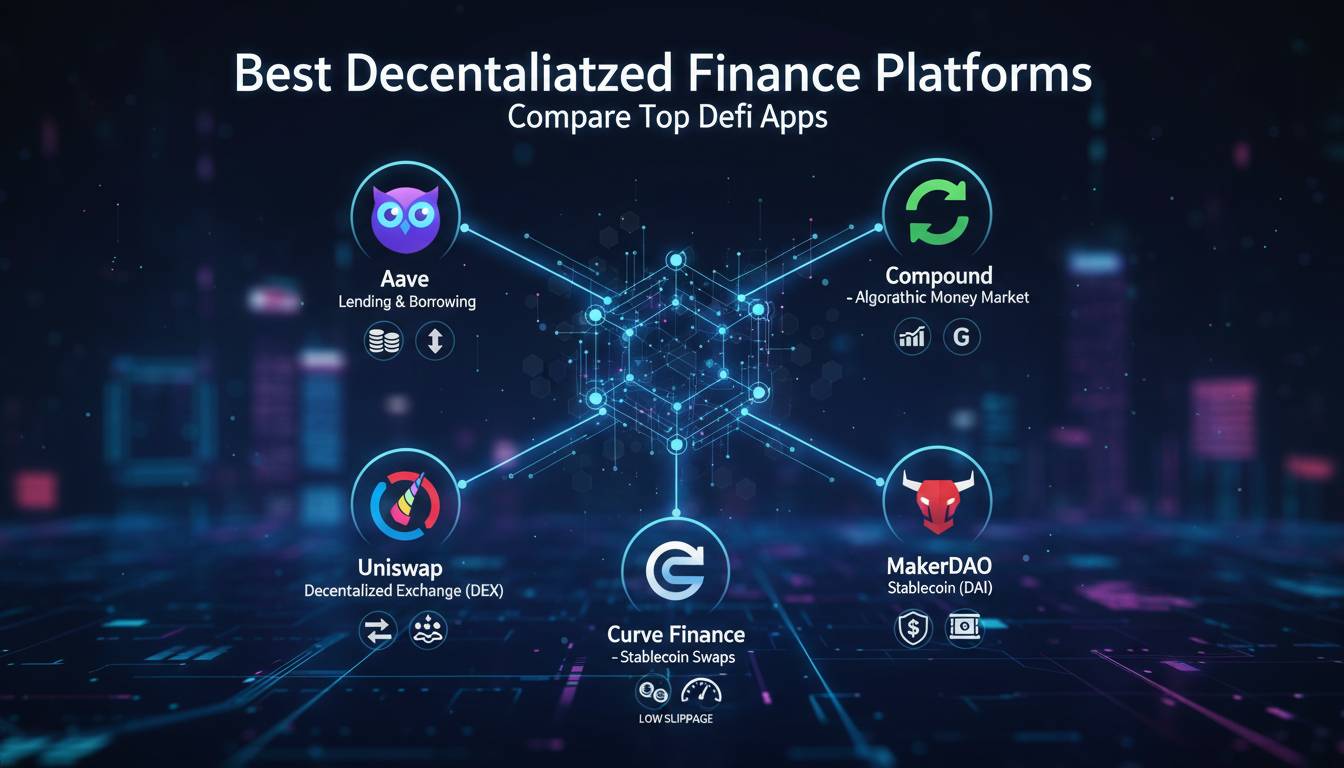
Best Decentralized Finance Platforms – Compare Top DeFi Apps
Decentralized finance (DeFi) has transformed how people access financial services, offering open, permissionless alternatives to traditional banking. With billions locked in DeFi protocols, choosing the right platform requires understanding key differences in security, yields, and functionality. This guide compares the leading decentralized finance platforms to help you make informed decisions about where to invest and earn yields in 2024.
📊 STATS
• $98 billion in total value locked across DeFi protocols (DefiLlama, December 2024)
• 4,200+ DeFi projects launched globally
• $2.1 trillion in cumulative DeFi trading volume
• 89% of DeFi users cite yield farming as primary motivation
Key Takeaways
• Uniswap leads DEX trading with $8.4 billion daily volume
• Aave dominates lending with $15+ billion in total value locked
• Curve Finance handles 45% of stablecoin swaps
• Lido controls 75% of liquid staking market share
• Yield aggregator protocols offer 2-5x higher APY than traditional staking
What is Decentralized Finance (DeFi)?
Decentralized finance refers to financial services built on blockchain technology that operate without traditional intermediaries like banks, brokerages, or insurance companies. These protocols use smart contracts—self-executing code that automatically enforces agreement terms—to enable lending, borrowing, trading, and earning interest directly between users.
DeFi eliminates the need for middlemen by leveraging cryptocurrency networks like Ethereum, Solana, and Polygon. Users maintain full control of their assets through non-custodial wallets, meaning they hold their private keys rather than trusting a centralized entity. This pseudonymous system operates 24/7, allowing anyone with an internet connection to access financial services regardless of geographic location or banking status.
The DeFi ecosystem encompasses several core categories: decentralized exchanges (DEXs) for swapping tokens, lending platforms for earning interest or obtaining loans, yield farming protocols for maximizing returns, and stablecoins for price stability. Each category serves different financial needs, and many users combine multiple protocols to optimize their crypto strategy.
Core DeFi Components
Smart Contracts:
These self-executing programs automatically handle transactions when predetermined conditions are met. Once deployed, they cannot be altered, ensuring transparent and tamper-proof operations. The code is typically open-source, allowing anyone to audit the contract’s security.
Liquidity Pools:
Users contribute cryptocurrency to pools that facilitate trading or lending. In return, they earn a portion of transaction fees and, often, governance tokens. These pools replace traditional order books, enabling instant trades even for illiquid assets.
Governance Tokens:
Most DeFi protocols issue tokens that grant holders voting rights on protocol upgrades, parameter changes, and treasury management. Holding these tokens can also provide fee discounts, staking rewards, or exclusive access to new features.
💡 STAT: The average DeFi protocol distributes 5-15% of token supply to early liquidity providers, creating strong incentive structures for early adoption.
How DeFi Differs from Traditional Finance
Traditional finance relies on centralized institutions that verify transactions, hold deposits, and manage risk. These institutions maintain operating hours, require extensive identity verification, and often charge high fees for services. DeFi removes these gatekeepers, replacing human decision-making with transparent code and enabling near-instant settlement times.
Key Features to Look for in DeFi Platforms
Selecting the right DeFi platform requires evaluating several critical factors that impact your security, returns, and user experience. Understanding these features helps you navigate the complex landscape of decentralized protocols.
Security Considerations
Audits: Reputable platforms undergo multiple third-party security audits from firms like Trail of Bits, OpenZeppelin, or Certik. Look for recent audits and review their findings.
Bug Bounties: Platforms with active bug bounty programs offer financial rewards to security researchers who identify vulnerabilities, demonstrating ongoing commitment to protocol safety.
Insurance Options: Some platforms partner with insurance protocols like Nexus Mutual to protect users against smart contract failures, though coverage terms vary significantly.
User Experience Factors
Gas Efficiency: Network fees vary dramatically across blockchains. Layer-2 solutions like Arbitrum and Optimism offer 10-50x lower transaction costs than Ethereum mainnet, making frequent DeFi interactions practical for smaller portfolios.
Mobile Accessibility: While most DeFi began as desktop-first applications, mobile wallets and dApps have matured significantly. Evaluate whether a platform offers a functional mobile interface if you plan to manage positions on the go.
Customer Support: By design, DeFi has no customer service department. However, active community forums, comprehensive documentation, and responsive developer teams on Discord or Telegram indicate projects that prioritize user success.
Financial Considerations
Yield Stability: Some protocols offer variable yields that fluctuate daily, while others provide fixed rates. Understanding how returns are generated helps you assess sustainability and risk.
Token Incentives: Many platforms boost yields through native token rewards. These incentives can significantly increase apparent returns but come with token price volatility risk.
Impermanent Loss: When providing liquidity to AMMs, price divergence between deposited tokens can result in losses compared to simply holding. Evaluate this risk carefully before supplying liquidity to trading pairs.
Top Decentralized Finance Platforms in 2024
Uniswap – Best Decentralized Exchange
Uniswap remains the dominant decentralized exchange, processing billions in daily trading volume across Ethereum, Arbitrum, Optimism, and Polygon networks. The protocol pioneered the automated market maker (AMM) model, where liquidity pools replace traditional order books.
Pros:
• Highest DEX trading volume ($8.4 billion daily)
• Lowest slippage for major trading pairs
• Extensive token listings (10,000+ trading pairs)
• Strong security track record with multiple audits
Cons:
• Higher gas costs on Ethereum mainnet
• Impermanent loss risk for liquidity providers
• V3 concentrated liquidity requires active management
Best For: Token swaps, liquidity provision on volatile pairs, arbitrage opportunities
Uniswap’s V4 architecture introduces hooks, allowing developers to customize pool behavior for specialized use cases like limit orders or dynamic fees.
Aave – Best Lending Protocol
Aave is the largest decentralized lending protocol, enabling users to supply assets as collateral and borrow against them. The protocol supports over 20 collateral types and offers both stable and variable interest rates.
Pros:
• $15+ billion in total value locked
• Wide asset support across multiple chains
• Flash loans for advanced users
• Proven stability during market downturns
Cons:
• Liquidation risk if collateral value drops
• Interest rate volatility
• Complex risk parameters for new users
Best For: Earning interest on crypto holdings, borrowing without selling, leveraged positions
Aave’s safety module provides an additional layer of protection, with stakers earning rewards whileBuffering against protocol shortfalls.
Lido – Best Liquid Staking
Lido enables users to stake their Ethereum and receive liquid stETH tokens that retain value while earning staking rewards. This solves the liquidity problem inherent in native staking, where tokens are locked until Ethereum enables withdrawals.
Pros:
• 75% market share in liquid staking
• Daily reward accrual to stETH balance
• Integration across 100+ DeFi protocols
• Institutional-grade node operators
Cons:
• Centralization concerns (single entity operates nodes)
• Smart contract risk
• Market discount during negative sentiment
Best For: ETH holders wanting staking rewards while maintaining liquidity for DeFi activities
Lido’s tokenized staking approach has become infrastructure for the broader DeFi ecosystem, with stETH serving as collateral across lending protocols.
Curve Finance – Best Stablecoin DEX
Curve Finance specializes in stablecoin and wrapped asset swaps, offering extremely low slippage for correlated assets. The protocol uses specialized AMM curves optimized for assets that should maintain parity.
Pros:
• Handles 45% of stablecoin trading volume
• Minimal slippage (<0.01% for large trades)
• CRV token incentives for liquidity providers
• Strong security with external audits
Cons:
• Limited to stablecoins and wrapped assets
• CRV token volatility
• Complex tokenomics for new users
Best For: Stablecoin swaps, low-risk yield farming, peg maintenance strategies
Curve’s concentrated liquidity pools allow LPs to concentrate their capital within specific price ranges, dramatically improving efficiency.
MakerDAO – Best Stablecoin Protocol
MakerDAO issues DAI, the largest decentralized stablecoin pegged to the US dollar. Users generate DAI by locking collateral (ETH, USDC, wBTC) into Vaults, paying stability fees while maintaining ownership of their assets.
Pros:
• Most battle-tested decentralized stablecoin
• Over-collateralized with robust liquidation mechanisms
• Decentralized governance with MKR token holders
• Multi-collateral support
Cons:
• Complexity for new users
• Stability fees fluctuate with market conditions
• Over-collateralization limits capital efficiency
Best For: Creating stablecoin liquidity without selling crypto, long-term collateralized loans
MakerDAO’s Endgame plan proposes significant governance restructuring, potentially introducing sub-DAOs and new collateral types.
DeFi Platform Comparison
| Platform | Category | TVL | Primary Network | Best For |
|---|---|---|---|---|
| Uniswap | DEX | $6.2B | Multi-chain | Token trading |
| Aave | Lending | $15B+ | Multi-chain | Borrowing/earning |
| Lido | Staking | $30B+ | Ethereum | Liquid staking |
| Curve | Stablecoin DEX | $2.4B | Multi-chain | Stablecoin swaps |
| MakerDAO | Stablecoin | $8.7B | Ethereum | DAI generation |
Comparison by Use Case
For Maximum Security:
Aave and MakerDAO have the longest operational track records without major exploits. Both have weathered significant market stress including the 2022 crypto crash. Uniswap’s V2 and V3 contracts have also proven robust.
For Highest Yields:
Yield aggregators like Yearn Finance and Convex Finance often offer superior returns by automatically shifting capital between protocols. However, these higher yields come with smart contract risk and strategy complexity.
For Lowest Costs:
Layer-2 networks like Arbitrum and Optimism dramatically reduce transaction costs. Most major DeFi protocols have deployed on these networks, enabling cost-effective interaction.
How to Get Started with DeFi
Getting started with decentralized finance requires careful preparation to minimize risk while learning the system. Follow this step-by-step approach to enter the DeFi ecosystem safely.
Prerequisites
- [ ] Hardware wallet (Ledger or Trezor recommended)
- [ ] Compatible wallet software (MetaMask, Rabby)
- [ ] Cryptocurrency on supported network
- [ ] Time to research before committing funds
Time: 1-2 hours initial setup | Cost: $50-200 for hardware wallet
Step 1: Set Up Your Wallet
Start by installing MetaMask or another reputable Web3 wallet as a browser extension. Create a new wallet and write down your seed phrase on paper—never digitally. Consider purchasing a hardware wallet for larger holdings, as this provides superior security against malware and phishing.
Step 2: Acquire Network Tokens
You’ll need the native token of your chosen blockchain for gas fees. For Ethereum DeFi, you’ll need ETH for transaction costs. Many bridges allow moving assets between networks, or you can purchase directly through exchanges that support withdrawals to your target network.
Step 3: Connect to Your First Protocol
Start with a well-established platform like Uniswap for trading or Aave for lending. Connect your wallet, review the contract permissions you’re granting, and start with a small test transaction. Never invest more than you’re willing to lose, especially when learning.
⏱ Start with $50-100 | 💡 Tip: Always keep enough native tokens for potential gas fees plus a 20% buffer
Step 4: Diversify Across Protocols
Once comfortable, consider spreading across multiple platforms to reduce single-protocol risk. Many users allocate between lending (Aave), staking (Lido), and liquidity provision (Uniswap or Curve) based on their risk tolerance.
Troubleshooting:
| Problem | Fix |
|---|---|
| Transaction failing | Increase gas limit or switch to off-peak hours |
| Slippage too high | Adjust slippage tolerance in settings |
| Contract approval pending | Cancel and resubmit with higher gas |
| Token not appearing | Add token address to wallet manually |
Risks and Security Considerations
DeFi offers substantial opportunities but comes with significant risks that traditional finance investors may not expect. Understanding these risks helps you make informed decisions about where and how much to invest.
Smart Contract Risk
By design, smart contracts cannot be modified once deployed. If vulnerabilities exist, they can be exploited. The DeFi ecosystem has seen billions lost to hacks, including the $625 million Ronin Bridge exploit and numerous flash loan attacks. Always research whether protocols have undergone multiple audits and maintain active bug bounty programs.
Impermanent Loss
When providing liquidity to AMMs, the ratio between your deposited tokens can shift, potentially resulting in losses compared to simply holding. This risk intensifies with volatile trading pairs. Stablecoin pairs minimize but don’t eliminate this risk entirely.
Regulatory Uncertainty
DeFi protocols operate in a regulatory gray area that varies by jurisdiction. Some countries have banned crypto activities entirely, while others are developing specific frameworks. The SEC and other regulators have signaled increased scrutiny of DeFi platforms, potentially impacting token values or protocol operations.
⚠️ CRITICAL: Never invest more than you can afford to lose entirely. DeFi protocols can fail suddenly due to bugs, market conditions, or regulatory action. Start with small amounts and only increase exposure after understanding each platform thoroughly.
Prevent: Use hardware wallets, enable transaction notifications, never click unknown links, verify all contract addresses on block explorers before interacting.
Future of Decentralized Finance
The DeFi ecosystem continues evolving rapidly, with several trends shaping its future trajectory. Cross-chain interoperability is improving through bridges and multi-chain protocols, enabling users to access services across different blockchain networks without friction. This fragmentation challenge remains significant but is gradually improving.
Institutional adoption is accelerating, with traditional financial institutions exploring DeFi for treasury management, settlement, and yield generation. This influx of capital brings increased liquidity and legitimacy but may also introduce regulatory attention that changes the landscape.
Account abstraction and gas sponsorship technologies are making DeFi more accessible by enabling gasless transactions and social recovery options. These improvements address usability barriers that have historically limited mainstream adoption.
Frequently Asked Questions
What is the safest DeFi platform?
Aave and MakerDAO are considered among the safest DeFi platforms due to their long operational history without major exploits, multiple security audits, and over-collateralized models. However, all DeFi carries smart contract risk, and no platform is completely risk-free.
How do I earn passive income with DeFi?
The main methods include lending your crypto on platforms like Aave to earn interest, staking tokens through liquid staking providers like Lido, providing liquidity to DEXs like Uniswap or Curve to earn trading fees, and using yield aggregators like Yearn Finance to automatically optimize returns.
What’s the minimum amount to start using DeFi?
You can start with any amount, though transaction fees make small deposits impractical on Ethereum mainnet. Networks like Polygon, Arbitrum, or Binance Smart Chain offer much lower fees, making smaller positions viable. Consider gas costs relative to your position size.
Is DeFi better than traditional banking?
DeFi offers higher potential yields, 24/7 accessibility, and pseudonymous transactions, but lacks FDIC insurance, customer support, and established consumer protections. The choice depends on your technical comfort, risk tolerance, and need for traditional financial safeguards.
Can I lose money in DeFi?
Yes, you can lose money through smart contract exploits, impermanent loss, token price drops, liquidation during volatility, and scams. DeFi is high-risk, and you should only invest capital you can afford to lose entirely.
How do I choose the right DeFi platform?
Start by identifying your goal (earning interest, trading, borrowing). Research security audits, track record, total value locked, and community engagement. Begin with small test transactions on established protocols before exploring newer or higher-yielding platforms.
Conclusion
Decentralized finance has matured significantly, offering sophisticated financial services that rival traditional institutions in many respects. Platforms like Uniswap, Aave, Lido, Curve, and MakerDAO provide robust infrastructure for earning yields, trading assets, and accessing liquidity without intermediaries.
Success in DeFi requires balancing potential returns against smart contract risks, volatility, and regulatory uncertainty. Start with established protocols, use hardware wallets, and never invest more than you can afford to lose. As the ecosystem continues evolving, staying informed about emerging risks and opportunities remains essential for long-term participation in decentralized finance.