157Views 0Comments

BTC ETF Approval: What Investors Need to Know Now
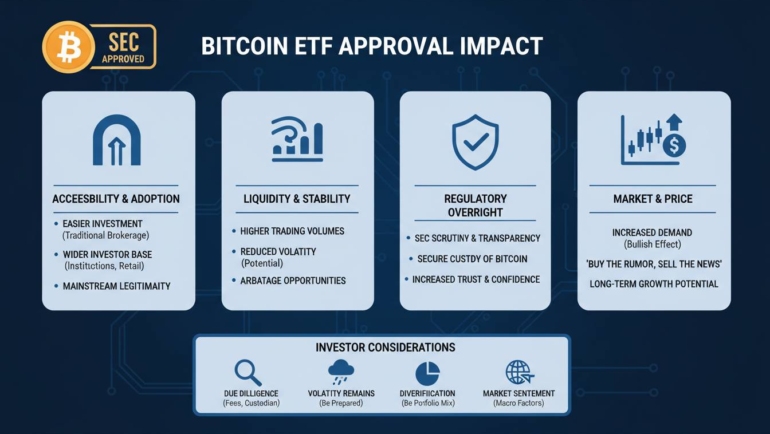
The SEC’s historic approval of spot Bitcoin ETFs in January 2024 marked a watershed moment for cryptocurrency markets, opening institutional-grade investment pathways into the world’s largest digital asset. For the first time, investors can gain exposure to Bitcoin through traditional brokerage accounts without the complexities of direct cryptocurrency ownership. This comprehensive guide covers everything you need to know about BTC ETF approval, how these instruments work, and strategic considerations for incorporating them into your portfolio.
📊 KEY STATS
• January 11, 2024 – SEC approved 11 spot Bitcoin ETFs for trading
• $4.6 billion – Net inflows into Bitcoin ETFs in the first week
• $55 billion+ – Assets under management in Bitcoin ETFs within 3 months
• 11 – Number of spot Bitcoin ETFs approved initially
Key Takeaways
- Regulatory Milestone: The SEC approved spot Bitcoin ETFs after over a decade of rejections, signaling mainstream acceptance
- Institutional Access: These ETFs provide traditional investment infrastructure including brokerage accounts, retirement plans, and fiduciary platforms
- Multiple Options: Investors can choose from 11+ issuers including BlackRock, Fidelity, Grayscale, and Bitwise
- Fee Competition: Race to the bottom on management fees has driven costs as low as 0.00% for some providers
- Custodial Security: Professional custody eliminates self-custody risks while maintaining regulatory protections
What Is a Bitcoin ETF?
A Bitcoin ETF (Exchange-Traded Fund) is a publicly traded investment vehicle that holds Bitcoin as its primary asset, allowing investors to buy and sell shares through traditional stock exchanges. Unlike directly purchasing Bitcoin on a cryptocurrency exchange, a Bitcoin ETF provides exposure to Bitcoin’s price movements without requiring investors to manage private keys, wallets, or interact with blockchain technology directly.
How Bitcoin ETFs Work
Bitcoin ETFs operate by maintaining Bitcoin reserves in secure custody while issuing shares that trade on national securities exchanges. The ETF sponsor purchases and holds actual Bitcoin, storing it with qualified custodians that meet regulatory security standards. Each ETF share represents a proportional ownership interest in the underlying Bitcoin holdings, with the share price designed to track Bitcoin’s market price minus fees and expenses.
Key Components:
- Underlying Asset: Physical Bitcoin held in cold storage by regulated custodians
- Share Structure: ETFs issue shares that trade throughout market hours on exchanges like NYSE and Nasdaq
- Price Tracking: NAV (Net Asset Value) calculations ensure share prices reflect Bitcoin’s market value
- Creation/Redemption: Authorized participants can create or redeem shares based on supply and demand
💡 KEY FACT: The SEC required spot Bitcoin ETF sponsors to demonstrate robust surveillance-sharing agreements with licensed Bitcoin exchanges to prevent market manipulation, a key condition that enabled approval after years of rejection.
Why Approval Matters
The January 2024 approval represented the culmination of over a decade of regulatory deliberation. Prior to this, the SEC repeatedly rejected Bitcoin ETF applications citing concerns about market manipulation, custody security, and investor protection. The eventual approvals followed Bitcoin’s transformation into a globally recognized asset class with substantial institutional participation and regulated futures markets.
Benefits of Bitcoin ETFs for Investors
Bitcoin ETFs offer several distinct advantages over direct cryptocurrency ownership, particularly for traditional investors seeking exposure without operational complexity.
| Benefit | Impact | Consideration |
|---|---|---|
| Traditional Infrastructure | Trade through existing brokerage accounts | Same process as buying stocks |
| Regulatory Protection | Securities law oversight and investor protections | Not available with direct crypto ownership |
| Tax Efficiency | Clear cost basis reporting via 1099 forms | Simplified tax reporting |
| No Wallet Management | Eliminates risk of lost keys or hacks | No technical knowledge required |
| Retirement Account Access | Available in 401(k) and IRA accounts | Previously unavailable for Bitcoin |
| Institutional Credibility | Major financial institutions as sponsors | BlackRock, Fidelity, etc. |
Investment Advantages
Diversification: Bitcoin ETFs provide exposure to an uncorrelated asset class that has demonstrated portfolio diversification benefits. Research from various financial institutions indicates that allocating 1-5% of a diversified portfolio to Bitcoin can improve risk-adjusted returns.
Liquidity: These ETFs trade on major exchanges with deep order books, enabling investors to enter or exit positions throughout trading hours with minimal slippage. This contrasts sharply with cryptocurrency exchanges where liquidity can vary significantly across trading pairs.
Transparency: ETF sponsors publish daily holdings and weekly reports, allowing investors to verify exactly how much Bitcoin backs each share. This level of transparency was unavailable in many cryptocurrency investment products.
📈 CASE STUDY: BlackRock’s iShares Bitcoin Trust (IBIT) accumulated over $17 billion in assets within the first three months of trading, demonstrating unprecedented institutional and retail demand for regulated Bitcoin exposure.
Major Bitcoin ETFs: Comparison Guide
The SEC approved 11 spot Bitcoin ETFs on January 11, 2024, each with distinct fee structures, sponsorship backgrounds, and investment minimums. Understanding these differences helps investors select the most appropriate vehicle for their needs.
| Provider | Ticker | Fee (First Year) | Ongoing Fee | Min Investment |
|---|---|---|---|---|
| BlackRock | IBIT | 0.00% | 0.25% | None |
| Fidelity | FBTC | 0.00% | 0.25% | None |
| Grayscale | GBTC | 1.50% | 1.50% | None |
| Bitwise | BITB | 0.00% | 0.20% | None |
| Ark 21Shares | ARKB | 0.00% | 0.25% | None |
| Invesco | BTCO | 0.00% | 0.59% | None |
BlackRock iShares Bitcoin Trust (IBIT)
✅ Pros:
– World’s largest asset manager with $10+ trillion AUM
– Industry-low 0.25% ongoing fee after first year
– Extensive distribution network across brokerage platforms
– Superior liquidity due to institutional infrastructure
❌ Cons:
– Higher fee than some competitors after promotional period
– Newer to crypto market compared to specialized issuers
💰 Price: Market price varies with Bitcoin; expense ratio 0.25% (0.00% first year)
🎯 Best For: Investors prioritizing sponsor credibility, broad platform availability, and long-term holding strategies
BlackRock’s entry into the Bitcoin ETF space signaled institutional validation of cryptocurrency as an asset class. The firm’s extensive experience with ETF infrastructure and regulatory relationships provided confidence that the product would meet institutional due diligence requirements.
Fidelity Wise Origin Bitcoin Fund (FBTC)
✅ Pros:
– Fidelity’s decades of retirement account expertise
– Competitive fee structure matching industry leaders
– Strong presence in retirement and advisory platforms
– Institutional-grade operational infrastructure
❌ Cons:
– Slightly higher fee than lowest-cost competitors
– Less brand recognition in crypto-native communities
🎯 Best For: Retirement account investors and those with existing Fidelity relationships
Fidelity’s deep experience managing retirement accounts makes FBTC particularly attractive for tax-advantaged accounts. The firm’s reputation for operational excellence and customer service provides additional confidence for long-term investors.
Grayscale Bitcoin Trust (GBTC)
✅ Pros:
– Longest track record managing Bitcoin investment vehicle
– Largest institutional holder of Bitcoin among ETFs
– Converts from closed-end fund structure to ETF
– Extensive institutional investor relationships
❌ Cons:
– Significantly higher 1.50% expense ratio
– Historical premium/discount issues as closed-end fund
– Higher fees without commensurate feature advantages
🎯 Best For: Investors prioritizing track record and established brand over cost efficiency
Grayscale’s GBTC operated as a trust for years before converting to ETF structure, making it the most experienced Bitcoin investment vehicle despite its higher fee structure.
Bitwise Bitcoin ETF (BITB)
✅ Pros:
– Lowest ongoing expense ratio at 0.20%
– Pioneer in crypto index and ETF solutions
– Transparent operations and investor communications
– Strong performance in reducing Bitcoin’s premium
❌ Cons:
– Smaller AUM than BlackRock or Fidelity
– Less brand recognition outside crypto-native investors
🎯 Best For: Cost-conscious investors seeking lowest-fee option with strong crypto expertise
Bitwise distinguished itself through aggressive pricing and deep cryptocurrency market expertise, offering the lowest ongoing management fee among major Bitcoin ETFs.
How to Invest in Bitcoin ETFs
Investing in Bitcoin ETFs follows the same process as purchasing traditional ETFs through your existing brokerage account. No special cryptocurrency knowledge or wallet setup is required.
Prerequisites
- [ ] Traditional brokerage account (Fidelity, Schwab, Vanguard, etc.)
- [ ] Funded account with cash or securities
- [ ] Completion of any required ETF-specific disclosures
- [ ] Understanding of your investment time horizon and risk tolerance
Time: 10-15 minutes | Cost: Commission-free at most brokers
Step-by-Step Process
1. Open or Log Into Your Brokerage Account
Access your existing brokerage account through web or mobile platform. Ensure your account is funded with sufficient cash or that you have available margin if applicable.
2. Search for the Bitcoin ETF Ticker
Enter the ticker symbol (IBIT, FBTC, GBTC, BITB, ARKB, or BTCO) in your broker’s search function. Review the current price and confirm it’s trading on your exchange.
3. Review Key Information
Before purchasing, examine the expense ratio, daily trading volume, and sponsor information. Most brokers provide ETF profile pages with this information readily accessible.
4. Place Your Order
Select your order type (market for immediate execution, limit for price control) and specify the number of shares or dollar amount. Review order details and confirm.
5. Monitor Your Investment
Track your position through your brokerage’s portfolio tools. Set up price alerts if desired and review periodic statements for performance tracking.
⚠️ Avoid: Purchasing Bitcoin ETFs based solely on short-term price movements. Bitcoin remains volatile, and successful long-term investing requires patience and proper position sizing.
Troubleshooting
| Problem | Fix |
|---|---|
| ETF not available on platform | Contact broker to request availability; some require enabling crypto ETF trading |
| High commissions | Select commission-free ETF providers or brokers offering BTC ETF commission-free trading |
| Order not executing | Verify market is open; check for order type requirements |
| Unable to place in retirement account | Confirm ETF is approved for IRA/401(k) holding; some brokers restrict certain ETFs |
Risk Considerations and Common Mistakes
While Bitcoin ETFs represent a significant advancement in cryptocurrency accessibility, investors must understand the inherent risks and avoid common pitfalls.
Risk Factors
Volatility Risk: Bitcoin’s price remains highly volatile, with daily swings of 5% or more occurring regularly. This volatility can cause significant account value fluctuations and may not suit all risk tolerances.
Regulatory Risk: Changes in cryptocurrency regulations could impact ETF operations, fee structures, or availability. The regulatory landscape continues to evolve.
Custody Risk: While custodians maintain robust security, no system is entirely immune to compromise. Understand that you are dependent on the sponsor’s custody arrangements.
Liquidity Risk: During extreme market conditions, ETF liquidity may be tested. While major ETFs have demonstrated strong liquidity, this may not persist during all market environments.
Common Mistakes to Avoid
| Mistake | Impact | Solution |
|---|---|---|
| Overconcentration | Portfolio vulnerability to Bitcoin volatility | Limit allocation to 1-5% of total portfolio |
| Ignoring fees | Reduced returns over time | Compare expense ratios; favor lower-cost options |
| Timing the market | Missing gains, buying peaks | Use dollar-cost averaging approach |
| Ignoring tax implications | Unexpected tax bills | Consult tax professional; understand wash sale rules |
| Emotional decisions | Buying high, selling low | Maintain long-term investment discipline |
| Ignoring security | Account compromise risk | Enable two-factor authentication |
⚠️ CRITICAL: Never invest more in Bitcoin ETFs than you can afford to lose completely. Despite institutional adoption, cryptocurrency remains a speculative asset class with inherent volatility and uncertainty.
Expert Insights
The approval of spot Bitcoin ETFs represents a convergence of traditional finance and cryptocurrency markets. Industry leaders have emphasized both the opportunities and responsibilities this creates for investors.
👤 Michael Saylor, Executive Chairman of Strategy
“Bitcoin ETFs provide the missing link between traditional finance and Bitcoin, enabling every investor to access Bitcoin through their existing investment accounts with institutional-grade security and regulatory oversight.”
👤 Larry Fink, CEO of BlackRock
“Bitcoin has evolved into a legitimate asset class that can provide diversification benefits and serve as a hedge against uncertainty in traditional financial systems.”
📊 BENCHMARKS
| Metric | Average | Top Performers |
|——–|———|—————-|
| Daily Trading Volume | $1-2 billion | $3-5 billion |
| Expense Ratio | 0.35% | 0.00-0.20% |
| Tracking Error vs. Bitcoin | <1% | <0.5% |
Conclusion
The SEC’s approval of spot Bitcoin ETFs in January 2024 represents a transformational moment for cryptocurrency investment, providing mainstream investors with regulated, accessible exposure to Bitcoin through traditional brokerage infrastructure. These products address long-standing barriers to entry including custody complexity, regulatory uncertainty, and tax reporting challenges.
For investors considering Bitcoin ETFs, key considerations include selecting an appropriate allocation (typically 1-5% of a diversified portfolio), choosing between fee structures and sponsors based on individual needs, and maintaining long-term perspective despite inevitable volatility. The availability of these products through retirement accounts and traditional brokerage platforms makes them appropriate for a broader range of investors than ever before.
As the cryptocurrency market continues maturing, Bitcoin ETFs will likely serve as a primary gateway for institutional and retail capital flows. Understanding how these products work, their benefits and risks, and implementing sound investment practices will be essential for anyone seeking to incorporate Bitcoin into their long-term financial strategy.
Frequently Asked Questions
What is a spot Bitcoin ETF?
A spot Bitcoin ETF is an exchange-traded fund that holds actual Bitcoin as its underlying asset, allowing investors to buy and sell shares through traditional stock exchanges. Unlike futures-based ETFs, spot ETFs directly own Bitcoin, providing price exposure that closely tracks the cryptocurrency’s market value.
When were Bitcoin ETFs approved?
The SEC approved the first spot Bitcoin ETFs on January 11, 2024, allowing 11 different issuers to begin trading. This followed over a decade of rejection and represented a major regulatory shift in how traditional finance interacts with cryptocurrency.
How do I buy a Bitcoin ETF?
Purchase a Bitcoin ETF through any traditional brokerage account by searching for the ticker symbol (such as IBIT, FBTC, BITB, or GBTC) and placing a buy order. Most brokers offer commission-free trading for these ETFs, and no special cryptocurrency wallet or exchange account is required.
Are Bitcoin ETFs safe?
Bitcoin ETFs carry risks inherent to Bitcoin’s volatility and the evolving regulatory environment. However, they provide security advantages over direct Bitcoin ownership, including professional custody, regulatory oversight, and integration with traditional investment account protections.
What fees do Bitcoin ETFs charge?
Bitcoin ETF fees vary by provider, ranging from 0.00% promotional rates to 1.50% ongoing expense ratios. Most major issuers offer 0.00% for the first 6-12 months, with ongoing fees between 0.20-0.25% thereafter.
Can I hold Bitcoin ETFs in my retirement account?
Yes, Bitcoin ETFs are generally available for holding in IRAs, 401(k)s, and other tax-advantaged retirement accounts, making them suitable for long-term retirement portfolios seeking cryptocurrency exposure.