206Views 0Comments
Crypto ETF Approval: What Investors Need to Know
The approval of cryptocurrency exchange-traded funds (ETFs) represents one of the most significant developments in the modern financial landscape. For years, institutional and retail investors sought regulated pathways to gain exposure to Bitcoin and other digital assets without directly holding the underlying cryptocurrencies. The U.S. Securities and Exchange Commission (SEC) finally granted approval to spot Bitcoin ETFs in January 2024, followed by spot Ethereum ETFs in May 2024, opening new doors for mainstream cryptocurrency investment. Understanding these approval milestones, their implications, and how to navigate this evolving market is essential for investors looking to diversify their portfolios with digital asset exposure.
📊 STATS
• The first U.S. spot Bitcoin ETF launched January 11, 2024
• BlackRock’s IBIT accumulated over $20 billion in assets within its first 100 days
• Total spot Bitcoin ETF trading volume exceeded $10 billion in the first week
• Ethereum ETFs launched May 24, 2024, with $1 billion in trading volume on day one
Key Takeaways
• Regulatory Milestone: Spot Bitcoin and Ethereum ETFs provide SEC-regulated exposure to cryptocurrency prices
• Accessibility: Investors can now buy crypto ETFs through standard brokerage accounts
• Institutional Adoption: Major asset managers like BlackRock and Fidelity entering the space signals legitimacy
• Risk Factors: Volatility remains high, and regulatory uncertainty persists
• Portfolio Integration: Crypto ETFs offer diversification benefits but require careful position sizing
What Is a Crypto ETF?
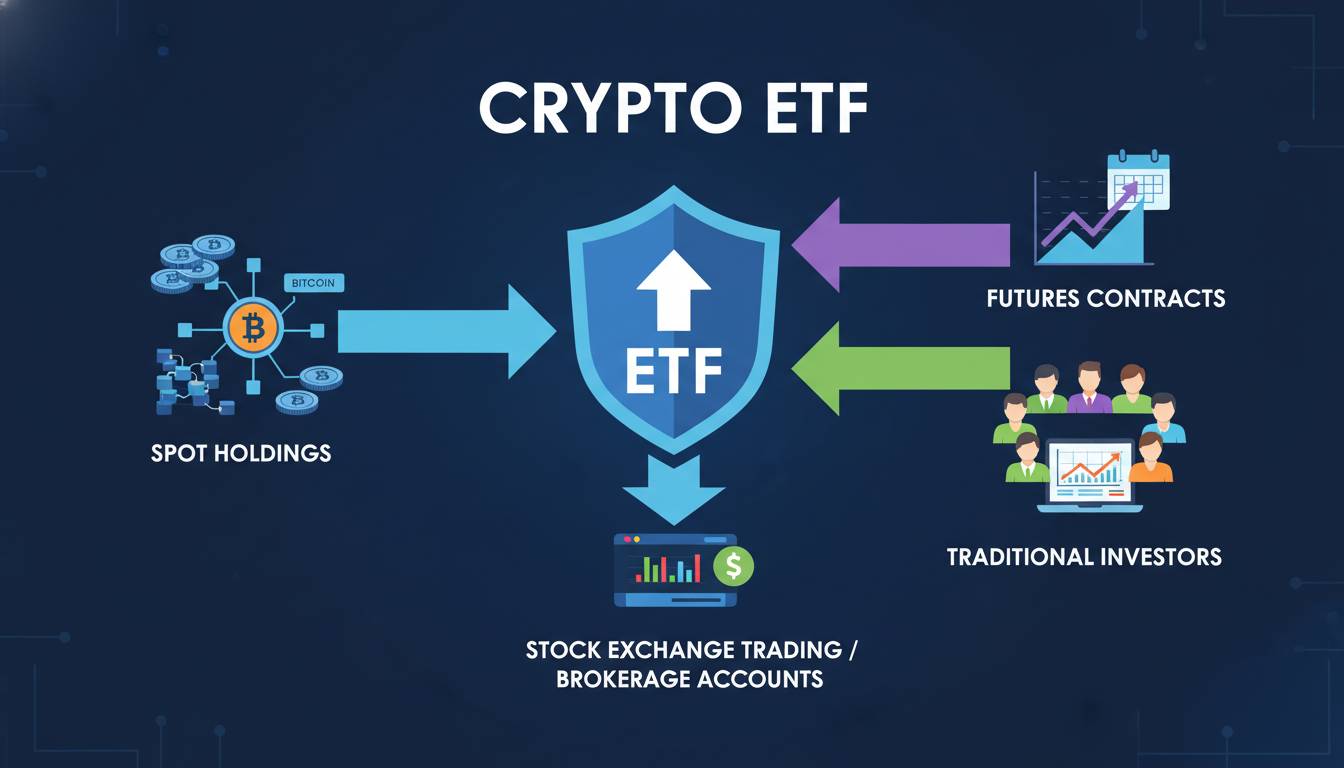
A cryptocurrency ETF is an exchange-traded fund that invests in cryptocurrencies or cryptocurrency-related assets, allowing investors to gain exposure to digital asset prices without directly purchasing, storing, or managing the underlying coins. These funds trade on traditional stock exchanges, making them accessible through existing brokerage accounts, retirement plans, and trading platforms. The ETF structure provides investors with the convenience of stock trading combined with the diversification potential of a pooled investment vehicle.
How Crypto ETFs Work
Crypto ETFs operate by holding actual cryptocurrency or derivative contracts that track cryptocurrency prices. For spot ETFs, the fund maintains reserves of the underlying cryptocurrency, with shares redeemable for the underlying assets in large institutional transactions. The fund’s share price closely tracks the cryptocurrency’s market price, minus management fees. This structure differs from futures-based ETFs, which hold futures contracts rather than actual cryptocurrency and may experience tracking error over time.
Key Components:
• Underlying Assets: Actual Bitcoin or Ethereum held in secure custody
• Custodian: Specialized cold storage solutions with insurance coverage
• Management Fee: Annual expense ratio typically ranging from 0.25% to 1.5%
• Creation/Redemption Mechanism: Authorized participants can create or redeem shares using underlying assets
💡 STAT: Spot Bitcoin ETFs charge between 0.25% and 0.99% annually, significantly lower than the 1.5-2% fees common among private crypto funds
Types of Crypto ETFs
The crypto ETF market encompasses several distinct product categories, each with different risk profiles and investment characteristics. Spot ETFs hold the underlying cryptocurrency directly, providing the most direct price exposure. Futures-based ETFs invest in standardized futures contracts, which can introduce tracking error and rollover costs. Grayscale Bitcoin Trust (GBTC), which converted to an ETF in January 2024, previously operated as a closed-end fund with significant premiums and discounts to net asset value.
The SEC Approval Process
The journey toward crypto ETF approval in the United States spanned nearly a decade, marked by numerous rejection letters, changing regulatory leadership, and evolving market dynamics. Understanding this approval process helps investors appreciate the regulatory framework governing these products and the considerations that influenced SEC decisions.
Historical Context
The SEC first considered Bitcoin ETF proposals in 2013 when the Winklevoss twins filed their application. For the next decade, the commission consistently rejected proposals, citing concerns about market manipulation, lack of regulation, and insufficient investor protection. SEC Chair Gary Gensler historically expressed skepticism about cryptocurrency markets, leading many analysts to believe ETF approval was years away. However, legal pressure from Grayscale Investments, which successfully challenged the SEC’s rejection of its Bitcoin ETF application, fundamentally altered the regulatory landscape.
January 2024: Bitcoin ETF Approval
On January 10, 2024, the SEC unexpectedly approved multiple spot Bitcoin ETF applications in a coordinated decision that transformed the cryptocurrency investment landscape. The approval came one day after a federal appeals court ruled that the SEC had acted “arbitrarily and capriciously” in rejecting Grayscale’s application. Eleven spot Bitcoin ETFs received approval, including products from industry giants BlackRock, Fidelity, Invesco, and Grayscale.
Approved Bitcoin ETF List:
• BlackRock iShares Bitcoin Trust (IBIT)
• Fidelity Wise Origin Bitcoin Fund (FBTC)
• Grayscale Bitcoin Trust (GBTC)
• Invesco Galaxy Bitcoin ETF (BTCO)
• 21Shares Core Bitcoin ETF (ARCA)
• Valkyrie Bitcoin Fund (BRRR)
• Franklin Templeton Digital Holdings (EZBC)
• Hashdex Bitcoin ETF (DEFI)
• Bitwise Bitcoin ETF (BITB)
• iShares Bitcoin Trust by iShares
May 2024: Ethereum ETF Approval
Building on the Bitcoin ETF momentum, the SEC approved spot Ethereum ETF applications in May 2024, marking another milestone for cryptocurrency mainstream adoption. The approval included eight Ethereum ETFs from issuers including BlackRock, Fidelity, Grayscale, and VanEck. Unlike the Bitcoin ETFs, Ethereum ETFs launched with a more cautious approach, with issuers initially waiving fees to attract assets in a competitive market.
Benefits for Investors
The approval of crypto ETFs offers substantial advantages for both institutional and retail investors seeking cryptocurrency exposure. These benefits extend beyond simple convenience to include regulatory oversight, tax efficiency, and portfolio construction flexibility.
| Benefit | Impact | Source |
|---|---|---|
| Regulatory Protection | SEC oversight ensures disclosure and investor protections | SEC.gov, 2024 |
| Accessibility | Trade through any brokerage with stocks/ETFs | FINRA, 2024 |
| Custodial Security | Professional cold storage reduces theft risk | Custodian reports, 2024 |
| Tax Efficiency | 1099 reporting simplifies cryptocurrency tax compliance | IRS guidance, 2024 |
| Institutional Credibility | Major asset managers validate cryptocurrency as asset class | Bloomberg, 2024 |
Top Advantages
• Familiar Investment Process: Investors use existing brokerage accounts without learning cryptocurrency exchanges or managing digital wallets
• Reduced Counterparty Risk: SEC-regulated custodians provide institutional-grade security
• Transparent Pricing: ETFs trade at market prices with real-time NAV calculations
• Retirement Account Eligibility: Crypto ETFs can be held in 401(k) and IRA accounts
• Lower Costs: Expense ratios are significantly lower than privately offered crypto funds
📈 CASE: BlackRock’s iShares Bitcoin Trust (IBIT) accumulated over $20 billion in assets within its first 100 days, making it the fastest-growing ETF in history (Bloomberg, April 2024)
Comparison: Crypto ETFs vs. Direct Cryptocurrency Ownership
Investors considering cryptocurrency exposure must decide between ETF structures and direct ownership of digital assets. Each approach offers distinct advantages and disadvantages that align with different investor preferences and circumstances.
| Factor | Crypto ETF | Direct Ownership |
|---|---|---|
| Cost | 0.25-1.0% annual fee | Exchange fees only |
| Control | No direct control | Full ownership |
| Security | Professional custody | Self-custody required |
| Accessibility | Any brokerage | Specialized exchange |
| Transferability | Instant trading | Blockchain confirmations |
| Tax Reporting | 1099 provided | Self-reporting required |
Crypto ETF Advantages
✅ Professional Management: Expert custodians handle security, insurance, and compliance
✅ Regulatory Oversight: SEC regulation provides investor protections
✅ Familiar Platforms: Trade alongside stocks, bonds, and mutual funds
✅ Retirement Accounts: Eligible for tax-advantaged accounts
❌ Management Fees: Ongoing costs reduce returns
❌ No Staking Rewards: Cannot earn staking income from ETF-held assets
Direct Ownership Advantages
✅ Full Control: Complete ownership without intermediary
✅ Lower Costs: No management fees beyond trading commissions
✅ Staking Income: Can earn yield through proof-of-stake participation
✅ Utility Access: Can use assets for decentralized finance applications
❌ Security Responsibility: Self-custody requires technical expertise
❌ Tax Complexity: More challenging tax reporting requirements
How to Invest in Crypto ETFs
Investing in crypto ETFs follows the same process as purchasing any other exchange-traded fund. Understanding the steps, considerations, and best practices helps investors execute their strategy effectively.
Prerequisites
- [ ] Traditional brokerage account (Fidelity, Schwab, TD Ameritrade, etc.)
- [ ] Funded account with available cash or margin capability
- [ ] Understanding of your investment objectives and risk tolerance
- [ ] Awareness of tax implications in taxable accounts
Time: 15-30 minutes to execute first trade | Cost: Commission-free at most brokerages
Steps
1. Open or Verify Brokerage Access
Ensure your brokerage offers the specific crypto ETF you want to purchase. Most major brokerages support the newly approved Bitcoin and Ethereum ETFs. Confirm that your account is funded with sufficient capital for your intended position size.
- Log into your brokerage account
- Search ticker symbol (IBIT, FBTC, GBTC, ETHA, etc.)
- Verify the ETF is available for trading on your platform
⏱ Time: 5 minutes | 💡 Tip: Some brokerages restrict new ETF offerings initially—check if you need to request access
2. Research Your Chosen ETF
Compare expense ratios, underlying assets, and issuer track records before investing. While all spot Bitcoin ETFs hold similar underlying assets, management fees and tracking precision vary.
⚠️ Avoid: Chasing recently launched ETFs with minimal trading volume
Fix: Stick to ETFs with tight bid-ask spreads and significant daily volume
3. Determine Position Size
Decide how much of your portfolio to allocate to cryptocurrency exposure. Financial advisors typically recommend limiting volatile assets to 1-5% of a diversified portfolio, though individual circumstances vary.
- Calculate dollar amount based on allocation strategy
- Consider dollar-cost averaging for large positions
- Account for management fees in expected returns
4. Execute Your Trade
Place a market or limit order through your brokerage’s trading platform. Market orders execute immediately at the best available price, while limit orders let you specify your maximum purchase price.
- Enter ticker symbol
- Select order type (market vs. limit)
- Specify quantity (number of shares)
- Review and confirm order
5. Monitor and Rebalance
Crypto ETF positions require ongoing monitoring due to the asset class’s volatility. Establish rebalancing triggers based on your investment policy.
Troubleshooting
| Problem | Fix |
|---|---|
| ETF not available at brokerage | Contact customer service or transfer to supporting brokerage |
| Wide bid-ask spread | Use limit orders or wait for better market conditions |
| Order rejected | Verify account permissions and sufficient funds |
| Price significantly different from underlying | Understand that minor premiums/discounts occur |
Risks and Considerations
While crypto ETFs represent a breakthrough for cryptocurrency accessibility, investors must understand the substantial risks associated with digital asset exposure. Cryptocurrency markets remain highly volatile, regulatory frameworks continue evolving, and the asset class carries unique characteristics that differ from traditional investments.
Market Volatility
Cryptocurrency prices can experience dramatic swings in short periods. Bitcoin has historically moved 10-20% weekly, with single-day moves of 5% being common. This volatility can trigger significant portfolio fluctuations and emotional decision-making. The approval of ETFs does not change the fundamental price dynamics of the underlying assets—it merely provides a new access mechanism.
| Risk Factor | Potential Impact | Mitigation |
|---|---|---|
| Price Volatility | 50%+ drawdowns possible | Position sizing, diversification |
| Regulatory Change | Potential restrictions or bans | Understand legal landscape |
| Liquidity Risk | Difficulty exiting positions | Stick to liquid ETFs |
| Custodian Risk | Security breaches possible | Research custodian quality |
⚠️ CRITICAL: Past performance does not guarantee future results. Bitcoin dropped over 75% from its 2021 peak before recovering. Investors should only allocate capital they can afford to lose.
Prevent: Never invest more than you can afford to lose, maintain emergency funds, and avoid borrowing to invest in cryptocurrency
Regulatory Uncertainty
While the SEC has approved spot ETFs for Bitcoin and Ethereum, regulatory frameworks remain subject to change. Future administrations may take different approaches to cryptocurrency oversight, potentially imposing additional restrictions or requirements. The classification of various cryptocurrencies as securities versus commodities continues evolving, affecting which assets may receive ETF approval in the future.
Custodian and Operational Risks
Crypto ETF custodians maintain the underlying cryptocurrency in cold storage, but operational risks persist. While major custodians carry insurance coverage and employ sophisticated security measures, no system is completely immune to breaches. Additionally, the ETF structure introduces counterparty risk through the fund sponsor and authorized participants.
Expert Insights
Industry leaders and financial experts have shared diverse perspectives on crypto ETF approval and its implications for investors and the broader financial system.
👤 Larry Fink, CEO of BlackRock
“Bitcoin represents a global, democratizing asset. We see it as digital gold—an alternative investment that can provide portfolio diversification.”
Data: BlackRock’s IBIT became the fastest-growing ETF in history | Advice: Consider small strategic allocation to portfolios
👤 Michael Sonnenshein, former CEO of Grayscale
“The approval of Bitcoin ETFs marks the culmination of years of advocacy and education about digital asset legitimacy.”
Data: Grayscale held $28 billion in Bitcoin assets at ETF approval | Advice: Understand the difference between spot and futures-based products
👤 Gary Gensler, SEC Chair (at time of approval)
“While the SEC is approving these products, investors should remain cautious about the significant risks of Bitcoin and crypto-asset markets.”
Data: SEC emphasized investor protection concerns | Advice: Conduct thorough due diligence before investing
📊 BENCHMARKS
| Metric | Average | Top Performers |
|——–|———|—————–|
| Annual Volatility | 60-80% | 45-55% |
| Management Fee | 0.50% | 0.25% |
| Daily Trading Volume | $500M+ | $2B+ |
| Assets Under Management | $1B+ | $10B+ |
Tools and Resources
| Tool | Cost | For | Rating |
|---|---|---|---|
| Yahoo Finance | Free | Price tracking, news | ⭐⭐⭐⭐⭐ |
| CoinGecko | Free | Underlying crypto prices | ⭐⭐⭐⭐ |
| SEC EDGAR | Free | Regulatory filings | ⭐⭐⭐⭐⭐ |
| Morningstar | Free/Premium | ETF analysis | ⭐⭐⭐⭐ |
| Bloomberg Terminal | $$$$ | Institutional research | ⭐⭐⭐⭐⭐ |
Top Picks:
• SEC.gov: Access prospectuses and regulatory filings for ETF issuers
• Brokerage Research: Use your brokerage’s research tools for commission-free ETF information
• Financial Advisors: Consider professional guidance for allocation decisions
Frequently Asked Questions
What is a crypto ETF?
A crypto ETF is an exchange-traded fund that holds cryptocurrency or cryptocurrency derivatives, allowing investors to gain exposure to digital asset prices through traditional brokerage accounts. Spot ETFs hold actual cryptocurrency reserves, while futures-based ETFs invest in standardized futures contracts. These products trade on major stock exchanges and are regulated by the SEC, providing investor protections not available when holding cryptocurrency directly.
When did the SEC approve Bitcoin ETFs?
The SEC approved spot Bitcoin ETFs on January 10, 2024, with trading beginning on January 11, 2024. This historic decision followed years of rejected applications and came one day after a federal appeals court ruled that the SEC had acted improperly in rejecting Grayscale’s Bitcoin ETF proposal. Eleven Bitcoin ETFs received approval on that date from issuers including BlackRock, Fidelity, and Grayscale.
Are crypto ETFs safe to invest in?
Crypto ETFs are not “safe” investments in the traditional sense—they carry substantial risk due to cryptocurrency price volatility. However, they provide regulatory protections and professional custody that direct cryptocurrency ownership lacks. The SEC’s approval means these products meet disclosure and operational requirements, but investors should understand they can still lose significant capital. No investment is guaranteed, and cryptocurrency remains a highly speculative asset class.
How do I buy a crypto ETF?
You can purchase crypto ETFs through any traditional brokerage account that supports ETF trading. Major platforms including Fidelity, Charles Schwab, TD Ameritrade, and E*TRADE all offer access to the approved Bitcoin and Ethereum ETFs. Simply search for the ticker symbol (such as IBIT for BlackRock’s Bitcoin ETF or ETHA for Ethereum ETFs), determine your position size, and execute a trade like you would for any stock or ETF.
What’s the difference between Bitcoin and Ethereum ETFs?
Bitcoin ETFs hold actual Bitcoin, providing direct exposure to Bitcoin’s price. Ethereum ETFs hold Ethereum and provide exposure to Ethereum’s price, which is influenced by both the cryptocurrency market and developments in the Ethereum blockchain ecosystem. Both asset classes are volatile, but Ethereum may have additional price drivers related to decentralized application development and network upgrades.
What are the tax implications of holding crypto ETFs?
Crypto ETFs held in taxable accounts generate capital gains or losses that must be reported on your tax return. Unlike direct cryptocurrency ownership, ETF providers issue Form 1099, simplifying the tax reporting process. For retirement accounts like IRAs or 401(k)s, crypto ETFs receive the same tax-advantaged treatment as traditional investments. Consult a tax professional for specific guidance based on your situation.
Conclusion
The approval of spot Bitcoin and Ethereum ETFs marks a watershed moment in cryptocurrency’s journey toward mainstream financial acceptance. These products provide unprecedented accessibility to digital asset markets through familiar, regulated investment vehicles. For portfolio managers and individual investors alike, crypto ETFs offer a way to include cryptocurrency exposure while benefiting from SEC oversight, professional custody, and simplified tax reporting.
However, investors must approach this opportunity with clear eyes about the risks involved. Cryptocurrency remains one of the most volatile asset classes, with prices capable of swinging dramatically in either direction. The regulatory approval does not change the fundamental characteristics of the underlying assets—it merely provides a new access mechanism. Position sizing, diversification, and realistic expectations are essential for anyone considering crypto ETF investments.
As the market matures, we can expect additional cryptocurrency ETFs to receive approval, further expanding investor options. The entry of major asset managers like BlackRock and Fidelity signals institutional validation of cryptocurrency as an emerging asset class. Yet this validation comes with responsibilities: investors must educate themselves, understand what they own, and allocate appropriately within their broader financial plans.
The crypto ETF revolution is still in its early chapters. Whether you’re a curious newcomer or a seasoned investor reconsidering your allocation, the key is to approach thoughtfully, invest only what you can afford to lose, and stay informed as this rapidly evolving market continues to develop.