168Views 0Comments
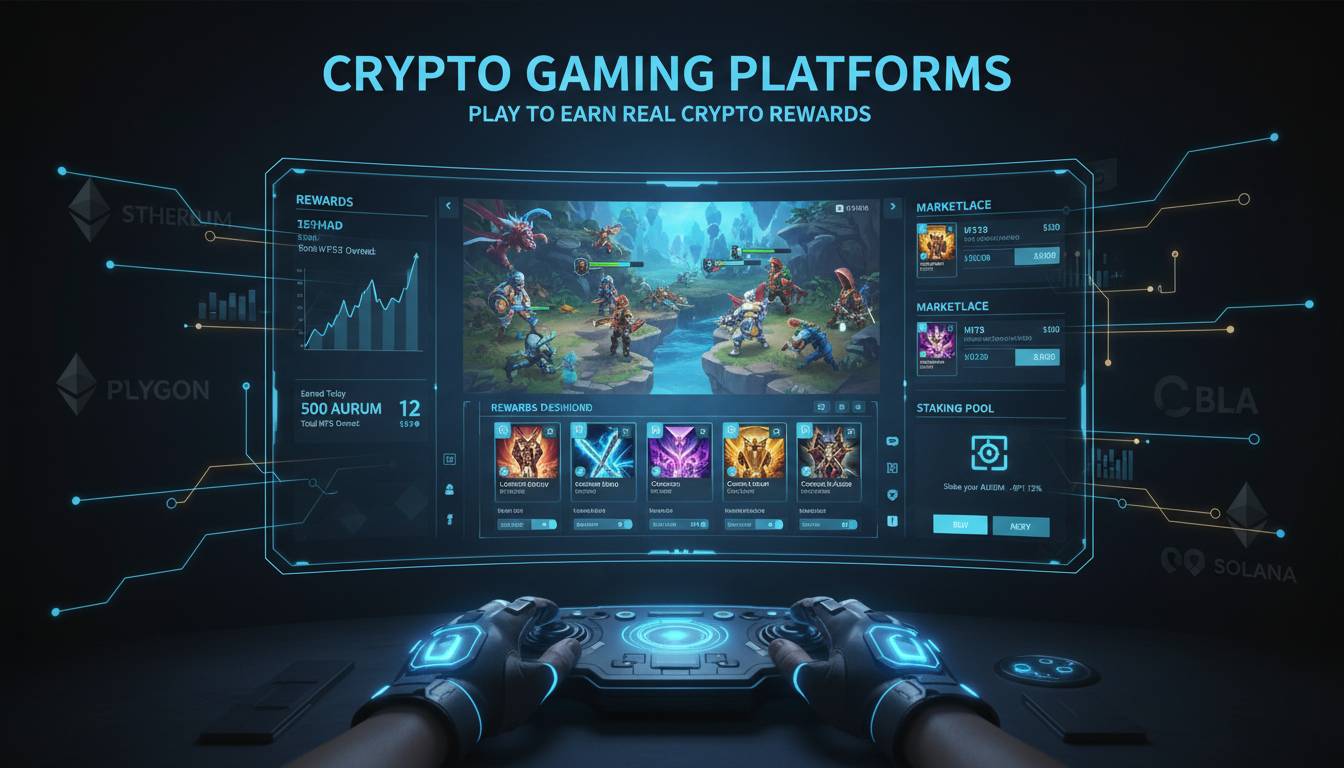
Crypto Gaming Platforms – Play to Earn Real Crypto Rewards
The intersection of cryptocurrency and gaming has exploded into a multi-billion dollar industry, transforming how players worldwide earn real value from their gaming skills. Crypto gaming platforms enable users to earn cryptocurrencies, non-fungible tokens (NFTs), and digital assets simply by playing games—turning entertainment into a potential income stream. With over 2.5 billion gamers globally and crypto adoption accelerating in the United States, the play-to-earn (P2E) model represents one of the most significant developments in both gaming and decentralized finance.
📊 STATS
• The global blockchain gaming market reached $4.6 billion in 2023 and is projected to hit $65.7 billion by 2027
• Axie Infinity recorded $1.3 billion in lifetime revenue as of early 2024 (TokenTerminal)
• Over 2.1 million daily active users engaged with blockchain games in Q1 2024 (DappRadar)
• 76% of crypto gamers are aged 18-35, with the majority based in Asia-Pacific and North America
Key Takeaways
• Market Growth: Blockchain gaming grew 200% year-over-year, making it the fastest-growing crypto sector
• Earning Potential: Top players earn anywhere from $200 to $10,000+ monthly depending on game mechanics and time investment
• Barrier to Entry: Most platforms require minimal initial investment, though some games demand upfront NFT purchases
• Regulatory Landscape: The US SEC has increased scrutiny on P2E tokens, classifying many as securities
• Sustainability Concerns: Energy consumption varies dramatically between Proof-of-Work and Proof-of-Stake gaming chains
What Are Crypto Gaming Platforms?
Crypto gaming platforms are online gaming ecosystems built on blockchain technology that reward players with cryptocurrency or NFT rewards for their in-game activities. Unlike traditional gaming where virtual items belong to the game developer, blockchain games give players true ownership of their digital assets through blockchain-based ownership records.
How Blockchain Gaming Works
These platforms operate on decentralized networks, typically using smart contracts to manage asset ownership, reward distribution, and in-game economies. When players complete missions, win battles, or achieve milestones, the platform distributes tokens directly to their crypto wallets. The entire process eliminates middlemen—players retain full control over their earnings and can withdraw or trade them on cryptocurrency exchanges.
The fundamental difference between traditional free-to-play games and crypto gaming lies in ownership economics. In conventional gaming, players spend money on in-game purchases but never truly own those items. Blockchain games transfer ownership to the player, allowing assets to be transferred between games, sold on secondary markets, or held as investments.
💡 STAT: Players spent over $4 billion on in-game purchases in traditional games in 2023 alone, yet retained zero ownership rights
Types of Crypto Gaming Platforms
Play-to-Earn (P2E) Games: These require active gameplay to earn token rewards. Players invest time and skill to generate returns, with earnings directly correlated to performance and engagement.
NFT Gaming Platforms: Focus on trading and collecting unique digital assets. Players can buy, sell, and breed in-game characters or items that appreciate in value based on rarity and utility.
GameFi Platforms: Combine decentralized finance mechanics with gaming—yield farming, staking, and liquidity mining integrated into gameplay loops.
Metaverse Gaming: Virtual world experiences where players explore, socialize, and earn through multiple activities including virtual real estate, avatar customization, and social gaming.
Benefits of Crypto Gaming Platforms
| Benefit | Impact | Source |
|---|---|---|
| True Asset Ownership | 100% player-owned digital items | Blockchain Council, 2024 |
| Real Monetary Rewards | Average earner makes $200-500/month | PlayToEarn.net, 2024 |
| Global Accessibility | Anyone with internet can participate | World Bank, 2024 |
| Secondary Markets | $5.2B in NFT gaming trades | DappRadar, 2024 |
| Transparent Economies | On-chain verification of all transactions | CoinGecko, 2024 |
Key Advantages
Financial Incentives: Unlike traditional gaming where only professional esports players earn money, crypto gaming allows casual players to generate returns through consistent gameplay. The democratization of earning opportunities means anyone with skills and time can participate.
Cross-Game Compatibility: Many platforms now adopt interoperable standards, allowing players to use purchased items across multiple games within the same ecosystem. This increases asset utility and investment value.
Community Governance: Leading platforms distribute governance tokens to players, giving them voting rights on game development decisions. This creates player-driven ecosystems where the community shapes the game’s future.
Passive Income Potential: Beyond active gameplay, many platforms offer staking opportunities where players can lock tokens to earn yield while not playing—effectively generating returns on earnings.
📈 CASE: The Sandbox, a virtual world platform, saw user-generated content sales reach $50 million in 2023, with creators retaining 95% of revenues
Comparing Top Crypto Gaming Platforms
| Factor | Axie Infinity | The Sandbox | StepN | Illuvium |
|---|---|---|---|---|
| Cost | Free to start | Free to start | $100+ initial | Free to start |
| Primary Token | AXS, SLP | SAND | GMT, GST | ILV |
| Best For | RPG battles | Virtual world | Fitness tracking | Open-world RPG |
| Daily Users | 500K+ | 300K+ | 200K+ | 150K+ |
| Rating | ⭐⭐⭐⭐ | ⭐⭐⭐⭐⭐ | ⭐⭐⭐ | ⭐⭐⭐⭐ |
Axie Infinity
✅ Pros: Established player base, scholarship program allows earning without upfront investment, extensive battle system
❌ Cons: High learning curve, token volatility, requires time investment for meaningful earnings
💰 Price: Free to download; AXS token trading around $8-15
🎯 For: Players seeking RPG combat mechanics and community engagement
Axie Infinity remains the most recognizable P2E game, pioneered the scholarship model where managers fund new players’ teams in exchange for earnings share. The game features creature collection, breeding, and turn-based battles.
The Sandbox
✅ Pros: Creative freedom, established brand partnerships, LAND-based investment opportunities, robust creator tools
❌ Cons: High LAND prices for meaningful presence, steep learning curve for creation tools
💰 Price: Free to explore; LAND parcels start at ~$1,500
🎯 For: Creators, brands, and players interested in user-generated content
The Sandbox offers a voxel-based virtual world where players own LAND, create experiences, and monetize creations. Partnerships with major brands like Adidas and Atari demonstrate mainstream adoption.
StepN
✅ Pros: Combines fitness with earning, physical health benefits, clear utility
❌ Cons: Significant upfront sneaker NFT investment, sustainability concerns about token economics
💰 Price: Sneaker NFTs range from $100-$2,000+
🎯 For: Fitness enthusiasts seeking motivation and crypto rewards
StepN revolutionized P2E by requiring physical movement—players earn GMT tokens by walking, jogging, or running outdoors with GPS tracking.
Illuvium
✅ Pros: AAA-quality graphics, open-world exploration, auto-battler mechanics
❌ Cons: Still in development, high system requirements
💰 Price: Free to play; ILV token
🎯 For: Players seeking premium gaming experiences with P2E elements
Illuvium represents the high-end of blockchain gaming, aiming to deliver console-quality graphics in a decentralized ecosystem.
How to Start Earning Crypto Through Gaming
Prerequisites:
– [ ] Cryptocurrency wallet (MetaMask, Coinbase Wallet)
– [ ] Small amount of crypto for gas fees (0.005 ETH minimum)
– [ ] Stable internet connection
– [ ] Time commitment (minimum 1-2 hours daily)
Time: 1-2 hours daily for meaningful earnings | Cost: $0-500 depending on game
Steps
1. Set Up a Crypto Wallet
Create a MetaMask or compatible wallet to store your earnings. Secure your seed phrase offline—this is your only recovery option. Connect your wallet to the gaming platform’s website or app. Most platforms operate on Ethereum, Solana, or Polygon networks.
⏱ 30 minutes | 💡 Tip: Use a hardware wallet for amounts exceeding $1,000
2. Research Platforms Before Investing
Start with free-to-play platforms to understand mechanics without financial risk. Join official Discord servers and subreddit communities to verify legitimacy. Check tokenomics—games with unlimited token supply face inflation risks.
⏱ 2-3 hours research | ⚠️ Avoid: Games promising guaranteed returns or those with anonymous development teams
3. Start Playing or Purchase Initial Assets
For scholarship programs (Axie Infinity), apply to managers who provide starter teams. If purchasing NFTs directly, buy from official marketplaces to avoid scams. Start with minimal investment to test withdrawal processes.
⚠️ Avoid: Secondary market purchases at significantly higher prices than floor—often speculation
4. Understand Tokenomics and Rewards
Learn how rewards distribute—the ratio of token to US dollar value matters. Consider impermanent loss if staking tokens. Track gas fees against potential earnings.
5. Withdraw and Manage Earnings
Transfer tokens to exchanges (Coinbase, Kraken) to convert to stablecoins or fiat. Consider tax implications—IRS guidance treats crypto gaming earnings as taxable income.
Troubleshooting
| Problem | Fix |
|---|---|
| Transaction failed | Increase gas fee or switch to Layer 2 networks like Polygon |
| Can’t connect wallet | Clear browser cache, ensure correct network selected |
| Low earnings | Join guilds for scholarship opportunities or switch games |
| Token price dropped | Dollar-cost average or hold for potential recovery |
| Scam warnings | Never share seed phrase; verify URLs match official sites |
Regulatory Considerations
The regulatory landscape for crypto gaming remains complex and evolving. The Securities and Exchange Commission (SEC) has increasingly scrutinized P2E tokens, with several projects receiving Wells notices or facing enforcement actions.
Key Regulatory Points
Securities Classification: Many gaming tokens may qualify as securities under the Howey Test, requiring registration or exemption. The SEC has specifically called outAxie Infinity’s SLP token as potentially unregistered.
Tax Implications: The IRS requires reporting of crypto gaming earnings as ordinary income. Players must track the dollar value at time of receipt and any capital gains when selling tokens.
Gaming Laws: Several states have introduced legislation specifically targeting P2E gaming, with varying requirements for operators and player protections.
⚠️ CRITICAL: The collapse of several P2E games (Axie Infinity’s bridge hack losing $625M, Terra Luna’s 99% crash affecting gaming tokens) demonstrates extreme volatility and fraud risks. Never invest more than you can afford to lose.
Prevent: Diversify across games, withdraw earnings regularly, research team backgrounds, and use only audited platforms.
Common Mistakes to Avoid
| Mistake | Impact | Solution |
|---|---|---|
| Investing life savings | 📉 Total loss risk | Limit to entertainment budget |
| Ignoring tokenomics | 📉 Inflation kills value | Choose capped supply tokens |
| Falling for scams | 📉 100% loss | Verify URLs, never share seeds |
| Not withdrawing earnings | 📉 Price crashes | Convert to stablecoins regularly |
| Ignoring gas fees | 📉 Eaten by fees | Use Layer 2 networks |
⚠️ CRITICAL: The average P2E game lifespan is less than 18 months, with over 80% of tokens dropping 90%+ from all-time highs . Treat gaming earnings as volatile income, not stable revenue.
Prevent: Withdraw earnings immediately to cold storage, verify all transactions, never click links from unknown sources, and diversify across at least 3-5 platforms.
Expert Insights
👤 Brian Voong, Founder at Launchpool
“Play-to-earn represents a fundamental shift in gaming economics, but players need to understand they’re beta testers in an experimental financial system. The games that will survive prioritize sustainable tokenomics over quick user growth.”
👤 Sarah Cheng, Lead Analyst at DappRadar
“The blockchain gaming sector saw 12% of all dApp activity in 2024, but sustainability remains the elephant in the room. Only platforms with genuine utility beyond speculation will endure.”
📊 BENCHMARKS
| Metric | Average | Top 10% |
|——–|———|———|
| Daily earnings (Axie) | $5-15 | $50+ |
| Monthly earnings (The Sandbox) | $20-100 | $500+ |
| ROI timeline | 3-6 months | 1-2 months |
| Player retention (90-day) | 15% | 40%+ |
Tools and Resources
| Tool | Cost | For | Rating |
|---|---|---|---|
| DappRadar | Free | Track game metrics and user activity | ⭐⭐⭐⭐⭐ |
| CoinGecko | Free | Token price tracking and market data | ⭐⭐⭐⭐⭐ |
| MetaMask | Free | Wallet management and game connections | ⭐⭐⭐⭐ |
| Step Finance | Free | Portfolio tracking across gaming tokens | ⭐⭐⭐⭐ |
| Axie Scholar | Free | Scholarship management and analytics | ⭐⭐⭐ |
Top Picks:
• DappRadar: Essential for tracking active users, volume, and legitimate platform metrics
• CoinGecko: Comprehensive token data including market cap, holders, and price history
• MetaMask: Industry-standard wallet with built-in network switching for gaming chains
Frequently Asked Questions
How much money can I make playing crypto games?
Earnings vary dramatically based on the game, time invested, and market conditions. Most casual players earn $5-50 monthly, while dedicated players with proper strategies earn $200-1,000+. Some top players in established games earn $5,000+ monthly, though this represents less than 1% of players.
Are crypto gaming platforms legal in the United States?
The legal status remains complex. Operating or playing P2E games is generally legal, but token sales and trading fall under securities regulations. Several states have specific gaming regulations. Players should consult tax professionals and understand their state’s position before participating.
Do I need to invest money to start earning?
Not necessarily. Several platforms offer “scholarship” programs where experienced players provide NFTs or game assets to newcomers in exchange for earnings share. Axie Infinity’s scholarship model pioneered this approach. Free-to-play models on platforms like The Sandbox also allow earning without initial investment.
What are the tax implications of crypto gaming earnings?
The IRS treats crypto earned through gaming as taxable ordinary income at its fair market value when received. Capital gains tax applies when converting to fiat or trading. Players must maintain detailed records of all transactions, including in-game NFT transfers that may constitute taxable events.
How safe are crypto gaming platforms?
Security risks include smart contract vulnerabilities, rug pulls (developers abandoning projects with funds), exchange hacks, and phishing attacks. Major hacks have resulted in losses exceeding $1 billion combined. Only use audited platforms, store assets in hardware wallets, and verify all transactions.
Which crypto gaming platform is best for beginners?
The Sandbox offers the lowest barrier to entry with free exploration and creator tools. Axie Infinity provides the most established ecosystem with scholarship programs. StepN appeals to fitness-motivated users. Beginners should start with free-to-play options before considering any investment.
Conclusion
Crypto gaming platforms represent a transformative intersection of entertainment and decentralized finance, offering genuine earning opportunities while introducing unprecedented ownership models for digital assets. The industry has matured significantly, with major gaming studios and venture capital firms investing billions into blockchain gaming development.
However, participants must approach with eyes wide open. The sector experiences extreme volatility, with most P2E tokens losing significant value over time. Regulatory uncertainty continues to pose risks, and security threats from hacks and scams remain pervasive. Success requires careful research, portfolio diversification, regular earnings withdrawal, and strict risk management.
For those willing to navigate these complexities, crypto gaming offers unique opportunities to monetize skills and time in ways traditional gaming never could. Start small, prioritize sustainable platforms with genuine utility, and treat earnings as volatile income rather than guaranteed revenue. The space will continue evolving—those who learn quickly and adapt will find the most success in this rapidly changing landscape.