257Views 0Comments
DeFi Yields: Proven Strategies to Maximize Your Crypto Returns
Decentralized finance (DeFi) has transformed how investors generate returns on cryptocurrency holdings, offering yields that far exceed traditional finance alternatives. With total value locked in DeFi protocols exceeding $100 billion, millions of investors are actively seeking ways to maximize their crypto returns through yield generation strategies. This comprehensive guide explores proven methods, risk management techniques, and expert insights to help you navigate the DeFi yield landscape effectively.
📊 STATS
• $124 billion in total value locked (TVL) across DeFi protocols
• 4.2 million unique addresses actively providing liquidity
• 67% of DeFi yields come from trading fees versus incentive rewards
• $2.1 billion lost to DeFi exploits in 2024 (Chainalysis)
Key Takeaways
• Yield farming generates returns through liquidity provision and token incentives
• Staking offers lower risk with consistent returns of 3-8% annually
• Yield optimization protocols automate strategies to maximize APY
• Impermanent loss remains the primary risk for liquidity providers
• Diversification across protocols reduces single-point failure risks
Understanding DeFi Yields
DeFi yields represent the returns users earn by supplying liquidity, staking assets, or participating in protocol governance within decentralized financial systems. Unlike traditional savings accounts that pay interest from loan interest margins, DeFi yields derive from multiple sources including trading fees, block rewards, protocol incentives, and liquidation profits.
Sources of DeFi Yield
Trading Fees: Decentralized exchanges like Uniswap and Curve charge 0.1-0.3% per swap, distributing a portion to liquidity providers. This accounts for sustainable, protocol-native yield that doesn’t depend on token inflation.
Token Incentives: Protocols distribute native tokens to attract liquidity, creating artificially high yields that typically decrease over time as incentive programs conclude. These rewards can add 5-50% APY but carry inflation risk.
Staking Rewards: Proof-of-stake networks pay validators and delegators block rewards, typically ranging from 3-8% annually for popular chains like Ethereum, Solana, and Polkadot.
Liquidation Bots: When borrowers’ collateral falls below maintenance thresholds, liquidators profit by purchasing assets at discounts, with profits distributed to lending protocol suppliers.
💡 STAT: Sustainable DeFi yields (from fees) typically range from 0.5-5% APY, while incentive-driven yields can reach 20-100% APY but are temporary
How DeFi Yield Generation Works
DeFi protocols operate through smart contracts—self-executing code that automatically handles asset transfers when predetermined conditions are met. When you deposit stablecoins into a lending protocol like Aave or Compound, the contract records your deposit and immediately begins accruing interest paid by borrowers.
The interest rate model uses an algorithmic approach where borrowing rates increase as utilization rises, ensuring liquidity remains available while maximizing lender returns. Interest accrues per block, with your balance updating dynamically.
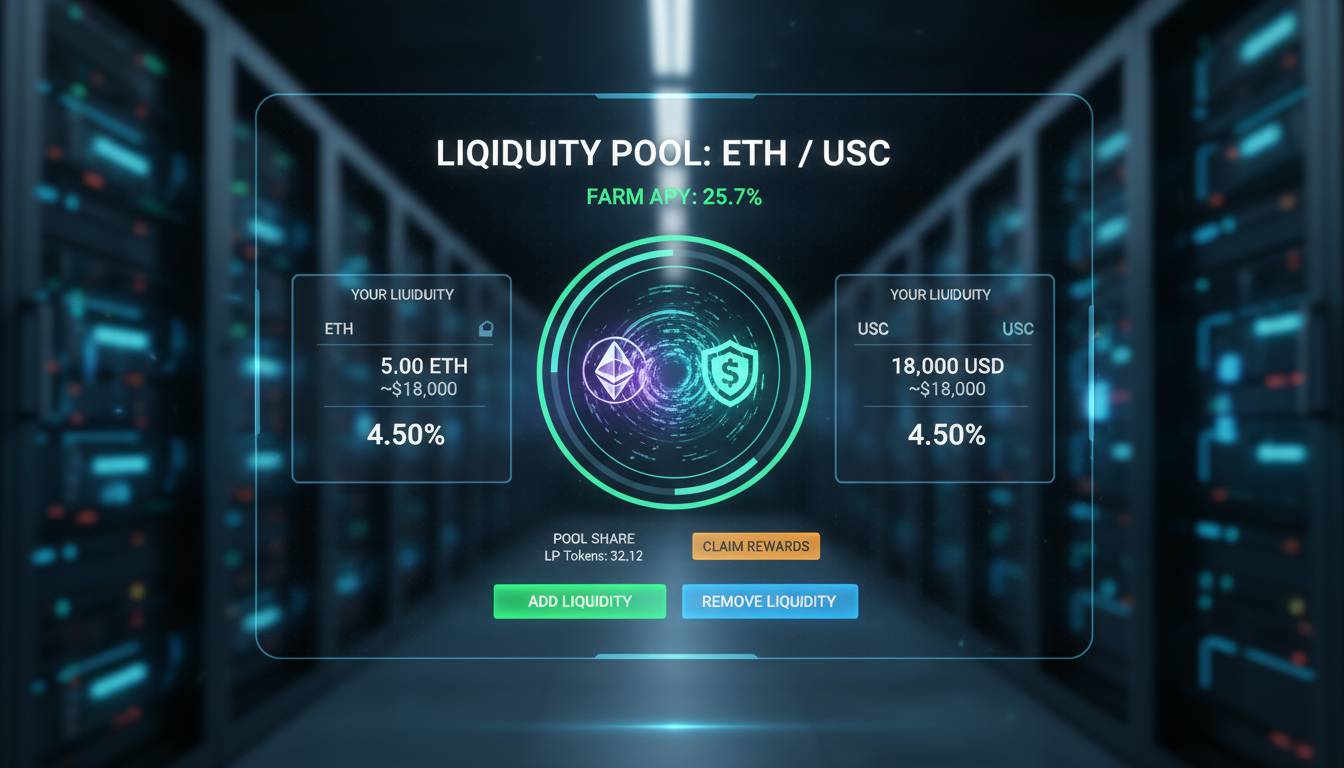
For liquidity provision on decentralized exchanges, you deposit paired assets (e.g., ETH and USDC) into liquidity pools. Trading fees are distributed proportionally based on your share of total pool liquidity. Your tokens represent a claim on the underlying assets plus accumulated fees.
Proven Strategies to Maximize DeFi Yields
Strategy 1: Yield Farming
Yield farming involves moving assets between protocols to chase the highest yields, typically combining lending, borrowing, and staking in optimized sequences. Advanced farmers use yield aggregators like Yearn Finance or Beefy Finance to automate these strategies.
Implementation Steps:
1. Assess risk tolerance and allocate capital accordingly
2. Research current yield opportunities across protocols
3. Use aggregator tools to identify optimal APY
4. Execute multi-step strategies (deposit, borrow, stake)
5. Monitor positions and rebalance as yields change
Expected Returns: 5-50% APY depending on strategy complexity and risk exposure
Strategy 2: Staking
Staking offers relatively predictable returns by locking tokens to support network operations. Beyond basic staking, liquid staking solutions like Lido or Rocket Pool let you maintain liquidity while earning staking rewards.
Types of Staking:
• Direct Staking: Lock tokens in native protocol (higher returns, illiquid)
• Liquid Staking: Receive derivative tokens representing staked assets (slightly lower returns, full liquidity)
• Staking as a Service: Third-party validators handle operations (convenience fee)
Expected Returns: 3-12% APY depending on network and staking type
Strategy 3: Liquidity Provision
Providing liquidity to decentralized exchanges generates returns from trading fees. Select pools with strong trading volume and avoid pairs with high impermanent loss risk.
Best Practices:
• Choose stablecoin pairs for minimal impermanent loss
• Focus on established DEXes with high volume (Uniswap, Curve)
• Consider concentrated liquidity for concentrated returns
• Monitor pool performance and withdraw during low-fee periods
Expected Returns: 2-15% APY from fees alone; incentive tokens can boost returns significantly
Strategy 4: Yield Aggregators
Automated yield optimization platforms like Yearn, Harvest, or Convex automatically move funds between strategies to maximize returns. These protocols handle rebalancing, gas optimization, and strategy switching.
Advantages:
• Professional strategy management
• Gas efficiency through batched transactions
• Reduced manual monitoring requirements
• Access to strategies requiring significant capital
Expected Returns: 1-5% above manual yield farming after fees
DeFi Yield Comparison
| Strategy | Risk Level | APY Range | Liquidity | Complexity |
|---|---|---|---|---|
| Stablecoin Lending | Low | 3-8% | High | Low |
| Staking | Low-Medium | 3-12% | Low-Medium | Low |
| Basic LP | Medium | 5-15% | High | Medium |
| Yield Farming | High | 10-50% | Variable | High |
| Leverage Farming | Very High | 20-100%+ | Low | Very High |
Stablecoin Lending
✅ Pros: Low risk, predictable returns, high liquidity
❌ Cons: Lower APY, smart contract risk, counterparty exposure
💰 Platforms: Aave, Compound, Morpho — 4-8% APY
🎯 Best For: Conservative investors seeking stable income
DEX Liquidity Provision
✅ Pros: Fee revenue, token incentives, full liquidity access
❌ Cons: Impermanent loss risk, smart contract vulnerability
💰 Platforms: Uniswap, Curve, Balancer — 2-20% APY
🎯 Best For: Medium-risk investors with paired assets
Yield Farming
✅ Pros: Highest potential returns, protocol token rewards
❌ Cons: Complex strategies, impermanent loss, rug pull risk
💰 Platforms: Yearn, Beefy, SpookySwap — 5-50% APY
🎯 Best For: Experienced DeFi users comfortable with active management
Risk Management in DeFi
Managing risk is essential when pursuing DeFi yields. The high returns come with substantial risks that require careful mitigation.
Smart Contract Risk
DeFi protocols contain code vulnerabilities that hackers exploit. Diversify across multiple protocols, use audited platforms, and consider insurance coverage through Nexus Mutual or similar providers.
Risk Indicators:
• Multiple security audits from reputable firms
• Active bug bounty programs
• Time since last exploit
• Code complexity and upgradeable proxies
Impermanent Loss
When providing liquidity to AMM pools, price divergence between paired assets causes impermanent loss—the permanent loss of value compared to simply holding assets. Stablecoin pairs minimize this risk.
Mitigation Strategies:
• Provide liquidity to correlated asset pairs
• Use protocols with low divergence loss (Curve)
• Enter and exit at similar price points
• Consider single-sided staking alternatives
Protocol Risk
DeFi protocols can fail due to poor governance, treasury depletion, or competitive displacement. Research team backgrounds, tokenomics, and community engagement before committing significant capital.
Common Mistakes to Avoid
| Mistake | Impact | Solution |
|---|---|---|
| Chasing highest APY | 📉 Complete loss of principal | Prioritize sustainable yields over promotional rates |
| Ignoring smart contract audits | 📉 Funds stolen via exploits | Only use audited protocols with established track records |
| Over-concentration | 📉 Single protocol failure = total loss | Diversify across 3-5 protocols minimum |
| Neglecting gas costs | 📉 Small yields eaten by fees | Use layer-2 networks or batch transactions |
| No exit strategy | 📉 Locked funds during market crashes | Maintain exit liquidity in stablecoins |
⚠️ CRITICAL: Never invest more than you can afford to lose in DeFi. The space remains highly experimental despite $100B+ in total value locked. Regulatory uncertainty, smart contract failures, and market volatility can eliminate yields rapidly.
Preventive Measures:
1. Start with small positions and test withdrawal processes
2. Use hardware wallets for significant holdings
3. Enable multi-sig protection for large accounts
4. Maintain emergency funds outside DeFi
5. Document all positions and private keys securely
Expert Insights
👤 Michaël van de Poppe, Founder at Eight Global
“DeFi yields have normalized significantly since 2020-2021’s parabolic era. Investors should focus on sustainable, fee-derived yields rather than chasing token incentives that disappear. The protocols surviving the next cycle will be those with real revenue streams.”
👤 Samantha Marina, DeFi Analyst at Messari
“Liquid staking has emerged as the bridge between CeFi and DeFi yields. ETH staking returns of 3-4% combined with liquid derivatives create compounding opportunities unavailable in traditional finance.”
📊 BENCHMARKS
| Metric | Average | Top Performers |
|——–|———|—————-|
| Lending APY (USDC) | 4.5% | 6.2% |
| Staking APY (ETH) | 3.2% | 4.1% |
| LP Fee Revenue | 8.2% | 15.4% |
| Yield Aggregator Returns | 5.1% | 9.3% |
Top DeFi Yield Platforms
| Platform | Primary Function | Risk Level | Fees | Rating |
|---|---|---|---|---|
| Aave | Lending | Low | 0.01-0.09% | ⭐⭐⭐⭐⭐ |
| Compound | Lending | Low | Variable | ⭐⭐⭐⭐ |
| Uniswap | DEX/LP | Medium | 0.01-0.3% | ⭐⭐⭐⭐⭐ |
| Curve | Stable DEX | Low-Medium | 0.04% | ⭐⭐⭐⭐⭐ |
| Lido | Liquid Staking | Low | 10% of rewards | ⭐⭐⭐⭐⭐ |
| Yearn | Yield Aggregator | Medium | 20% of profits | ⭐⭐⭐⭐ |
Top Picks:
• Aave: Industry-leading lending protocol with $25B+ TVL, multi-chain presence, and proven track record
• Curve Finance: Optimal for stablecoin and correlated asset liquidity provision with minimal impermanent loss
• Lido: Dominant liquid staking solution with 30%+ of staked ETH, providing best-in-class liquidity
Conclusion
DeFi yields offer unprecedented opportunities for crypto holders to generate returns exceeding traditional finance, but success requires understanding the underlying mechanisms and associated risks. Sustainable yield generation comes from trading fees and real protocol revenue, while incentive-driven returns are temporary and carry additional risk.
Start with low-complexity strategies like stablecoin lending or liquid staking before progressing to yield farming and leverage strategies. Diversify across protocols, conduct thorough due diligence on smart contracts, and never invest more than you can afford to lose. The DeFi landscape continues evolving rapidly—stay informed, remain cautious, and adapt your strategies as the ecosystem matures.
Frequently Asked Questions
What is a good DeFi yield right now?
Stablecoin lending typically offers 3-8% APY, which represents sustainable, lower-risk returns. Yield farming can reach 10-50% but carries significantly higher risk. Always verify current rates through official protocol dashboards rather than relying on outdated information.
Is DeFi yield safe?
DeFi yields carry multiple risks including smart contract vulnerabilities, impermanent loss, protocol failure, and regulatory changes. No DeFi investment is completely safe. Start with established protocols, diversify your holdings, and only invest amounts you’re prepared to lose entirely.
How do I start earning DeFi yields?
Begin by setting up a non-custodial wallet like MetaMask or Rabby. Purchase stablecoins (USDC, USDT, DAI) on a centralized exchange and bridge them to Layer 1 or Layer 2 networks. Deposit into a reputable lending protocol like Aave, or provide liquidity on Curve Finance for stablecoin pairs.
What is impermanent loss in DeFi?
Impermanent loss occurs when the price ratio between paired assets changes after you provide liquidity, resulting in lower value than simply holding the assets. It’s called “impermanent” because the loss becomes permanent upon withdrawal. Stablecoin pairs minimize this risk significantly.
What’s the difference between APY and APR in DeFi?
APR (Annual Percentage Rate) represents simple interest without compounding, while APY (Annual Percentage Yield) includes compound interest effects. DeFi protocols typically compound frequently (per block or per second), making APY the more accurate measure of actual returns.
Can I lose money in DeFi yield farming?
Yes, you can lose money through impermanent loss, smart contract exploits, rug pulls, liquidation during volatility, and rug pulls from new protocols. Thorough research, diversification, and risk management are essential to minimizing potential losses.