199Views 0Comments
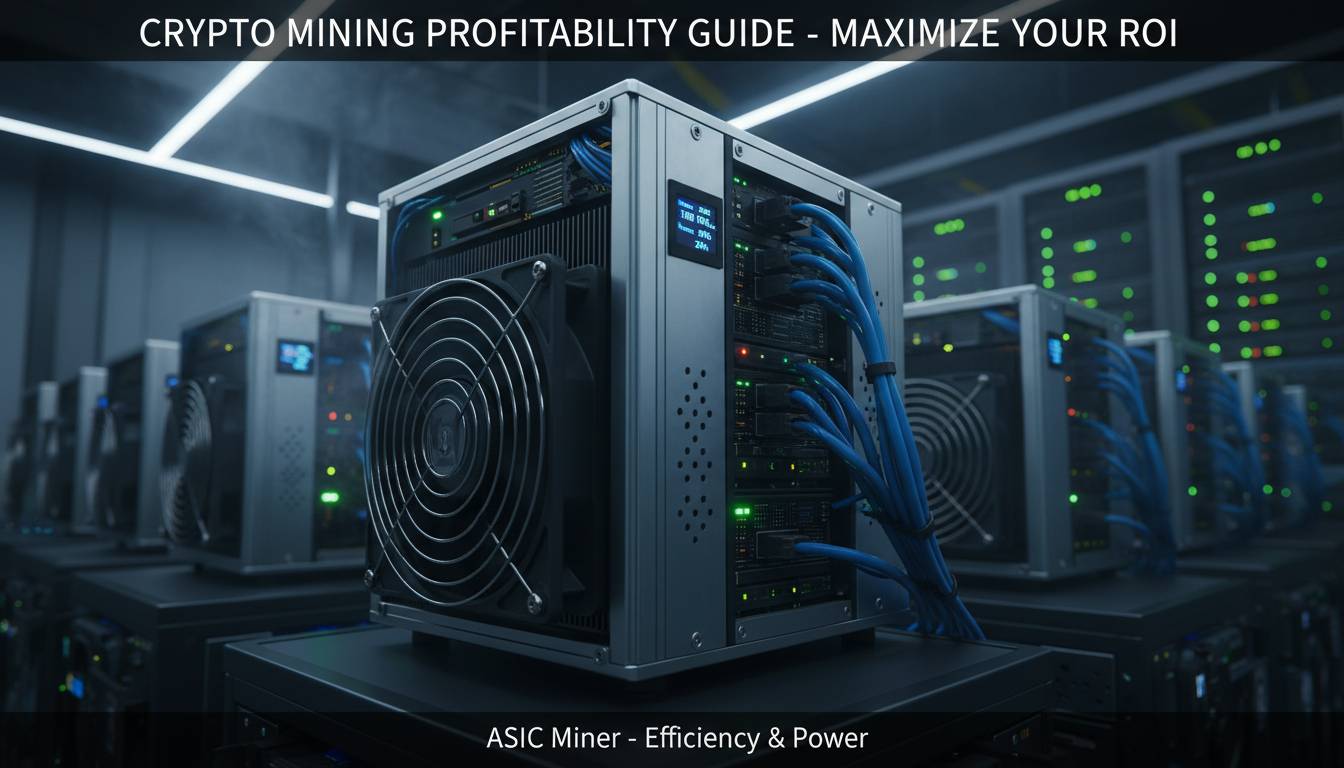
Crypto Mining Profitability Guide – Maximize Your ROI
Crypto mining profitability remains one of the most dynamic and contested topics in the cryptocurrency ecosystem. With Bitcoin’s hashrate reaching historic highs in 2024 and mining difficulty consistently climbing, understanding the true economics of proof-of-work mining has never been more critical for prospective and current miners alike.
This guide breaks down the real numbers behind crypto mining profitability, examines the factors that determine success, and provides actionable strategies to maximize your return on investment in an increasingly competitive landscape.
The Economics of Crypto Mining in 2024
Key Insights
– Bitcoin mining difficulty hit an all-time high of 82.05 trillion in March 2024
– Average electricity cost accounts for 60-80% of total mining operational expenses
– Mining farm profitability varies by 40-60% based on geographic location alone
– The average time to mine one Bitcoin with consumer-grade hardware exceeds 3 years
The fundamental economics of crypto mining rest on a straightforward formula: revenue minus costs equals profit. However, the variables within this equation have become increasingly complex. Revenue depends on block rewards (currently 6.25 BTC per block for Bitcoin) plus transaction fees, while costs encompass hardware, electricity, cooling, maintenance, and infrastructure.
For most individual miners, the math has grown increasingly challenging. The Bitcoin network’s total hashrate exceeded 600 exahashes per second (EH/s) in early 2024, meaning competition for block rewards has never been fiercer. Individual miners participating through mining pools now earn fractions of Bitcoin rather than full blocks, and these rewards must cover all operational costs while generating profit.
The landscape differs dramatically for industrial-scale operations. Mining farms in regions with abundant hydroelectric power in Texas, Quebec, and Iceland operate with electricity costs as low as $0.03-0.05 per kilowatt-hour, while home miners in high-cost areas like California or New York may pay $0.20-0.30 per kWh, fundamentally altering the profitability equation.
Hardware Investment: Breaking Down the Numbers
| Hardware Type | Hashrate | Power Consumption | Initial Cost | Best For |
|---|---|---|---|---|
| Antminer S19 XP | 140 TH/s | 3,010W | $3,500-4,000 | Professional mining |
| Antminer S19j Pro | 104 TH/s | 3,052W | $2,800-3,200 | Mid-tier operations |
| Whatsminer M30S+ | 112 TH/s | 3,472W | $2,500-3,000 | Cost-conscious pros |
| RTX 4090 (GPU) | ~120 MH/s | 450W | $1,600-1,800 | Ethereum Classic, Ravencoin |
| ASIC Starter | 50 TH/s | 1,200W | $800-1,200 | Beginners |
Hardware selection fundamentally shapes your profitability trajectory. Application-Specific Integrated Circuits (ASICs) dominate Bitcoin mining due to their specialized architecture, while Graphics Processing Units (GPUs) remain relevant for mining alternative cryptocurrencies.
The Antminer S19 XP, Bitmain’s flagship machine, offers 140 terahashes per second but consumes over 3,000 watts. At $0.10 per kWh electricity—a typical U.S. industrial rate—this machine costs approximately $7.26 daily to operate. At current Bitcoin prices and network difficulty, daily revenue hovers around $10-15 depending on pool performance, yielding $2.50-7.50 daily profit before hardware depreciation.
GPU mining presents a different calculus. The NVIDIA RTX 4090, while expensive, can generate $1.50-3.00 daily mining Ethereum Classic or other profitable altcoins, with significantly lower electricity consumption relative to ASICs. However, GPU mining profitability fluctuates dramatically with token prices, making it higher risk but potentially higher reward.
Electricity Costs: The Make-or-Break Factor
Electricity represents the largest ongoing expense in crypto mining, typically consuming 60-80% of total operational costs. This makes geographic location the single most important profitability factor for any mining operation.
Regional Electricity Cost Comparison (U.S. Average):
| Region | Average $/kWh | Impact on ASIC Profitability |
|---|---|---|
| Texas (west) | $0.04-0.06 | Highly favorable |
| Washington | $0.05-0.07 | Favorable |
| Louisiana | $0.06-0.08 | Favorable |
| National Average | $0.08-0.12 | Moderate |
| California | $0.20-0.30 | Challenging |
| New York | $0.18-0.25 | Challenging |
| Hawaii | $0.30-0.40 | Prohibitive |
Industrial miners increasingly relocate operations based on electricity costs. Texas has attracted massive mining investment due to its combination of abundant renewable energy, deregulated markets allowing competitive pricing, and permissive regulatory environment. The state’s electricity prices can drop below $0.02 per kWh during periods of wind and solar oversupply, creating exceptional profit opportunities.
For home miners, the economics remain tighter but并非不可能. Mining during off-peak hours, utilizing time-of-use rate plans, and participating in demand response programs can reduce effective electricity costs by 20-40%. Some miners operate profitably by mining only during weekend rate reductions or utilizing solar panel installations to offset grid consumption.
Mining Pools: Maximizing Consistent Returns
Solo mining has become virtually impractical for individual operators. With Bitcoin’s network producing approximately 144 blocks daily and millions of miners competing, the statistical probability of an individual miner solving a block approaches zero. Mining pools aggregate computational resources, distributing block rewards proportionally among participants.
Major Mining Pool Comparison:
| Pool | Fee | Payout Method | Notable Features |
|---|---|---|---|
| Foundry USA | 0% | PPLNS | Highest Bitcoin hashrate, U.S.-based |
| AntPool | 0% | FPPS | Zero fees, strong global presence |
| Poolin | 2.5% | FPPS | Excellent reliability, mobile app |
| ViaBTC | 2.0% | PPLNS | Multi-coin support |
| F2Pool | 2.5% | FPPS | Long-established, stable payouts |
Pool selection impacts profitability through fee structures and payout methods. Pay-Per-Last-N-Shares (PPLNS) rewards miners based on their contribution to the most recent shares, incentivizing consistent participation. Full Pay-Per-Share (FPPS) provides more predictable payouts by covering transaction fees as well, typically offering 5-10% higher returns than PPLNS during high-fee periods.
Foundry USA has emerged as the dominant Bitcoin mining pool, particularly after China crackdown migrations. Its 0% fee structure and U.S.-based operations appeal to miners prioritizing reliability and regulatory compliance. However, pool concentration raises network centralization concerns, prompting some miners to distribute hashrate across multiple pools as risk mitigation.
Calculating Your True ROI
Real ROI calculation requires accounting for all expenses across the hardware lifecycle, typically 3-5 years for ASIC equipment before technological obsolescence or failure.
ROI Calculation Framework:
- Total Initial Investment: Hardware cost + shipping + setup equipment (power supplies, cooling, space preparation)
- Annual Operating Costs: Electricity × 24 hours × 365 days + maintenance + internet + facility costs
- Annual Revenue: Average daily mining revenue × 365 days (accounting for difficulty increases)
- Depreciation: Hardware loses approximately 30-50% value annually as newer models release
- Break-Even Point: Initial investment ÷ (daily revenue – daily costs)
Using a mid-tier ASIC like the Antminer S19j Pro:
– Initial cost: $3,000
– Daily electricity: 3,052W × 24 × $0.08/kWh = $5.86
– Daily revenue (2024 average): $8-12
– Daily profit: $2-6
– Break-even timeline: 500-1,500 days (1.4-4 years)
However, this calculation omits critical variables. Bitcoin’s price volatility can double or halve revenue overnight. Difficulty increases—averaging 4-6% monthly in 2024—progressively erode profitability. Hardware failures, though often covered under warranty in the first year, represent additional risk. Electricity rate increases, particularly in regulated markets, can transform profitable operations into money-losing ones within months.
Strategies to Maximize Mining Profitability
Strategy 1: Optimize for Energy Efficiency
The joule per terahash (J/TH) metric measures how efficiently ASICs convert electricity into mining power. Newer machines like the S19 XP achieve 21.5 J/TH, while older S9 models require 95+ J/TH. Upgrading from legacy hardware can reduce electricity costs by 60-70% while maintaining or increasing output.
Strategy 2: Leverage Renewable Energy
Solar and wind installations can reduce or eliminate electricity costs entirely. A 5kW solar system costing $15,000-20,000 can power a single ASIC during daylight hours, potentially reducing effective electricity costs to $0.02-0.04 per kWh when accounting for installation amortization over 25 years.
Strategy 3: Explore Altcoin Opportunities
GPU mining profitable altcoins during Bitcoin-dominant periods can improve overall returns. Kaspa (KAS), Kadena (KDA), and Ravencoin (RVN) have all offered periods of superior profitability compared to Bitcoin mining, though with higher volatility.
Strategy 4: Heat Recovery
ASICs generate substantial waste heat—approximately 95% of consumed energy becomes thermal output. Heating workshops, greenhouses, or water heating systems can effectively reduce net operational costs in colder climates, effectively monetizing wasted energy.
Strategy 5: Tax Optimization
In the United States, miners can potentially deduct equipment costs through Section 179 depreciation, claim business energy credits for renewable installations, and offset mining income with equipment depreciation. Professional tax planning can improve effective ROI by 10-20%.
Future Outlook: Trends Affecting Profitability
The Bitcoin halving scheduled for April 2024 already reshaped mining economics, reducing block rewards from 6.25 to 3.125 BTC. Historical analysis suggests halving events create short-term profitability pressure but often precede price appreciation that eventually exceeds reduced block rewards.
Network difficulty will likely continue its upward trajectory, with industrial miners deploying increasingly sophisticated equipment. The emergence of next-generation 3nm chips from Bitmain and competitors promises 30-40% efficiency improvements, potentially making current-generation equipment obsolete faster than expected.
Regulatory developments pose additional uncertainty. Increased scrutiny on energy consumption could impact mining operations in certain jurisdictions, while clear regulatory frameworks in states like Texas and Wyoming may attract further mining investment.
Frequently Asked Questions
How long does it take to profit from crypto mining?
The break-even period for ASIC mining equipment typically ranges from 12 to 36 months, depending on electricity costs, Bitcoin price, and network difficulty. Home miners using consumer-grade hardware may never reach profitability due to high electricity costs relative to potential revenue.
Is crypto mining still profitable in 2024?
Yes, mining remains profitable for operations with electricity costs below $0.08 per kWh and access to efficient hardware. Industrial mining farms consistently generate profits, while individual profitability depends heavily on specific cost factors and market conditions.
Which cryptocurrency is most profitable to mine?
Bitcoin (BTC) remains the most stable choice for ASIC miners despite lower profit margins. GPU miners may find better short-term profitability in coins like Kaspa, Kadena, or Dogecoin, though these opportunities are typically short-lived and competitive.
Do I need expensive equipment to start mining?
While you can begin mining with consumer hardware like gaming GPUs, profitable mining requires investment in specialized ASIC equipment. Entry-level ASIC miners cost $800-2,000, with professional operations requiring significantly larger capital investments.
How does mining difficulty affect profitability?
Higher difficulty means your hardware solves shares less frequently, reducing your portion of block rewards. Difficulty increases typically require either lower electricity costs, more efficient hardware, or Bitcoin price appreciation to maintain profitability.
Can I mine Bitcoin at home profitably?
Home mining profitability is marginal at best in most U.S. regions. Unless you have access to electricity below $0.05 per kWh, own your property without utility rate increases on the horizon, and can manage heat/noise appropriately, professional mining operations typically outperform home setups.
Conclusion
Crypto mining profitability in 2024 demands strategic thinking beyond simply purchasing hardware and connecting to a pool. Success requires optimizing the entire value chain: efficient hardware selection, favorable electricity arrangements, appropriate pool participation, and realistic ROI expectations accounting for difficulty increases and market volatility.
For those with access to low-cost electricity and capital for proper equipment, mining remains viable as a long-term investment strategy. For others, indirect exposure through mining stocks, cloud mining contracts, or simply holding cryptocurrency may offer superior risk-adjusted returns.
The mining landscape will continue evolving with technological advances and market shifts. Stay informed, calculate your numbers carefully, and approach mining as a business rather than a get-rich-quick venture.