169Views 0Comments
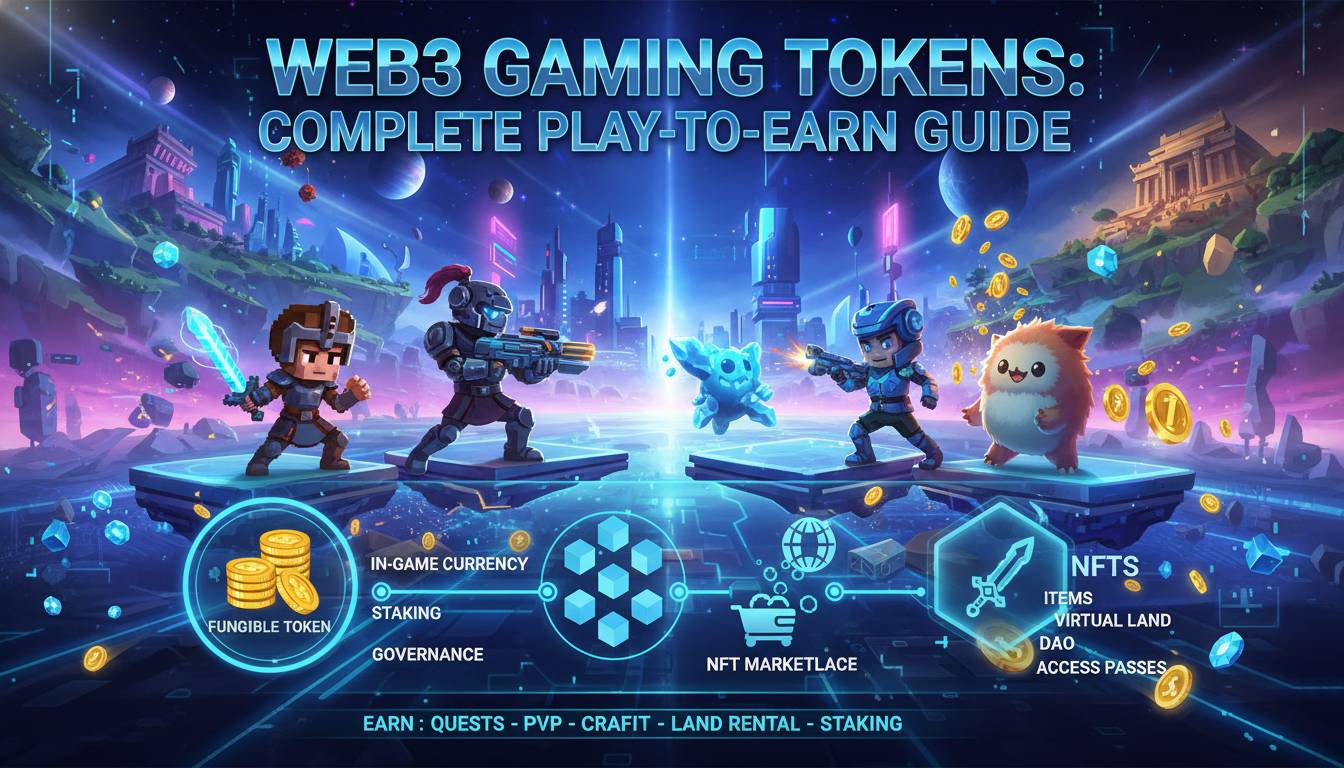
Web3 Gaming Tokens: Complete Play-to-Earn Guide
The global Web3 gaming market reached $2.8 billion in 2023, with over 400 blockchain games actively retaining players, according to DappRadar’s annual report. This explosive growth has transformed how gamers think about virtual economies, creating new opportunities for players to earn real value from their gaming time. Web3 gaming tokens represent this fundamental shift—digital assets that enable true ownership, decentralized economies, and player-driven value creation within video games.
What Are Web3 Gaming Tokens and How Do They Work
Web3 gaming tokens are blockchain-based digital assets designed specifically for use within cryptocurrency-powered video games. Unlike traditional in-game currencies that exist only within a company’s servers and can be revoked at any time, these tokens exist on public blockchains, giving players genuine ownership and the ability to transfer, sell, or trade their virtual assets outside the game’s ecosystem.
The technology foundation rests on smart contracts—self-executing programs deployed on blockchains like Ethereum, Solana, Polygon, or Binance Smart Chain. These contracts automatically govern token creation, distribution, and transactions without requiring traditional intermediaries like banks or payment processors. When you earn tokens through gameplay, the smart contract verifies your achievement and instantly transfers the earned tokens to your crypto wallet.
Two primary token types dominate the Web3 gaming landscape. Game tokens function as the primary in-game currency, used for purchasing items, upgrading characters, or accessing new content. NFTs (Non-Fungible Tokens) represent unique in-game assets such as rare weapons, character skins, land parcels, or collectibles. While game tokens are fungible (each unit equals another), NFTs are one-of-a-kind digital items with verified scarcity and ownership recorded permanently on the blockchain.
The play-to-earn model fundamentally differs from traditional gaming’s pay-to-play or free-to-play paradigms. In conventional games, developers capture all economic value created by player activities—whether through microtransactions, season passes, or expansion content. Web3 gaming tokens redistribute this value, allowing players to earn tokens representing real monetary value that can be converted to fiat currency through cryptocurrency exchanges.
The Economics of Play-to-Earn: Tokenomics Explained
Understanding tokenomics—the economic design of cryptocurrency tokens—proves essential for anyone participating in Web3 gaming. The tokenomics model directly impacts both player earnings potential and a game’s long-term sustainability.
Supply mechanics determine how many tokens will ever exist. Games may implement fixed maximum supplies, creating inherent scarcity that can drive value appreciation as demand increases. Others use inflationary models, continuously minting new tokens to reward active players, though this approach risks devaluation if token generation outpaces organic demand.
Distribution allocations reveal how tokens flow through the ecosystem. Most Web3 games allocate tokens across several categories: player rewards (typically 30-50%), development team (15-25%), treasury for ecosystem growth (10-20%), and investor allocations (10-30%). The player reward percentage—often called the “play-to-earn ratio”—significantly influences how much value players can capture from their gaming activities.
Token utility defines what holders can actually do with their tokens beyond speculation. Strong tokenomics designs create meaningful use cases: staking tokens for governance voting rights, locking tokens to access premium game features, burning tokens (removing them permanently from circulation) to upgrade equipment, or using tokens as collateral in decentralized finance protocols. Games with multiple utility layers tend to maintain value better than those with limited use cases.
The sustainability challenge represents the model’s critical vulnerability. If players primarily earn tokens to immediately sell them for profit rather than reinvesting in the game economy, selling pressure overwhelms demand, causing token prices to collapse. Successful Web3 games create economic loops where earned tokens fuel further gameplay investments, character progression, or community participation, reducing pure speculative selling.
Top Web3 Gaming Tokens by Market Performance
Several tokens have emerged as leaders in the blockchain gaming sector, each with distinct economic models and gameplay offerings.
| Token | Blockchain | Market Cap (2024) | Primary Game |
|---|---|---|---|
| AXS | Ethereum | $1.2B | Axie Infinity |
| SAND | Ethereum | $950M | The Sandbox |
| MANA | Ethereum | $880M | Decentraland |
| GALA | Ethereum | $400M | Gala Games |
| ENJ | Ethereum | $320M | Various NFT gaming |
| IMX | Ethereum | $2.1B | Immutable X ecosystem |
Axie Infinity pioneered the play-to-earn movement, allowing players to earn AXS tokens by battling, completing daily quests, and breeding Axie characters. At its peak in 2021, some players in developing nations earned more than local minimum wages through consistent gameplay, though token value has subsequently declined significantly.
The Sandbox and Decentraland focus on virtual real estate and social experiences rather than traditional gameplay. Players purchase LAND NFTs representing virtual property, then develop experiences or rent space to other creators. Both platforms host virtual events, concerts, and branded experiences from major corporations seeking engagement with Web3-native audiences.
Gala Games takes a different approach, emphasizing node-based governance where token holders run network infrastructure and vote on game development priorities. This decentralized model gives players direct influence over which games receive development resources.
Immutable X functions as a Layer 2 scaling solution specifically designed for NFT gaming, offering gas-free transactions while maintaining Ethereum’s security. The IMX token powers the ecosystem, with games built on the platform distributing IMX rewards to players.
How to Get Started with Web3 Gaming
Entering Web3 gaming requires several technical steps, though platforms increasingly simplify the onboarding process for newcomers.
First, you need a cryptocurrency wallet—the foundation of Web3 identity. MetaMask remains the most widely supported option, available as a browser extension and mobile app. This wallet stores your private keys (essentially your password for accessing crypto assets) and connects to games through Web3 protocols. Setting up MetaMask involves installing the extension, creating a secure password, and carefully recording your seed phrase—a 12 or 24-word phrase that can restore your wallet if you lose access.
Next, you’ll need to acquire cryptocurrency to fund your gaming activities. Most Web3 games require some initial investment, whether purchasing starting characters, upgrading equipment, or covering transaction fees. Major exchanges like Coinbase, Binance, and Kraken allow you to purchase tokens like Ethereum (ETH) or Polygon (MATIC) using traditional payment methods, then transfer them to your wallet.
Understanding gas fees proves critical for managing costs. Every blockchain transaction—including in-game purchases and token transfers—requires fees paid to network validators. Ethereum mainnet fees can range from $1 to $50+ depending on network congestion, while Polygon and other Layer 2 solutions offer transactions for fractions of a cent. Many Web3 games now operate on these lower-cost networks specifically to improve accessibility.
The gameplay loop typically involves completing challenges, winning competitions, or achieving milestones that reward tokens. Earnings vary dramatically based on game popularity, your skill level, time invested, and token market conditions. Some players earn modest supplemental income, while dedicated players in high-yielding games have generated significant returns—though the high-risk nature means many others experience losses.
Risks and Challenges in Web3 Gaming
The Web3 gaming space carries substantial risks that traditional gamers rarely encounter, requiring careful consideration before investing time or money.
Regulatory uncertainty remains the sector’s most significant external risk. Securities classification questions hover over many gaming tokens, with the U.S. Securities and Exchange Commission indicating that tokens offering profit-sharing characteristics may qualify as unregistered securities. Regulatory actions could force exchanges to delist tokens or compel games to restructure their tokenomics, potentially destroying value overnight.
Token volatility far exceeds traditional financial markets. Gaming tokens have experienced 80-95% value declines from all-time highs across the sector. A game that seems profitable in tokens may become unprofitable within weeks if market sentiment shifts. This volatility makes it impossible to predict actual earnings, and players should never invest more than they can afford to lose entirely.
Scams and fraud proliferate in the relatively unregulated Web3 space. Fake airdrops trick users into connecting wallets to malicious sites that drain all assets. Ponzi-scheme games promise unsustainable returns before collapsing. Even legitimate games may have development teams that abandon projects when token prices decline. Researching teams, checking code audits, and understanding token distribution helps mitigate but doesn’t eliminate these risks.
Technical complexity creates barriers that frustrate many users. Lost seed phrases mean permanent asset loss with no recovery options. Signing malicious transactions can empty wallets. Network congestion can prevent timely responses during critical gameplay moments. The learning curve remains steep despite ongoing UX improvements.
Environmental concerns surround proof-of-work blockchains historically used by gaming tokens, though many games now utilize more energy-efficient proof-of-stake networks or Layer 2 scaling solutions.
The Future of Web3 Gaming and Gaming Tokens
The sector continues evolving rapidly, with several emerging trends likely shape its trajectory.
Gaming-focused blockchain infrastructure is improving dramatically. Dedicated gaming chains like Solana, Immutable X, and Ronin offer transaction speeds and costs suitable for real-time gameplay, addressing the latency issues that plagued early Web3 games. As infrastructure matures, games can implement more complex mechanics without sacrificing user experience.
AAA game studios are increasingly entering the space. While early Web3 games often came from small independent teams, major publishers now experiment with blockchain integration. Ubisoft launched Quartz NFTs for Ghost Recon Breakpoint, though the initiative received significant player backlash. Electronic Arts has filed blockchain-related patents. The entry of established developers suggests long-term industry belief in Web3 gaming’s potential, even if initial implementations face resistance.
Mobile-first Web3 gaming targets the largest gaming audience globally. Games optimized for smartphones reduce entry barriers compared to PC or console requirements. This democratization could massively expand the player base beyond current Web3 enthusiasts.
Interoperability standards are developing, allowing assets to move between different games and platforms. Current token standards primarily function within single games, limiting asset utility. Cross-chain bridges and standardized NFT protocols could eventually enable players to use their characters or items across multiple gaming ecosystems.
The sector faces an uncertain but potentially transformative future. Success depends on balancing player value capture with sustainable economic models, improving user experience to match traditional gaming, and navigating regulatory landscapes that remain undefined.
Frequently Asked Questions
Are Web3 gaming tokens legal in the United States?
The legal status remains complex and evolving. The SEC has indicated that many gaming tokens could qualify as securities depending on their specific characteristics, particularly if marketed as investment opportunities with profit expectations. However, playing games and earning tokens for personal entertainment use generally doesn’t trigger securities regulations. Players should consult current regulations and potentially tax professionals, as the IRS treats cryptocurrency earnings as taxable income.
How much money can you realistically earn from play-to-earn gaming?
Earnings vary dramatically and are largely unpredictable. Early Axie Infinity players in the Philippines reported earning $200-1,000 monthly during the 2021 boom, though token value declines reduced these amounts significantly. Most players today earn small amounts—often equivalent to a few dollars daily—or nothing substantial. High earnings typically require significant time investment, initial capital for equipment/characters, and skill in competitive gameplay.
What happens to my tokens if a game shuts down?
Unlike traditional games where server shutdowns eliminate all value, blockchain tokens persist on the network even if developers abandon the game. However, without active gameplay or utility, these tokens typically become worthless. Some games implement buyback mechanisms or community governance to maintain some value, but players should assume complete loss is possible and never invest more than they can afford to lose.
Do I need to be good at gaming to earn tokens?
Requirements vary by game. Some play-to-earn games reward time invested equally to skill, making them accessible to casual players. Others feature competitive leaderboards where skilled players earn disproportionate rewards. Games of chance or NFT flipping don’t require gaming skill at all but involve market speculation risks. Most players should expect to spend considerable time learning game mechanics before generating meaningful earnings.
Are Web3 games safe from hacking and theft?
No—blockchain gaming has experienced significant hacks. The Ronin network (supporting Axie Infinity) suffered a $625 million hack in 2022. Individual wallet security depends entirely on user practices. Never share your seed phrase, verify all transaction details before signing, use hardware wallets for significant holdings, and be extremely cautious about connecting wallets to unfamiliar websites.