243Views 0Comments
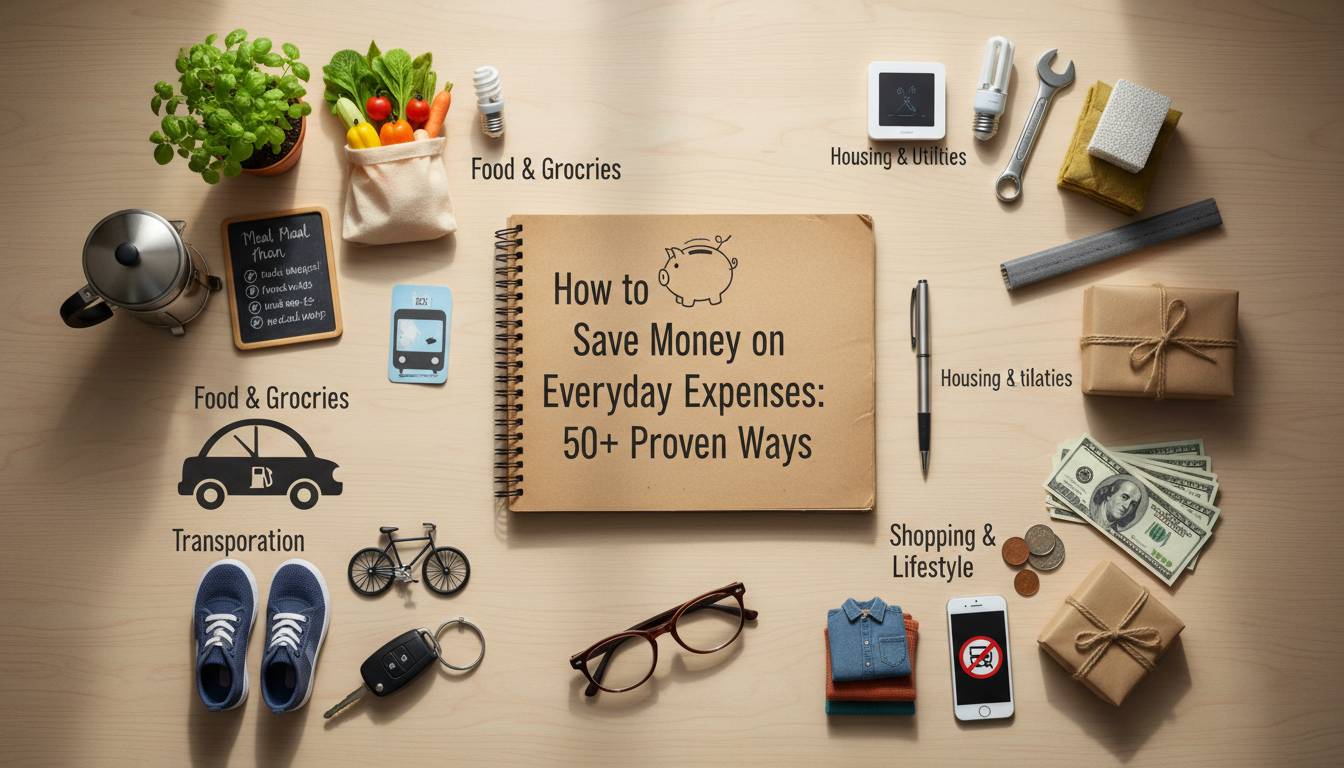
How to Save Money on Everyday Expenses: 50+ Proven Ways
The average American household spends approximately $5,200 monthly on living expenses, with nearly 30% of that money going toward costs that could be reduced or eliminated entirely. Whether you’re trying to build an emergency fund, pay off debt, or simply gain more financial flexibility, mastering everyday savings is the foundation of long-term wealth. This guide provides 50+ actionable strategies across every major expense category, backed by data and practical implementation steps you can start using today.
Why Everyday Expenses Matter More Than You Think
Small savings add up faster than most people realize. A $5 coffee habit purchased five days per week amounts to $100 per month or $1,200 annually. Multiply that across multiple expense categories—groceries, transportation, subscriptions, utilities—and the numbers become staggering. Research from the Bureau of Labor Statistics indicates that housing, food, and transportation combined account for over 60% of average household spending, yet most Americans never actively shop for better rates on these fixed costs.
The key insight is this: your income level matters far less than your savings rate. Someone earning $50,000 annually who saves 20% builds wealth faster than someone earning $100,000 who saves nothing. By targeting everyday expenses strategically, you can potentially redirect 15-25% of your income toward savings without sacrificing quality of life.
Key Insights
– The average household wastes $1,500-$2,500 annually on unused subscriptions alone
– Comparison shopping for insurance can save 20-30% on premiums
– Meal planning reduces grocery spending by an average of 25%
– Small daily habit changes compound into thousands saved per year
Housing: Your Biggest Expense Category
Housing typically consumes 30-35% of take-home pay for most Americans, making it the single most impactful area for savings. Even small percentage reductions translate to hundreds of dollars monthly.
Negotiate Your Rent or Refinance Your Mortgage
If you rent, your landlord may have more flexibility than you expect, especially if you’ve been a reliable tenant. A simple conversation requesting a rate freeze or modest reduction often yields results—property managers would rather retain good tenants than absorb turnover costs. For homeowners, refinancing when interest rates drop by just 0.5% can save $100-200 monthly on a $300,000 loan.
| Strategy | Potential Savings | Best For |
|---|---|---|
| Rent negotiation | $50-200/month | Long-term tenants in competitive markets |
| Mortgage refinancing | $100-300/month | Homeowners with rates 0.5%+ above current market |
| Roommate addition | $400-800/month | Those with extra space |
| Downsizing | $300-1000/month | Households with more space than needed |
Reduce Utility Costs Through Behavioral Changes
Heating and cooling typically account for nearly half of utility bills. Adjusting your thermostat by 2-3 degrees—lower in winter, higher in summer—can reduce costs by 10-15% without significant comfort loss. Installing a smart thermostat optimizes usage automatically, with users reporting savings of $150-200 annually.
Other high-impact strategies include switching to LED bulbs (saving $75-100 per year), unplugging phantom energy devices, and conducting an energy audit through your utility company, which often provides free assessments and rebates for efficiency improvements.
Grocery Savings Without Eating Ramen
Food costs average $300-500 monthly per household, but most families overspend by 25-50% through poor planning and impulse purchases. The good news: you can eat healthier while spending significantly less.
Master the Art of Meal Planning
Planning weekly meals before shopping reduces food waste and prevents expensive impulse purchases. Start by auditing what you currently have, then build shopping lists around sales and seasonal produce. Budget-friendly staples like lentils, beans, eggs, and frozen vegetables provide nutritious foundations while costing under $2 per serving.
📊 RESEARCH FINDINGS
| Strategy | Average Savings | Source |
|———-|—————–|——–|
| Meal planning | 25% on groceries | Journal of Nutrition Education and Behavior, 2022 |
| Shopping sales cycles | 30-40% | USDA Economic Research Service |
| Buying store brands | 20-25% | Consumer Reports |
| Reducing food waste | $400-600/year | EPA estimates |
Strategic Shopping Techniques
Shopping with a full stomach reduces impulse buys by up to 30%, according to food psychology research. Using cashback apps like Ibotta or Fetch Rewards provides 1-5% back on groceries—amounting to $15-25 monthly for average households. Buying in bulk only makes sense for items you genuinely use, and purchasing generic store brands typically offers identical quality at 20-40% lower cost.
Transportation: Breaking the Car Payment Cycle
Transportation costs—including car payments, insurance, fuel, and maintenance—consume 15-20% of household budgets for most families. Yet this category offers substantial savings potential for those willing to adjust habits.
Drive Smarter, Not Less
Fuel efficiency drops significantly during aggressive acceleration and high speeds. Maintaining steady speeds, using cruise control on highways, and ensuring proper tire inflation can improve gas mileage by 10-25%. A 15-gallon tank filled twice monthly sees savings of $20-40 monthly from improved efficiency alone.
Consider whether you truly need multiple vehicles. Families with two cars might explore whether one could be eliminated, saving $300-500 monthly on payment, insurance, fuel, and maintenance. Alternatively, trading a financed vehicle for a reliable used car eliminates monthly payments while keeping transportation capability.
| Vehicle Cost Comparison | Monthly Cost | Annual Cost |
|---|---|---|
| New car with payment | $500-700 | $6,000-8,400 |
| Reliable used car (owned) | $150-250 | $1,800-3,000 |
| One less vehicle | $400-500 saved | $4,800-6,000 saved |
Public Transit and Alternative Transportation
For those living in metro areas, public transit passes often cost less than maintaining a vehicle. Even partial usage—commuting via transit while keeping a car for weekends—reduces annual costs by $2,000-4,000. Biking or walking for trips under three miles eliminates fuel costs entirely while providing health benefits.
Cutting the Subscription Scramble
The average American subscribes to 4-6 streaming services, paying $40-60 monthly for content they rarely watch. Magazine subscriptions, gym memberships, software licenses, and automated renewals quietly drain bank accounts throughout the year.
Conduct a Subscription Audit
Create a list of every recurring charge on your credit card and bank statements. For each subscription, ask: “Did I use this at least once in the past month?” If not, cancel it. The “\$5 coffee” mindset focuses on small purchases, but forgotten subscriptions often represent \$10-30 monthly—amounting to \$120-360 annually per subscription.
Smart Sharing and Rotation Strategies
Many streaming services permit account sharing within households. Families can split costs across platforms rather than each maintaining all services. Another approach involves rotating subscriptions—maintaining one streaming service for three months, then switching to another during the next cycle to access different content libraries without carrying multiple memberships.
Gym memberships present similar opportunities. Unless you use the gym daily, consider switching to pay-per-visit options, working out at home with basic equipment (\$200-300 one-time investment), or using free community resources like park fitness equipment.
Utility Optimization: The Invisible Savings
Beyond behavioral changes, strategic decisions about utility providers and services can reduce monthly bills by 20-30% without any lifestyle changes.
Shop Around for Better Rates
Electricity and natural gas markets in many states allow consumers to choose suppliers. Third-party providers frequently offer introductory rates 10-20% below utility defaults. However, read contract terms carefully—promotional rates often jump significantly after the initial period. Similarly, bundling internet, phone, and television services typically saves \$30-50 monthly versus purchasing separately.
Address Major Inefficiencies
A single leaky faucet dripping one drip per second wastes over 3,000 gallons annually, while a running toilet can waste 200 gallons daily. These hidden costs add \$50-100 annually per leak. Upgrading to low-flow showerheads (\$20-30) saves the average family \$50-100 yearly on water heating costs alone.
Internet service represents a frequently overlooked expense. Promotional rates typically last 12-24 months before jumping \$20-40 monthly. Calling your provider every year or two to negotiate a new promotional rate—or citing competitor offers—often results in retention discounts without changing service.
Healthcare Costs Don’t Have to Break You
Healthcare expenses rank among the most stressful household costs, yet strategic planning can reduce outlays significantly without compromising care quality.
Preventive Care Pays Dividently
Health insurance plans typically cover annual physicals, screenings, and vaccinations at no cost. Taking advantage of these services catches potential issues early when treatment costs less and prevents expensive emergency room visits. Many community health centers offer sliding-scale fees for uninsured individuals, while prescription discount cards like GoodRx reduce medication costs by 30-70%.
HSA and FSA Maximization
For those with high-deductible health plans, Health Savings Accounts provide triple tax advantages—tax-free contributions, growth, and withdrawals for medical expenses. Even contributions that go unused accumulate for future years or become investment funds. Flexible Spending Accounts offer similar benefits for shorter timeframes, though funds typically expire annually.
👤 Dr. Sarah Chen, Chief Medical Officer at HealthFirst Direct
“Patients who engage in preventive care and compare prescription prices at different pharmacies often reduce their out-of-pocket costs by 40-60% without compromising care quality. The system is imperfect, but informed consumers have significant leverage.”
The Psychology of Saving: Mindset Shifts That Last
Technical strategies fail without behavioral changes. Long-term savings success requires mindset shifts that transform money management from deprivation to empowerment.
Automate Everything
Pay yourself first by automating savings contributions. Setting up automatic transfers to savings accounts on payday ensures consistent saving regardless of month-end spending behavior. The goal: treat savings like a bill that must be paid. Starting with even \$25-50 weekly builds momentum, and most people adjust quickly to living on slightly less than they thought possible.
Implement the 24-Hour Rule
Before any non-essential purchase over \$20, wait 24 hours. This cooling-off period dramatically reduces impulse buying. Most “must-have” items lose their urgency after a day, and the resulting savings compound significantly. One client reported saving \$3,400 annually simply by implementing this rule for six months.
Track Every Dollar
Awareness precedes action. Using apps like Mint, YNAB, or even simple spreadsheets to track spending reveals patterns and waste that would otherwise go unnoticed. Knowledge empowers better decisions—and seeing exactly where money goes motivates behavioral change far more effectively than abstract financial goals.
Frequently Asked Questions
What’s the single most effective way to save money on everyday expenses?
The most impactful strategy is conducting a comprehensive audit of all recurring expenses—subscriptions, insurance, utilities, and housing costs—and systematically negotiating or switching providers for each. This requires minimal ongoing effort while typically saving 15-25% of total expenses. Most people find \$200-500 monthly in savings through this approach alone.
How much can the average household realistically save annually?
Most households can save \$3,000-\$8,000 annually through the strategies outlined in this guide without significant lifestyle changes. Those willing to make moderate adjustments—like meal planning, eliminating one vehicle, or downsizing housing—can save \$10,000-20,000 annually. The range depends largely on current spending habits and willingness to optimize.
Should I focus on cutting expenses or increasing income?
Both matter, but cutting expenses typically provides more immediate and reliable results. Unlike income increases (which may require significant time, education, or career changes), expense reductions begin working immediately and don’t require additional work hours. Ideally, pursue both simultaneously—direct any income increases straight to savings rather than lifestyle expansion.
How long does it take to see meaningful savings?
Most strategies produce results within the first month. Subscription cancellations take effect immediately, utility negotiations yield savings on the next bill, and grocery shopping changes show impact at checkout. Behavioral changes like automated savings take 2-3 months to feel normal, but the savings compound from day one.
What’s the biggest mistake people make when trying to save money?
The most common mistake is attempting too many changes simultaneously, leading to burnout and abandonment. Successful savers focus on implementing 2-3 strategies at a time, building habits before adding more. Another significant error is focusing only on small purchases (\$5 coffees) while ignoring major expenses where savings potential is far greater.
How do I stay motivated to save money long-term?
Connect savings to meaningful goals—whether that’s financial independence, security for your family, or specific life experiences. Regularly review progress and celebrate milestones. Automating savings removes willpower from the equation entirely. Surround yourself with like-minded individuals or communities who support financial goals rather than criticizing sacrifice.
Conclusion
Saving money on everyday expenses isn’t about deprivation—it’s about intentionality. Every dollar you redirect from unnecessary costs toward savings or debt payment compounds into freedom, security, and choice. Start with the strategies requiring the least behavior change: audit your subscriptions, negotiate one bill, or automate your savings this week. Small actions create momentum, and momentum creates lasting change. The path to financial independence begins with recognizing that you control far more of your expenses than you likely realized—and taking that first step today.