158Views 0Comments
Index Funds vs ETFs: Key Differences Beginners Must Know
If you’re new to investing, you’ve likely encountered both index funds and ETFs as recommended options for building long-term wealth. Both offer low-cost ways to own a diversified portfolio that tracks broad market indices, but they work differently—and those differences matter for your wallet, your taxes, and your peace of mind. Understanding these distinctions helps you choose the right tool for your financial goals without getting overwhelmed by complexity.
The good news is that both index funds and ETFs are excellent choices for beginners. Research from Vanguard shows that index investing consistently outperforms actively managed funds over time, with 92% of large-cap active funds underperforming the S&P 500 over a 20-year period . Whether you choose an index fund or ETF, you’re positioning yourself on the winning side of the investment equation. The key is knowing which format serves your specific needs.
| What | Why | Result |
|---|---|---|
| Index Funds | Passive management, low turnover | Lower costs, tax efficiency |
| ETFs | Real-time trading, flexibility | More control, instant pricing |
Key Insights
– Both index funds and ETFs track the same market indices with minimal fees
– ETFs offer intraday trading; index funds trade once per day at closing price
– Index funds typically have higher minimum investment requirements
– ETFs generally offer superior tax efficiency due to their unique structure
– Both are ideal for long-term investors seeking broad market exposure
What Are Index Funds?
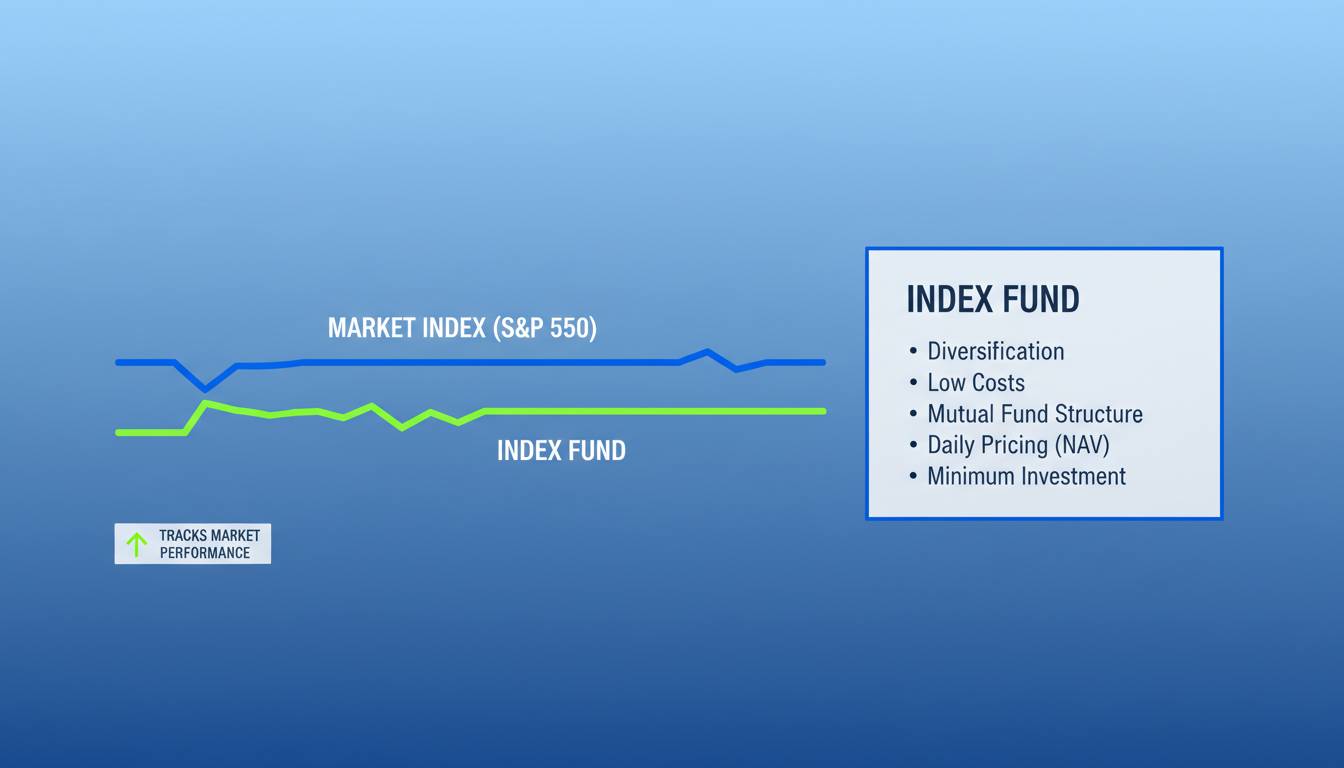
An index fund is a type of mutual fund designed to track a specific market index, such as the S&P 500, the total stock market, or the Bloomberg Aggregate Bond Index. The fund manager’s job is not to pick winning stocks but simply to hold the same securities in the same proportions as the target index. This “passive” approach keeps costs extremely low, which is the primary advantage of index funds.
When you buy shares of an index fund, you’re purchasing a tiny slice of hundreds or thousands of companies. If the index goes up over time, your investment grows. If the index declines, your investment loses value. There’s no illusion of outperformance through stock picking—the fund delivers exactly what the market provides, minus a small fee.
How Index Funds Work
Index funds operate as mutual funds, which means all investor money pools together. When you place a trade to buy or sell, it executes at the fund’s net asset value (NAV), which calculates once per day after the market closes. This single daily price is a key characteristic distinguishing index funds from ETFs.
For example, if you invest $5,000 in a total stock market index fund, your money combines with other investors’ capital. The fund uses this pooled money to purchase small pieces of every company in the index—perhaps 4,000+ stocks for the total US market fund. You own a proportional slice of everything. When Apple does well, your investment benefits. When Amazon struggles, your investment feels it. The collective performance determines your returns.
Types of Index Funds
Index funds come in several varieties serving different investment objectives:
- Total stock market funds – Own nearly every publicly traded US company
- S&P 500 funds – Track the 500 largest US companies
- International funds – Hold stocks from countries outside the US
- Bond funds – Track indexes of government and corporate bonds
- Sector funds – Focus on specific industries like healthcare or technology
This variety lets you build a complete portfolio using only index funds, achieving broad diversification with minimal effort.
What Are ETFs?
An exchange-traded fund (ETF) is a basket of securities that trades on a stock exchange just like individual stocks. When you buy an ETF, you’re purchasing a collection of stocks, bonds, or other assets that you can trade throughout the day during market hours. The first ETF launched in 1993 (SPY, tracking the S&P 500), and the industry has grown to over $8 trillion in assets under management .
ETFs share the same passive philosophy as index funds—they aim to track an index rather than beat it. However, their structure differs fundamentally. While an index fund is a mutual fund that issues shares directly to investors, an ETF is a fund that lists shares on an exchange. This structural difference enables several important features.
How ETFs Work
ETFs use a creation and redemption mechanism involving authorized participants (typically large financial institutions). When demand pushes an ETF’s price above its underlying value, authorized participants create new ETF shares by delivering the actual securities to the ETF sponsor. When demand pushes price below value, they redeem shares for the underlying securities. This process keeps ETF prices closely aligned with their fair value.
Because ETFs trade on exchanges, their price fluctuates continuously throughout the trading day. You can place limit orders, stop-loss orders, and other advanced trade types. You can also see your order fill immediately—there’s no waiting until market close to know your execution price.
Types of ETFs
The ETF universe spans numerous categories:
- Stock ETFs – Track domestic or international equity indices
- Bond ETFs – Follow fixed-income indices
- Sector ETFs – Focus on specific industries or sectors
- Commodity ETFs – Track gold, oil, agricultural products
- Currency ETFs – Follow foreign exchange rates
- Inverse ETFs – Move opposite to their tracked index
- Leveraged ETFs – Use derivatives to amplify index returns
This diversity makes ETFs incredibly versatile for implementing various investment strategies.
Key Differences Between Index Funds and ETFs
Understanding the structural differences between these two investment vehicles helps you choose appropriately. While both serve similar investment purposes, their operational mechanics create distinct advantages and limitations.
Trading Mechanism
The most fundamental difference lies in how you buy and sell them. Index funds execute only once daily—at the closing net asset value—because they’re mutual funds. You submit your order, and it processes when the market closes. ETFs trade continuously throughout the day like stocks, with prices updating second-by-second.
This distinction affects flexibility. Suppose you have $1,000 to invest and want to put it to work immediately. With an ETF, your money becomes invested the moment your trade executes—potentially within seconds. With an index fund, you must wait until market close, and your actual purchase price remains unknown until then.
Price Discovery
ETFs benefit from continuous price discovery. Throughout the trading day, supply and demand determine the ETF’s price, which should closely track the underlying index’s value. If prices diverge significantly, arbitrageurs step in to profit from the discrepancy, keeping prices aligned.
Index funds calculate their price only once daily. The NAV you see at market close represents the weighted average of all underlying securities at that moment. While this eliminates intraday price volatility, it also means you can’t react to sudden market movements until the next trading day.
| Feature | Index Funds | ETFs |
|---|---|---|
| Trading frequency | Once daily | Intraday (continuous) |
| Price determination | NAV at close | Market price throughout day |
| Order types | Market, limit | All stock order types |
| Trade timing | End of day | Any time during market hours |
Cost Comparison: Fees and Expenses
Investment costs significantly impact long-term returns. Even small fee differences compound dramatically over decades of investing. Both index funds and ETFs are known for low costs, but subtle differences exist.
Expense Ratios
The expense ratio represents the annual fee as a percentage of your investment. It covers the fund’s operating expenses, including management fees, administrative costs, and custodial fees. Index funds and ETFs tracking the same index typically have nearly identical expense ratios.
For a standard S&P 500 fund, you might pay 0.03% to 0.05% annually—meaning $3 to $5 per $10,000 invested. Total market funds often cost slightly more, around 0.03% to 0.07%. These tiny percentages translate to remarkably low dollar costs. Over 30 years, a 0.04% difference might cost you roughly $3,000 on a $100,000 portfolio—a meaningful but not devastating amount.
Transaction Costs
ETFs may incur commission fees depending on your brokerage. Many brokers now offer commission-free ETF trading, making this consideration less important for most investors. Index funds purchased directly from the fund company often have no transaction fees, though some brokerages charge for mutual fund trades.
However, index funds may have redemption fees if you sell quickly—these typically apply only if you sell before holding the position for a short period, such as 30 or 90 days. ETFs don’t impose such restrictions because they trade like stocks.
Hidden Costs
The real cost difference emerges in the bid-ask spread—the difference between what buyers pay and sellers receive. Every trade involves this spread, which represents a small implicit cost. For highly liquid ETFs tracking popular indices, spreads are minimal (pennies per share). For less-traded ETFs, spreads can widen meaningfully.
Index funds avoid bid-ask spreads entirely since you trade at the NAV. For investors placing large orders or trading infrequently, this difference rarely matters. For active traders, ETF flexibility might justify accepting tiny spreads.
Trading Flexibility: When You Can Buy and Sell
Your personal circumstances and investing style influence which trading mechanism matters most.
Intraday Trading Capability
ETFs let you react to market events in real time. If markets plunge 3% in a single day, you can buy more shares at lower prices immediately. If you need cash urgently, you can sell at the current market price rather than waiting for the close. This flexibility appeals to investors who want control over their execution timing.
Index funds require patience. Your trade sits until market close, and the price you receive depends on that day’s final trading. This limitation rarely matters for long-term investors who ignore daily market noise. But if you invest regularly through dollar-cost averaging, the timing difference is irrelevant—you’re buying consistently regardless of daily fluctuations.
Limit Orders and Stop Losses
Experienced investors appreciate ETF capabilities for managing entries and exits. You can set limit orders to buy only at your desired price, protecting yourself from overpaying during volatile periods. Stop-loss orders automatically sell if prices fall to a specified level, limiting potential losses.
Index funds don’t support these order types. You receive whatever price the NAV provides at close. For buy-and-hold investors, this limitation poses no problem. For those wanting precise control, ETFs provide meaningful advantages.
Fractional Shares
Both index funds and ETFs now offer fractional share investing through most major brokerages. You can invest $100 in a fund with a $300 share price, owning one-third of a share. This accessibility democratizes investing, allowing you to put every dollar to work immediately regardless of share prices.
Tax Efficiency: Which Is Better for Your Taxes?
Tax efficiency matters enormously in taxable brokerage accounts. The difference between tax-efficient and tax-inefficient investments can cost you thousands of dollars over your investing lifetime.
How ETFs Generate Tax Efficiency
ETFs enjoy a structural tax advantage called “in-kind” creation and redemption. When authorized participants exchange securities for ETF shares (or vice versa), they transfer securities rather than cash. This in-kind transfer means the ETF rarely needs to sell securities to meet investor redemptions, avoiding capital gains distributions.
Because ETFs trade on exchanges like stocks, they’re also subject to capital gains taxes only when you sell shares at a profit. The fund itself rarely distributes capital gains to shareholders. This explains why many ETFs have never distributed capital gains—investors pay taxes only on their own trading decisions.
Index Fund Tax Treatment
Index funds, as mutual funds, must distribute capital gains annually to shareholders when the fund sells securities. Even if you didn’t sell your shares, you might owe taxes on distributions representing gains the fund realized. This “hidden” tax occurs regardless of your intentions.
However, index funds have extremely low turnover since they rarely trade. The index composition changes slowly, so capital gains distributions remain minimal or nonexistent. Most index fund shareholders never receive significant distributions, making this concern largely theoretical for long-term buy-and-hold investors.
| Tax Feature | Index Funds | ETFs |
|---|---|---|
| Annual capital gains distributions | Possible | Rare |
| Tax efficiency for buy-and-hold | High | Very high |
| Control over tax timing | Limited | Full |
For tax-advantaged retirement accounts like IRAs and 401(k)s, tax efficiency differences don’t matter—these accounts shield your investments from annual tax consequences. Focus tax-efficiency optimization on taxable brokerage accounts where you directly control the timing of gains and losses.
Minimum Investment Requirements
Your starting capital influences which investment type works better for your situation.
Index Fund Minimums
Traditional index funds often require minimum investments ranging from $1,000 to $10,000, though some have no minimum or allow small initial purchases. Vanguard’s Admiral Shares typically require $3,000 minimum, while their mutual fund share classes might require less. Many brokers offer their own index funds with minimal or no minimums.
These requirements can seem daunting for new investors just starting with a few hundred dollars. However, fractional share availability and low-cost ETF options have largely eliminated this barrier.
ETF Minimums
ETFs have no minimum investment beyond the price of a single share (and fractional shares eliminate even this limitation). If an S&P 500 ETF trades at $450 per share and you have $100 to invest, you can buy 0.22 shares through most modern brokerages.
This accessibility makes ETFs particularly attractive for beginners investing small amounts. You can start with $50 or $100 and build gradually without hitting minimums.
Which Should You Choose?
Your individual circumstances determine the optimal choice. Consider these factors when deciding.
Choose Index Funds If:
You want simplicity and don’t mind trading at market close. Index funds work well for investors who set up automatic monthly investments and ignore their portfolios for years. The once-daily pricing feels irrelevant when you’re holding for decades. Many investors appreciate the “set and forget” nature—no temptation to check prices constantly.
Choose ETFs If:
You want trading flexibility and tax control. ETFs suit investors who value the ability to trade intraday, use advanced order types, or potentially act on market opportunities. If you’re investing smaller amounts and want fractional shares, ETFs offer easier access.
The Hybrid Approach
Many investors use both. You might hold index funds in retirement accounts where tax efficiency matters less and trade ETFs in taxable accounts where you want maximum control. Others simply choose one and stick with it consistently—either approach works well.
Common Mistakes to Avoid
Beginners often make these errors when choosing between index funds and ETFs.
Mistake #1: Obsessing Over Minor Fee Differences
Worrying about a 0.01% expense ratio difference while ignoring your own behavior costs more. Whether you choose an index fund or ETF, your asset allocation, contribution consistency, and emotional discipline matter far more than tiny fee variations.
Mistake #2: Chasing Flexibility You Never Use
ETFs offer intraday trading, but most investors don’t benefit from checking prices daily. If you’re a long-term investor, the “flexibility” of ETFs becomes irrelevant. You’re paying for capability you won’t exercise.
Mistake #3: Ignoring Asset Location
Where you hold investments matters as much as what you hold. Holding ETFs in taxable accounts maximizes their tax advantages. Holding index funds in IRAs eliminates tax-efficiency concerns. Asset location strategy often matters more than the fund type itself.
Mistake #4: Overcomplicating Your Portfolio
Both index funds and ETFs let you build diversified portfolios with just a few holdings. Resist the temptation to own dozens of funds “for diversification.” More holdings don’t necessarily mean better diversification, and they increase complexity without improving returns.
Frequently Asked Questions
Can I hold both index funds and ETFs in the same portfolio?
Absolutely. Many investors use both vehicles depending on the account type and specific investment goals. For example, you might use index funds in your 401(k) where your plan offers limited options, and ETFs in your IRA where you want maximum flexibility. There’s no rule requiring you to choose only one.
Do index funds or ETFs perform better historically?
Both track the same indices, so their performance is nearly identical before fees. After fees, the difference remains negligible for most index-tracking products. The performance question is really about which index you choose, not whether you choose an index fund or ETF structure.
Are index funds safer than ETFs?
Safety depends on what you’re invested in, not the fund structure. An S&P 500 index fund and an S&P 500 ETF holding the same stocks carry identical risk—you’re exposed to the same market movements. The difference lies in trading mechanics and tax treatment, not underlying risk.
Which is better for beginners with little money to invest?
ETFs generally work better for beginners with small amounts because they allow fractional shares without minimum investment requirements. You can start investing with $50 or less through most brokerages. However, many index funds now offer low or no minimums as well.
Can I convert index funds to ETFs without tax consequences?
Some fund families offer conversion privileges between mutual fund and ETF share classes of the same strategy. These in-kind conversions typically don’t trigger taxable events. However, not all providers offer this option, so check with your specific fund company if this matters to you.
How do I decide between different index funds or ETFs tracking the same index?
Focus on expense ratios first—lower is better. Then consider whether the fund is available at your brokerage without transaction fees. For taxable accounts, look at the fund’s tax efficiency history, though this rarely differs meaningfully among index trackers. Finally, ensure the fund has sufficient assets and trading volume.
Conclusion
Both index funds and ETFs represent brilliant innovations that democratize investing for ordinary people. They offer low costs, broad diversification, and simplicity—everything beginners need to build wealth over time. The differences between them matter, but they’re differences of mechanics and preference, not fundamental quality.
For most long-term investors, the choice comes down to personal preference and convenience. If you value simplicity and automatic investing, index funds work beautifully. If you want trading flexibility and tax control, ETFs might suit you better. Many successful investors use both.
What truly matters is that you start investing, stay consistent, and keep costs low regardless of which vehicle you choose. The index fund versus ETF debate is far less important than actually being in the market, contributing regularly, and maintaining discipline through market ups and downs. Start where you are, use what you have, and build your financial future one contribution at a time.