225Views 0Comments
Bitcoin Halving Impact on Price: What Investors Need to Know
The Bitcoin halving represents one of the most anticipated events in the cryptocurrency market, occurring approximately every four years when the reward for mining new Bitcoin blocks is cut in half. This programmed scarcity mechanism has historically preceded significant price movements, making it a focal point for investors, traders, and market analysts. Understanding how Bitcoin halving impacts price requires examining both the fundamental economics of supply reduction and the psychological dynamics that drive market behavior during these pivotal moments.
Understanding the Bitcoin Halving Mechanism
Bitcoin operates on a deflationary model built into its source code by creator Satoshi Nakamoto. The network produces new Bitcoin through mining, where computers compete to solve complex mathematical puzzles and add new blocks to the blockchain. When Bitcoin launched in 2009, miners received 50 BTC per block. The halving event automatically reduces this reward by 50% according to a predetermined schedule hardcoded into the protocol.
The halving occurs approximately every 210,000 blocks, which translates to roughly four years based on the average block time of ten minutes. This mechanism continues until the total supply reaches 21 million BTC, which mathematicians estimate will occur around the year 2140. At that point, no new Bitcoin will enter circulation, making the cryptocurrency theoretically deflationary against inflationary fiat currencies.
The purpose behind this design was to create controlled scarcity that would theoretically increase value over time as demand grew. Unlike central banks that can print money at will, Bitcoin’s monetary policy is transparent and predictable. Every participant in the network knows exactly when halvings occur and can factor this information into their investment decisions. This predictability stands in stark contrast to traditional financial markets, where monetary policy decisions often come as surprises.
Historical Price Performance Around Halving Events
Examining past Bitcoin halvings reveals a consistent pattern of price appreciation in the months and years following each event, though the magnitude and timing have varied significantly.
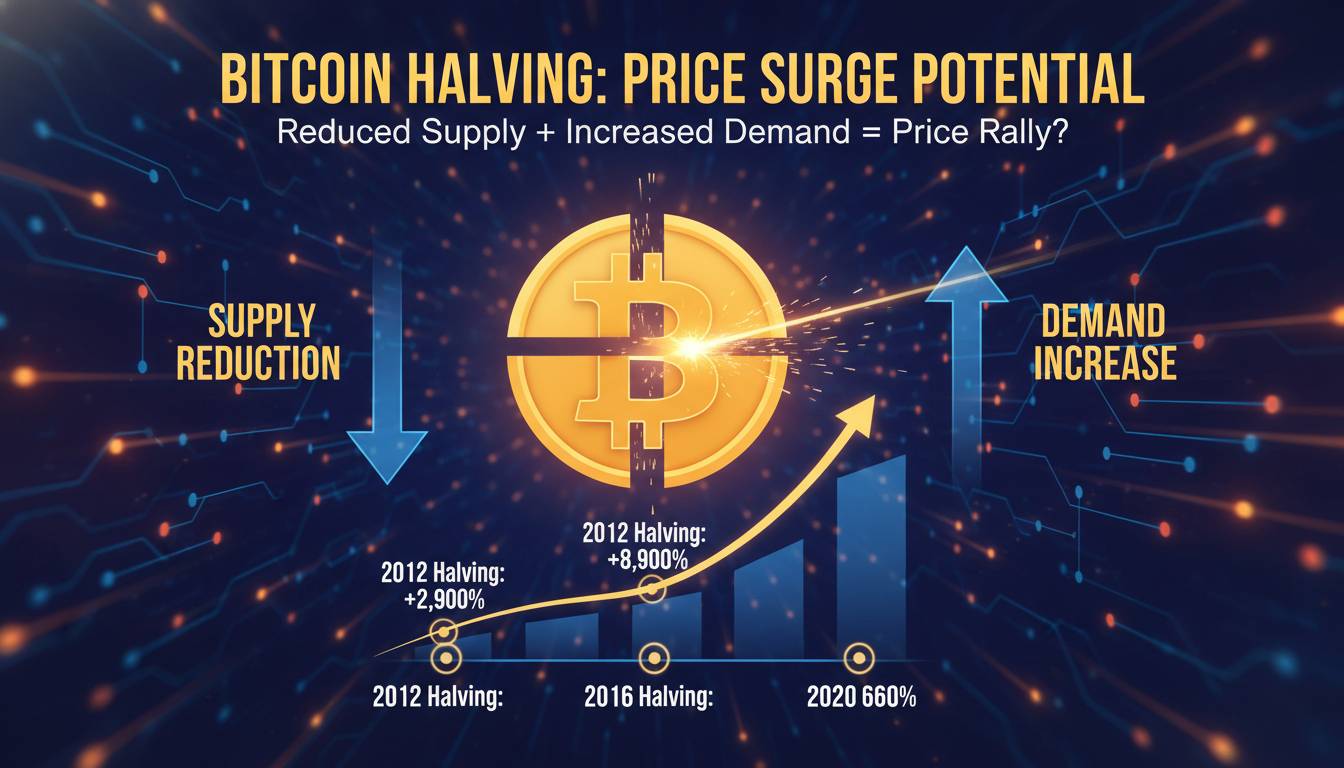
The 2012 Halving: On November 28, 2012, the block reward decreased from 50 BTC to 25 BTC. In the months leading up to this event, Bitcoin traded at relatively modest levels, around $10-15. Following the halving, the price began a steady ascent that accelerated dramatically in late 2013, when Bitcoin reached nearly $1,100 at its peak. This represented an extraordinary return for early investors who had accumulated Bitcoin in the years prior.
The 2016 Halving: The second halving occurred on July 9, 2016, reducing the block reward from 25 BTC to 12.5 BTC. Bitcoin was trading at approximately $650 at the time of the halving. The subsequent price action proved remarkable, with Bitcoin surpassing $19,000 in December 2017—a gain of nearly 3,000% from the halving price. While this bull run eventually corrected substantially, it demonstrated the powerful upward momentum that can follow halving events.
The 2020 Halving: The most recent halving happened on May 11, 2020, during the COVID-19 pandemic, when the block reward dropped from 12.5 BTC to 6.25 BTC. Bitcoin was trading around $9,000 at the time. The price subsequently surged to new all-time highs, surpassing $64,000 in April 2021. This bull market was characterized by unprecedented institutional adoption, with major corporations and investment funds allocating portions of their portfolios to Bitcoin.
While these historical patterns are compelling, investors should note that past performance does not guarantee future results. Each halving occurred within different macroeconomic contexts, regulatory environments, and market maturity levels.
The Supply and Demand Economics
The fundamental economic argument for Bitcoin price appreciation following halvings rests on basic supply and demand principles. When the block reward is reduced, the rate of new Bitcoin entering circulation decreases by 50%. This effectively slows the inflation rate of Bitcoin’s money supply, creating what economists call a supply shock.
If demand remains constant or grows while supply growth slows, the equilibrium price must rise to balance the market. Bitcoin advocates argue that increasing adoption and awareness will continue driving demand higher over time, while the decreasing emission rate creates structural upward pressure on prices.
However, the relationship between supply reduction and price is not instantaneous or mechanical. Markets are forward-looking, meaning participants often price in anticipated supply changes before the actual halving occurs. This phenomenon helps explain why Bitcoin sometimes begins appreciating well before the halving date, as traders position themselves for expected future gains.
The stock-to-flow model, popular among Bitcoin analysts, attempts to quantify the relationship between existing supply and new production. This model compares Bitcoin’s stock (existing supply) to its flow (annual new production), arguing that higher ratios correlate with higher prices. Critics of this model point out that it has failed to accurately predict price movements during bear markets and may oversimplify complex market dynamics.
Market Psychology and Sentiment Dynamics
Beyond fundamental economics, halving events trigger powerful psychological responses that influence price movements. The narrative surrounding Bitcoin halvings has become deeply embedded in market culture, with participants anticipating scarcity-driven price increases.
This anticipation creates self-fulfilling prophecy dynamics. As more investors buy Bitcoin in expectation of post-halving price increases, their collective demand pushes prices higher. This phenomenon, known as “buy the rumor, sell the news,” often results in significant price volatility around the actual halving date as traders who positioned early take profits.
Market sentiment indicators consistently show heightened optimism and speculative activity in the months surrounding halvings. Social media engagement, search trends, and trading volumes typically spike as mainstream attention turns to Bitcoin. This increased attention can attract new participants to the market, further amplifying demand.
Conversely, some analysts argue that the halving is already “priced in” by the time it occurs, meaning that rational market participants have already adjusted their positions based on the known schedule. This perspective suggests that significant price movements more than a year before or after the halving may have already captured the anticipated supply shock.
Institutional Adoption and Market Maturation
The 2024 halving marked a significant shift in Bitcoin’s market structure compared to previous events. Institutional investors now play a substantial role in price discovery and market dynamics, a development that fundamentally changes how halving impacts may manifest.
The approval of Bitcoin exchange-traded funds (ETFs) in early 2024 opened cryptocurrency exposure to mainstream investors through traditional brokerage accounts. This regulatory development brought billions of dollars in institutional capital into the market, creating new demand channels that did not exist during previous halvings.
Investment firms including BlackRock, Fidelity, and numerous hedge funds have allocated capital to Bitcoin as part of diversified portfolio strategies. This institutional involvement brings greater liquidity, more sophisticated trading strategies, and potentially reduced volatility over time. However, it also means that Bitcoin’s price movements may increasingly correlate with broader market conditions and macroeconomic factors.
The maturation of the Bitcoin derivatives market has also changed the landscape. Futures contracts, options, and other financial instruments allow investors to hedge exposure or speculate on price movements without holding the underlying asset. These tools can amplify both gains and losses, potentially increasing volatility around halving events.
What Investors Should Consider
For investors evaluating Bitcoin in the context of halving events, several practical considerations merit attention. First, understanding your investment time horizon is essential. While historical data suggests long-term appreciation following halvings, short-term price movements remain highly unpredictable and can be extremely volatile.
Dollar-cost averaging represents a strategy many investors use to navigate Bitcoin’s volatility. By spreading purchases across regular intervals regardless of price, investors can reduce the impact of short-term fluctuations and accumulate Bitcoin over time. This approach removes the pressure of timing the market precisely around halving events.
Portfolio allocation should reflect individual risk tolerance and investment objectives. Financial advisors typically recommend that investors allocate only a small percentage of their portfolio to volatile assets like Bitcoin, ensuring that potential losses would not significantly impact their financial security.
Security considerations remain paramount for Bitcoin holders. Hardware wallets provide the safest storage option for significant holdings, protecting against exchange hacks and digital theft. Understanding the distinction between holding your own keys versus leaving Bitcoin on an exchange is crucial for any investor.
Regulatory developments continue to shape Bitcoin’s investment landscape. Different jurisdictions have adopted varying approaches to cryptocurrency regulation, and future policy changes could significantly impact Bitcoin’s utility and value. Staying informed about regulatory discussions in major markets helps investors anticipate potential headwinds or tailwinds.
The Road Ahead: Future Halvings and Market Evolution
Looking forward, Bitcoin will experience approximately 32 more halving events before reaching its 21 million coin cap. Each event will continue reducing the new supply rate, theoretically making existing Bitcoin more scarce relative to growing demand.
The macroeconomic environment surrounding future halvings remains uncertain. Factors including global monetary policy, economic stability, technological developments, and competitive cryptocurrency projects will all influence Bitcoin’s trajectory. Investors should approach future halvings with an understanding that while historical patterns provide context, they do not guarantee similar outcomes.
The integration of Bitcoin into traditional financial systems appears likely to continue, with more institutional products, payment options, and regulatory frameworks developing over time. This maturation may gradually reduce the extreme volatility that has characterized Bitcoin’s history, potentially making it more suitable for mainstream investment portfolios.
Frequently Asked Questions
Does Bitcoin always go up after a halving?
Historically, Bitcoin has reached new all-time highs following each halving event, but this pattern does not guarantee future results. The timing and magnitude of price appreciation have varied significantly, with periods of consolidation and correction occurring between initial movements and ultimate peaks. Investors should be prepared for volatility and avoid assuming automatic gains.
How far in advance should I buy Bitcoin before a halving?
There is no optimal time to purchase Bitcoin relative to halving events. Some traders attempt to buy months or years before anticipated halvings to capture potential appreciation, while others prefer to buy gradually over time through dollar-cost averaging. Trying to time the market precisely around specific dates is notoriously difficult and carries significant risk.
Will the 2024 halving cause Bitcoin to reach $100,000 or more?
Price predictions for Bitcoin are highly speculative and should be treated with skepticism. While some analysts have suggested six-figure targets, these forecasts are based on various assumptions about adoption, macroeconomic conditions, and market sentiment that may or may not materialize. Past performance does not predict future results.
Does the halving affect Bitcoin’s transaction fees?
The halving directly impacts the block reward paid to miners, not transaction fees. However, as block rewards decrease over time, transaction fees will become increasingly important for maintaining mining incentives. Some analysts expect transaction fees to rise as mining revenue from block rewards diminishes, though this depends on Bitcoin’s usage patterns and market dynamics.
Should I sell my Bitcoin around the halving date?
Whether to buy, hold, or sell Bitcoin is a personal decision based on individual financial circumstances, risk tolerance, and investment goals. Some traders attempt to capitalize on volatility by selling before anticipated price drops and buying back at lower levels, while long-term investors may choose to hold through market fluctuations. There is no one-size-fits-all strategy.
How does Bitcoin halving compare to traditional currency inflation events?
Traditional currency inflation occurs when central banks increase the money supply, typically diluting the value of existing currency. Bitcoin halving does the opposite—it reduces the rate of new supply creation, theoretically making each Bitcoin more valuable if demand holds steady. However, Bitcoin’s price is determined by complex market dynamics, not just supply mechanics.