3Views 0Comments
Best Crypto Exchanges for US Traders 2024 – Low Fees & Secure Trading
The cryptocurrency market in the United States continues to evolve rapidly in 2024, with regulatory clarity improving and institutional adoption accelerating. For US traders seeking to buy, sell, and trade digital assets, selecting the right exchange remains a critical decision that impacts security, costs, and overall trading experience. This comprehensive guide examines the top crypto exchanges available to US traders, analyzing their fee structures, security features, asset selections, and regulatory compliance to help you make an informed decision.
The US cryptocurrency landscape differs significantly from other markets due to stringent regulatory requirements imposed by the Securities and Exchange Commission (SEC), Commodity Futures Trading Commission (CFTC), and state-level regulators. These regulations, while sometimes criticized for creating barriers to entry, provide important investor protections that US traders should value. The exchanges featured in this guide have all undergone rigorous compliance procedures to operate legally within the United States, offering peace of mind alongside competitive trading features.
Coinbase: The Industry Leader for US Traders
Coinbase stands as the largest and most well-established cryptocurrency exchange in the United States, serving over 100 million users globally with its primary headquarters in San Francisco. The company went public on NASDAQ in April 2021, making it the first major cryptocurrency exchange to undergo a public offering, which brought increased transparency and regulatory scrutiny that benefits users.
For US traders, Coinbase offers access to over 200 cryptocurrencies, including all major assets like Bitcoin (BTC), Ethereum (ETH), Solana (SOL), and numerous altcoins. The exchange operates as a fully regulated entity, holding money transmitter licenses in most states and maintaining compliance with federal securities laws. This regulatory standing makes Coinbase particularly attractive to institutional investors and conservative individual traders who prioritize legal compliance.
The fee structure at Coinbase has evolved to become more competitive, though it remains somewhat higher than some alternatives, particularly for smaller transactions. The exchange offers two platforms: Coinbase (the main platform with higher fees but easier interface) and Coinbase Advanced Trade (lower fees starting at 0.40% for makers and 0.60% for takers, comparable to professional exchanges). Users also benefit from Coinbase Wallet, a non-custodial wallet solution that provides full control over private keys while integrating seamlessly with the exchange.
Security features include two-factor authentication (2FA), biometric login options, cold storage for the majority of customer funds, and FDIC insurance for USD balances up to $250,000 through the exchange’s partnership with various banks. Coinbase also maintains a secure asset fund (SAFU) that provides an additional layer of protection for users.
Kraken: Professional-Grade Trading with Full US Coverage
Kraken distinguishes itself as one of the few exchanges offering full coverage across all 50 US states, making it an excellent choice for traders in locations where other platforms face restrictions. Founded in 2011, Kraken has weathered multiple market cycles and regulatory challenges, emerging as one of the most secure and reliable platforms available to American traders.
The exchange offers an impressive selection of over 200 cryptocurrencies with particularly strong liquidity for Bitcoin, Ethereum, and various altcoin pairs. Kraken’s fee structure ranks among the most competitive in the industry, with maker fees starting at 0.16% and taker fees beginning at 0.26% for high-volume traders. Even casual traders benefit from reasonable rates, with fees decreasing significantly for those trading more than $50,000 monthly.
Kraken provides two distinct trading platforms: Kraken (the standard platform) and Kraken Pro (the professional trading interface with advanced charting, order types, and lower fees). The Kraken Pro platform rivals dedicated professional exchanges while maintaining the security and regulatory compliance expected from a US-based platform.
The exchange has earned recognition for its security practices, having never experienced a major hack despite handling billions of dollars in trading volume over its decade-plus history. Kraken stores the majority of digital assets in cold storage, maintains comprehensive audit trails, and offers features like master keys and time-delayed withdrawals for enhanced account security.
Gemini: Regulated Excellence and User-Focused Design
Gemini, founded in 2014 by the Winklevoss twins (notable for their early involvement with Bitcoin and their role in Facebook’s founding), has positioned itself as the most regulated cryptocurrency exchange in the United States. Headquartered in New York, Gemini operates under strict oversight from the New York Department of Financial Services (NYDFS), providing users with exceptional regulatory protections.
The exchange offers trading in over 100 cryptocurrencies with particularly strong security infrastructure that includes hardware security modules (HSMs), multi-signature wallets, and SOC 2 Type II certification. Gemini was one of the first exchanges to complete a SOC 2 examination, demonstrating its commitment to security and operational excellence.
For US traders, Gemini provides several account options including Gemini Exchange (the standard trading platform) and Gemini Active Trader (for more frequent traders seeking lower fees). The fee structure on Gemini Active Trader starts at 0.35% for makers and 0.35% for takers, with volume discounts available for larger traders. The standard Gemini platform uses a simpler fee schedule based on order size.
Gemini’s mobile application receives consistently high ratings for its intuitive design, making it particularly suitable for beginners entering the cryptocurrency market. The platform also offers Gemini Earn, a staking and lending program that allows users to earn interest on their cryptocurrency holdings, though yields have decreased in the current market environment.
Binance.US: Low-Cost Trading with Limitations
Binance.US emerged as the American arm of Binance, the world’s largest cryptocurrency exchange by volume, following regulatory concerns that led Binance to restrict US access to its global platform. The US version operates independently and complies with American regulations, offering significantly lower fees than most competitors.
The fee structure at Binance.US represents one of its strongest advantages, with maker and taker fees starting at just 0.10% for the lowest volume tiers and decreasing further for high-volume traders. This makes it particularly attractive for active traders focused on minimizing costs. The platform offers trading in approximately 150 cryptocurrencies with strong liquidity for major pairs.
However, US traders should understand the limitations that come with Binance.US. The platform offers fewer cryptocurrencies than its parent company due to regulatory restrictions, and certain features available on international exchanges are not available in the United States. Additionally, Binance.US has faced regulatory scrutiny and operational challenges, including temporary pauses on certain services in 2023, which may give some traders pause.
Security features include two-factor authentication, address whitelisting, cold storage for funds, and the Secure Asset Fund for Users (SAFU) that provides emergency insurance. The platform has also implemented mandatory identity verification for all users, aligning with US regulatory requirements.
Cash App: Simplicity for Bitcoin-Only Traders
Cash App, developed by Block (formerly Square), has become a popular entry point for Americans interested in purchasing Bitcoin. While not a full-featured cryptocurrency exchange, Cash App provides a remarkably simple interface that has attracted millions of users seeking straightforward Bitcoin purchases.
The primary advantage of Cash App lies in its integration with existing financial infrastructure. Users who already have Cash App accounts can purchase Bitcoin instantly without creating separate accounts on cryptocurrency exchanges. The app supports Bitcoin only, making it unsuitable for traders seeking exposure to other cryptocurrencies.
Fees on Cash App are higher than dedicated exchanges, with the service adding markup to Bitcoin prices that can range from 1.5% to 2% depending on payment method and market conditions. For casual buyers purchasing small amounts, this fee structure may be acceptable given the convenience factor, but active traders will find significant savings by using dedicated exchanges.
Cash App stores Bitcoin on behalf of users, meaning customers do not have direct control of their private keys. For users seeking true ownership and self-custody, transferring Bitcoin to a personal wallet after purchase is recommended.
Factors to Consider When Choosing a US Crypto Exchange
Selecting the optimal cryptocurrency exchange requires evaluating several factors beyond just trading fees. Security should remain paramount, as cryptocurrency exchanges remain attractive targets for hackers. Look for exchanges that maintain the majority of assets in cold storage, offer two-factor authentication, and have demonstrated track records without major security breaches.
Regulatory compliance protects your ability to access your funds and provides legal recourse if issues arise. Exchanges registered with the SEC or CFTC, or holding state money transmitter licenses, provide greater assurance of compliance with US laws. This is particularly important as regulatory enforcement actions have occasionally led to exchanges restricting US access or freezing assets.
Asset availability matters for traders seeking specific cryptocurrencies. While major exchanges offer Bitcoin and Ethereum, altcoin availability varies significantly. If you plan to trade emerging tokens, verify that your chosen exchange supports them before opening an account.
Payment methods affect both convenience and costs. Bank transfers typically offer the lowest fees, while credit card purchases often incur premium rates. Availability of features like staking, lending, and fiat withdrawal options varies by platform and may influence your choice depending on your trading strategy.
Conclusion: Finding Your Ideal US Crypto Exchange
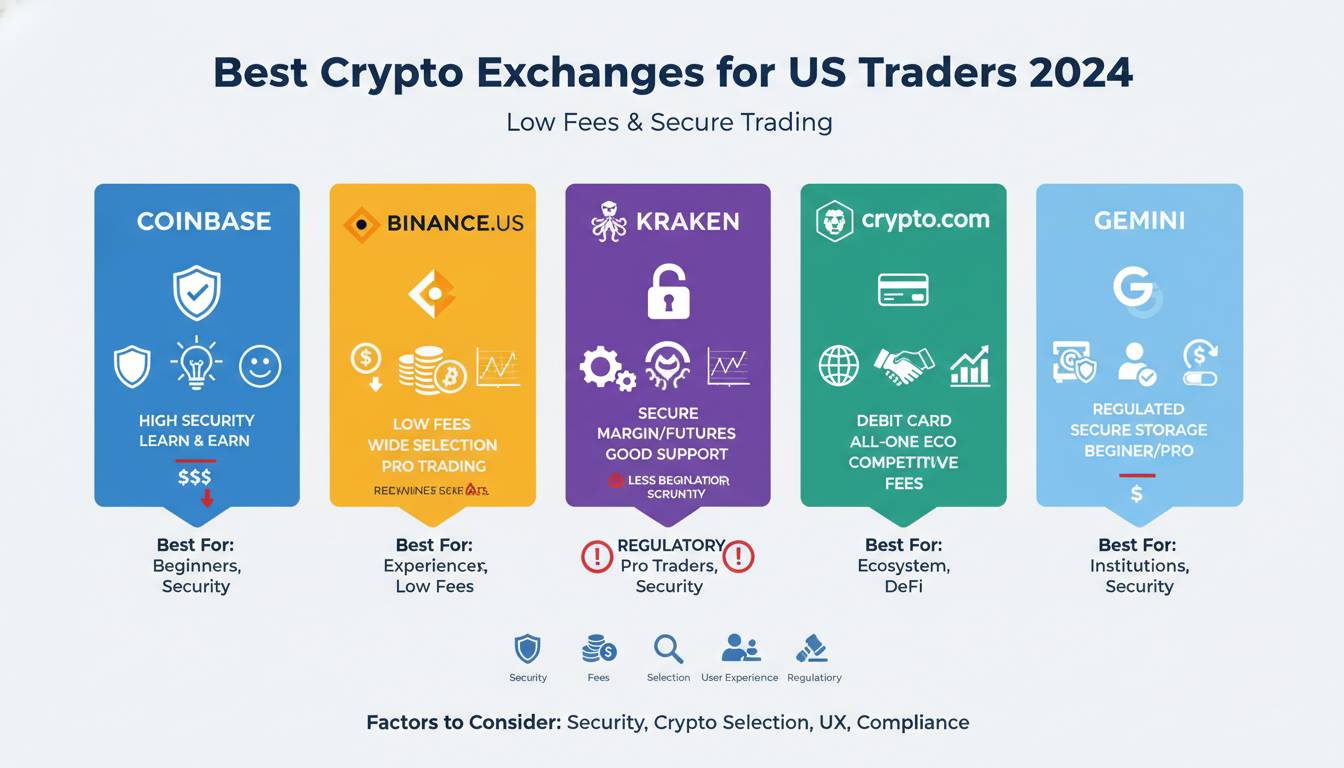
The best cryptocurrency exchange for US traders in 2024 depends on individual needs, trading experience, and priorities. Coinbase offers the most comprehensive all-around package with exceptional regulatory compliance, making it ideal for beginners and institutional investors willing to pay slightly higher fees for peace of mind. Kraken provides the best combination of low fees, full US coverage, and professional trading features, serving both casual and serious traders effectively.
Gemini excels for users prioritizing regulatory oversight and security, particularly those in New York who face fewer platform options. Binance.US remains the choice for cost-conscious traders willing to accept some limitations in exchange for the lowest fees in the market. Cash App serves casual Bitcoin buyers who value simplicity over cost efficiency.
Regardless of your choice, remember that cryptocurrency investments carry significant risk, and no exchange guarantees profits or complete security. Diversification across platforms, use of hardware wallets for long-term holdings, and thorough understanding of tax implications all contribute to a successful trading strategy. The US cryptocurrency market offers excellent options for traders at every level, and selecting the right platform forms the foundation for your trading success.
Frequently Asked Questions
Are US crypto exchanges safe to use?
US-based cryptocurrency exchanges that comply with federal and state regulations implement robust security measures including cold storage for digital assets, two-factor authentication, and regular security audits. While no platform can guarantee absolute security, regulated US exchanges like Coinbase, Kraken, and Gemini have strong track records and provide investor protections that unregulated platforms cannot match. Always enable all available security features and consider storing significant holdings in personal wallets.
Which crypto exchange has the lowest fees for US traders?
Binance.US currently offers the lowest fees among major US-regulated exchanges, with maker and taker fees starting at 0.10% for the lowest volume tiers. Kraken and Gemini Active Trader also offer competitive rates starting around 0.16-0.26% for makers. However, fee structures vary significantly based on trading volume, so high-volume traders may find different platforms more cost-effective depending on their activity level.
Do I need to pay taxes on crypto trades in the United States?
Yes, the IRS treats cryptocurrency as property, meaning capital gains taxes apply to profits from selling, trading, or using cryptocurrency. Each transaction creates a taxable event that must be reported. Maintaining detailed records of all transactions, including purchases, sales, and transfers, is essential for accurate tax reporting. Many exchanges provide tax documents, but consulting with a tax professional familiar with cryptocurrency is recommended.
Can I use international crypto exchanges as a US resident?
Most international cryptocurrency exchanges restrict or prohibit US residents from using their services due to regulatory complexities. Using a prohibited exchange could result in account closure, fund freezing, or legal consequences. It is safer and more practical to use exchanges specifically authorized to operate in the United States, which provide consumer protections and comply with US laws.
What is the minimum deposit to start trading on US crypto exchanges?
Minimum deposits vary by platform. Most US exchanges do not require minimum deposits for cryptocurrency transfers, allowing you to start with any amount. For fiat deposits via bank transfer, minimums typically range from $1 to $10. Some platforms like Cash App allow Bitcoin purchases starting from just $1, making them accessible for beginners testing the market with small amounts.
Which crypto exchange is best for beginners in 2024?
Coinbase and Gemini offer the most beginner-friendly interfaces with extensive educational resources, making them ideal for those new to cryptocurrency trading. Both platforms provide simple purchase flows, clear fee explanations, and mobile apps that make buying cryptocurrency straightforward. Cash App offers the simplest experience for Bitcoin-only purchases but limits users to a single cryptocurrency.