8Views 0Comments
How to Earn Yield on Crypto Without Trading: Proven Methods
Passive income in cryptocurrency has evolved far beyond simple holding. While “buy and hold” remains a strategy, the emergence of staking, lending, and decentralized finance (DeFi) protocols now allows crypto holders to generate consistent yields without actively trading markets. These methods require initial capital and setup, but once configured, they generate returns automatically—making them ideal for investors seeking income without the time commitment of day trading.
The global crypto staking market reached $48.7 billion in total value locked as of early 2025, while crypto lending platforms collectively hold over $25 billion in deposits. This article examines the most effective non-trading yield methods, analyzes real returns, and identifies the risks every investor should understand before participating.
Understanding Crypto Yield: The Basics
Crypto yield represents the interest or rewards earned on cryptocurrency holdings. Unlike traditional bank savings accounts that pay 0.01% to 5% annually, crypto yield protocols frequently offer 3% to 15% APY—and sometimes substantially more for newer or higher-risk assets.
The fundamental mechanisms include:
- Staking: Locking cryptocurrencies in a proof-of-stake network to support blockchain operations and earning rewards in return
- Lending: Depositing crypto assets to lending protocols that lend to borrowers at higher interest rates
- Liquidity provision: Supplying assets to decentralized exchange pools that facilitate trading
The critical distinction from trading is this: these methods generate returns through network participation or asset utility rather than buying low and selling high. Your capital remains relatively static while earning ongoing interest.
Staking: The Foundation of Non-Trading Yield
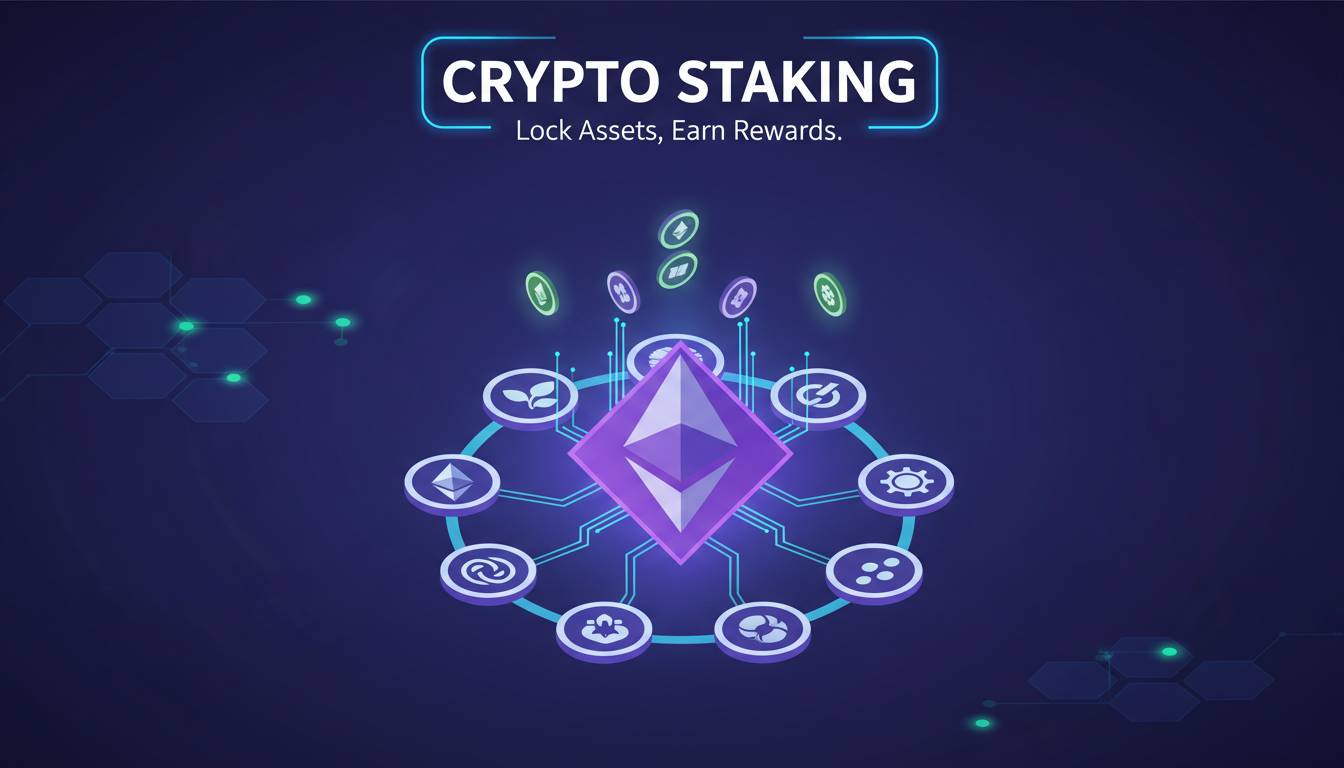
Staking represents the most established method for earning crypto yield without trading. When you stake cryptocurrency, you lock your tokens in a blockchain network to support operations like validating transactions and securing the protocol. In return, you receive staking rewards—typically paid in the same cryptocurrency you staked.
Ethereum Staking
Ethereum, the second-largest cryptocurrency by market capitalization, transitioned to proof-of-stake in September 2022. As of 2025, Ethereum staking offers approximately 3% to 5% APY, depending on the validator and stake duration.
| Staking Method | Minimum | Annual Yield | Lock-up Period | Complexity |
|---|---|---|---|---|
| Native Staking (32 ETH) | $80,000+ | 3.5% | None (unbonding ~18 hrs) | High |
| Staking as a Service | $100 | 3-4% | None | Low |
| Liquid Staking (rETH/cbETH) | $10 | 3.2-3.8% | None | Low |
| Centralized Exchange Staking | $10 | 2-4% | Variable | Very Low |
Liquid staking has emerged as a popular compromise. Protocols like Rocket Pool (rETH) and Coinbase Wrapped Staked ETH (cbETH) allow users to stake Ethereum while receiving a liquid token representing their staked position. This enables continued use of the assets in DeFi while earning staking rewards.
Proof-of-Stake Altcoins
Beyond Ethereum, numerous proof-of-stake blockchains offer higher staking yields:
- Cardano (ADA): 4% to 6% APY through native staking
- Solana (SOL): 6% to 8% APY, though with higher volatility
- Polkadot (DOT): 7% to 12% APY, with longer lock-up periods
- Avalanche (AVAX): 7% to 9% APY with 25-day minimum stake
Higher yields typically correlate with greater token inflation or increased network risk. Always verify current rates through official sources before committing capital.
Crypto Lending Platforms: Bank-Like Returns
Crypto lending operates similarly to traditional banking—you deposit cryptocurrency, and the platform lends it to borrowers at higher interest rates. The spread between what borrowers pay and what lenders earn creates the yield.
Centralized Lending Platforms
Centralized platforms like Celsius (now defunct), BlockFi, and Gemini Earn offer straightforward lending products. However, the 2022-2023 market cycle demonstrated significant counterparty risk—Celsius, Three Arrows Capital, and Voyager all collapsed, leaving users unable to access their funds.
As of 2025, more established platforms dominate the market:
| Platform | Supported Assets | Primary Yield | Insurance/Protection | Regulatory Status |
|---|---|---|---|---|
| Gemini | USDC, BTC, ETH | 4-6% | FDIC (USD only) | Licensed (NY) |
| Kraken | USDC, USDT | 4-7% | None | Licensed (US) |
| Ledn | BTC, ETH, USDC | 5-8% | AUM-backed reserves | Licensed (Canada/US) |
Decentralized Lending Protocols
Decentralized lending protocols like Aave, Compound, and MakerDAO operate without intermediaries. Users supply assets to liquidity pools, and borrowers draw from these pools with collateral. Interest rates adjust algorithmically based on supply and demand.
Aave remains the largest decentralized lending protocol, with over $14 billion in total value locked as of early 2025. Typical yields range from 2% to 8% APY depending on the asset and market conditions. Stablecoins like USDC and USDT typically offer the highest yields due to consistent borrowing demand.
The advantage of decentralized lending is transparency—you can verify all transactions on-chain. The disadvantage is navigating wallet integration, gas fees, and smart contract risk.
DeFi Yield Strategies Without Active Trading
Decentralized finance offers numerous methods to earn yield beyond simple staking and lending. While “yield farming” often involves active management, several strategies require minimal ongoing attention.
Liquidity Provision
Decentralized exchanges like Uniswap and Curve use automated market maker (AMM) models, requiring liquidity providers to supply token pairs. When traders swap tokens, they pay fees—portion of which goes to liquidity providers.
However, liquidity provision carries impermanent loss risk: if the relative price of your deposited tokens changes significantly, you may lose value compared to simply holding. This is why experienced providers focus on stablecoin pairs or tokens with low price correlation.
dYdX and Perpetual Protocol
For those seeking yield without trading, perpetual trading platforms offer funding rate arbitrage opportunities. Traders earn when funding rates align with their positions, though this requires understanding perpetual contracts—a steeper learning curve than simple staking.
Real Yield Protocols
Recent innovations focus on generating “real yield”—sustainable returns from actual protocol revenue rather than inflationary token emissions. Protocols like GMX and Gains Network distribute real profits to token holders, potentially offering more sustainable long-term returns than token-incentivized farms.
Risk Assessment: What Could Go Wrong
Before earning yield on crypto, understanding the risks is essential:
Smart Contract Risk: Decentralized protocols use code that may contain vulnerabilities. The Ronin Bridge hack ($625 million, March 2022) and Wormhole bridge attack ($320 million, February 2022) demonstrate the stakes. Audit firms like Trail of Bits, OpenZeppelin, and Certik review code, but audits don’t guarantee security.
Counterparty Risk: Centralized platforms hold your assets. If they become insolvent—like Celsius, Three Arrows Capital, or Voyager—you may lose everything. Look for regulated entities with transparent reserves.
Token Volatility: Staking rewards are paid in the staked token. If that token’s price drops 50%, your yield may not compensate for the capital loss. Consider staking tokens you plan to hold long-term regardless of price.
Slashing Risk: Validator operators who act maliciously or fail to perform correctly may have portions of their stake “slashed”—destroyed as a penalty. Solo stakers face this risk directly; staking-as-a-service providers typically cover slashing losses.
Regulatory Risk: The SEC and other regulators continue to examine staking services and DeFi protocols. Some services have faced enforcement actions, potentially affecting accessibility or tax treatment.
Real-World Examples: Actual Yields in 2024-2025
Ethereum Liquid Staking Performance
An investor who deposited 10 ETH into Rocket Pool’s liquid staking protocol on January 1, 2024, would have earned approximately 0.38 ETH in staking rewards by January 1, 2025—roughly 3.8% yield. Additionally, the rETH token value increased as Ethereum’s price rose, providing total returns exceeding simple holding.
USDC Lending on Aave
A USDC lender on Aave’s Ethereum mainnet earned approximately 4.2% APY throughout 2024, with yields fluctuating between 3.5% and 6% based on borrowing demand. Unlike staking, USDC maintains peg stability—meaning the principal value remained constant while generating income.
Cardano Staking Rewards
Cardano’s native staking produced approximately 4.3% APY in 2024, with rewards distributed every epoch (5 days). The process requires no lock-up—staked ADA remains withdrawable at any time—making it one of the more flexible high-yield options.
Common Mistakes to Avoid
Chasing Highest Yields: The highest APY often indicates highest risk. Unsustainable yield farms typically collapse once token emissions end. Focus on established protocols with clear revenue models.
Ignoring Lock-Up Periods: Some staking options require 14 to 21 days of unbonding. During this period, your tokens generate no yield and may be illiquid during market volatility.
Not Diversifying Across Protocols: Putting all capital into single staking or lending protocol creates concentration risk. Distribute across multiple chains and protocols.
Overlooking Tax Implications: Staking rewards and lending interest are generally treated as income in the US. Track all yields received to accurately report on tax returns.
Neglecting Gas Fees: Interacting with DeFi protocols requires paying network fees. For small portfolios, gas costs may exceed yield earnings. Calculate net returns before participating.
Frequently Asked Questions
Is crypto staking safe?
Crypto staking is generally safer than active trading but carries risks including smart contract vulnerabilities, token price volatility, and potential slashing for validators. Using reputable liquid staking protocols or established centralized exchanges reduces but doesn’t eliminate these risks. Diversifying across multiple staking assets reduces exposure to any single protocol failure.
How much can you earn from crypto lending?
Crypto lending yields range from 2% to 12% APY depending on the asset and platform. Stablecoins like USDC and USDT typically offer 4% to 8%, while volatility assets like BTC and ETH offer 1% to 4%. Decentralized protocols often offer higher yields than centralized platforms but require more technical expertise to use safely.
Do you have to pay taxes on crypto yield earnings?
Yes, in the United States, crypto staking rewards and lending interest are generally treated as ordinary income and must be reported on your tax return. The fair market value of tokens received counts as income at the time of receipt. Capital gains may also apply when you eventually sell earned tokens.
What’s the difference between staking and yield farming?
Staking involves locking tokens to support blockchain operations and earning rewards—typically low-risk and relatively passive. Yield farming involves moving assets across DeFi protocols to maximize returns, often requiring active management and carrying higher risks including impermanent loss. Staking is simpler; yield farming demands more attention and expertise.
Can you lose money earning crypto yield?
Yes, several scenarios can result in losses: token price drops can outweigh yield earnings, smart contract hacks can result in total fund loss, centralized platform insolvency can freeze or lose assets, and impermanent loss in liquidity provision can reduce portfolio value. Never invest more than you can afford to lose, and thoroughly research any protocol before committing funds.
Conclusion: Building Sustainable Passive Income
Earning yield on cryptocurrency without trading is entirely feasible—and for many investors, preferable to the stress and time commitment of active trading. The key is selecting methods aligned with your risk tolerance, technical comfort level, and investment timeline.
For beginners, centralized exchange staking or lending offers the simplest entry point with manageable risks. Intermediate users may explore liquid staking protocols for better yields while maintaining flexibility. Advanced DeFi participants can access sophisticated strategies but must accept greater complexity and risk.
Whatever method you choose, remember that yield rates fluctuate based on market conditions. The 8% APY available today may drop to 4% next year as competition increases or token economics change. Build expectations around sustainable, moderate returns rather than chasing unsustainable highs that inevitably correct.
Start small. Verify yields on test amounts before committing significant capital. And accept that even the most “passive” yield strategies require periodic monitoring for protocol changes, new risks, or opportunities to optimize returns.