8Views 0Comments
How to Diversify Your Stock Portfolio for Long-Term Growth
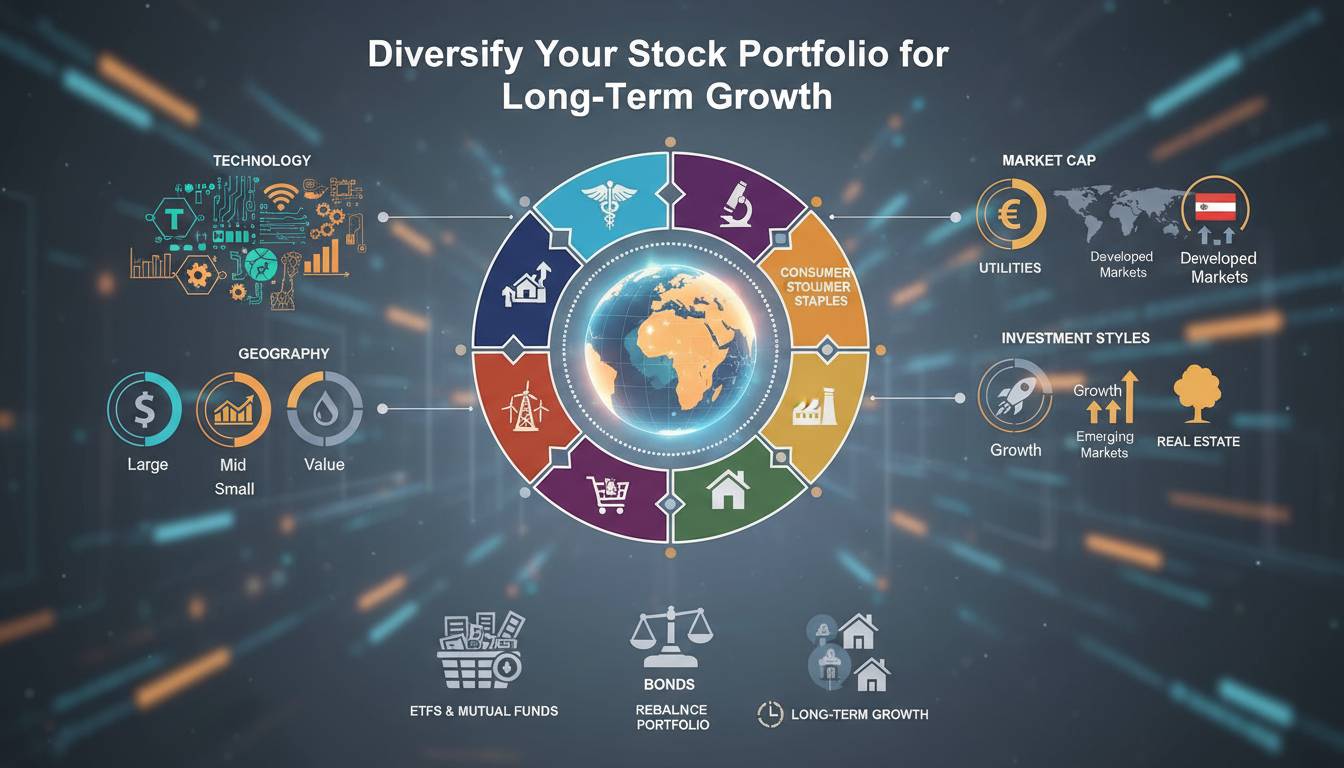
Building a diversified stock portfolio is one of the most effective ways to reduce risk while capturing long-term market growth. Rather than putting all your money into a handful of stocks, diversification spreads your investments across different asset classes, sectors, and regions—so when some investments struggle, others can keep your portfolio stable. Research from Vanguard indicates that portfolio diversification can reduce volatility by up to 40% without sacrificing expected returns. Whether you’re just starting or looking to optimize an existing portfolio, understanding how to diversify effectively is essential for achieving your financial goals over decades.
Why Diversification Matters for Long-Term Investors
The stock market naturally fluctuates. Some years growth stocks outperform; other years, value stocks or bonds do better. No one can consistently predict which sector will lead. Diversification is your insurance policy against this uncertainty—it ensures you’re not reliant on any single investment’s performance.
Beyond reducing risk, diversification actually improves risk-adjusted returns. When you hold a mix of investments that don’t move in perfect sync, your portfolio’s overall volatility decreases while your expected return stays intact. This concept, sometimes called the “free lunch” of investing, is backed by decades of financial research. Modern Portfolio Theory, developed by Harry Markowitz in the 1950s, won a Nobel Prize for demonstrating how proper diversification can optimize the return-to-risk ratio of any portfolio.
Think about what happens when you only own tech stocks. A sector-wide downturn—similar to the dot-com crash of 2000 or the 2022 tech selloff—could devastate your portfolio. But if you also own healthcare companies, utilities, financials, and international stocks, the damage from any single sector’s decline gets absorbed by your other holdings. You’re not trying to pick winners; you’re ensuring that winners and losers across the economy balance each other out over time.
Core Principles of Portfolio Diversification
Asset Class Diversification
The foundation of any diversified portfolio starts with spreading money across different asset classes. Stocks are just one option—bonds, real estate, commodities, and cash equivalents all play different roles. Generally, stocks offer higher long-term growth potential but with more short-term volatility. Bonds provide stability and income but historically lower returns. The right mix depends on your age, risk tolerance, and goals.
A common rule of thumb suggests holding your age in bonds—so a 30-year-old might hold 30% bonds and 70% stocks, while a 60-year-old might shift toward 60% bonds. However, this formula has limitations. Many financial advisors now recommend that younger investors keep more stocks since they have decades to recover from market downturns. Vanguard’s research suggests that a 90/10 or 80/20 stock-to-bond allocation often outperforms more conservative mixes over 30-year periods, even accounting for higher volatility.
Sector and Industry Diversification
Within your stock holdings, spreading money across different sectors protects you from sector-specific crashes. The U.S. economy has 11 major sectors, from technology and healthcare to consumer discretionary and energy. Each responds differently to economic conditions. During recessions, consumer staples and utilities often outperform while cyclicals like retail and manufacturing struggle. During economic expansions, growth sectors typically lead.
The S&P 500 gives you some built-in sector diversification since it tracks 500 companies across all major sectors. But even within the index, certain sectors carry disproportionate weight. As of 2024, technology companies represent roughly 30% of the S&P 500, meaning movements in tech stocks heavily influence the index. If you’re building a portfolio of individual stocks, you’ll need to be more intentional about sector allocation.
Geographic Diversification
Many U.S. investors overweight their own market. Yet the United States represents only about half of the global stock market capitalization. International investing provides exposure to faster-growing economies and industries that may not exist or be well-represented in the U.S. Countries like India, Brazil, and Southeast Asian nations have growing middle classes driving consumption and innovation.
However, international investing comes with added complexities—currency fluctuations, different accounting standards, and political risks. Many financial experts recommend keeping 20-40% of your stock allocation in international markets, typically through low-cost index funds that provide broad exposure across developed and emerging markets.
Market Cap Diversification
Companies come in different sizes, measured by market capitalization (stock price multiplied by shares outstanding). Large-cap stocks are established companies with market values above $10 billion. Mid-caps fall between $2-10 billion, while small-caps are below $2 billion. Each category has different risk and return characteristics.
Large caps tend to be more stable but may offer slower growth. Small caps have more room to grow but carry higher risk. Historically, small caps have outperformed large caps over very long periods, but with significant volatility. A diversified portfolio should include exposure across market capitalizations, typically achieved through a mix of large-cap index funds, mid-cap funds, and small-cap funds or specific small-cap holdings.
Practical Steps to Diversify Your Portfolio
Step 1: Assess Your Current Holdings
Before adding new investments, understand what you already own. Pull up your brokerage account and categorize each holding by sector, market cap, and asset class. You might discover you’re more concentrated than you realized—perhaps your employer stock represents a disproportionate share, or your tech holdings are overweight.
Many investors accumulate concentrations over time without realizing it. Maybe you bought Apple years ago and it’s grown to represent 15% of your portfolio. Or perhaps your 401(k) defaults to a fund that heavily weights certain sectors. Identifying these concentrations is the first step toward fixing them.
Step 2: Determine Your Target Allocation
Decide how you want your ideal portfolio to look across different dimensions. A simple three-fund portfolio—containing a U.S. stock index fund, an international stock fund, and a bond fund—provides excellent diversification for most investors. More sophisticated investors might add a small-cap fund, a real estate investment trust (REIT) fund, and other asset classes.
Your target allocation should align with your goals and risk tolerance. Younger investors saving for retirement in 30+ years might aim for 90% stocks, 10% bonds. Someone five years from retirement might shift toward 60% stocks, 40% bonds. Write down your target percentages so you have a clear benchmark for rebalancing.
Step 3: Choose Low-Cost Index Funds and ETFs
For most investors, low-cost index funds and exchange-traded funds (ETFs) provide the easiest path to diversification. Rather than picking individual stocks—which requires significant research and carries unsystematic risk—you can buy funds that hold hundreds or thousands of companies instantly.
Look for funds with expense ratios below 0.20%—the VOO S&P 500 ETF charges just 0.03%, meaning you keep more of your returns. Vanguard, Fidelity, and Schwab all offer excellent low-cost index funds covering U.S. stocks, international stocks, bonds, and other asset classes. Target-date retirement funds automatically adjust allocations as you age, making them particularly convenient for hands-off investors.
Step 4: Implement Through Regular Contributions
You don’t need a massive sum to start building a diversified portfolio. Consistent monthly contributions—called dollar-cost averaging—let you invest steadily over time while naturally averaging out market volatility. If you can invest $500 monthly, you can build significant diversification within a few years by splitting contributions across different asset classes.
For example, you might allocate $300 to a U.S. stock index fund, $100 to an international stock fund, and $100 to a bond fund. Over time, this systematic approach builds a portfolio matching your target allocation without requiring you to time the market.
Step 5: Rebalance Periodically
Markets move, and your portfolio’s actual allocation will drift away from your targets. When stocks outperform bonds, your stock allocation grows beyond your intended percentage. Rebalancing—selling some winners and buying laggards—returns your portfolio to your target allocation while forcing you to “buy low, sell high” instinctively.
Most financial experts recommend rebalancing annually or when your allocation drifts more than 5 percentage points from targets. This doesn’t require constant attention. Set a calendar reminder once a year to review your portfolio and make adjustments. Some brokerages offer automatic rebalancing services that handle this for you.
Common Diversification Mistakes to Avoid
Over-Diversification
While diversification is essential, you can have too much of a good thing. Holding 50 different funds might feel safe, but it often leads to mediocre returns and unnecessary complexity. When everything is diversified, your portfolio essentially becomes the entire market—you won’t significantly outperform or underperform, which might be fine, but you could achieve the same result with far fewer holdings.
Instead, focus on meaningful diversification across major asset classes and sectors. A portfolio of 5-10 funds can provide excellent diversification. More holdings rarely improve your risk-return profile meaningfully after you reach reasonable diversification.
Ignoring Concentration Risk
Some investors think they’re diversified because they own multiple stock funds. But if those funds overlap significantly—like owning three different technology-focused funds—you’re not actually diversified. Read the fund prospectuses to understand what each holding contains. Overlapping holdings mean you’re not getting the protection you think you are.
Similarly, many people hold concentrated positions in their employer’s stock or in individual stocks they’ve accumulated over years. While these positions might have performed well, they introduce significant risk. If your employer faces financial trouble, you could lose both your job and your investment simultaneously.
Chasing Recent Performance
It’s tempting to overweight investments that have recently outperformed. But diversification works precisely because you can’t predict which asset class will lead in any given year. By chasing last year’s winners, you’re making a prediction about future performance while increasing concentration risk in whatever recently outperformed.
The best approach is to maintain your target allocation regardless of recent performance. This requires discipline, especially when your lagging holdings feel discouraging. But historical evidence consistently shows thatasset allocation decisions drive most of your long-term returns—far more than picking individual securities.
Timing the Market
Some investors attempt to diversify by moving entirely to cash during uncertain times, then re-entering when they feel confident. This strategy almost never works over the long term. Missing just a few of the market’s best days dramatically reduces your returns. Diversification protects you during downturns, but it requires staying invested through them.
The data is clear: time in the market beats timing the market. Rather than trying to predict and avoid downturns, accept that they’ll happen and trust your diversified portfolio to weather them. History shows the market recovers and reaches new highs—your job is to stay the course.
Building Your Long-Term Strategy
Diversification isn’t a one-time task—it’s an ongoing process that evolves throughout your life. Your optimal allocation in your 20s differs significantly from your 30s, 40s, and beyond. As you approach retirement, gradually shifting toward more conservative allocations protects your accumulated wealth from a significant market downturn right before you need to withdraw.
But even in retirement, complete avoidance of stocks often costs more than it saves. With people living 30+ years in retirement, you need growth to maintain your purchasing power against inflation. Many financial planners now recommend keeping 40-60% in stocks even in retirement, with the exact percentage depending on your other income sources and risk tolerance.
Consider working with a fee-only fiduciary financial advisor if you’re uncertain about your allocation. These professionals are legally required to act in your best interest and can help you design an appropriate strategy based on your specific circumstances. They can also help you optimize for tax efficiency, which becomes increasingly important as your portfolio grows.
Frequently Asked Questions
How many stocks do I need to be properly diversified?
For individual stock investing, most experts suggest holding at least 25-30 different stocks across various sectors to achieve meaningful diversification. However, achieving broad diversification with individual stocks is time-consuming and costly. For most investors, 3-5 low-cost index funds or ETFs provide better diversification than 30 individual stocks, with far less effort and lower costs.
Should I include bonds in my portfolio if I’m young?
Yes, even young investors can benefit from some bond exposure. While you have a long time horizon and can tolerate volatility, bonds provide psychological comfort during market downturns—helping you stay invested rather than panic-selling. A common recommendation for young investors is 10-20% bonds, though some advocate for 0% if you have high risk tolerance and strong emotional discipline.
How often should I rebalance my portfolio?
Annual rebalancing is typically sufficient for most investors. Set a specific time each year—perhaps your birthday or the start of each year—to review your allocation and rebalance if any asset class has drifted more than 5 percentage points from your target. More frequent rebalancing rarely improves outcomes and can create unnecessary trading costs and tax events.
Is international diversification still worth it given U.S. market dominance?
Yes, international diversification remains valuable despite the U.S. market’s strong recent performance. International markets provide exposure to different economic cycles, currencies, and emerging industries. Many analysts expect international markets to potentially outperform U.S. markets in coming decades given valuation differences. A 20-30% international allocation remains a common recommendation.
What’s the simplest diversified portfolio for beginners?
A three-fund portfolio containing a U.S. total stock market fund, an international stock fund, and a U.S. bond fund provides excellent diversification with minimal complexity. Target-date funds offered by major brokerages automate this approach, automatically adjusting your allocation as you age. Both options require just a few decisions and provide instant diversification across thousands of securities.
Does diversification still work during major market crashes?
Diversification doesn’t eliminate losses during market crashes—it reduces them. During the 2008 financial crisis, a diversified portfolio lost less than a portfolio concentrated in financial stocks or other hard-hit sectors. While you won’t avoid all downturns entirely, diversification ensures no single crash destroys your entire portfolio, helping you stay invested for the recovery.
Conclusion
Diversification remains one of the most powerful tools for long-term investment success. By spreading your money across asset classes, sectors, and geographies, you reduce risk without sacrificing expected returns. The key is starting with a clear target allocation, implementing it through low-cost index funds, and maintaining discipline through market ups and downs.
Remember that diversification is a process, not a one-time action. Your life circumstances change, your goals evolve, and market conditions shift. Regular review and occasional rebalancing keep your portfolio aligned with your strategy. Stay the course, contribute consistently, and trust that a diversified portfolio will weather the inevitable market storms while capturing long-term growth.