3Views 0Comments
Roth IRA vs Traditional IRA: Which Is Better For You?
QUICK ANSWER: The better IRA depends on your current tax rate versus your expected future tax rate. Choose a Traditional IRA if you want tax-deductible contributions now and expect to be in a lower tax bracket in retirement. Choose a Roth IRA if you expect to be in a higher tax bracket in retirement or want tax-free withdrawals later. (This is educational content, not financial advice—consult a qualified tax professional for your specific situation.)
AT-A-GLANCE:
| Factor | Traditional IRA | Roth IRA |
|---|---|---|
| Tax on Contributions | May be tax-deductible | Made with after-tax dollars |
| Tax on Withdrawals | Taxed as ordinary income | Generally tax-free |
| Required Minimum Distributions | Must start at age 73 | No RMDs during owner’s lifetime |
| Income Limits | None (but deductions may be limited) | Yes, based on modified AGI |
| Best For | Lower current tax bracket | Higher future tax bracket |
KEY TAKEAWAYS:
– ✅ Traditional IRA contributions may be tax-deductible now, but withdrawals in retirement are fully taxed
– ✅ Roth IRA grows tax-free and qualified withdrawals are tax-free, making it valuable for those expecting higher taxes later
– ✅ Traditional IRAs require mandatory withdrawals starting at age 73, while Roth IRAs have no RMD requirements during the original owner’s lifetime (SECURE 2.0 Act, 2023)
– ❌ Common mistake: Choosing based solely on current tax rate without considering future tax brackets
– 💡 “The decision often comes down to whether you want to pay taxes now or later—this is the ‘tax arbitrage’ of retirement planning” — Investopedia Tax Strategy (2024)
KEY ENTITIES:
– Products: Traditional IRA, Roth IRA, 401(k), SEP-IRA
– Experts Referenced: IRS, financial advisors, certified public accountants
– Organizations: Internal Revenue Service (IRS), Securities and Exchange Commission (SEC)
– Standards: SECURE 2.0 Act (2023), IRS contribution limits (2024, 2025)
LAST UPDATED: January 2025
Understanding the Fundamental Difference
The core distinction between a Traditional IRA and a Roth IRA lies in when you pay taxes on your money. Think of it as choosing between two payment schedules: pay the taxman now or pay later.
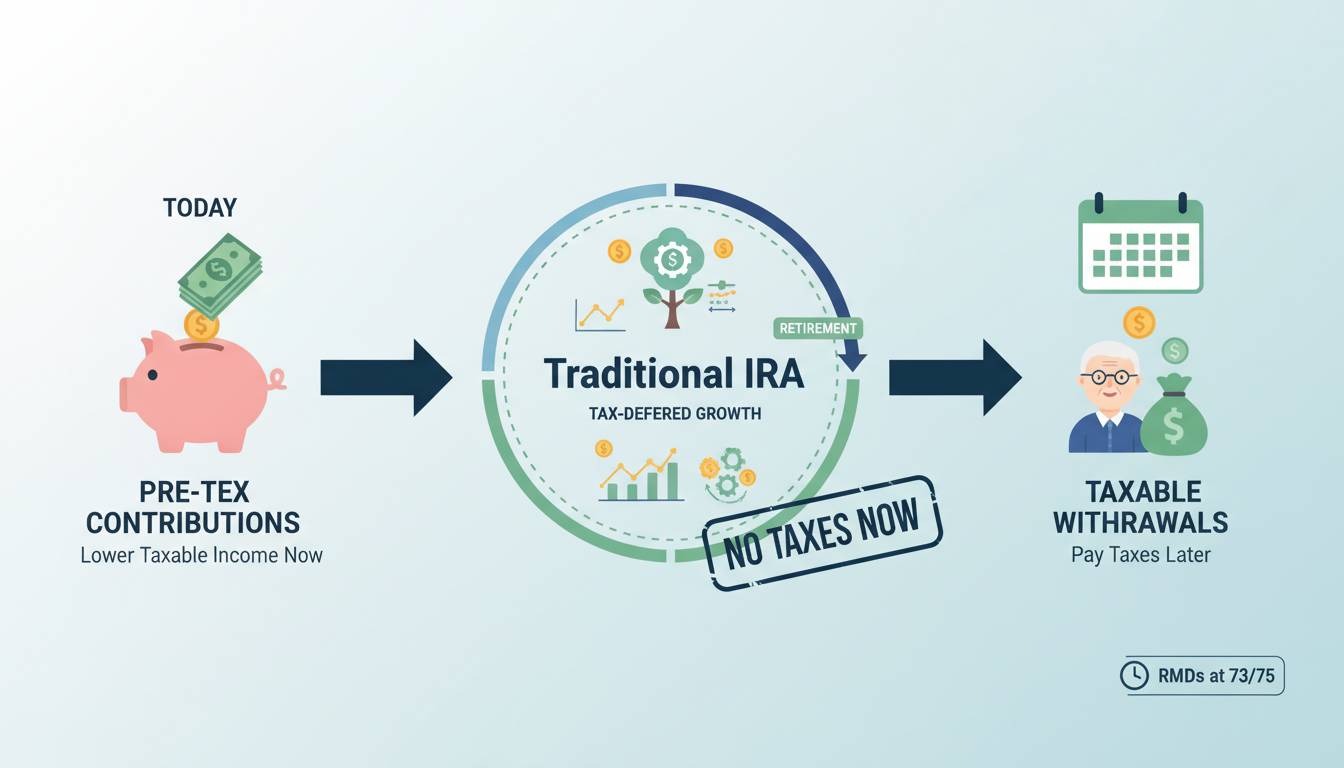
With a Traditional IRA, you may receive an immediate tax benefit through deductible contributions. Your money grows tax-deferred, and when you withdraw funds in retirement, those withdrawals are taxed as ordinary income. This structure appeals to people who are currently in higher tax brackets and want to reduce their current taxable income.
A Roth IRA works in the opposite direction. You contribute money you’ve already paid taxes on—after-tax dollars. Your investments grow tax-free, and qualified withdrawals in retirement are completely tax-free. There’s no tax deduction for contributions, but you lock in tax-free growth and withdrawals.
Both accounts allow you to contribute up to $7,000 in 2024 ($8,000 if you’re 50 or older), though income limits restrict who can contribute to a Roth IRA. Traditional IRAs have no income limits for contributions, but the tax deductibility of contributions phases out if you or your spouse have a workplace retirement plan like a 401(k).
How Taxes Work in Each Account Type
Traditional IRA Taxation
When you contribute to a Traditional IRA, you may be eligible for an upfront tax deduction. If you’re covered by a workplace retirement plan, the deduction phases out at certain income levels. For 2024, single filers with modified adjusted gross income (MAGI) between $77,000 and $87,000 see partial deductions, while those above $87,000 receive no deduction. Married couples filing jointly see phase-out ranges of $123,000 to $143,000.
The real tax impact arrives in retirement. Every dollar you withdraw from a Traditional IRA is added to your ordinary income and taxed at your marginal rate. This means required minimum distributions (RMDs) starting at age 73 will create taxable income whether you need the money or not.
Consider this scenario: If you contribute $7,000 annually for 30 years and earn a 7% average return, you’d accumulate approximately $661,000. If you’re in the 24% tax bracket in retirement, you’d owe roughly $158,000 in taxes on those withdrawals—money that could have grown tax-free in a different account structure.
Roth IRA Taxation
Roth IRA contributions are never tax-deductible. You fund these accounts with money you’ve already paid income taxes on. The payoff comes later: your investments grow tax-free, and qualified withdrawals are completely tax-free.
The income limits for Roth IRA contributions in 2024 restrict eligibility for single filers with MAGI above $146,000, with complete phase-out at $161,000. Married couples lose eligibility completely at $240,000 (phase-out begins at $230,000). These limits have increased over time but remain a significant barrier for high earners.
The tax-free withdrawal benefit becomes extraordinarily valuable in high-tax scenarios. If you retire with $800,000 in a Roth IRA and are in a 32% tax bracket, you’d save approximately $256,000 in taxes compared to holding that same money in a Traditional IRA.
Required Distributions: A Critical Difference
The SECURE 2.0 Act made significant changes to required minimum distributions that dramatically impact the Traditional vs. Roth decision.
Traditional IRAs force you to begin taking withdrawals at age 73. The RMD amount is calculated based on your account balance divided by your life expectancy. These withdrawals are mandatory regardless of whether you need the money, and they trigger ordinary income tax.
Roth IRAs offer a major advantage here: there are no required minimum distributions during your lifetime. Your money can continue growing tax-free indefinitely. This makes Roth IRAs exceptionally valuable for those who don’t need the money in retirement and want to maximize wealth transfer to heirs.
This provision matters enormously for estate planning. Traditional IRA Required Minimum Distributions reduce your ability to control when—and how much—you pay in taxes. Roth IRAs give you flexibility to let investments grow, withdraw what you need when you need it, and pass remaining assets to beneficiaries with no RMD requirements for them either.
Who Should Choose a Traditional IRA?
Traditional IRAs make the most sense for specific situations:
You expect lower taxes in retirement. If you anticipate being in a significantly lower tax bracket when you retire—perhaps because you’ll have less income or live in a tax-friendlier state—a Traditional IRA allows you to defer taxes to that lower rate.
You need the tax deduction now. High earners not eligible for Roth IRA contributions, or those whose workplace plan limits Traditional IRA deductibility, may still benefit from the deduction if their income falls below phase-out thresholds.
You’re in a high current tax bracket. Reducing taxable income today provides immediate value. A $7,000 Traditional IRA contribution might save you $1,680 in taxes if you’re in the 24% bracket—money you could then invest elsewhere.
You plan to minimize retirement spending. If you expect to live modestly in retirement and keep your taxable income low, the impact of Traditional IRA taxes will be minimal.
Financial advisors often recommend a “桶” (bucket) strategy—holding some money in Traditional accounts and some in Roth accounts—to create flexibility in managing retirement tax brackets.
Who Should Choose a Roth IRA?
Roth IRAs tend to benefit certain groups more than others:
You’re in a lower tax bracket now. If you’re early in your career or in a lower tax bracket, paying taxes now at a lower rate and locking in tax-free growth provides long-term value.
You expect higher taxes in the future. If you believe tax rates will increase—perhaps due to government budget deficits or policy changes—a Roth IRA hedges against that risk.
You want tax-free retirement income. Avoiding required minimum distributions and creating tax-free income in retirement provides flexibility that Traditional IRAs cannot match.
You’re a good saver. Maxing out a Roth IRA early in life creates decades of tax-free growth. A $7,000 contribution at age 25 growing at 7% for 40 years becomes approximately $106,000—all tax-free.
You want to leave tax-free inheritance. Roth IRAs pass to heirs without immediate income tax consequences, making them powerful estate planning tools.
Many financial experts, including those at Vanguard and Fidelity, suggest that younger workers favoring Roth options often benefit from decades of tax-free growth that outweigh the value of current deductions.
Can You Have Both?
Yes—you’re not forced to choose just one. Many Americans benefit from having both account types, creating a “tax diversification” strategy.
A common approach involves contributing to a workplace 401(k) to get any employer match, then contributing to a Traditional or Roth IRA depending on eligibility, then returning to maximize the 401(k) if additional funds exist.
This hybrid approach lets you manage your tax situation in retirement by drawing from whichever account makes the most sense in a given year. Need more income? Tap the Traditional IRA (which is taxable). Want to stay in a lower bracket? Use Roth withdrawals.
Backdoor Roth IRA contributions remain popular for high earners exceeding income limits. This involves making a non-deductible Traditional IRA contribution, then converting it to a Roth IRA. The process requires careful tax planning and may trigger taxes on any existing Traditional IRA balances—sometimes called the “pro-rata rule.”
Real-World Considerations
Traditional IRA Example
Consider Michael, age 35, earning $85,000 annually as a software developer. He’s in the 22% tax bracket and has a 401(k) through work. He contributes $7,000 to his Traditional IRA and receives a partial deduction of approximately $4,900 due to his income.
He saves about $1,078 in taxes this year. Over 30 years of contributing $7,000 annually at 7% returns, his $210,000 in contributions grows to approximately $661,000. If he’s in the 24% bracket in retirement, he’ll owe roughly $158,000 in taxes on those withdrawals.
His effective tax benefit: $1,078 annually for 30 years = $32,340 in tax savings, but he pays $158,000 later.
Roth IRA Example
Sarah, age 30, earns $55,000 as a teacher in the 12% tax bracket. She contributes $7,000 to a Roth IRA—after taxes. Over 35 years at 7%, her $245,000 in contributions becomes approximately $1.1 million. Every dollar is tax-free when she withdraws it in retirement.
Her cost: She paid taxes on $7,000 in income that year (approximately $840 in federal taxes at her bracket). Her benefit: $1.1 million in tax-free withdrawals.
Making Your Decision: Key Questions to Ask
1. What’s your current tax bracket versus your expected retirement bracket?
Compare your current marginal rate to where you expect to be. If you’re in the 32% bracket now and expect to be in the 12% bracket in retirement, Traditional likely wins. If you’re in the 12% bracket now and expect to be in the 24% bracket later, Roth wins.
2. Do you qualify for Traditional IRA deductions?
If your income exceeds limits and you’re covered by a workplace plan, your Traditional IRA contribution won’t be deductible—diminishing the benefit.
3. Do you qualify for Roth IRA contributions?
Income limits may prevent direct Roth contributions. In that case, a Traditional IRA (non-deductible) or backdoor Roth strategy becomes relevant.
4. Do you need the tax deduction now?
If you’re struggling to save, the immediate tax break might motivate participation. If you can save regardless, the long-term Roth benefit might be more valuable.
5. What’s your timeline to retirement?
Longer time horizons favor Roth accounts—more years of tax-free compounding. Shorter timelines may not justify giving up the current deduction.
6. Do you want to leave money to heirs?
Roth IRAs pass income-tax-free to beneficiaries, while Traditional IRAs create taxable income for heirs.
Frequently Asked Questions
Q: Can I contribute to both a Traditional IRA and a Roth IRA in the same year?
Direct Answer: Yes, you can contribute to both, but your total contributions across all IRAs cannot exceed $7,000 in 2024 ($8,000 if you’re 50 or older).
Detailed Explanation: You could, for example, contribute $4,000 to a Traditional IRA and $3,000 to a Roth IRA. However, the tax deductibility of Traditional IRA contributions still depends on your income and whether you have a workplace retirement plan. Keep in mind that Roth IRA income limits may also apply.
Q: What happens if I withdraw money early from either IRA?
Direct Answer: Early withdrawals from Traditional IRAs before age 59½ typically incur a 10% penalty plus ordinary income taxes, while Roth IRA contributions can be withdrawn tax-free at any time.
Detailed Explanation: Traditional IRA early withdrawals are penalized because you’re breaking the tax-deferred bargain. However, Roth IRA earnings withdrawn before age 59½ may face taxes and penalties, but your original contributions can always be taken out tax-free since you already paid taxes on that money. There are exceptions for first-time home purchases, qualified education expenses, and other hardships.
Q: Do I have to take money out of my IRA at a certain age?
Direct Answer: Traditional IRAs require minimum distributions starting at age 73, while Roth IRAs have no mandatory withdrawals during your lifetime.
Detailed Explanation: The SECURE 2.0 Act raised the RMD age to 73 for 2023 and beyond. These required withdrawals are calculated based on your account balance and life expectancy. Missing RMDs incurs a 25% penalty on the amount not withdrawn. Roth IRAs never require withdrawals during your lifetime, letting your money grow tax-free indefinitely.
Q: Is a Roth IRA better than a 401(k)?
Direct Answer: Not necessarily—each has advantages. A 401(k) with employer matching offers immediate “free money,” while Roth 401(k)s combine employer matches with Roth tax benefits.
Detailed Explanation: If your employer offers a 401(k) match, always contribute enough to get the full match before contributing to an IRA. The match is essentially a 100% return on your contribution that you shouldn’t pass up. Roth 401(k) options combine the tax-free growth of a Roth with employer matches, though they have required minimum distributions. A Roth IRA might be better if you exceed 401(k) contribution limits or want more investment choices.
Q: Can I convert a Traditional IRA to a Roth IRA?
Direct Answer: Yes, you can convert a Traditional IRA to a Roth IRA, but you’ll owe ordinary income taxes on any pre-tax contributions and earnings in the account.
Detailed Explanation: This “conversion” is how high earners access Roth benefits despite income limits. A common strategy is the backdoor Roth: contribute to a non-deductible Traditional IRA, then convert to Roth. If you have other Traditional IRA balances, the pro-rata rule requires you to calculate the taxability of the conversion based on all your Traditional IRA assets. Conversions can be spread across years to manage tax brackets.
Q: Which IRA is better for early retirement?
Direct Answer: A Roth IRA is generally better for early retirement because you can withdraw contributions tax-free before age 59½ without penalties.
Detailed Explanation: Since Roth IRA contributions (not earnings) can be accessed anytime tax-free, early retirees can use their principal while allowing earnings to continue growing tax-free. Traditional IRAs penalize early withdrawals heavily. However, Roth IRA earnings withdrawn before 59½ may face penalties unless you meet specific criteria like first-time home purchases or qualified expenses.
Conclusion
The Traditional vs. Roth IRA decision ultimately hinges on understanding your current tax situation and your expectations for the future. Neither choice is universally superior—the right answer depends entirely on your individual circumstances.
A Traditional IRA offers immediate tax relief and makes sense when you’re in a high tax bracket now and expect lower rates in retirement. A Roth IRA provides tax-free growth and withdrawals, making it valuable for those expecting higher taxes or who want maximum flexibility in retirement.
Most financial experts suggest tax diversification—holding both account types—to give yourself options when retirement arrives. This approach lets you manage your tax bracket in retirement by drawing from whichever account makes the most sense in any given year.
The most important action is to start contributing if you haven’t already. The power of tax-advantaged compounding over decades dwarfs the differences between account types. Begin with your workplace plan to capture any employer match, then explore IRA options that align with your tax situation.
IMMEDIATE ACTION STEPS:
| Timeframe | Action | Expected Outcome |
|---|---|---|
| This Week (30 min) | Review your current tax bracket and estimate retirement tax bracket | Clear direction on which IRA type fits |
| This Month | Check if you qualify for Roth IRA contributions or Traditional IRA deductions | Know your eligibility before contributing |
| This Quarter | Open or fund the appropriate IRA based on your analysis | Begin tax-advantaged growth |
FINAL RECOMMENDATION: If you’re uncertain, consider splitting contributions between both account types for tax diversification. A financial advisor or CPA can help model your specific situation and optimize your retirement tax strategy.
TRANSPARENCY NOTE: This article provides educational information about IRA basics and is not personalized financial advice. Contribution limits, income limits, and rules may change. Consult a qualified tax professional or financial advisor for guidance specific to your situation.