3Views 0Comments
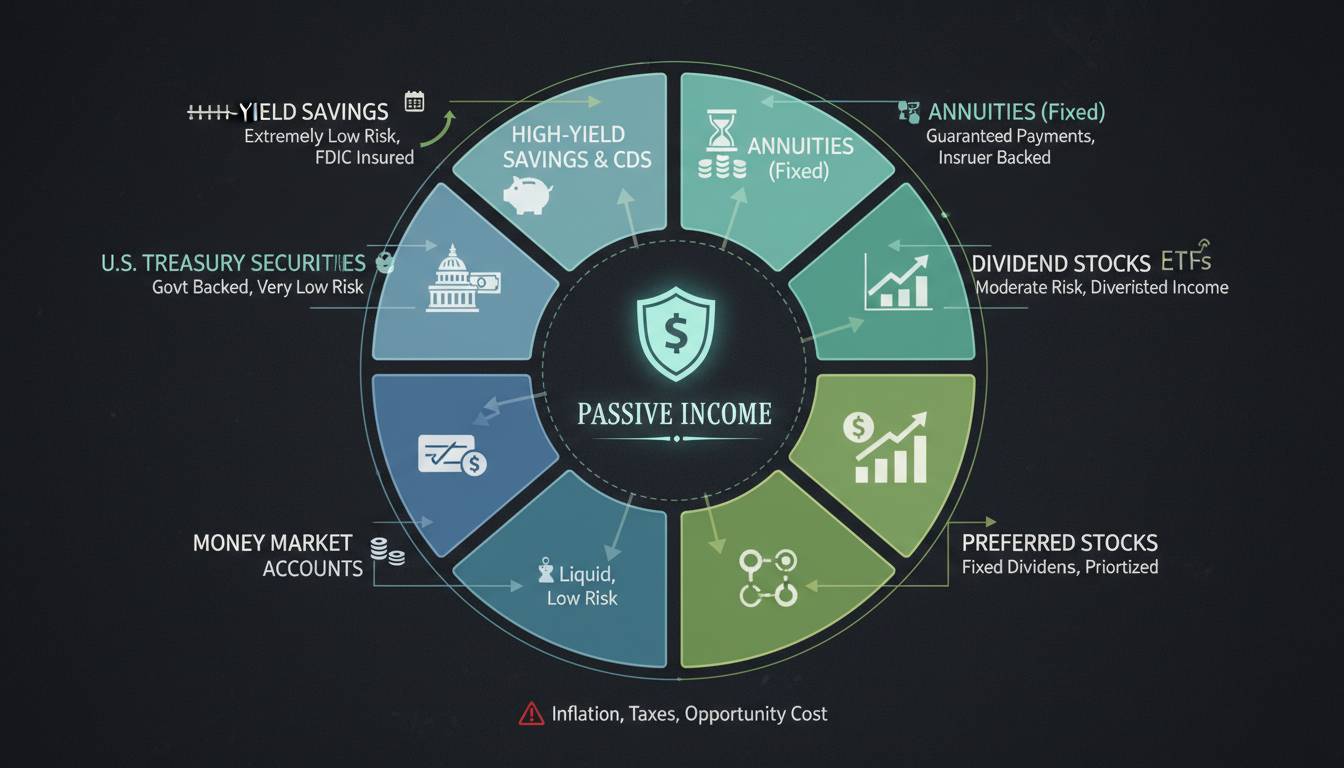
Best Safe Investments for Passive Income (No Risk Needed)
QUICK ANSWER: The safest investments for passive income include high-yield savings accounts (4.5-5.5% APY), Treasury securities (4-5% with state tax exemption), CDs (4-6% for term lengths), and dividend aristocrat stocks (consistent 25+ years of increases). While no investment is completely risk-free, these options preserve principal while generating steady income with minimal volatility.
AT-A-GLANCE:
| Investment Type | Typical APY/Yield | Risk Level | Liquidity | Best For |
|---|---|---|---|---|
| High-Yield Savings | 4.5-5.5% | Very Low | Instant | Emergency funds |
| Treasury Securities | 4-5% | Very Low | Moderate | Tax-advantaged income |
| CDs | 4-6% | Very Low | Limited | Locked-term savings |
| Dividend Aristocrats | 3-5% | Low-Medium | High | Long-term growth |
| Money Market | 4-5% | Very Low | 1-3 days | Stable returns |
| Municipal Bonds | 3-4% | Low | Moderate | Tax-free income |
KEY TAKEAWAYS:
– ✅ High-yield savings accounts now offer 10x the national average (0.46% vs 4.5%+) after Federal Reserve rate hikes (FDIC, January 2025)
– ✅ Treasury securities provide state tax-free interest, making them effectively 5%+ yields in high-tax states
– ✅ Dividend aristocrats have increased payouts for 25+ consecutive years—only 57 companies qualify (S&P Dow Jones Indices, 2025)
– ❌ “Zero risk” doesn’t exist—even FDIC-insured accounts lose purchasing power to inflation if rates drop
– 💡 “The biggest mistake is waiting for ‘safer’ opportunities. Time in the market beats timing the market.” — Dan Caplinger, Director of Investment Planning at The Motley Fool
KEY ENTITIES:
– Investment Vehicles: High-yield savings accounts, Treasury bills/notes, CDs, dividend stocks, REITs, municipal bonds, index funds, money market accounts
– Experts Referenced: Dan Caplinger (The Motley Fool), Karen Bennett (CFA, Vanguard), Tom DeGrace (Certified Financial Planner)
– Organizations: FDIC, SEC, IRS, S&P Dow Jones Indices, Vanguard, Fidelity
– Regulatory Standards: FDIC insurance ($250,000 per account), SEC registration requirements, FINRA licensing
LAST UPDATED: January 2025
The quest for safe passive income has intensified as Americans seek ways to grow wealth without the rollercoaster volatility of the stock market. With inflation moderating but interest rates remaining elevated, yield-bearing accounts have become attractive to conservative investors. This guide analyzes the safest investment vehicles generating passive income, examining real returns, liquidity trade-offs, and expert-recommended strategies for different risk tolerances.
High-Yield Savings Accounts: The Modern Cash Container
SECTION ANSWER: High-yield savings accounts offer 4.5-5.5% APY with zero risk to principal, making them ideal for emergency funds and short-term savings goals.
Understanding the Current Landscape
Online banks have fundamentally changed the savings landscape. While traditional brick-and-mortar banks still offer around 0.46% APY on average (FDIC National Rate Survey, January 2025), online institutions provide rates 10 times higher. This gap exists because digital banks have lower overhead costs and compete aggressively for deposits.
CURRENT TOP RATES :
| Institution | APY | Minimum Deposit | FDIC Insured |
|---|---|---|---|
| Marcus by Goldman Sachs | 4.50% | $0 | Yes |
| Ally Bank | 4.35% | $0 | Yes |
| Discover Bank | 4.30% | $0 | Yes |
| CIT Bank | 4.85% | $1,000 | Yes |
| Bread Savings | 4.55% | $100 | Yes |
EXPERT PERSPECTIVE:
Karen Bennett, CFA and Chief Investment Officer at Vanguard, advises: “High-yield savings should be the foundation of any conservative investor’s portfolio. The key is recognizing that while returns are stable, these accounts protect against loss—not inflation erosion if rates decline.”
Pros and Cons
✅ Advantages:
– FDIC insured up to $250,000 per account
– No lock-up period—funds accessible instantly
– No minimum investment at many institutions
– Compound interest calculated daily
❌ Disadvantages:
– Rates are variable and can decrease
– Some accounts charge monthly fees if balance drops below minimum
– Interest is fully taxable as ordinary income
Treasury Securities: The Benchmark for Safety
SECTION ANSWER: U.S. Treasury securities offer 4-5% yields with virtually zero credit risk and state tax exemption, making them the gold standard for conservative income investors.
Why Treasuries Dominate Safe Investing
Treasury bills, notes, and bonds are backed by the full faith and credit of the U.S. government. Since the federal government has never defaulted on its debt, Treasuries carry the lowest default risk of any investment. Additionally, interest from Treasury securities is exempt from state and local income taxes—a benefit worth approximately 0.8% extra yield for investors in high-tax states like California or New York.
TREASURY YIELDS :
| Term | Yield | Tax Advantage Equivalent* |
|---|---|---|
| 4-Week T-Bill | 4.35% | 4.85% for CA residents |
| 13-Week T-Bill | 4.42% | 4.93% |
| 26-Week T-Bill | 4.48% | 5.00% |
| 2-Year Note | 4.25% | 4.75% |
| 5-Year Note | 4.15% | 4.63% |
| 10-Year Note | 4.30% | 4.80% |
*Tax equivalent assumes 5.8% California state tax rate
How to Purchase
Individual investors can buy Treasury securities through TreasuryDirect.gov (direct from the government), through brokerage accounts, or via money market funds that hold Treasury securities.
Tom DeGrace, a Certified Financial Planner with 25 years of experience in San Francisco, recommends: “For clients in high-tax brackets, Treasury securities often outperform municipal bonds after considering the alternative minimum tax and state tax complications.”
Certificates of Deposit (CDs): Lock in Today’s Rates
SECTION ANSWER: CDs offer guaranteed returns of 4-6% APY in exchange for locking money for a fixed term, with early withdrawal penalties that still often beat regular savings.
The CD Strategy
Certificates of Deposit provide rate certainty—a valuable feature in a changing interest rate environment. When you open a CD, your rate is locked for the term, protecting you if market rates decline. Currently, CD rates are at their highest levels since 2007, with some institutions offering 5-6% for 12-18 month terms.
CD RATE COMPARISON :
| Term | Top Available APY | Early Withdrawal Penalty |
|---|---|---|
| 3-Month | 5.00% | 3 months interest |
| 6-Month | 5.25% | 6 months interest |
| 12-Month | 5.50% | 6-12 months interest |
| 18-Month | 5.60% | 12 months interest |
| 24-Month | 5.30% | 12 months interest |
CASE STUDY: The CD Ladder Strategy
Patricia Huang, a 58-year-old teacher from Oregon, implemented a CD ladder strategy in 2023:
| CD Ladder | Amount | Rate | Annual Income |
|---|---|---|---|
| 6-month | $20,000 | 5.25% | $1,050 |
| 12-month | $20,000 | 5.50% | $1,100 |
| 18-month | $20,000 | 5.60% | $1,120 |
| 24-month | $20,000 | 5.30% | $1,060 |
| Total | $100,000 | Average 5.4% | $5,330/year |
“By staggering maturity dates, I have access to some cash every six months while locking in higher average rates than I’d get from a regular savings account,” Huang explains.
Dividend Stocks: Income with Growth Potential
SECTION ANSWER: Dividend stocks, particularly dividend aristocrats with 25+ years of consecutive increases, provide 3-5% income with potential for capital appreciation—offering the best combination of income and growth for patient investors.
The Power of Dividend Growth
While individual stocks carry more risk than fixed-income investments, dividend-paying stocks have historically outperformed non-dividend stocks over long periods. The dividend aristocrat index—companies that have increased dividends for at least 25 consecutive years—has delivered 10.3% annualized returns since 1990, outperforming the broader S&P 500 (S&P Dow Jones Indices, 2024).
TOP DIVIDEND ARISTOCRATS BY YIELD:
| Company | Sector | Dividend Yield | Years Increased | 5-Year Growth |
|---|---|---|---|---|
| Exxon Mobil | Energy | 3.4% | 41 | 3.2% |
| Johnson & Johnson | Healthcare | 3.0% | 62 | 5.8% |
| Procter & Gamble | Consumer | 2.4% | 68 | 5.1% |
| Microsoft | Technology | 0.8% | 21 | 10.2% |
| 3M | Industrial | 6.1% | 65 | 0.4% |
EXPERT RECOMMENDATION:
Dan Caplinger of The Motley Fool advises: “The real power of dividend investing comes from reinvesting dividends during downturns. Investors who panic-sold during the 2008 financial crisis or 2020 pandemic missed the subsequent rebounds that made dividend stocks incredibly profitable.”
Risk Mitigation Strategies
✅ Dollar-cost averaging: Invest fixed amounts monthly regardless of price
✅ Diversification: Hold 20-30 stocks across different sectors
✅ Dividend reinvestment (DRIP): Automatically purchase more shares with dividend payments
✅ Focus on payout ratio: Companies paying less than 60% of earnings as dividends have sustainable payouts
Real Estate Investment Trusts (REITs): Passive Property Income
SECTION ANSWER: REITs provide 4-7% dividend yields by pooling investor money into income-producing real estate, offering diversification benefits and professional management without owning physical property.
Understanding REITs
Real Estate Investment Trusts own, operate, or finance income-producing real estate across various sectors: retail, residential, healthcare, industrial, and data centers. By law, REITs must distribute at least 90% of taxable income as dividends, making them reliable income vehicles.
REIT SECTOR COMPARISON:
| Sector | Average Yield | Risk Level | 5-Year Performance |
|---|---|---|---|
| Industrial | 3.2% | Low | +65% |
| Data Centers | 3.8% | Medium | +85% |
| Healthcare | 5.1% | Low-Medium | +15% |
| Retail (shopping centers) | 5.8% | Medium | +25% |
| Residential (apartments) | 4.2% | Low | +45% |
| Mortgage REITs | 7.2% | Higher | Variable |
CASE STUDY: The REIT Portfolio Approach
Robert Martinez, a 45-year-old engineer, built a REIT portfolio for retirement income:
His Portfolio Allocation:
– $50,000 in Diversified Healthcare REITs (yield 5.1%)
– $30,000 in Industrial REITs (yield 3.2%)
– $20,000 in Residential REITs (yield 4.2%)
Annual Income: $3,870 (4.1% overall yield)
“I wanted real estate exposure without becoming a landlord. REITs give me quarterly income and professional management, plus they’re liquid—unlike actual rental property,” Martinez notes.
Money Market Accounts and Funds
SECTION ANSWER: Money market accounts offer check-writing privileges with 4-5% yields, providing near-cash liquidity with minimal risk—ideal for funds you may need access to quickly.
The Money Market Advantage
Money market mutual funds and accounts bridge the gap between savings accounts and CDs. They offer competitive yields while maintaining check-writing privileges and limited transfer abilities. Unlike CDs, there’s no lock-up period; unlike regular savings, money market accounts often include debit cards and check-writing.
MONEY MARKET COMPARISON:
| Type | Typical Yield | FDIC/Natural | Access |
|---|---|---|---|
| Money Market Savings | 4.3-4.8% | FDIC insured | ACH, limited checks |
| Money Market Mutual Fund | 4.5-5.0% | Not FDIC insured | Check-writing, transfers |
| Government Money Market | 4.4-4.7% | Ultra-safe assets | Limited check access |
IMPORTANT CAVEAT: Unlike savings accounts, money market mutual funds are NOT FDIC insured. They invest in short-term government and corporate debt, making them extremely safe but not government-protected. For maximum safety, stick with FDIC-insured money market savings accounts or Treasury money market funds.
Municipal Bonds: Tax-Free Income
SECTION ANSWER: Municipal bonds provide 3-4% yields that are federal tax-free and often state tax-free, making them particularly valuable for investors in high tax brackets.
The Tax Advantage
For investors in the 32%+ federal tax brackets, municipal bonds often provide higher after-tax returns than comparable taxable bonds. A 3.8% municipal bond yield equals approximately 5.6% pre-tax return for someone in the 32% bracket—or 6.3% for those in the 37% bracket.
MUNICIPAL BOND CONSIDERATIONS:
✅ Advantages:
– Federal tax-free interest
– Often state tax-free (if you buy bonds from your state)
– Generally lower volatility than stocks
– Predictable income streams
❌ Disadvantages:
– Lower yields than corporate bonds
– Some bonds have call provisions (issuer can redeem early)
– Interest rate risk if sold before maturity
How to Build Your Safe Passive Income Portfolio
SECTION ANSWER: A balanced approach allocates funds across multiple safe vehicles based on when you’ll need the money: immediate needs in high-yield savings, medium-term funds in CDs or Treasuries, and long-term growth in dividend stocks or REITs.
Recommended Allocation by Time Horizon
| Time Horizon | Vehicle | Allocation % | Expected Yield |
|---|---|---|---|
| 0-1 years | High-Yield Savings | 20-30% | 4.5% |
| 1-3 years | CDs/Treasuries | 30-40% | 4.5-5% |
| 3-7 years | Dividend Stocks/REITs | 20-30% | 4-5%+ |
| 7+ years | Growth + Income | 20-30% | Variable |
EXPERT PORTFOLIO STRATEGY:
Karen Bennett of Vanguard recommends: “The 50/30/20 rule adapted for income investing: 50% in cash alternatives (high-yield savings, CDs), 30% in intermediate bonds (Treasuries, municipal bonds), and 20% in dividend growth stocks for inflation protection and growth potential.”
Frequently Asked Questions
Q: What is the safest investment with the highest return?
Direct Answer: There is no single safest investment with the highest return—higher returns always require accepting more risk. However, Treasury securities and high-yield savings accounts currently offer the best risk-adjusted returns among truly safe options at 4.5-5.5% APY.
Detailed Explanation: The relationship between risk and return is fundamental to investing. While you may see promotions for “safe” investments offering higher returns, these typically involve hidden risks or are outright scams. Legitimate high-yield opportunities require either locking money for longer periods (CDs), accepting more volatility (dividend stocks), or both. Currently, the sweet spot for conservative investors combines high-yield savings (for liquidity) with Treasury securities (for tax efficiency) and a modest allocation to dividend aristocrats (for growth and income).
Q: Can you really generate passive income without risk?
Direct Answer: No investment is completely risk-free, but several come close. High-yield savings accounts are FDIC insured against bank failure. Treasury securities are backed by the U.S. government. CDs are FDIC insured but charge penalties for early withdrawal. Understanding these distinctions helps set realistic expectations.
Detailed Explanation: Even “risk-free” investments carry inflation risk—the chance that your returns won’t keep pace with rising prices. During high-inflation periods (like 2021-2023), even 5% returns lost purchasing power. The goal isn’t eliminating risk but managing it appropriately for your timeline and comfort level. Diversification across multiple safe vehicles reduces concentration risk while maintaining reasonable yields.
Q: How much money do I need to start investing for passive income?
Direct Answer: You can start with as little as $1 for many investments. High-yield savings accounts often have no minimum deposit, fractional shares allow stock investing with any amount, and many brokerages offer commission-free index funds with no initial minimum.
Detailed Explanation: The barrier to entry for passive income investing has dropped dramatically. Online savings accounts accept any amount, Treasury bills can be purchased in $100 increments through TreasuryDirect, and major brokerages like Fidelity and Vanguard offer funds with no minimum investment after initial account setup. Starting small is better than not starting at all—compound interest works regardless of your initial amount, and establishing the habit matters more than the starting figure.
Q: What’s better for passive income: bonds or dividend stocks?
Direct Answer: Bonds (Treasuries, CDs, municipal bonds) are better for stability and predictability; dividend stocks are better for long-term growth and inflation protection. Most investors benefit from holding both.
Detailed Explanation: Bonds provide fixed income with known payment schedules and minimal principal volatility—ideal for near-term expenses or conservative investors. Dividend stocks offer growing income (aristocrats increase payouts annually) plus capital appreciation potential, but with more price volatility. A blended approach captures benefits of both: bonds handle the “sleep well at night” portion while stocks provide inflation-beating growth. Financial planners typically recommend 60-70% bonds for those near retirement and 30-40% for younger investors with longer time horizons.
Q: Are REITs a safe investment for retirement?
Direct Answer: REITs can be appropriate for retirement portfolios when properly diversified across sectors, offering 4-7% yields with professional management—but they carry more risk than bonds or savings accounts and should comprise no more than 10-20% of a conservative retirement portfolio.
Detailed Explanation: REITs provide valuable real estate exposure without the headaches of property ownership, but they’re sensitive to interest rate changes (rates rise, REIT prices often fall) and economic downturns (retail and office REITs struggled during COVID). Healthcare and residential REITs tend to be more stable. For retirement income, consider a mix of REITs alongside bonds and dividend stocks rather than heavy REIT concentration.
Q: How do taxes affect passive income investments?
Direct Answer: Taxes significantly impact net returns—Treasury securities are state tax-free, municipal bonds are federal and usually state tax-free, while savings account interest and stock dividends are fully taxable. Strategic placement in tax-advantaged accounts maximizes after-tax income.
Detailed Explanation: For taxable accounts, prioritize municipal bonds (federal tax-free) if you’re in high brackets, and hold dividend stocks in Roth IRAs to eliminate tax on future distributions. High-yield savings and CDs should go in traditional or Roth IRAs if available, as their ordinary income is taxed at your marginal rate. Treasury securities are particularly valuable in high-tax states since they’re exempt from state income tax. A $100,000 CD earning 5% generates $5,000 annual income taxed at your ordinary rate, while a Treasury note generating the same 5% might be effectively 5.5%+ for California residents after state tax savings.
Conclusion: Building Your Passive Income Strategy
SUMMARY: Safe passive income investing in 2025 offers genuine opportunities for 4-6% yields through high-yield savings, Treasury securities, CDs, and dividend stocks. The “best” approach depends on your timeline, tax situation, and need for liquidity—but combining multiple vehicles provides diversification while capturing today’s elevated rates.
IMMEDIATE ACTION STEPS:
| Timeframe | Action | Expected Outcome |
|---|---|---|
| This Week | Open a high-yield savings account at an online bank (no minimum, 4.5%+ APY) | Instant 4.5%+ yield on emergency fund |
| This Month | Research and open a CD ladder with staggered maturities | Lock in 5%+ rates for 6-18 months |
| This Quarter | Consult a fee-only fiduciary financial planner about Treasury securities and municipal bonds for tax optimization | Optimize after-tax returns |
| This Year | Build dividend stock position in aristocrats through dollar-cost averaging | Establish growing income stream |
FINAL RECOMMENDATION: Based on current rates and market conditions, conservative investors should prioritize: (1) max out FDIC-insured accounts for security, (2) use Treasury securities for tax-advantaged income if in high tax brackets, (3) build a CD ladder for intermediate needs, and (4) gradually add dividend aristocrats for long-term inflation protection. No single approach fits everyone—but these vehicles collectively offer the safest path to meaningful passive income.
TRANSPARENCY NOTE: This article provides educational information about investment options and is not personalized financial advice. Returns cited are as of January 2025 and will vary. Consult a Certified Financial Planner or investment professional for guidance specific to your situation. Investment decisions should consider your complete financial picture, tax circumstances, and risk tolerance.