5Views 0Comments
Cryptocurrency Arbitrage Trading Explained: How to Profit
QUICK ANSWER: Cryptocurrency arbitrage is a trading strategy that exploits price differences of the same digital asset across different exchanges. For example, if Bitcoin trades at $67,000 on Coinbase but $67,400 on Kraken, traders buy on the lower exchange and sell on the higher one to capture the $400 difference. However, this strategy requires significant capital, fast execution, and careful consideration of transfer fees and withdrawal times that can erase profits.
AT-A-GLANCE:
| Aspect | Details |
|---|---|
| What It Is | Exploiting price differences between exchanges |
| Typical Profit Margin | 0.5%-3% per trade (before fees) |
| Capital Required | $10,000+ recommended for meaningful returns |
| Main Risk Factors | Transfer delays, fees, price volatility, regulatory changes |
| Types | Spatial, triangular, decentralized arbitrage |
| Time Investment | Requires constant monitoring (hours daily) |
| Legal Status | Legal in the US but subject to capital gains taxes |
KEY TAKEAWAYS:
– ✅ Price gaps are narrowing – Increased competition has reduced arbitrage opportunities from 5%+ margins in 2017 to under 1% today
– ✅ Speed is essential – Most profitable opportunities last seconds to minutes before being corrected by algorithmic traders
– ✅ Fees can destroy profits – Exchange fees, withdrawal fees, and network transaction costs often exceed the price differential
– ❌ Not risk-free – “Risk-free” claims are misleading; price can move against you during transfer time
– 💡 Institutional players dominate – Most arbitrage is now executed by high-frequency trading firms with sophisticated infrastructure
KEY ENTITIES:
– Major Exchanges: Coinbase, Binance, Kraken, Gemini, KuCoin
– Blockchain Networks: Bitcoin, Ethereum, Solana
– Trading Concepts: Spread, slippage, market maker, order book
– Regulatory Bodies: SEC, CFTC, FinCEN
– Tools: Trading bots, API connections, wallet infrastructure
LAST UPDATED: January 2026
Introduction
The cryptocurrency market operates 24 hours a day, seven days a week, across dozens of exchanges worldwide. This fragmented landscape creates a fundamental inefficiency: the same digital asset often trades at different prices on different platforms at the same moment. Savvy traders have learned to exploit these discrepancies through a strategy called arbitrage—and while the concept sounds simple, the reality involves substantial complexity, risk, and competition.
This guide breaks down exactly how cryptocurrency arbitrage works, the different types of strategies traders employ, the real costs and risks involved, and whether this approach makes sense for your investment portfolio. We’ll examine the current state of the arbitrage landscape in 2026, separate fact from fiction about “risk-free” profits, and provide practical guidance for those interested in pursuing this strategy.
What Is Cryptocurrency Arbitrage Trading?
Cryptocurrency arbitrage is the practice of purchasing a digital asset on one exchange where the price is lower and simultaneously selling it on another exchange where the price is higher. The profit comes from the price differential—the “spread” between the two markets—minus any transaction costs.
Why Do Price Differences Occur?
Several factors contribute to price discrepancies between cryptocurrency exchanges:
Liquidity Variations: Smaller exchanges often have less trading volume, leading to less efficient price discovery. When a large order comes through, it can move the price significantly, creating temporary inefficiencies that arbitrageurs exploit.
Regional Demand Differences: Cryptocurrency demand varies by region due to local regulations, banking relationships, and cultural adoption patterns. A trader in South Korea might face higher demand (and prices) for certain coins compared to American or European markets—a phenomenon sometimes called the “Kimchi Premium.”
Withdrawal and Deposit Delays: Unlike traditional financial markets, cryptocurrency transfers between exchanges can take minutes to hours depending on network congestion. During this delay, the price can shift, eroding potential arbitrage profits.
Technical Infrastructure: Exchanges with faster matching engines and better API responsiveness can capture price inefficiencies before others do, leading to fragmented pricing across platforms.
A Simple Example
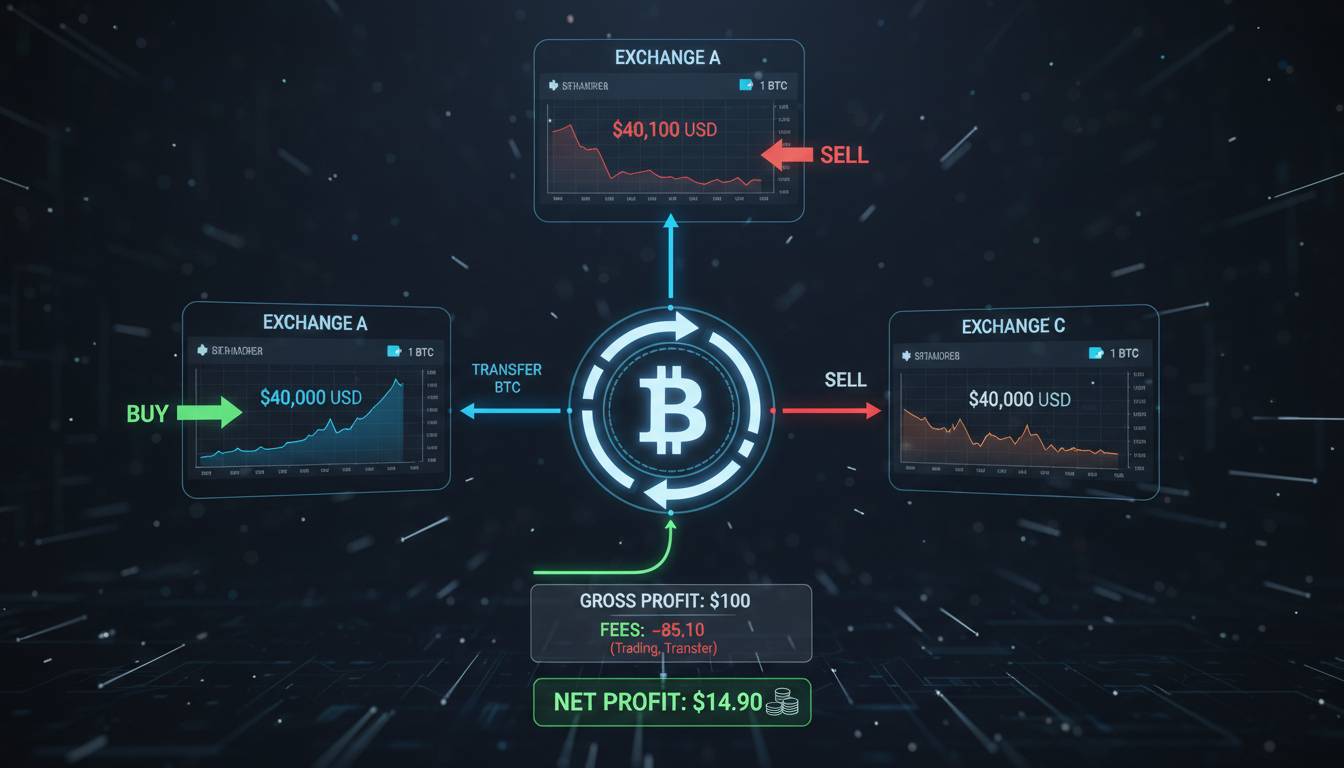
Imagine Bitcoin is trading at $67,000 on Coinbase and $67,350 on Kraken. You notice this $350 difference and decide to arbitrage:
- You deposit $67,000 onto Coinbase
- You buy 1 BTC at $67,000
- You transfer the BTC to Kraken (assuming $15 network fee)
- You sell 1 BTC at $67,350 on Kraken
- You withdraw USD to your bank (assuming $25 withdrawal fee)
Your profit calculation:
- Sale proceeds: $67,350
- Purchase cost: -$67,000
- Network transfer fee: -$15
- Withdrawal fee: -$25
- Net profit: $310 (0.46% return)
This example illustrates why arbitrage requires substantial capital—the absolute dollar profit is modest relative to the capital employed, and fees can quickly eat into returns.
Types of Cryptocurrency Arbitrage
Not all arbitrage opportunities are created equal. Traders employ several distinct strategies depending on their technical capabilities, capital availability, and risk tolerance.
Spatial Arbitrage
The most straightforward approach: buying cryptocurrency on one exchange and transferring it to another where the price is higher. This requires maintaining balances on multiple exchanges and being prepared to act quickly when opportunities arise.
Pros: Conceptually simple, doesn’t require complex technical setup
Cons: Subject to transfer delays and blockchain congestion; price can move during transfer time
Triangular Arbitrage
This more sophisticated strategy involves three different cryptocurrencies on a single exchange. A trader might exchange Bitcoin for Ethereum, then Ethereum for Solana, then Solana back to Bitcoin—all within one platform. If the conversion rates don’t perfectly align with the actual market values, a profit can be captured without any blockchain transfers.
For example, if converting BTC→ETH→SOL→BTC should theoretically return you to your starting amount but actually returns slightly more, you’ve captured an arbitrage profit.
Pros: No blockchain transfer delays; faster execution
Cons: Requires deep understanding of conversion rates; more complex calculations; still subject to exchange downtime and API issues
Decentralized Finance (DeFi) Arbitrage
Decentralized exchanges (DEXs) like Uniswap and Raydium use automated market makers (AMMs) rather than order books. Price discrepancies between DEXs and centralized exchanges, or between different DEXs, create arbitrage opportunities.
Pros: Often operates outside traditional exchange regulatory frameworks
Cons: Smart contract risk, impermanent loss, and complex gas fee management on networks like Ethereum
Statistical Arbitrage
This advanced approach uses mathematical models and machine learning to identify patterns across many cryptocurrencies simultaneously. Traders might short overperforming assets and long underperforming ones, betting that prices will converge over time.
Pros: Diversified across many positions; sophisticated risk management
Cons: Requires significant programming expertise and capital; often dominated by institutional players
The Real Costs and Risks
Arbitrage is rarely the “risk-free” opportunity it’s sometimes advertised to be. Understanding the full cost structure and risk factors is essential before pursuing this strategy.
Transaction Costs
Every step in the arbitrage process carries fees:
- Trading fees: Most exchanges charge 0.1%-0.5% per trade, though high-volume traders can negotiate lower rates
- Withdrawal fees: Cryptocurrency network fees vary; Bitcoin transfers might cost $5-$50 depending on network congestion, while Ethereum transactions fluctuate widely
- Deposit fees: Some exchanges charge for fiat deposits, though this is less common in the US market
- Spread costs: The bid-ask spread—the difference between buying and selling prices—acts as an implicit cost
When you’re chasing a 0.5% price differential, even modest fees can eliminate your profit margin entirely.
Execution Risk
Cryptocurrency markets move quickly. The price gap you identified might close by the time you execute your trade, leaving you with a losing position. This is especially problematic for spatial arbitrage, where blockchain transfer times create a delay between buying and selling.
Counterparty Risk
When you’re holding cryptocurrency on an exchange, you’re exposed to the exchange’s operational and financial stability. Several exchanges have collapsed or frozen withdrawals over the years, including notable cases like FTX in 2022 and numerous smaller platforms.
Regulatory Risk
The regulatory environment for cryptocurrency remains uncertain. The SEC has taken enforcement action against various crypto platforms, and regulatory changes could suddenly make certain arbitrage strategies unviable or illegal in certain jurisdictions.
Tax Implications
In the United States, the IRS treats cryptocurrency transactions as taxable events. Each buy-sell arbitrage cycle potentially triggers capital gains taxes, complicating the net profitability calculation. Consultation with a tax professional is strongly recommended.
How to Get Started with Crypto Arbitrage
For those genuinely interested in pursuing arbitrage opportunities, a systematic approach is essential.
Step 1: Research and Education
Before risking capital, thoroughly understand how cryptocurrency exchanges operate, how to read order books, and how blockchain transfers work. Practice with small amounts or on testnets before committing significant resources.
Step 2: Choose Your Exchanges
Select reputable exchanges with good liquidity, competitive fee structures, and reliable uptime. US-based traders should prioritize regulated platforms like Coinbase, Kraken, or Gemini, which comply with US securities laws.
Step 3: Set Up Accounts and Verification
Complete full verification on multiple exchanges—this can take weeks for US-based platforms due to Know Your Customer (KYC) requirements. Maintaining balances on several exchanges simultaneously enables faster execution when opportunities arise.
Step 4: Develop Your Strategy
Decide whether you’ll pursue manual arbitrage (monitoring prices yourself and executing trades) or automated arbitrage (using trading bots that detect and execute opportunities automatically). Manual trading suits those with time to monitor markets; automated trading requires technical expertise to set up and maintain.
Step 5: Start Small and Track Everything
Begin with modest capital to test your strategy in real market conditions. Maintain detailed records of every transaction, including fees, transfer times, and the profit or loss on each arbitrage attempt. This data will help you refine your approach over time.
Common Mistakes to Avoid
Many aspiring arbitrage traders make predictable errors that can be avoided with proper preparation.
Chasing tiny spreads: Beginner traders often get excited about any price difference, failing to account for fees and execution time. Only pursue opportunities where the spread significantly exceeds your total costs.
Ignoring transfer times: Bitcoin transfers can take 10-60 minutes during busy periods. During this time, the price differential will almost certainly change. More sophisticated traders use exchanges with faster networks like Solana or utilize cross-chain bridges for quicker transfers.
Underestimating competition: The arbitrage space is highly competitive, with professional trading firms deploying sophisticated algorithms that identify and execute opportunities in milliseconds. Humans simply cannot compete on pure speed—this is why many individual traders focus on less liquid assets where institutional attention is lower.
Neglecting security: Maintaining balances across multiple exchanges increases your attack surface. Use hardware wallets for long-term storage, enable two-factor authentication everywhere, and consider using separate accounts for arbitrage activities.
Is Crypto Arbitrage Right for You?
Arbitrage trading is not suitable for most individual investors. Consider these factors before pursuing this strategy:
Time commitment: Successful arbitrage requires hours of daily monitoring or significant investment in automation infrastructure.
Capital requirements: Meaningful profits require substantial capital—most experts recommend at least $10,000-$25,000 to make the effort worthwhile after accounting for fees and risks.
Technical skill: Understanding APIs, trading bots, and blockchain mechanics is increasingly necessary as competition intensifies.
Risk tolerance: Despite being called “arbitrage,” this strategy carries real risks of loss. Never arbitrage money you cannot afford to lose.
Alternative approaches: For most investors, dollar-cost averaging into a diversified portfolio remains a more suitable strategy than active arbitrage trading.
Frequently Asked Questions
Q: Is cryptocurrency arbitrage legal in the United States?
Yes, cryptocurrency arbitrage is legal in the United States. There’s no law against buying an asset on one platform and selling it on another at a higher price—this is simply how markets work. However, you must report all profits as capital gains on your tax returns, and any exchange you use must comply with US regulations, including KYC/AML requirements. The CFTC has jurisdiction over cryptocurrency derivatives, while the SEC has taken the position that many tokens are securities subject to registration requirements.
Q: How much money do I need to start arbitrage trading?
Most experts recommend at least $10,000-$25,000 to pursue arbitrage seriously. With smaller amounts, the transaction fees and effort required don’t justify the modest absolute profits. For example, a $1,000 capital base pursuing a generous 2% spread would only generate $20 before fees—barely worth the time investment. Remember that you’ll need to maintain balances on multiple exchanges simultaneously, so your starting capital needs to cover several thousand dollars on each platform.
Q: Can I use arbitrage bots to automate trading?
Yes, arbitrage bots exist and can automate the process of detecting and executing trades. Popular options include HaasOnline, Cryptohopper, and Bitsgap. However, these bots require significant setup expertise, ongoing maintenance, and typically cost $50-$500+ monthly in subscription fees. Additionally, bots face their own risks: API failures, exchange outages, and the ever-present competition from faster algorithmic traders. Many experienced traders recommend learning manual arbitrage first before investing in automation.
Q: Why do arbitrage opportunities exist if they’re profitable?
Opportunities persist because of real-world friction. Blockchain transfers take time (unlike instant stock settlement), exchanges have different liquidity levels, regional demand varies, and not all traders have equal access to all markets. Additionally, opportunities disappear quickly when identified—the existence of profit potential attracts traders who compete away the advantage. In 2017, spreads of 5%+ were common; today, most profitable opportunities on major cryptocurrencies are below 1% due to intense competition. The opportunities that remain require either significant capital, superior technology, or focus on less-efficient altcoins.
Q: What’s the biggest risk in cryptocurrency arbitrage?
The biggest risk is price movement during transfer time. When you buy Bitcoin on Exchange A and need to transfer it to Exchange B to sell, the price can change significantly during the transfer window. If Bitcoin drops in value faster than you can complete the transfer, you could end up selling at a loss. This “execution risk” means arbitrage is never truly risk-free. Additional major risks include exchange collapses (counterparty risk), unexpected fee increases, and regulatory shutdowns of certain strategies or exchanges.
Conclusion
Cryptocurrency arbitrage offers a legitimate way to profit from market inefficiencies, but it’s far from the effortless “free money” sometimes advertised. The strategy requires substantial capital, technical expertise, constant attention, and acceptance of real risks including execution delays, exchange failures, and regulatory changes.
For most individual investors, the complexity and capital requirements make arbitrage unsuitable. Time spent learning arbitrage might be better directed toward improving skills in other investment strategies with more predictable risk-reward profiles.
If you do decide to pursue arbitrage, start with tiny amounts, track every transaction meticulously, and never risk money you cannot afford to lose. The cryptocurrency market will continue evolving, and opportunities will shift with it—but the fundamental principle remains: be skeptical of claims of easy profits, understand your costs completely, and respect the sophisticated competition you’re up against.
Disclaimer: This article is for educational purposes only and does not constitute financial advice. Cryptocurrency investments carry significant risk, including the potential loss of your entire capital. Consult with licensed financial professionals and tax advisors before making investment decisions.