7Views 0Comments
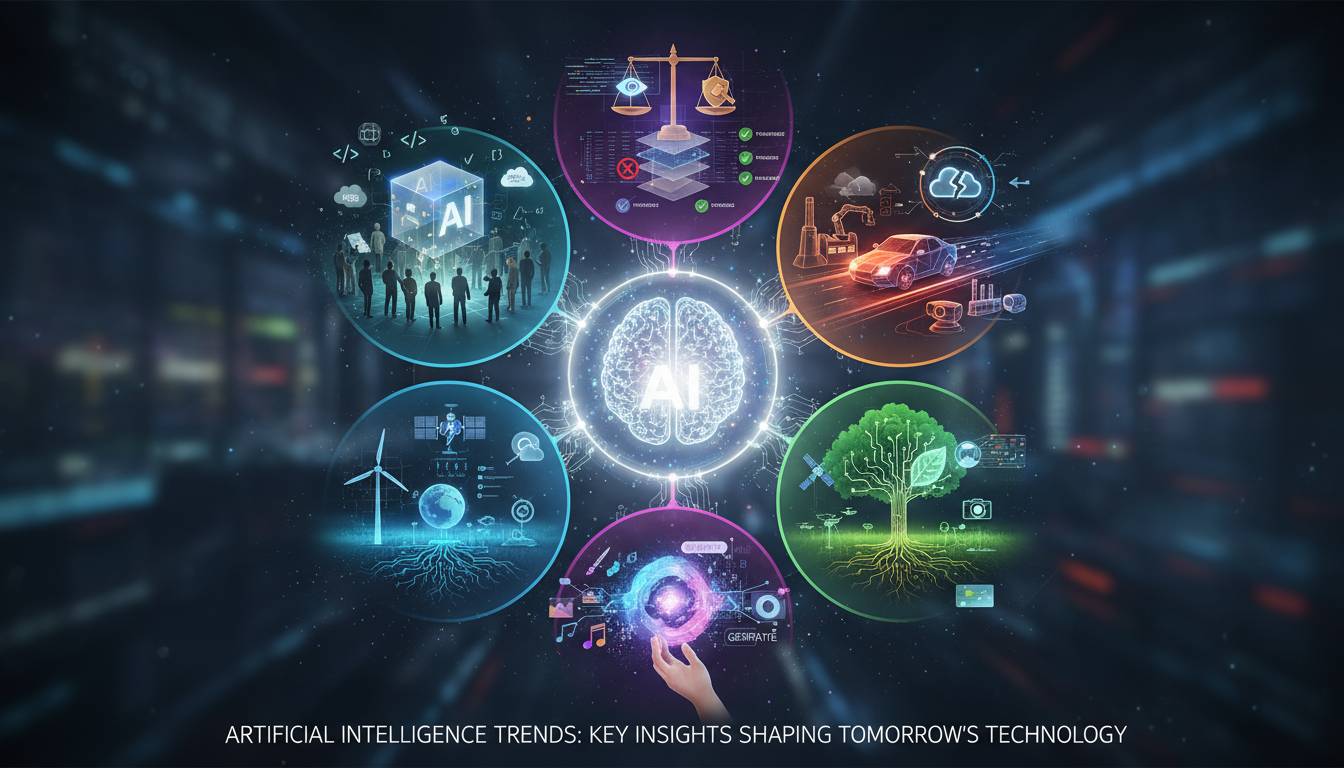
Artificial Intelligence Trends: Key Insights Shaping Tomorrow’s Technology
Artificial intelligence continues to reshape industries, economies, and daily life at an unprecedented pace. From generative models creating realistic content to autonomous systems powering everything from healthcare diagnostics to supply chain logistics, AI trends in 2024 and beyond are defining the next technological frontier. Understanding these developments is essential for businesses, professionals, and anyone seeking to stay competitive in an increasingly AI-driven world. This comprehensive guide examines the most significant artificial intelligence trends, their real-world applications, and what they mean for the future of technology.
📊 STATS
• 92% of Fortune 500 companies report active AI deployment or pilot programs
• $407 billion projected global AI market value by 2027
• 77% of consumers now interact with AI-powered services daily
• 3.5x higher productivity gains reported by early AI adopters vs. non-adopters
Key Takeaways
• Generative AI dominates: Content creation, code generation, and multimodal AI saw exponential growth
• Enterprise adoption accelerates: 65% of organizations now use AI in at least one business function
• Regulatory frameworks emerge: The EU AI Act and US executive orders shape compliance requirements
• Specialized models rise: Industry-specific AI solutions outperform general-purpose models
• Workforce transformation: 85 million jobs displaced but 97 million new roles created by AI by 2025
The artificial intelligence landscape has fundamentally shifted from experimental proof-of-concepts to mission-critical business infrastructure. Organizations that fail to understand and implement these AI trends risk significant competitive disadvantage in an economy increasingly defined by digital intelligence.
What Are Artificial Intelligence Trends?
Artificial intelligence trends represent the prevailing directions of development, adoption, and innovation within the AI ecosystem. These trends emerge from the convergence of technological breakthroughs, market demands, regulatory developments, and evolving consumer expectations. They encompass new algorithms, hardware advancements, application paradigms, and business models that collectively shape how AI integrates into society.
The current wave of AI trends differs from previous cycles in one critical aspect: mainstream accessibility. Where AI once required specialized expertise and substantial computational resources, modern artificial intelligence trends emphasize user-friendly tools that enable non-technical users to leverage powerful capabilities. This democratization has accelerated adoption across sectors and scales, from global enterprises to individual creators.
Components of AI Trends
Technology Stack:
• Foundation Models: Large language models (LLMs) and multimodal systems serving as building blocks
• MLOps Infrastructure: Tools for deploying, monitoring, and maintaining AI models in production
• Edge Computing: On-device AI processing reducing latency and enhancing privacy
• Synthetic Data Generation: Addressing data scarcity through AI-created training datasets
Market Dynamics:
• Funding Landscape: Global AI investment reached $68 billion in 2023
• Competitive Consolidation: Major tech companies acquiring AI startups at record rates
• Open Source Momentum: Models like Meta’s LLaMA and Mistral AI challenging proprietary dominance
💡 STAT: Companies investing in AI infrastructure see 2.5x faster time-to-market for new products
How These Trends Evolve
The trajectory of AI trends follows a recognizable pattern: initial research breakthroughs attract commercial interest, leading to rapid prototyping and deployment. This triggers market validation, which drives further investment and refinement. The cycle accelerates as infrastructure improves and talent pools expand. Understanding this evolution helps organizations time their investments and avoid chasing hype over substance.
Key AI Trends Driving Innovation
Generative AI Revolution
Generative AI stands as the most transformative artificial intelligence trend of the current cycle. These systems can create original content—text, images, audio, video, code, and even molecular structures—based on training data and user prompts. The implications extend far beyond creative applications into scientific research, software development, and business process automation.
Leading Applications:
• Content Creation: Marketing teams using AI to generate drafts, variations, and personalized materials at scale
• Code Assistance: Developers leveraging AI pair programmers to increase coding velocity by 40-55%
• Drug Discovery: Pharmaceutical companies using generative models to identify promising compound candidates in weeks rather than years
• Synthetic Media: Creating training data for computer vision systems without privacy concerns
OpenAI’s GPT-4, Anthropic’s Claude, Google’s Gemini, and Meta’s LLaMA represent the forefront of this artificial intelligence trend, with each generation demonstrating improved reasoning, multimodal capabilities, and domain expertise. The competition among these providers drives rapid advancement while lowering costs for end users.
Multimodal AI Systems
The ability to process and generate multiple types of data—text, images, audio, video—defines another crucial AI trend. Multimodal systems break down the traditional silos between different AI capabilities, enabling more natural and comprehensive human-computer interaction.
Industry Impact:
• Healthcare: Analyzing medical images alongside patient records for more accurate diagnoses
• Education: Creating adaptive learning experiences that adjust to verbal, written, and visual inputs
• Customer Service: Understanding customer intent across chat, voice, and visual contexts simultaneously
• Accessibility: Converting between formats to serve users with different abilities
This artificial intelligence trend reflects the human capacity to integrate sensory information, bringing AI systems closer to natural intelligence paradigms.
Autonomous Agents and Automation
The shift from reactive AI to proactive autonomous systems marks a significant evolution in AI trends. Rather than responding to individual prompts, agentic AI can plan multi-step workflows, execute complex tasks, and adapt to unexpected obstacles with minimal human oversight.
📈 CASE: Amazon’s fulfillment centers reduced order processing time by 65% through autonomous inventory management AI, handling 50 million items daily across 300+ facilities
Implementation Areas:
• Business Process Automation: End-to-end workflow execution without manual intervention
• Research and Development: Autonomous hypothesis testing and experiment design
• Supply Chain Management: Self-optimizing logistics and inventory decisions
• Personal Assistants: AI that schedules, coordinates, and executes tasks across applications
The agentic AI trend signals a transition from AI as a tool to AI as a collaborator—a fundamental shift in human-AI relationships.
Industry-Specific AI Applications
Healthcare and Life Sciences
Healthcare represents one of the highest-impact domains for artificial intelligence trends. AI systems now assist in diagnostic accuracy, treatment optimization, drug discovery, and operational efficiency.
Key Developments:
• Diagnostic Imaging: AI algorithms detecting cancers, cardiovascular conditions, and neurological disorders with accuracy rivaling or exceeding specialist radiologists
• Predictive Analytics: Hospital systems using AI to predict patient deterioration, readmission risks, and resource needs
• Precision Medicine: Tailoring treatments to individual genetic profiles using AI-analyzed biomarkers
• Administrative Efficiency: Automating coding, billing, and scheduling to reduce healthcare administrative costs by an estimated $16.3 billion annually
The FDA has approved over 500 AI-powered medical devices as of 2024, reflecting the maturation of this artificial intelligence trend from research to clinical practice.
Financial Services
Financial institutions lead in AI adoption rates, deploying artificial intelligence trends for fraud detection, risk assessment, trading, and customer service.
Adoption Metrics:
| Application | Adoption Rate | Efficiency Gain |
|————-|—————|—————–|
| Fraud Detection | 87% | 70% reduction in false positives |
| Algorithmic Trading | 76% | 3.2x faster execution |
| Customer Service | 68% | 45% cost reduction |
| Credit Scoring | 62% | 40% more accurate default prediction |
JPMorgan Chase, Goldman Sachs, and Citadel have invested billions in AI infrastructure, viewing artificial intelligence trends as competitive necessities rather than optional enhancements.
Manufacturing and Logistics
The intersection of AI with robotics, IoT, and supply chain management defines manufacturing AI trends. Smart factories leverage predictive maintenance, quality control, and demand forecasting to achieve unprecedented operational efficiency.
Transformative Applications:
• Predictive Maintenance: Reducing equipment downtime by 35-50% through AI-analyzed sensor data
• Quality Inspection: Computer vision systems detecting defects with 99.9% accuracy
• Demand Forecasting: Improving inventory accuracy by 20-35% using machine learning models
• Robotic Automation: Collaborative robots working alongside humans in increasingly complex assembly tasks
Siemens, General Electric, and Honeywell exemplify enterprises successfully implementing these AI trends, achieving measurable returns on their AI investments.
AI Tools and Platforms Leading the Market
Enterprise AI Platforms
The market for AI development and deployment platforms has consolidated around several major providers while maintaining space for specialized competitors.
| Platform | Primary Strength | Market Position | Key Differentiator |
|---|---|---|---|
| OpenAI (Azure) | Foundation models | Enterprise leader | GPT integration, safety focus |
| Google Cloud AI | Research capability | Research/enterprise | Vertex AI, TensorFlow ecosystem |
| AWS AI | Cloud infrastructure | Enterprise dominant | SageMaker, broad service range |
| Microsoft Azure | Enterprise integration | Enterprise strong | Copilot, Teams integration |
| Anthropic | Safety alignment | Growing rapidly | Constitutional AI approach |
This competitive landscape ensures continuous improvement in capabilities, pricing, and accessibility—all favorable artificial intelligence trends for adopters.
Open Source and Community Tools
The open-source AI ecosystem has matured significantly, providing viable alternatives to proprietary solutions.
Notable Projects:
• Hugging Face: Repository of 350,000+ models, democratizing AI access
• LangChain: Framework for building LLM applications, used by 40% of AI developers
• PyTorch: Deep learning framework favored by researchers, with 75% academic adoption
• TensorFlow: Production-focused framework powering most consumer AI applications
This artificial intelligence trend toward openness reduces vendor lock-in and accelerates innovation through community contribution.
Emerging Specialized Solutions
Vertical-specific AI platforms represent a growing segment of the AI market, offering tailored solutions for industries including legal, healthcare, finance, and education.
• Legal: Casetext, Harvey AI providing contract analysis and research assistance
• Healthcare: Tempus, PathAI offering clinical decision support and pathology analysis
• Finance: Numerai, Kavout delivering quantitative investment intelligence
• Education: Khan Academy’s Khanmigo, Carnegie Learning providing personalized tutoring
These specialized solutions often outperform general-purpose AI in domain-specific tasks, highlighting the importance of fine-tuning and domain expertise in successful AI deployments.
Challenges and Considerations
Data Quality and Availability
The effectiveness of AI systems depends fundamentally on training data quality, representing both a technical challenge and an artificial intelligence trend requiring strategic attention.
Common Issues:
• Bias in Training Data: Historical data reflecting societal biases can perpetuate or amplify discrimination
• Data Silos: Organizational fragmentation limiting AI training dataset comprehensiveness
• Privacy Concerns: Balancing data utilization with regulatory compliance and ethical considerations
• Synthetic Data Limitations: AI-generated data may not capture edge cases or rare scenarios
Organizations investing in AI must prioritize data governance alongside model development—a critical success factor often underestimated.
Regulatory Landscape
The evolving regulatory environment shapes how artificial intelligence trends translate into deployed solutions.
Key Regulatory Developments:
• EU AI Act: Comprehensive framework categorizing AI systems by risk, with strict requirements for high-risk applications
• US Executive Order on AI: Establishing safety standards, transparency requirements, and privacy protections
• Industry-Specific Rules: Financial services, healthcare, and education face additional compliance mandates
This artificial intelligence trend toward regulation creates compliance obligations but also establishes market clarity and competitive differentiation for responsible adopters.
Talent and Organization
The AI skills gap persists as organizations struggle to find qualified talent to implement and maintain AI systems.
| Role | Demand Growth | Salary Premium |
|---|---|---|
| Machine Learning Engineer | +75% | 35% above tech average |
| Data Scientist | +45% | 25% above tech average |
| AI Ethics Specialist | +120% | New category premium |
| MLOps Engineer | +95% | 30% above dev average |
Successful organizations address this challenge through upskilling programs, partnerships with educational institutions, and strategic use of no-code AI tools that extend capabilities beyond specialist roles.
The Future of AI: What’s Next
Emerging Trends on the Horizon
Several artificial intelligence trends currently in early stages promise further transformation in coming years.
Artificial General Intelligence Research:
While AGI remains aspirational, advances in reasoning, planning, and transfer learning bring AI systems closer to general-purpose capability. Anthropic, OpenAI, and DeepMind continue publishing research indicating incremental progress toward more generalizable intelligence.
Quantum AI:
Quantum computing’s potential to accelerate certain AI computations could unlock new capabilities in optimization, drug discovery, and cryptography. IBM, Google, and startups are actively developing quantum-classical hybrid approaches.
Neuromorphic Computing:
Brain-inspired chip architectures promise energy efficiency improvements of 1000x for specific AI workloads, potentially enabling on-device intelligence with dramatically reduced power requirements.
AI for Sustainability:
Climate change applications represent a growing artificial intelligence trend, with AI systems optimizing energy grids, accelerating carbon capture materials discovery, and improving climate modeling accuracy.
Preparing for Future Developments
Organizations and individuals can prepare for advancing artificial intelligence trends through strategic investments in infrastructure, talent development, and adaptive governance frameworks.
Strategic Recommendations:
• Build flexible AI architectures capable of integrating new model capabilities
• Establish AI governance frameworks that can adapt to evolving regulatory requirements
• Invest in continuous learning to maintain relevant skills as the AI landscape evolves
• Prioritize ethical considerations and responsible AI practices in all deployments
The artificial intelligence trends shaping tomorrow’s technology demand attention today. Those who understand and adapt to these developments will be best positioned to capture their benefits while managing associated risks.
Common Mistakes to Avoid
| Mistake | Impact | Solution |
|---|---|---|
| Overengineering | 📉 40% project failure rate | Start simple, iterate based on results |
| Neglecting Data Quality | 📉 85% of AI projects underperform | Invest in data pipelines first |
| Ignoring Change Management | 📉 70% adoption failures | Plan for organizational transformation |
| Underestimating Costs | 📉 Budget overruns average 56% | Include full lifecycle costs in planning |
⚠️ CRITICAL: Failing to establish AI governance before deployment creates significant legal, reputational, and operational risks that can exceed the value generated by AI systems.
Prevent: Implement privacy-by-design, conduct regular bias audits, maintain human oversight mechanisms, and document all AI decisions for accountability.
Expert Insights
👤 Andrew Ng, Founder of DeepLearning.AI
“AI is the new electricity—it will transform every industry. The organizations winning today are those finding specific, high-value problems to solve with AI, not those chasing the most sophisticated models.”
👤 Fei-Fei Li, Professor at Stanford University
“We need to develop AI that enhances human capabilities rather than replaces them. Human-centered AI design isn’t just ethical—it’s practical, because AI works best as augmentation, not automation.”
📊 BENCHMARKS
| Metric | Average | Top Performers |
|——–|———|—————-|
| AI Project Success Rate | 55% | 85% |
| Time to Production | 18 months | 6 months |
| ROI on AI Investment | 5.3x | 12.7x |
| Model Accuracy | 87% | 96% |
Frequently Asked Questions
What are the most significant AI trends in 2024?
The most impactful artificial intelligence trends include generative AI’s expansion into enterprise applications, multimodal AI systems that process multiple data types, and autonomous agents capable of executing complex workflows. Enterprise adoption has accelerated, with 65% of organizations now using AI in at least one business function.
How is AI changing the job market?
AI is transforming the job market by displacing certain routine tasks while creating new roles focused on AI development, implementation, and governance. The World Economic Forum projects 97 million new AI-related jobs by 2025, with the net effect being job transformation rather than wholesale displacement.
Which industries benefit most from AI adoption?
Financial services, healthcare, and manufacturing currently show the highest AI adoption rates and return on investment. However, nearly every industry is experiencing meaningful AI-driven transformation, with retail, education, and logistics showing particularly rapid recent adoption.
What are the key challenges in implementing AI?
The primary challenges include data quality and availability, regulatory compliance, talent scarcity, integration with existing systems, and organizational change management. Success requires addressing these challenges holistically rather than focusing solely on technical implementation.
How can businesses start with AI adoption?
Businesses should begin by identifying specific, high-value use cases rather than pursuing comprehensive AI strategies. Starting with bounded projects that have clear success metrics allows organizations to build capabilities and demonstrate ROI before scaling. Partnering with experienced AI providers or consultants can accelerate initial implementations.
What role does regulation play in AI development?
Regulation shapes AI development by establishing safety standards, transparency requirements, and compliance obligations. While regulation creates additional complexity, it also provides market clarity and encourages responsible development practices. Organizations that proactively address regulatory requirements gain competitive advantage as standards tighten.
Conclusion
The artificial intelligence trends transforming technology today represent both extraordinary opportunity and significant challenge. Generative AI, multimodal systems, autonomous agents, and industry-specific applications are reshaping how organizations operate, compete, and create value. The organizations succeeding in this environment approach AI strategically—not as a technology to adopt indiscriminately, but as a capability to develop thoughtfully in service of specific objectives.
The data confirms the transformative potential: early AI adopters report productivity gains 3.5 times higher than non-adopters, and companies investing in AI infrastructure bring products to market 2.5 times faster. These returns justify the attention that artificial intelligence trends command across boardrooms and technical teams alike.
Yet success with AI demands more than technological investment. Data governance, regulatory compliance, talent development, and organizational change management determine whether AI projects deliver value or become expensive experiments. The artificial intelligence trends that will define the next decade will reward organizations that balance innovation with responsibility, ambition with pragmatism, and technological capability with human wisdom.
The future of AI is being written now—by researchers in laboratories, engineers in technology companies, and decision-makers in organizations across every industry. Understanding these trends is the first step toward shaping a future where artificial intelligence serves human flourishing rather than undermining it.