4Views 0Comments
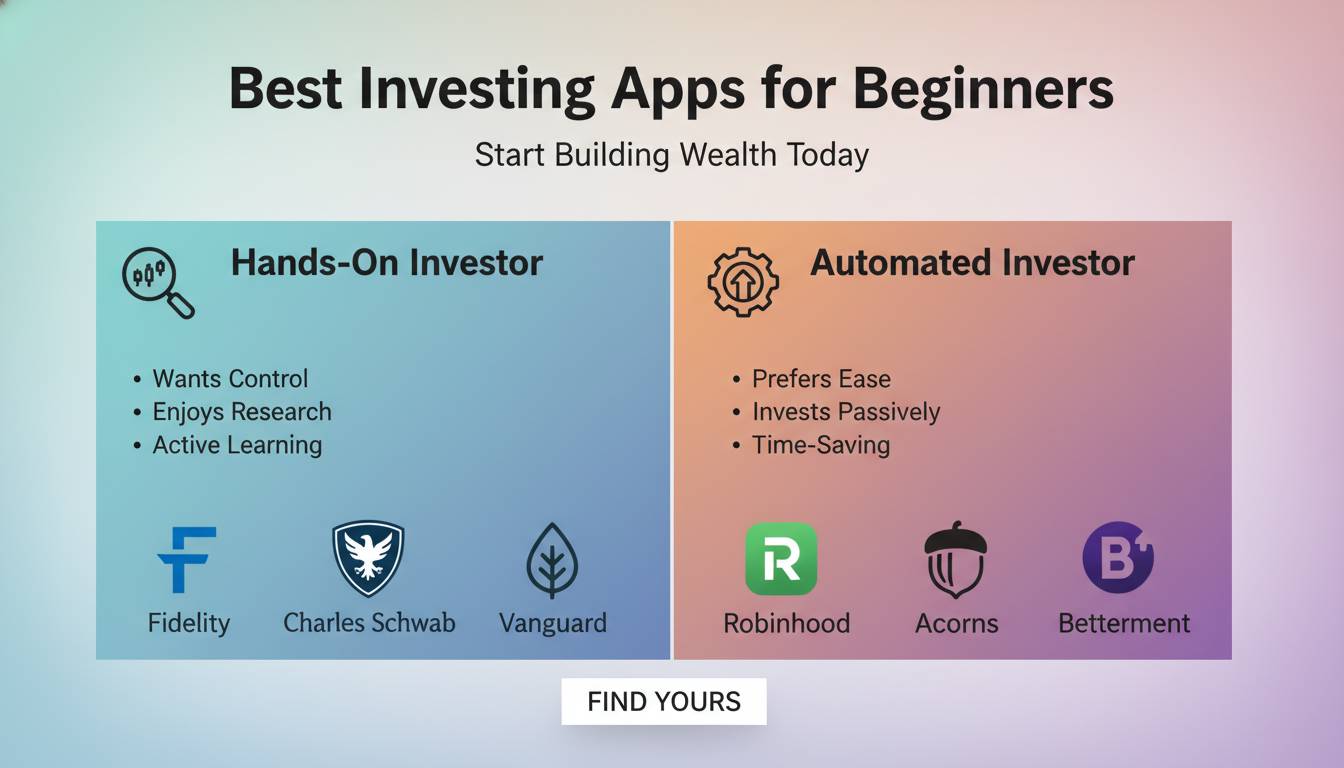
Best Investing Apps for Beginners | Start Building Wealth Today
The best investing apps for beginners make it simple to start building wealth with as little as $1. Modern investment platforms have eliminated traditional barriers like minimum deposits and high commission fees, enabling anyone to begin investing in stocks, ETFs, and fractional shares within minutes. These apps combine user-friendly interfaces with powerful educational tools, making them ideal for those new to the financial markets.
📊 STATS
• 31% of Americans invest in stocks as of 2024 (FINRA)
• $0 minimum deposit required by most top apps (2024)
• 13+ million users on leading platforms like Robinhood
• $0 commission trading now standard across major apps
Key Takeaways
• Fidelity offers the best overall experience with $0 commissions and excellent research tools
• Robinhood provides the simplest interface for absolute beginners
• Acorns automatically invests spare change through round-ups
• Betterment leads in automated portfolio management
• All recommended apps are SIPC-insured protecting up to $500,000
What Are Investing Apps?
Investing apps are mobile and web-based platforms that allow individuals to buy and sell financial securities directly from their smartphones or computers. These digital platforms have transformed traditional brokerage services by offering streamlined interfaces, real-time trading, and educational resources designed specifically for novice investors.
Core Features
Account Types Available:
• Individual Brokerage: Taxable accounts for personal investing
• Traditional IRA: Pre-tax contributions, taxed upon withdrawal
• Roth IRA: After-tax contributions, tax-free growth and withdrawals
• Joint Accounts: Shared ownership with a partner or family member
Investment Options:
• Individual Stocks: Ownership shares in single companies
• ETFs: Baskets of securities that track indexes or sectors
• Mutual Funds: Professionally managed investment pools
• Fractional Shares: Portions of expensive stocks starting at $1
• Options: Contracts giving the right to buy/sell stocks
💡 STAT: Fractional share trading has increased 400% since 2020, making high-priced stocks like Amazon ($180+) accessible to beginners
How Investing Apps Work
Opening an account takes approximately 10-15 minutes and requires basic personal information, Social Security number, and bank account details for funding. Once approved, users can browse investments, execute trades, and monitor portfolios in real-time. Most apps send push notifications for price alerts, news updates, and portfolio changes.
The process involves linking a bank account, funding the investment account, researching securities through built-in tools, and placing market or limit orders. Settlement typically occurs within two business days, with funds available for immediate reinvestment or withdrawal.
Benefits of Using Investing Apps for Beginners
| Benefit | Impact | Source |
|---|---|---|
| $0 Commissions | Save $5-10 per trade | SEC, 2024 |
| Low Minimums | Start with $1-$5 | Company websites |
| Fractional Shares | Invest in any stock | NASDAQ, 2024 |
| Educational Tools | Learn while earning | App reviews |
| Automated Features | Set it and forget it | Investopedia |
Top Advantages
Accessibility: Traditional brokerages often required $1,000+ minimums and charged $5-10 per trade. Modern apps eliminate these barriers entirely, with most offering $0 minimum deposits and commission-free trading as of 2024.
Educational Integration: Leading apps like Fidelity and Charles Schwab embed educational content directly into their platforms. Users learn about compound interest, asset allocation, and diversification while making investment decisions.
Real-Time Information: Unlike old-school brokerages that delayed quotes by 15 minutes, apps provide streaming real-time prices, market news, and analyst ratings instantly.
Automated Investing: Services like Betterment and Acorns automate contributions and rebalancing, helping users maintain proper asset allocation without manual intervention.
📈 CASE: Acorns users save and invest an average of $200 monthly through automatic round-ups, building portfolios averaging $15,000 within five years
Comparison of Top Investing Apps for Beginners
| Factor | Fidelity | Robinhood | Acorns | Betterment | Schwab |
|---|---|---|---|---|---|
| Minimum | $0 | $0 | $5 | $10 | $0 |
| Commissions | $0 | $0 | $1-3/mo | 0.25% | $0 |
| Fractional | ✅ | ✅ | ❌ | ✅ | ✅ |
| Robo-Advisor | Fidelity Go | ❌ | ✅ | ✅ | Intelligent |
| Best For | All-around | Simplicity | Beginners | Automation | Research |
Fidelity
✅ Pros: Comprehensive research tools, $0 commissions, excellent customer service, wide investment selection
❌ Cons: Interface can feel overwhelming for complete beginners
💰 Price: $0 trading, optional managed accounts start at $10/month
🎯 For: Beginners who want to learn and grow with their platform
Fidelity remains the gold standard for beginners seeking a full-featured platform. The company offers over 10,000 mutual funds, thousands of ETFs, and fractional shares through Fidelity Spire. New investors benefit from extensive educational content, including video tutorials, articles, and virtual workshops. The mobile app provides intuitive navigation while the web platform offers advanced charting for those who develop skills over time.
Robinhood
✅ Pros: Extremely simple interface, no account minimums, clean design, crypto trading available
❌ Cons: Limited research tools, no mutual funds, occasional service outages
💰 Price: $0 trading, optional Robinhood Gold $5/month
🎯 For: Absolute beginners wanting the simplest possible experience
Robinhood revolutionized investing by stripping away complexity. The interface displays a single feed of stocks with simple buy/sell buttons, making it nearly impossible to confuse. However, the platform offers limited research capabilities compared to competitors, and beginners may struggle to understand what they’re actually buying without additional research. The introduction of Robinhood Gold providesLevel 2 market data and larger instant deposits for $5 monthly.
Acorns
✅ Pros: Automatic investing, round-up feature, micro-investing, retirement accounts available
❌ Cons: Monthly fees ($3-12), limited investment control, no individual stocks
💰 Price: $3-12/month depending on features
🎯 For: Beginners who struggle to remember to invest
Acorns simplifies investing through automation. Users link debit and credit cards, with every purchase rounded to the nearest dollar—the difference gets invested automatically. For example, a $4.50 coffee results in $0.50 invested. The platform offers five portfolios ranging from conservative to aggressive, adjusting automatically based on goals and risk tolerance. While monthly fees eat into small balances, the automatic nature builds consistent habits.
Betterment
✅ Pros: Professional portfolio management, tax-loss harvesting, goal-based investing, low minimums
❌ Cons: Management fees (0.25-0.40%), limited customization, no individual stocks
💰 Price: 0.25% annual fee for Digital, 0.40% for Premium
🎯 For: Hands-off investors wanting professional oversight
Betterment pioneered the robo-advisor space, offering algorithmically-managed portfolios tailored to individual goals and risk tolerance. Users answer questions about timeline, risk tolerance, and financial goals, then Betterment constructs and automatically rebalances portfolios. The platform excels at tax efficiency, employing tax-loss harvesting strategies that offset capital gains with losses—particularly valuable for taxable accounts.
Charles Schwab
✅ Pros: Excellent research, $0 commissions, branch network, ATM fee refunds
❌ Cons: Interface less modern than competitors
💰 Price: $0 trading, advisory services vary
🎯 For: Beginners who may want to visit physical branches
Schwab combines the resources of a major brokerage with beginner-friendly pricing. The platform offers comprehensive research from multiple providers, real-time streaming quotes, and a network of 300+ branch locations nationwide. Schwab Intelligent Portfolios provides free automated management with no advisory fees—revenue comes from cash allocations held in the program’s cash feature.
How to Start Investing with Apps
Prerequisites:
– [ ] Bank account (checking or savings)
– [ ] Social Security number
– [ ] Government-issued ID
– [ ] Age 18+ (or guardian for minors)
– [ ] Smartphone or computer with internet
Time: 15-30 minutes | Cost: $0-$10
Steps
1. Choose Your Platform
Select an app based on your goals: Fidelity for comprehensive features, Robinhood for simplicity, Acorns for automation, or Betterment for managed portfolios. Consider whether you want individual stocks, ETFs only, or full mutual fund access.
⏱ 10 minutes | 💡 Tip: Most apps allow opening multiple accounts, so start with one and expand later
2. Create Your Account
Download the app or visit the website, enter personal information including name, address, Social Security number, and employment status. Verify identity through ID upload and answer suitability questions about investment experience.
⚠️ Avoid: Rushing through risk questions → Fix: Answer honestly to receive appropriate recommendations
3. Link Your Bank Account
Connect a checking or savings account for funding. Most apps support instant transfers through Plaid, while others require manual ACH transfers taking 2-3 business days. Start with small amounts while verifying everything works correctly.
4. Fund Your Account
Transfer money from your linked bank account. While some apps offer instant funding, others require waiting periods. Most experts recommend starting with $100-500 to get comfortable before adding larger amounts.
⚠️ Avoid: Investing all available cash immediately → Fix: Keep 3-6 months expenses in savings before aggressive investing
5. Research and Select Investments
Browse available securities using screening tools. Beginners should consider low-cost index ETFs like SPY (S&P 500), VTI (total stock market), or BND (bonds). Fractional shares allow purchasing expensive stocks with minimal money.
6. Place Your First Order
Select a security, choose order type (market executes immediately at current price, limit sets your price), enter quantity or dollar amount, and confirm. Monitor your first investment and set price alerts.
Troubleshooting:
| Problem | Fix |
|———|—–|
| Transfer failed | Verify bank credentials, try again in 24 hours |
| Order not executing | Ensure market is open (9:30 AM – 4 PM ET) |
| Account pending verification | Upload clearer ID, contact support |
| Can’t sell position | Check if stock has trading restrictions |
Common Mistakes Beginners Make
| Mistake | Impact | Solution |
|---|---|---|
| Investing all at once | Buy at market peak | Use dollar-cost averaging |
| Ignoring diversification | 100% loss possible | Spread across sectors/asset classes |
| Chasing hot stocks | Significant losses | Focus on index funds initially |
| Checking portfolio daily | Emotional decisions | Review monthly, not hourly |
| Not starting | 0% returns | Begin with whatever amount possible |
⚠️ CRITICAL: Trying to time the market—waiting for the “perfect” moment to invest—typically results in missing the best trading days. Research shows missing the S&P 500’s 10 best days between 2000-2020 would cut returns by nearly half
Prevent: Set up automatic monthly contributions regardless of market conditions
Expert Insights
👤 John Bogle III, Founder of Vanguard
“Time is your friend, impulse is your enemy. The simplest portfolio works best—a low-cost index fund holds the entire market for minimal cost.”
Data: Index funds beat 92% of actively managed funds over 20 years | Advice: Start simple, stay the course
👤 Catherine McGinn, CFP at Personal Capital
“New investors should automate contributions before they even start. Set up automatic transfers on payday—this removes emotion and builds wealth consistently.”
Data: Automating savings increases contribution rates 30% | Advice: Pay yourself first
📊 BENCHMARKS
| Metric | Average | Top 10% |
|——–|———|———|
| Annual Return | 7-10% | 12-15% |
| Portfolio Turnover | 50%+ | Under 10% |
| Expense Ratio | 0.50% | Under 0.10% |
| Time to $100K | 15-20 years | 10-12 years |
Tools and Resources
| Tool | Cost | For | Rating |
|---|---|---|---|
| Morningstar | Free/$10 | Stock/fund research | ⭐⭐⭐⭐⭐ |
| Yahoo Finance | Free | Portfolio tracking | ⭐⭐⭐⭐ |
| Investopedia | Free | Education | ⭐⭐⭐⭐⭐ |
| Seeking Alpha | Free/Premium | Analysis | ⭐⭐⭐⭐ |
Top Picks:
• Yahoo Finance: Best free portfolio tracking with real-time quotes and news aggregation
• Investopedia Simulator: Practice trading with virtual money before risking real funds
• Mint: Budget integration to find money to invest
Frequently Asked Questions
Which investing app is best for beginners with no money?
Fidelity and Charles Schwab offer $0 minimums and excellent educational resources. Robinhood provides the simplest interface, while Acorns works for those wanting automatic investing through round-ups. You can start with as little as $1 at most platforms, making “no money” essentially irrelevant in 2024.
Do investing apps actually make money?
Yes, investing apps are profitable businesses. Robinhood makes money through payment for order flow (PFOF), interest on user cash, and premium subscriptions. Brokerages like Fidelity and Schwab earn through asset management fees, interest income, and mutual fund partnerships.
Can you lose money on investing apps?
Yes, you can lose your entire investment. Individual stocks can go to zero if companies fail. However, diversified portfolios across ETFs reduce risk significantly. All recommended apps are SIPC-protected, insuring accounts up to $500,000 against brokerage failure—not investment losses.
What is the safest app for beginner investing?
Fidelity, Charles Schwab, and Vanguard are the safest options—these are trillion-dollar firms with excellent regulatory compliance records. SIPC insurance provides additional protection. Avoid lesser-known apps with limited track records or those promising guaranteed returns.
Conclusion
Starting your investment journey has never been easier or more affordable. The best investing apps for beginners in 2024 eliminate traditional barriers while providing powerful tools to build wealth over time. Whether you choose Fidelity for comprehensive features, Robinhood for simplicity, Acorns for automation, or Betterment for professional management, the most important step is simply beginning.
Remember that successful investing requires patience, discipline, and consistency. Focus on low-cost index funds, automate your contributions, and resist the temptation to chase trends or time the market. Starting with even small amounts compounds significantly over decades—the earlier you begin, the more time your money has to grow.
Take action today: download one of these apps, fund your account with whatever amount feels comfortable, and purchase your first share. Your future self will thank you for starting now rather than waiting for the “perfect” moment that never comes.