8Views 0Comments
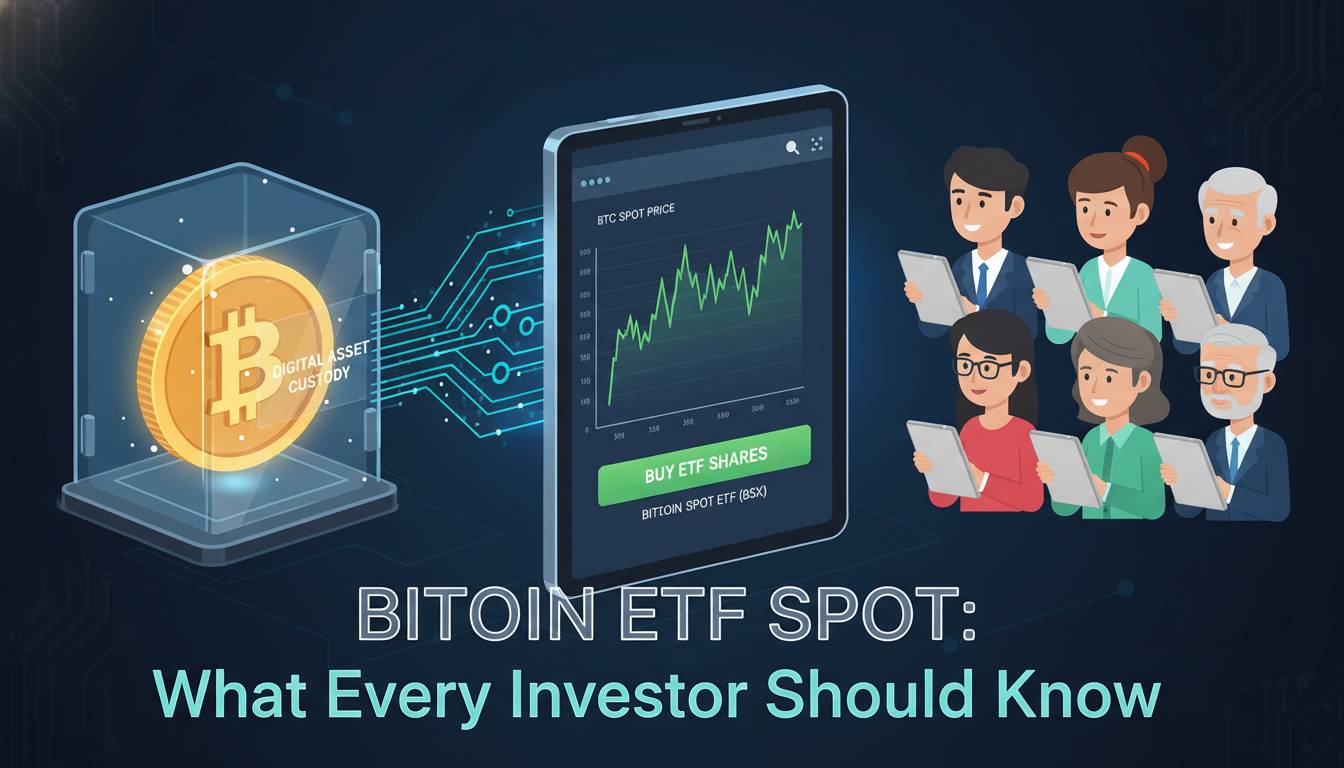
Bitcoin ETF Spot: What Every Investor Should Know
Bitcoin spot ETFs represent one of the most significant developments in cryptocurrency investing since Bitcoin’s creation. These exchange-traded funds directly hold Bitcoin as their underlying asset, allowing investors to gain exposure to Bitcoin’s price movements without the complexities of directly purchasing, storing, and securing the cryptocurrency itself. Since the U.S. Securities and Exchange Commission (SEC) approved the first spot Bitcoin ETFs in January 2024, billions of dollars have flowed into these products, transforming how institutional and retail investors access the world’s largest cryptocurrency.
📊 STATS
• $58.5 billion in cumulative inflows into U.S. spot Bitcoin ETFs through late 2024
• 11 spot Bitcoin ETFs approved by the SEC on January 10, 2024
• $1.1 billion in single-day trading volume for leading spot Bitcoin ETFs
• BlackRock’s IBIT became the fastest-growing ETF in history, reaching $50 billion in assets in under than 300 days
• 40% of Bitcoin trading volume now influenced by ETF-related flows (J.P. Morgan, 2024)
Key Takeaways
• Spot Bitcoin ETFs hold actual Bitcoin, tracking the real-time price of the cryptocurrency
• SEC approval in January 2024 marked a watershed moment for cryptocurrency mainstream adoption
• Lower barriers to entry allow traditional investors to access Bitcoin through standard brokerage accounts
• Custodial solutions eliminate the need for investors to manage private keys or digital wallets
• Regulatory oversight provides investor protections previously unavailable in crypto markets
The launch of spot Bitcoin ETFs has fundamentally changed the investment landscape, offering a bridge between traditional finance and the cryptocurrency ecosystem. For investors considering these products, understanding their structure, benefits, risks, and practical considerations is essential for making informed investment decisions.
What Is a Bitcoin Spot ETF?
A Bitcoin spot ETF is an exchange-traded fund that purchases and holds actual Bitcoin as its primary investment, with the fund’s shares designed to track the spot price of Bitcoin. Unlike futures-based ETFs that derive value from Bitcoin futures contracts, spot ETFs hold the cryptocurrency in custody, offering direct exposure to Bitcoin’s market price. This distinction is crucial for investors seeking authentic price correlation with Bitcoin.
How Spot ETFs Differ from Other Crypto Investment Vehicles
Direct Ownership: Spot Bitcoin ETFs hold Bitcoin in cold storage through qualified custodians, meaning the fund literally owns the underlying asset. When you buy shares of a spot Bitcoin ETF, you’re gaining exposure to Bitcoin’s price without actually holding the cryptocurrency yourself.
Futures ETFs: These funds invest in Bitcoin futures contracts rather than actual Bitcoin. They may experience tracking error due to the cost of rolling futures contracts and do not provide direct Bitcoin ownership.
Bitcoin Mutual Funds: Some financial institutions offer private Bitcoin funds with high minimum investment requirements ($25,000 or more), while spot ETFs have minimums as low as the price of a single share.
Direct Cryptocurrency Purchase: Buying Bitcoin through exchanges requires self-custody, secure storage solutions, and dealing with wallet management complexities. Spot ETFs eliminate these operational burdens.
💡 STAT: Spot Bitcoin ETFs have reduced the average cost of gaining Bitcoin exposure by 60-80% when accounting for custody, security, and transaction costs compared to direct ownership .
Components of a Spot Bitcoin ETF
Elements:
• Bitcoin Holdings: The fund maintains actual Bitcoin in secure, regulated custody
• Authorized Participants: Financial institutions that create/reddem ETF shares in large blocks
• Custodian: A qualified custodian (often Fidelity or Coinbase Custody) holds the Bitcoin
• Administrator: Handles fund accounting, NAV calculation, and investor transactions
• Index Provider: Determines the pricing methodology, typically using major Bitcoin exchanges
How Spot Bitcoin ETFs Work
The mechanics of spot Bitcoin ETFs involve a creation and redemption process facilitated by authorized participants. When demand for ETF shares increases, authorized participants purchase Bitcoin on the open market and deliver it to the fund custodian in exchange for new ETF shares. Conversely, when investors sell ETF shares, authorized participants redeem them for Bitcoin, which is then sold on the open market.
This creation/redemption mechanism helps keep the ETF’s market price closely aligned with Bitcoin’s actual spot price. The fund’s net asset value (NAV) is calculated daily based on the Bitcoin held in custody, with shares trading throughout the day on national securities exchanges like the Nasdaq and NYSE.
The average daily premium or discount to NAV for major spot Bitcoin ETFs has remained narrow—typically within 0.1-0.3%—demonstrating efficient price discovery and minimal tracking error since launch.
Benefits of Investing in Spot Bitcoin ETFs
Spot Bitcoin ETFs offer several compelling advantages that have attracted both institutional and retail investors. These benefits address many of the traditional friction points that have prevented broader adoption of cryptocurrency investments.
| Benefit | Impact | Source |
|---|---|---|
| Mainstream Accessibility | Enabled $58B+ in flows within first year | Bloomberg, 2024 |
| Tax Efficiency | 1099 reporting simplifies crypto tax compliance | IRS guidance, 2024 |
| Reduced Complexity | No wallet management or private keys needed | SEC filing analysis |
| Institutional Credibility | Major providers (BlackRock, Fidelity) offer trusted vehicles | SEC approvals, 2024 |
| 24/7 Trading | Market access during traditional market hours | Exchange data, 2024 |
Key Advantages
Top Benefits:
• Brokerage Integration: Investors can buy spot Bitcoin ETFs through existing retirement accounts (401k, IRA) and taxable brokerage accounts without opening specialized crypto exchanges
• Regulatory Oversight: The SEC provides ongoing regulation and disclosure requirements, offering investor protections absent in unregulated crypto markets
• Institutional-Grade Custody: Major custodians like Fidelity and Coinbase provide bank-grade security, insurance coverage, and regulatory compliance
• Transparent Pricing: Daily holdings disclosures show exactly how much Bitcoin the fund holds
• Familiar Investment Experience: Investors use the same tools and platforms they use for stocks and bonds
📈 CASE: BlackRock’s iShares Bitcoin Trust (IBIT) became the fastest ETF in history to reach $10 billion in assets, accomplishing this milestone in just 22 trading days after launch—a testament to pent-up institutional demand.
Comparison of Major Spot Bitcoin ETFs
With multiple spot Bitcoin ETFs now trading, investors have options. Here’s how the leading products compare:
| Factor | BlackRock (IBIT) | Fidelity (FBTC) | Ark/21Shares (ARKB) | Bitwise (BITB) |
|---|---|---|---|---|
| Expense Ratio | 0.25% | 0.25% | 0.25% | 0.20% |
| AUM | $50B+ | $20B+ | $3B+ | $2B+ |
| Daily Volume | $1B+ | $500M+ | $200M+ | $100M+ |
| Custodian | Coinbase | Fidelity | Coinbase | Coinbase |
| Creation Size | 10,000 shares | 10,000 shares | 10,000 shares | 10,000 shares |
BlackRock iShares Bitcoin Trust (IBIT)
✅ Pros: Low expense ratio (0.25%), massive liquidity, brand recognition, institutional-grade infrastructure, widest broker availability
❌ Cons: Higher premium to NAV during high demand periods, relatively new track record
💰 Price: Market price typically ranges from $40-80 per share
🎯 For: First-time spot Bitcoin investors seeking maximum liquidity and trusted provider
BlackRock’s entry into the Bitcoin ETF market signaled significant validation for cryptocurrency as an asset class. The world’s largest asset manager brought its extensive distribution network, operational expertise, and brand credibility to the product. IBIT’s rapid asset accumulation demonstrates strong institutional and retail demand.
Fidelity Wise Origin Bitcoin Fund (FBTC)
✅ Pros: Low expense ratio, Fidelity’s established infrastructure, strong institutional adoption, extensive retirement account availability
❌ Cons: Slightly higher bid-ask spreads during volatile periods
💰 Price: Market price typically ranges from $20-45 per share
🎯 For: Investors who already hold Fidelity accounts or prefer existing Fidelity ecosystem
Fidelity brings decades of ETF management experience and one of the most extensive brokerage platforms in the industry. The firm’s deep experience with digital asset custody (Fidelity Digital Assets) provides operational advantages.
Ark 21Shares Bitcoin ETF (ARKB)
✅ Pros: Active management approach, ARK Invest’s innovation focus, educational resources
❌ Cons: Higher turnover in creation/redemption process, smaller asset base
💰 Price: Market price typically ranges from $45-55 per share
🎯 For: Growth-oriented investors who follow ARK Invest’s investment philosophy
Bitwise Bitcoin ETF (BITB)
✅ Pros: Lowest expense ratio (0.20%), established crypto-native expertise, tax-loss harvesting capabilities
❌ Cons: Smaller AUM means potentially wider spreads
💰 Price: Market price typically ranges from $25-40 per share
🎯 For: Cost-conscious investors seeking lowest management fees
Bitwise differentiates with the lowest expense ratio among major spot Bitcoin ETFs, making it attractive for long-term holders focused on minimizing costs.
How to Invest in Spot Bitcoin ETFs
Investing in spot Bitcoin ETFs requires a standard brokerage account with access to the Nasdaq or NYSE where these products trade. Here’s how to get started:
Prerequisites:
– [ ] Individual brokerage account (traditional or Roth IRA)
– [ ] Retirement account with ETF trading (401k, IRA)
– [ ] Verification of spot Bitcoin ETF availability on your platform
– [ ] Understanding of your investment goals and risk tolerance
Time: 15-30 minutes to set up | Cost: Commission-free at most brokers
Steps
1. Open or Verify Brokerage Access
Most major brokers (Fidelity, Schwab, Vanguard, TD Ameritrade, E*TRADE, Robinhood) offer spot Bitcoin ETF trading. Confirm your broker offers the specific ETF you want to purchase.
⏱ 5 minutes | 💡 Tip: Many brokers waived commissions for spot Bitcoin ETFs—confirm before trading
2. Fund Your Account
Transfer existing cash or securities to your brokerage account. ACH transfers typically take 1-3 business days.
⏱ 1-3 days | 💡 Tip: Some brokers offer instant funding with debit cards for faster access
3. Place Your Order
Search for the ETF ticker symbol (IBIT, FBTC, ARKB, BITB) and place a market or limit order. Market orders execute immediately at the best available price.
⏱ 2-5 minutes | 💡 Tip: Use limit orders during volatile markets to control execution price
4. Monitor Your Investment
Track performance through your brokerage platform. Consider setting price alerts and reviewing portfolio allocation regularly.
⏱ Ongoing | 💡 Tip: Many platforms now offer integrated crypto and traditional asset views
5. Understand Tax Implications
Spot Bitcoin ETFs generate 1099 tax reporting (typically from the ETF sponsor), simplifying tax compliance compared to direct cryptocurrency transactions.
Troubleshooting
| Problem | Fix |
|---|---|
| ETF not available on platform | Contact broker to request addition or transfer accounts |
| High bid-ask spread | Use limit orders and trade during market hours |
| Order rejected | Verify account permissions and any trading restrictions |
| Confirmed NAV vs market price discrepancy | Wait for spread to narrow or use limit orders at NAV |
Risks and Considerations
While spot Bitcoin ETFs have democratized Bitcoin access, investors must understand the inherent risks involved with any Bitcoin investment.
Market Volatility
Bitcoin remains among the most volatile asset classes, with daily price swings of 5% or more occurring regularly. This volatility can result in significant short-term losses, and investors should only allocate capital they can afford to lose.
Regulatory Risk
The regulatory environment for cryptocurrency remains evolving. Future regulatory changes could impact ETF operations, tax treatment, or even viability. While SEC approval provides current legitimacy, future administrations may take different positions.
Counterparty Risk
While custodians provide secure storage, the fund structure introduces counterparty dependencies. The failure of a custodian or authorized participant could theoretically create complications, though regulatory requirements and insurance protections mitigate this risk.
Expense Ratios
While lower than many actively managed crypto funds, expense ratios (0.20-0.25%) represent ongoing costs that compound over time. Over a 10-year holding period, these fees meaningfully reduce returns.
Tracking Error
Although spot ETFs aim to track Bitcoin’s price precisely, differences between NAV and market price, along with timing variations in Bitcoin acquisition, can create small tracking discrepancies during extreme volatility.
⚠️ CRITICAL: Spot Bitcoin ETFs do not guarantee profits and can lose value. Bitcoin has experienced multiple drawdowns exceeding 70% from all-time highs. Past performance does not predict future results. Never invest more than you can afford to lose.
Prevent: Maintain proper diversification, invest only surplus capital, understand your time horizon, and consider dollar-cost averaging to reduce timing risk.
Expert Insights
👤 Barry Sterman, ETF Analyst at Bloomberg Intelligence
“Spot Bitcoin ETFs have fundamentally transformed cryptocurrency from an alternative asset into a mainstream investment vehicle. The institutional quality infrastructure behind products like IBIT and FBTC provides accessibility that was previously impossible for most investors.”
Data: $58B+ cumulative flows in first year | Advice: Consider allocation of 1-5% of diversified portfolio for long-term exposure
👤 Cathie Wood, CEO of ARK Invest
“Bitcoin represents a monetary innovation that could reshape how we think about stores of value and payment systems. Spot ETFs remove the technical barriers that have prevented many investors from participating in this transformation.”
Data: ARKB reached $3B+ AUM within first year | Advice: Think of Bitcoin as a long-term strategic allocation rather than a trading vehicle
📊 BENCHMARKS
| Metric | Average | Top 10% |
|——–|———|———|
| Daily Volume (IBIT) | $800M | $2.1B |
| Premium/Discount to NAV | 0.15% | 0.02% |
| Expense Ratio | 0.25% | 0.20% |
| Volatility (Annualized) | 55% | 45% |
Common Mistakes to Avoid
| Mistake | Impact | Solution |
|---|---|---|
| Overallocation | 📉 Portfolio volatility exceeds tolerance | Limit Bitcoin exposure to 1-5% of total portfolio |
| Timing the market | 📉 Missing best days reduces returns | Use dollar-cost averaging instead |
| Ignoring tax implications | 📉 Unexpected tax bills | Consult tax advisor about crypto tax treatment |
| Choosing solely on fees | 📉 Liquidity matters more than 0.05% | Prioritize AUM and trading volume |
| Ignoring custody security | 📉 Counterparty risk | Verify custodian quality and insurance |
⚠️ CRITICAL: Many investors make the mistake of buying spot Bitcoin ETFs during extreme enthusiasm and selling during panic. This behavior destroys value and contradicts successful long-term Bitcoin investment strategies.
Prevent: Establish an investment thesis before purchasing, set predetermined exit points, and avoid checking prices daily.
Tools and Resources
| Tool | Cost | For | Rating |
|---|---|---|---|
| Yahoo Finance | Free | Real-time pricing, portfolio tracking | ⭐⭐⭐⭐⭐ |
| ETF Database | Free | Expense ratio comparison, fund screening | ⭐⭐⭐⭐ |
| Coinbase Custody | Free (embedded) | Custodian for major ETFs | ⭐⭐⭐⭐⭐ |
| IRS Crypto Tax Guide | Free | Tax compliance information | ⭐⭐⭐⭐ |
| TradingView | Free/Premium | Technical analysis | ⭐⭐⭐⭐ |
Top Picks:
• Yahoo Finance: Best for integrated portfolio tracking with traditional assets
• ETF Database: Best for comparing expense ratios and fund characteristics across providers
• SEC EDGAR: Best for reviewing official fund disclosures and holdings
Conclusion
Bitcoin spot ETFs have fundamentally changed cryptocurrency investing, offering mainstream accessibility through familiar investment vehicles. The January 2024 SEC approvals launched a new era where investors can access Bitcoin through their existing brokerage accounts, retirement plans, and trusted financial institutions.
The benefits are substantial: simplified access, regulatory oversight, institutional-grade custody, and tax efficiency make spot ETFs an attractive option for most investors. Major providers like BlackRock and Fidelity have brought unprecedented credibility and infrastructure to cryptocurrency investing.
However, investors must approach spot Bitcoin ETFs with clear understanding of the risks involved. Bitcoin’s inherent volatility, regulatory uncertainty, and the experimental nature of this product category demand appropriate caution. Successful investors will maintain proper diversification, use dollar-cost averaging strategies, and allocate only capital they can afford to lose.
As the cryptocurrency market continues maturing, spot Bitcoin ETFs will likely remain a cornerstone of institutional and retail Bitcoin exposure. For investors seeking to add Bitcoin to their portfolios, these products offer the most straightforward, regulated, and accessible pathway available today.
Frequently Asked Questions
What is a spot Bitcoin ETF?
A spot Bitcoin ETF is an exchange-traded fund that directly holds actual Bitcoin as its underlying asset. The fund’s shares trade on traditional stock exchanges and track the spot (current market) price of Bitcoin, allowing investors to gain Bitcoin exposure without purchasing or storing the cryptocurrency directly.
How do spot Bitcoin ETFs differ from Bitcoin futures ETFs?
Spot Bitcoin ETFs hold actual Bitcoin in custody, providing direct price exposure. Bitcoin futures ETFs invest in futures contracts rather than actual Bitcoin, which can result in tracking error and different tax treatment. Spot ETFs are generally preferred for long-term buy-and-hold strategies.
Are spot Bitcoin ETFs safe to invest in?
Spot Bitcoin ETFs carry the same volatility and market risks as Bitcoin itself, since the fund holds actual Bitcoin. While they offer regulatory oversight and professional custody that direct Bitcoin ownership lacks, they are not insured against Bitcoin price losses. Investors should understand they can lose their entire investment.
How much does it cost to invest in a spot Bitcoin ETF?
The primary costs are expense ratios (0.20-0.25% annually) and any trading commissions your broker charges. Most major brokers now offer commission-free trading for these ETFs. Unlike direct Bitcoin purchases, there are no wallet fees or network transaction fees.
Can I hold spot Bitcoin ETFs in my retirement account?
Yes, spot Bitcoin ETFs can be held in self-directed IRAs, 401(k) accounts that allow ETF investments, and other retirement accounts. This provides potential tax advantages and allows Bitcoin exposure within tax-advantaged retirement portfolios. Check with your account custodian about specific availability.
What is the minimum investment for spot Bitcoin ETFs?
There is no formal minimum investment beyond purchasing a single share. The share price varies by fund (typically $25-$80 per share), meaning you can start investing with as little as the price of one share through any broker that offers the ETF.