3Views 0Comments
Crypto Trading Bot: Automate Trades & Maximize Profits
The cryptocurrency market never sleeps. Trading volumes hit hundreds of billions of dollars daily, and price swings can happen at any hour—3am, during your commute, right in the middle of a meeting. This reality has driven massive adoption of crypto trading bots: software programs that automatically buy and sell based on rules you set. The appeal is obvious—you can capitalize on opportunities without staring at charts all day. As AI and machine learning have advanced, these bots have grown from simple automated scripts into sophisticated tools capable of processing enormous datasets and executing trades in milliseconds.
What Is a Crypto Trading Bot?
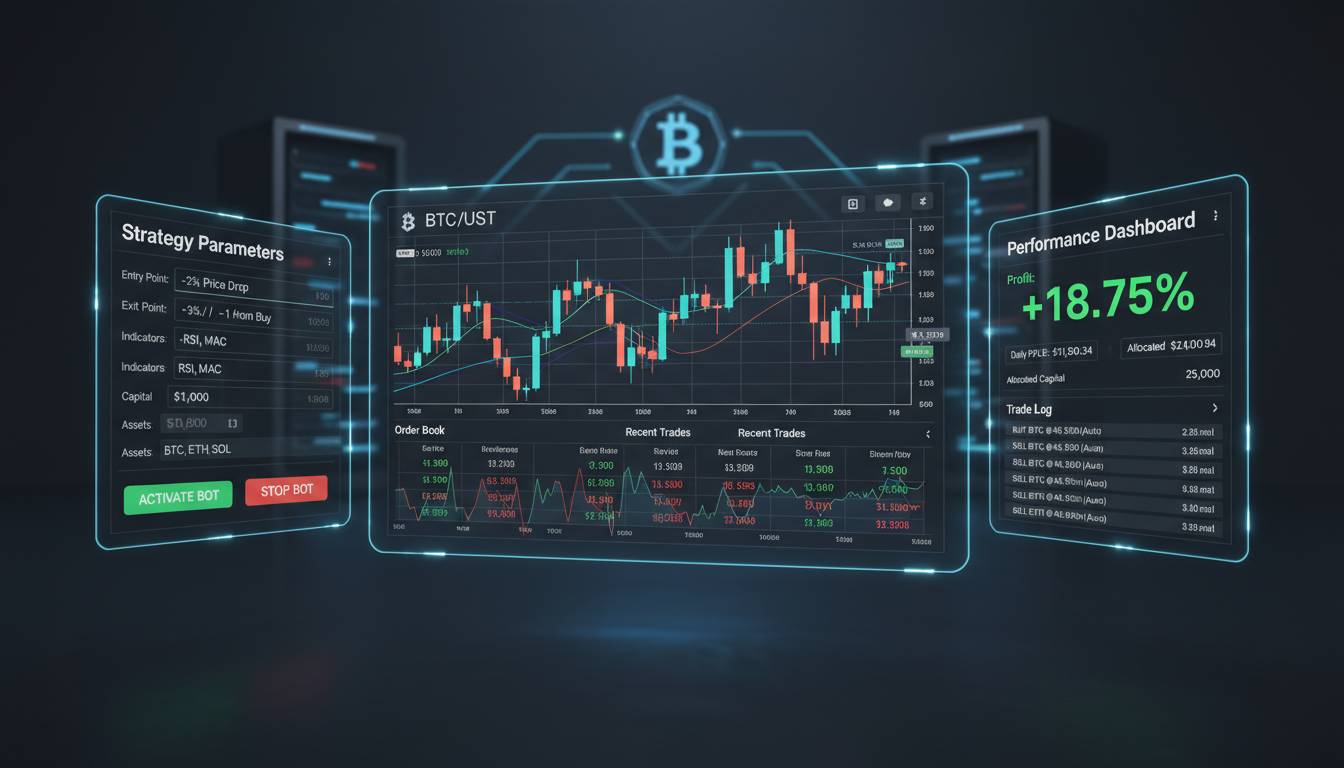
A crypto trading bot is a program that connects to cryptocurrency exchanges through APIs (Application Programming Interfaces). It pulls real-time market data—prices, trading volumes, order book depth—then analyzes that data against its programmed strategy. When conditions match what you’ve defined, it executes the trade automatically.
The core appeal is simple: these bots don’t get tired. Human traders need sleep, food, and breaks. Bots can monitor dozens of cryptocurrency pairs across multiple exchanges simultaneously. In crypto’s wild 24/7 markets, where a 30% move can happen while you’re asleep, this matters.
Most bots run one of a few common strategies. Trend-following bots buy when prices rise and sell when they fall, riding existing momentum. Mean reversion bots assume prices return to historical averages—they buy when assets get oversold and sell when they’re overbought. Arbitrage bots exploit price differences between exchanges, buying on one platform where it’s cheaper and selling immediately on another where it’s higher.
How Crypto Trading Bots Work
A bot’s technical setup involves several moving parts working together. First, it collects market data from connected exchanges: current prices, trading volumes, order book depth, historical charts. This data becomes the foundation for all analysis.
Once the bot has enough data, its algorithm evaluates conditions against the trading strategy. This might involve technical indicators like moving averages, RSI (Relative Strength Index), or Bollinger Bands—or more complex machine learning models. When the analysis spots an opportunity matching the bot’s criteria, it generates a signal and executes the trade through the exchange’s API.
Risk management is built into most bots. Stop-loss orders automatically sell when prices drop below a threshold. Take-profit orders lock in gains when prices hit targets. Position sizing algorithms determine how much capital to allocate to each trade based on your overall risk tolerance.
About 15% of all Bitcoin trading volume on major exchanges comes from automated trading systems, according to a 2023 Chainalysis report. That’s a huge chunk of the market, showing how mainstream algorithmic trading has become.
Popular Types of Trading Bots
The market offers bots for every skill level. Pre-built bots come with ready-to-use strategies—perfect for beginners who don’t want to code their own algorithms. These typically run on subscriptions, from around $20 to several hundred dollars monthly depending on features and supported exchanges.
Customizable bot platforms suit intermediate traders with some technical background. You can build personalized strategies using visual builders or actual code. You set entry and exit conditions, configure risk parameters, then backtest using historical data before risking real money.
High-frequency trading bots sit at the top of the complexity ladder. These can execute thousands of trades per second, capitalizing on price discrepancies that exist for fractions of a second. They require serious technical skills and serious capital—not something most retail traders should attempt.
Social trading bots let you automatically copy successful traders you follow. It’s a way to access sophisticated strategies without building them yourself. Whether that’s smart or just outsourcing your thinking depends on who you ask.
Benefits of Using Crypto Trading Bots
The biggest advantage is removing emotion from trading. Fear makes people panic-sell when markets crash. Greed makes them chase prices higher after missing the entry. Bots follow their rules regardless of how the market feels, maintaining discipline when it matters most.
Speed matters too. In competitive trading environments, milliseconds translate into real money. Bots analyze conditions and execute orders way faster than any human could, capturing opportunities before they vanish.
Portfolio diversification becomes practical when a bot handles multiple pairs across multiple exchanges. Doing this manually would require literally impossible attention spans. Bots can spread risk across assets and strategies without breaking a sweat.
Backtesting lets you validate strategies using historical data before putting money at risk. This testing phase reveals weaknesses in your logic and helps you optimize parameters. Most platforms include backtesting tools that simulate performance over specific time periods.
Risks and Considerations
Bots aren’t magic money printers. Market conditions change, and strategies that worked in a bull market can get crushed during bear markets or prolonged sideways periods. A bot optimized for one environment often fails when that environment shifts.
Technical failures are real threats. Connectivity issues, API errors, exchange outages, and software bugs can cause unintended trades or missed opportunities. The May 2021 flash crash—when Bitcoin dropped nearly 50% in hours before recovering—caught plenty of bots executing stop-loss orders at terrible prices.
Security deserves serious attention. Bots need API keys with trading permissions. If those keys get compromised, hackers can drain your account. Reputable providers offer security features like two-factor authentication and API restrictions that prevent withdrawals, but you need to do your part too.
Regulatory uncertainty surrounds crypto everywhere. Bots operating across international exchanges might accidentally violate local laws. The SEC has been increasing scrutiny of algorithmic trading in crypto, and future regulations could reshape how these tools work.
Choosing the Right Crypto Trading Bot
Picking a bot means evaluating a few key factors. First, check which exchanges it supports—you need it to connect where you actually trade. Major bots support Binance, Coinbase, Kraken, and others, but support varies.
Security should be priority number one. Look for API key restrictions, two-factor authentication, data encryption, and a transparent security track record. User reviews reveal a lot about how seriously a provider takes these issues.
Pricing runs the gamut. Some platforms charge monthly subscriptions. Others take a percentage of profits. Free options exist but usually have limitations. Don’t assume expensive equals better—cost doesn’t guarantee performance.
Customer support becomes critical when things break. When markets are moving fast, you can’t wait hours for a response. Test their support before you commit money.
The Future of Automated Crypto Trading
AI will keep pushing these tools forward. Machine learning can spot patterns in market data that traditional analysis misses, potentially improving predictions. Some developers are adding natural language processing to analyze social media and news, letting bots respond to emerging trends faster than humans can.
DeFi opens new territory. As decentralized finance protocols grow, bots are moving beyond centralized exchanges into arbitrage across DEXes, lending platforms, and yield farming. New profit opportunities come with new risks to understand.
Regulations will shape what comes next. As governments establish clearer crypto rules, bots may face new compliance requirements. Providers that adapt to regulatory changes while maintaining performance will likely lead the industry.
Conclusion
Crypto trading bots have become serious tools for serious crypto participants. The ability to operate continuously, eliminate emotional decisions, and execute complex strategies offers real advantages over manual trading. That said, these benefits come with real risks that require careful management—solid strategy design, good security habits, and realistic expectations.
If you’re considering automated trading, start small while you learn the platform. Combining bot trading with human oversight gives you the best of both worlds: automation’s speed and discipline, plus human judgment for situations algorithms can’t handle. As technology keeps advancing, these tools will only get more capable—and more central to how crypto gets traded.
Frequently Asked Questions
Are crypto trading bots profitable?
They can be, but success depends on strategy quality, market conditions, and proper configuration. No bot guarantees profits. Many lose money, especially when markets shift unexpectedly. Backtesting shows how strategies performed historically but says nothing about future results.
How much does a crypto trading bot cost?
Everything from free to hundreds monthly. Some platforms charge subscriptions; others take profit shares. Institutional-grade HFT bots can cost thousands monthly or require significant minimum investments.
Is using a crypto trading bot legal?
Generally legal in most places, including the US. You still need to follow local regulations and pay taxes on profits. The regulatory picture keeps evolving, and some strategies might attract scrutiny.
Can beginners use crypto trading bots?
Yes. Many platforms offer beginner-friendly interfaces with pre-built strategies. Start with small amounts while you learn. Understanding how these systems work matters—even if you’re not coding yourself.
Do I need programming skills to use a crypto trading bot?
Not necessarily. Many platforms have visual builders and ready-made bots. But if you want custom strategies or serious optimization, coding knowledge helps—especially Python.
What’s the best crypto trading bot for beginners?
3Commas, Cryptohopper, and Quadency all target beginners with intuitive interfaces and copy trading. Look for free trials or demo modes so you can explore before spending money.