16Views 0Comments
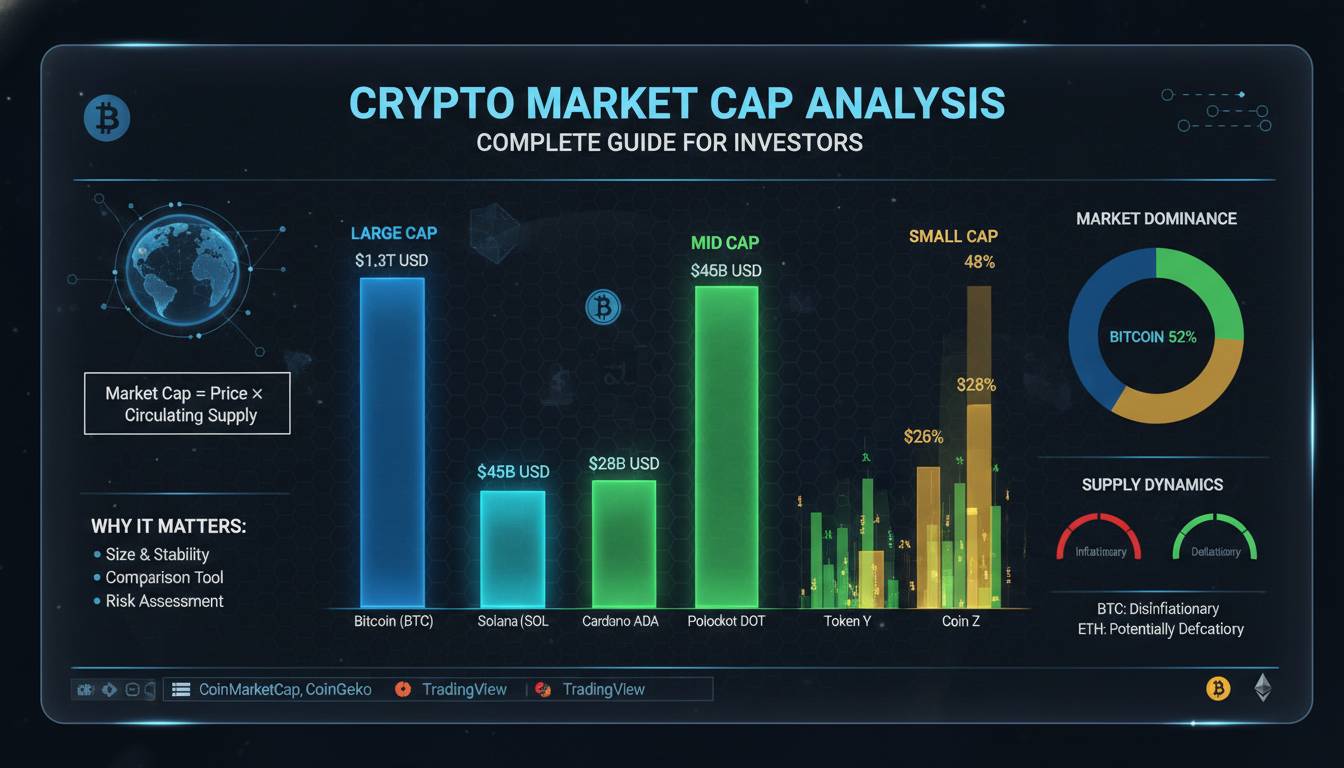
Cryptocurrency Market Cap Analysis: Complete Guide for Investors
The total cryptocurrency market capitalization surpassed $3 trillion for the first time in November 2021, marking a watershed moment that validated digital assets as a permanent fixture in global financial markets. As of early 2025, the crypto market continues to evolve, with market cap serving as the primary metric investors use to gauge the relative size, stability, and growth potential of different cryptocurrencies. Understanding how to analyze market capitalization—and recognizing its limitations—has become essential knowledge for anyone looking to make informed decisions in this dynamic space.
What Is Cryptocurrency Market Capitalization?
Market capitalization, commonly referred to as market cap, represents the total dollar value of a cryptocurrency’s outstanding supply. In simple terms, it calculates how much the entire supply of a digital asset would be worth if you multiplied its current price by the number of coins or tokens in circulation. This metric provides investors with a quick way to compare the relative size of different cryptocurrencies, much like how market cap works for traditional stocks.
The calculation follows a straightforward formula: Market Cap = Current Price × Circulating Supply. For Bitcoin, this means taking the current trading price and multiplying it by the approximately 19.6 million BTC in circulation. For tokens with staking mechanisms or locked supplies, the calculation may involve circulating supply rather than total supply, which investors should verify before making comparisons.
Market cap serves as a foundational metric because it accounts for both price and supply dynamics. A cryptocurrency trading at $1,000 with 10 million coins in circulation has a $10 billion market cap, while one trading at $10,000 with only 500,000 coins sits at $5 billion. Despite the second asset’s higher individual price, the first actually commands twice the market presence—a crucial distinction that price-only comparisons miss entirely.
How Market Cap Is Calculated and Where Data Comes From
The mechanics of market cap calculation appear simple on the surface, but understanding the nuances of each component reveals important analytical considerations. Current prices derive from trading data across multiple exchanges, with major data aggregators like CoinMarketCap and CoinGecko averaging prices from numerous markets to create representative figures that minimize the impact of any single exchange’s anomalies.
Circulating supply represents the number of tokens actively available in the market and held by public holders. This figure excludes tokens that are locked, reserved, or held by the development team in long-term vesting schedules. Different projects handle supply reporting differently, and some controversies in crypto history have centered on discrepancies between reported circulating supply and actual market availability.
Several reputable platforms provide market cap data with varying methodologies. CoinMarketCap, acquired by Binance in 2020, ranks as the most widely referenced source and uses a weighted average methodology across trading pairs. CoinGecko employs a similar approach but also factors in liquidity metrics. Messari, founded by former CoinDesk research director Ryan Selkis, provides more granular data with a focus on institutional-grade accuracy.
Key Data Sources for Market Cap Analysis:
| Source | Strength | Primary Audience |
|---|---|---|
| CoinMarketCap | Largest user base, comprehensive coverage | General investors |
| CoinGecko | Strong on liquidity data, transparent methodology | Active traders |
| Messari | Institutional focus, high accuracy standards | Professional investors |
| CoinMetrics | On-chain data focus, Network Value metrics | Researchers |
The reliability of market cap data depends significantly on the accuracy of circulating supply figures, which in turn depends on project transparency and the integrity of on-chain data. Investors conducting serious analysis should cross-reference multiple sources and verify supply claims by examining blockchain explorers directly.
Why Market Cap Matters for Investment Decisions
Market cap functions as a essential screening tool because it correlates with several characteristics that experienced investors value. Larger market cap cryptocurrencies typically exhibit lower volatility, deeper liquidity, and greater institutional acceptance—all factors that influence risk management and portfolio construction strategies.
Research from multiple sources indicates that the cryptocurrency market exhibits a hierarchical structure where Bitcoin and Ethereum, as the two largest assets by market cap, demonstrate stronger store-of-value properties and serve as market benchmarks. Smaller cap assets, while offering higher potential upside, carry substantially greater risk of permanent loss or complete project failure. This risk-reward relationship forms the foundation of market cap-based portfolio allocation strategies.
The practical implications extend to trading mechanics as well. Assets with higher market caps typically experience smaller spreads between bid and ask prices, meaning investors pay less in transaction costs. Large-cap cryptocurrencies also handle larger order volumes without significant price impact, which matters particularly for institutional investors or those making substantial allocations.
Market cap also provides context for price movements. A 10% price increase in a $200 billion asset represents fundamentally different market dynamics than the same percentage move in a $200 million asset. The former suggests substantial capital inflow or changed sentiment at scale, while the latter might result from a single large buyer or coordinated social media campaign.
Market Cap Categories: Understanding Tier Classifications
Investment professionals typically categorize cryptocurrencies into three primary tiers based on market capitalization, with each tier exhibiting distinct characteristics that should inform investment strategy.
Large-Cap Cryptocurrencies
Large-cap cryptocurrencies generally include assets with market caps exceeding $10 billion, though some analysts use $5 billion as the threshold. This category includes Bitcoin, Ethereum, and increasingly, established layer-1 chains and major DeFi protocols. These assets offer the highest stability, deepest liquidity, and greatest institutional adoption. They also typically demonstrate lower percentage price swings compared to smaller assets, making them suitable for conservative allocations or core portfolio holdings.
The advantages of large-cap focus come with tradeoffs. These assets generally offer lower growth potential on a percentage basis because their size makes exponential appreciation mathematically difficult to sustain. An investor seeking 10x returns would need the combined crypto market to expand dramatically by holding only established assets.
Mid-Cap Cryptocurrencies
Mid-cap cryptocurrencies typically range from $1 billion to $10 billion in market cap. These assets have demonstrated product-market fit and achieved meaningful adoption but still retain substantial growth potential. Examples include established altcoins with functional ecosystems, scaling solutions that have gained traction, and governance tokens for major DeFi protocols.
This tier offers a balance between growth potential and reduced risk compared to smaller caps. Mid-cap assets typically have professional market makers, established exchange listings, and enough trading volume to enter and exit positions without extreme slippage. However, they remain vulnerable to significant drawdowns during market corrections and carry higher project-specific risk than large-cap leaders.
Small-Cap and Micro-Cap Cryptocurrencies
Assets below $1 billion market cap fall into the small-cap or micro-cap category. This tier encompasses thousands of projects ranging from promising early-stage protocols to outright scams. While the highest potential returns exist in this category, the failure rate is correspondingly extreme. Academic research suggests that majority of cryptocurrency projects fail within their first two years, and this attrition concentrates heavily in the small-cap space.
Investors allocating to small-cap cryptocurrencies should expect high variance in outcomes. Research from Chainalysis indicates that approximately 25% of Bitcoin addresses from 2017 remain active, while the equivalent figure for smaller tokens sits dramatically lower. The appropriate approach involves position sizing that acknowledges the probabilistic nature of outcomes—limiting exposure to amounts one can afford to lose entirely.
Comparing Market Cap Across Major Cryptocurrencies
Examining current market cap distribution reveals insights about market structure and the relative success of different blockchain ecosystems. The following comparison illustrates how major cryptocurrencies stack up against each other, along with key metrics that contextualize their positions.
| Cryptocurrency | Market Cap Range | Primary Use Case | Circulating Supply | Dominance |
|---|---|---|---|---|
| Bitcoin (BTC) | $800B – $1.2T | Store of value, payments | ~19.6M BTC | 50-55% |
| Ethereum (ETH) | $250B – $400B | Smart contracts, DeFi | ~120M ETH | 18-22% |
| Tether (USDT) | $90B – $120B | Stablecoin, payments | ~95B USDT | 6-8% |
| BNB | $40B – $80B | Exchange token, BNB Chain | ~150M BNB | 3-5% |
| Solana (SOL) | $30B – $60B | High-speed blockchain | ~440M SOL | 2-4% |
| XRP (XRP) | $25B – $50B | Cross-border payments | ~55B XRP | 2-3% |
| Cardano (ADA) | $15B – $30B | Smart contracts | ~35B ADA | 1-2% |
These figures represent approximate ranges rather than precise snapshots, as cryptocurrency market caps fluctuate constantly. The dominance percentages show how Bitcoin continues to command the majority of total crypto market value, though this share has decreased over time as the ecosystem has matured and diversified.
Market cap comparisons become particularly interesting when examining the relationships between assets. The BTC/ETH ratio, for instance, has historically ranged from 1:1 during peak altcoin seasons to over 20:1 during periods of maximum Bitcoin dominance. These cycles reflect changing investor sentiment toward risk-on versus risk-off positioning in the broader crypto market.
Limitations and Risks of Market Cap Analysis
While market cap serves as a useful starting point for analysis, experienced investors recognize its significant limitations. Understanding these constraints prevents costly mistakes that arise from over-reliance on any single metric.
Supply Manipulation and Misreporting
The cryptocurrency space has experienced numerous instances where reported circulating supply diverged dramatically from actual market availability. The case of Tether (USDT) illustrates ongoing debates about backing and transparency, though the stablecoin has maintained its peg throughout market cycles. More dramatically, various projects have been accused of artificially inflating supply figures or manipulating circulating supply through complex token unlock schedules designed to obscure true dilution.
Illiquidity Despite High Market Cap
Market cap calculations assume that the entire circulating supply could be liquidated at the current price—a fiction that breaks down completely for assets with low actual trading volume. A cryptocurrency might show a $1 billion market cap while having only $50,000 in daily trading volume. Attempting to sell a $10 million position in such an asset would move the price drastically downward, meaning the “market cap” provides misleading information about actual exit liquidity.
Token Distribution Inequality
Market cap treats all tokens as equal, ignoring concentration of ownership. A project where 90% of tokens belong to a small group of insiders presents different risk characteristics than one with widely distributed holdings, yet both might show identical market caps. Research from multiple blockchain analytics firms consistently shows that wealth concentration in cryptocurrency exceeds even the most unequal traditional asset distributions.
Fully Diluted vs. Circulating Market Cap
Sophisticated analysts often calculate “fully diluted” market cap, which projects current prices onto total eventual supply rather than current circulating supply. This matters particularly for tokens with massive inflation schedules. A cryptocurrency showing a $500 million market cap today might have a $5 billion fully diluted cap if a large percentage of tokens remain locked, indicating substantial future dilution that current holders will experience.
Practical Application: Using Market Cap in Your Investment Strategy
Integrating market cap analysis into investment decisions requires establishing clear frameworks that align with individual risk tolerance and investment objectives. Several established approaches have demonstrated coherence across market cycles.
Market Cap Weighted Indexing
The simplest approach involves allocating capital proportional to market cap, mimicking traditional index fund strategies. This method automatically overweight established assets and underweight speculative bets, providing broad market exposure without active selection. Several cryptocurrency index products implement this approach, including Bitwise’s BITW and various exchange-traded products.
Tiered Allocation Models
More sophisticated investors often employ tiered allocation strategies that weight different market cap tiers according to risk preferences. A conservative allocation might place 60% in large-cap assets, 30% in mid-cap, and 10% in small-cap opportunities. This approach provides growth exposure while maintaining substantial stable holdings.
Strategic Rebalancing
Regardless of initial allocation, periodic rebalancing ensures that portfolio weights drift back toward intended targets as market movements occur. This disciplined approach forces selling assets that have appreciated and buying assets that have declined, effectively implementing contrarian buying at portfolio level. Research suggests this strategy particularly benefits cryptocurrency portfolios given the asset class’s tendency toward extreme cycles.
Quality Filtering Within Tiers
Market cap alone cannot identify which projects deserve allocation. Within each tier, investors should apply qualitative analysis examining team credibility, technical fundamentals, competitive positioning, token economics, and community health. A mid-cap cryptocurrency with strong fundamentals and clear utility deserves portfolio consideration, while one that has merely generated hype deserves skepticism regardless of its market cap position.
The Future of Cryptocurrency Market Cap Analysis
Market cap analysis continues to evolve as the cryptocurrency industry matures. Several trends are reshaping how investors interpret and apply this fundamental metric.
On-chain analytics have become increasingly sophisticated, with firms like Glassnode, Chainalysis, and Nansen providing granular data about holder behavior, exchange flows, and network health. These data points supplement market cap with information about actual economic activity, helping investors distinguish between projects with genuine utility and those trading purely on speculation.
Institutional adoption has also transformed market structure. The approval of spot Bitcoin ETFs in 2024 opened cryptocurrency markets to traditional financial institutions, bringing professional analysis standards and increasing focus on market cap as a sizing metric. This institutional participation has generally favored large-cap assets while reducing some of the extreme volatility that previously characterized the space.
The emergence of real-world asset tokenization represents another shift, as traditional financial instruments migrate to blockchain infrastructure. These developments may eventually render current market cap rankings obsolete as the lines between cryptocurrency and traditional finance blur, though market cap will likely remain relevant as a measure of crypto-native ecosystem size.
Conclusion
Cryptocurrency market cap analysis provides essential foundation for informed investment decisions, offering a standardized method to compare the relative size and significance of different digital assets. The metric’s simplicity makes it accessible while its correlation with key characteristics like volatility, liquidity, and institutional acceptance ensures continued relevance.
However, market cap works best as a starting point rather than a final answer. Successful cryptocurrency investing requires understanding its limitations—including supply manipulation risks, liquidity concerns, and concentration issues—while applying qualitative analysis to identify projects with genuine value proposition beyond mere size. By integrating market cap analysis within a broader framework of due diligence and risk management, investors can navigate the cryptocurrency market’s complexity with greater confidence.
Frequently Asked Questions
How often does cryptocurrency market cap change?
Cryptocurrency market cap changes continuously as prices fluctuate throughout 24/7 trading markets. Major data aggregators update figures in real-time, though significant changes typically occur during high-volume trading periods. Daily changes of 5-10% are common, while extreme volatility can produce double-digit percentage shifts within hours.
Can market cap be manipulated in cryptocurrency?
Yes, cryptocurrency market cap can be manipulated through various methods including wash trading, false supply reporting, and coordinated price manipulation. This risk is highest in low-liquidity assets where small trading volumes can move prices dramatically. Experienced investors verify data across multiple sources and examine on-chain metrics to identify potential manipulation.
Is a high market cap cryptocurrency automatically a better investment?
No, high market cap indicates established size and liquidity but does not guarantee investment success or even fundamental quality. Many large-cap cryptocurrencies have subsequently failed or declined dramatically, while some of the strongest performers emerged from small-cap positions. Market cap should inform position sizing rather than investment selection.
Should I only invest in large-cap cryptocurrencies?
Investing exclusively in large-cap cryptocurrencies reduces risk but limits growth potential. A balanced approach typically includes exposure across market cap tiers, with allocation percentages reflecting individual risk tolerance. Conservative investors might emphasize large-cap holdings while those seeking higher returns may accept greater small-cap exposure.
How does cryptocurrency market cap compare to stock market cap?
The calculation methodology is identical, but the underlying assets differ fundamentally. Stock market caps represent ownership stakes in revenue-generating businesses with regulatory oversight, while cryptocurrency market caps often represent utility tokens, governance tokens, or commodities without inherent cash flows. This distinction means cryptocurrency market cap requires different interpretive frameworks.
What is the total cryptocurrency market cap?
The total cryptocurrency market cap fluctuates significantly based on market conditions. It has ranged from approximately $800 billion during bear markets to over $3 trillion during peak bull markets. As of recent periods, the total crypto market cap typically ranges between $1.5 trillion and $2.5 trillion, though exact figures vary by the moment of measurement.