13Views 0Comments
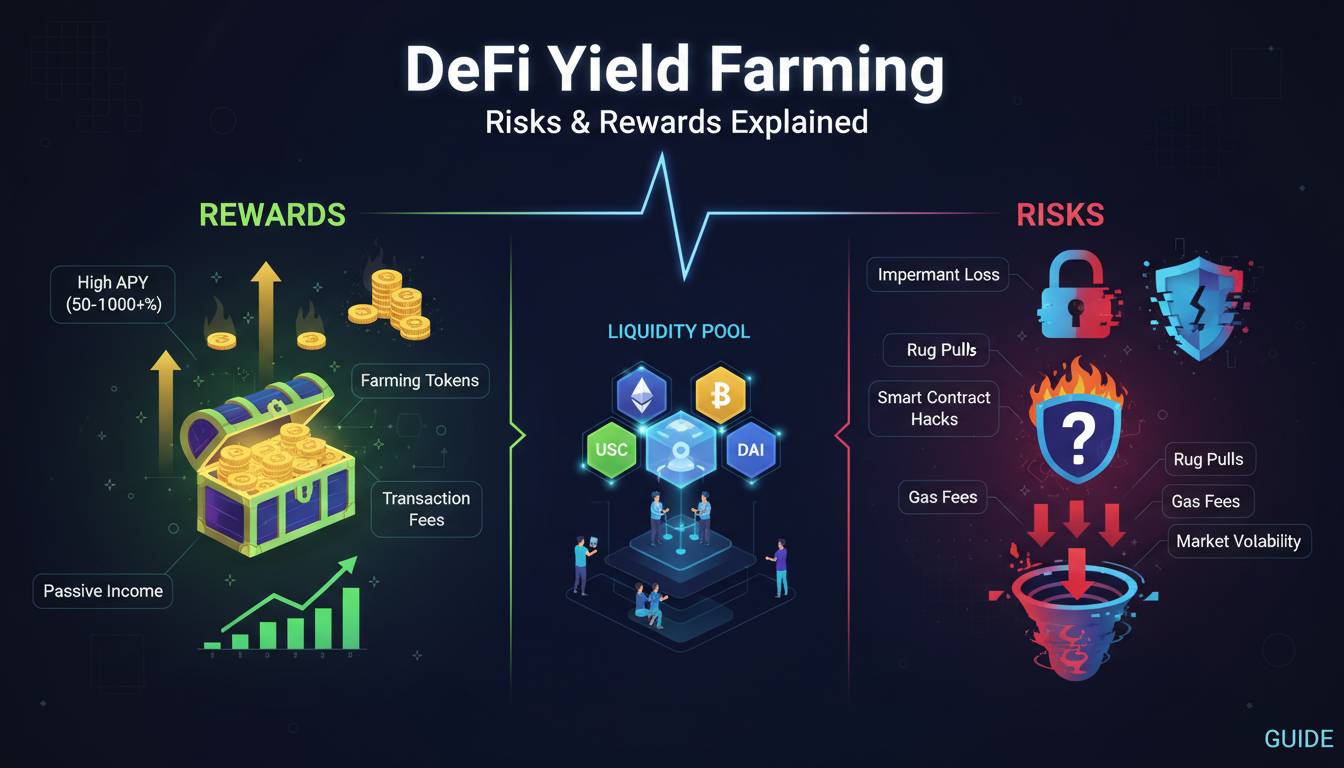
DeFi Yield Farming: Risks & Rewards Explained | Guide
Decentralized finance (DeFi) yield farming has transformed how investors generate returns on cryptocurrency holdings, offering yields that traditional finance cannot match—but carrying risks that have wiped out billions in user funds. Understanding both the potential rewards and the very real dangers is essential before committing capital to any yield farming protocol.
The DeFi ecosystem saw over $4.2 billion lost to exploits and scams in 2022 alone , while simultaneously producing yields that routinely exceeded 100% annually—sometimes reaching thousands of percent. This stark contrast defines the yield farming landscape: extraordinary gains are possible, but so are total losses.
This guide examines how yield farming works, breaks down the actual risks that have destroyed portfolios, details the reward mechanisms that attract capital, and provides a framework for evaluating opportunities without becoming another statistic.
What Is Yield Farming in DeFi?
Yield farming, also known as liquidity mining, is the process of locking cryptocurrency assets into DeFi protocols to earn rewards. Unlike traditional savings accounts that pay interest, yield farming leverages blockchain smart contracts to automate returns through various mechanisms including trading fees, token emissions, and staking incentives.
Key Mechanisms Driving Yields:
| Mechanism | How It Works | Typical Returns |
|---|---|---|
| Trading Fees | Liquidity providers earn a portion of swap fees | 0.1-1% APR |
| Token Rewards | Protocols distribute native tokens as incentives | 5-200%+ APR |
| Staking Rewards | Lock tokens to validate network transactions | 3-20% APR |
| Borrowing Rewards | Lenders earn interest on supplied assets | Variable |
The fundamental innovation is that users become the “bank” rather than customers of one. By supplying liquidity to decentralized exchanges like Uniswap or Curve, participants enable trading while earning a share of fees generated. Protocols compete for liquidity by offering additional token rewards, creating the yields that have attracted over $55 billion in total value locked at various points .
Why This Matters: The yield you earn isn’t charity—it’s compensation for providing capital that makes DeFi markets function. Higher rewards typically indicate higher risk, as protocols must attract liquidity through unsustainable token emissions or leverage positions that amplify losses.
How Yield Farming Actually Works
Understanding the mechanics requires examining the complete flow from deposit to returns.
Step 1: Choosing a Protocol and Asset Pair
Yield farmers typically supply liquidity to decentralized exchanges in the form of token pairs—for example, ETH paired with USDC. The ratio depends on the pool: stablecoin pairs (USDC/USDT) carry lower risk but offer lower yields, while volatile pairs (ETH/WBTC) generate more trading fees but expose providers to impermanent loss.
Step 2: Supplying Liquidity
Once tokens are deposited, the protocol issues liquidity provider (LP) tokens representing the user’s share of the pool. These LP tokens accumulate value from trading fees and any additional token rewards the protocol distributes.
Step 3: Staking or Compounding
Many protocols allow farmers to stake LP tokens to earn additional rewards. Advanced strategies involve “compounding”—automatically reinvesting yields to increase the effective return rate through compound growth.
Step 4: Harvesting and Withdrawing
Returns accumulate in the pool or as staking rewards. Farmers must decide when to harvest (convert rewards to principal) and whether to continue farming or exit entirely.
Common Strategies:
- Single-Asset Staking: Simpler approach, lower complexity
- Concentrated Liquidity: Provide liquidity within specific price ranges for higher fees but increased risk
- Cross-Protocol Stacking: Move rewards from one protocol to another to compound returns
- Leveraged Farming: Borrow assets to increase exposure (advanced, extremely risky)
The Rewards: Understanding Potential Returns
Yield farming rewards derive from three primary sources, each with different risk characteristics.
Trading Fee Revenue
Every trade on a decentralized exchange generates fees distributed to liquidity providers. During periods of high market volatility, trading fee revenue can substantialy exceed token emission rewards. The top DeFi protocols processed over $150 billion in monthly volume during peak periods , creating significant fee opportunities.
Actual Performance Data:
- Uniswap V3 concentrated liquidity providers: 15-40% APR during volatile periods
- Curve Finance stablecoin pools: 2-8% APR typically
- Specialized volatile pools: 10-50% APR possible
Token Incentives
Protocols distribute native tokens to attract liquidity. These tokens often represent governance rights and future revenue sharing, but their value depends entirely on protocol adoption and tokenomics.
Critical Consideration: Token rewards are typically inflated initially to attract users but often decline significantly after emission schedules reduce. This creates “yield cliff” scenarios where apparent returns collapse within months.
Bridging and Cross-Chain Rewards
Layer 2 networks and alternative chains frequently offer boosted yields to attract TVL. Arbitrum, Optimism, and zkSync have offered tokens worth hundreds of dollars to early users, plus ongoing yield premiums.
Real Example: A liquidity provider who supplied $10,000 to Arbitrum’s GMX protocol in early 2023 earned approximately $3,000 in ARB token airdrops plus 15-25% APR in esGMX rewards—a total return that significantly outperformed traditional finance but required understanding complex token vesting schedules.
The Risks: Why Farmers Lose Money
The rewards are real, but the risks have destroyed more portfolios than any other factor in DeFi history.
Smart Contract Vulnerabilities
DeFi protocols are only as secure as their code. Bugs in smart contracts have resulted in over $6 billion in losses since 2020 . Even audited protocols suffer vulnerabilities:
- The Ronin Bridge hack (2022): $625 million lost due to compromised private keys
- Wormhole exploit (2022): $320 million stolen through signature verification failure
- FTX collapse (2022): Affected DeFi protocols holding FTT tokens
Mitigation: Use protocols with multiple audits, established track records, and time-tested code. No protocol is risk-free, but audited protocols with bug bounties and proven histories offer better odds.
Impermanent Loss
When providing liquidity to volatile asset pairs, the value of your holdings can decrease relative to simply holding the assets. This “impermanent loss” becomes permanent when you withdraw.
Example Scenario:
- Deposit: 1 ETH + 3,000 USDC (when ETH = $3,000)
- After 1 year: ETH = $4,500
- Holding value: 1 ETH ($4,500) + 3,000 USDC ($3,000) = $7,500
- LP pool value: ~$7,100 (loss of ~$400 from impermanent loss)
- Plus trading fees earned: ~$200
- Net result: $7,300 vs. $7,500 held
The loss becomes permanent upon withdrawal. High-yield volatile pairs often generate fees that exceed impermanent loss, but this is not guaranteed.
Rug Pulls and Exit Scams
DeFi’s permissionless nature means anyone can launch a token and attract liquidity, then drain the pool and disappear. The “rug pull” remains one of the most common DeFi fraud types, with scammers draining over $2.5 billion from investors in 2022 alone .
Warning Signs:
- Anonymous or pseudonymous teams with no verifiable history
- Token distribution heavily concentrated in few wallets
- No audit or copy-pasted code from existing protocols
- Unusually high yields (anything over 100% APY should trigger skepticism)
- Liquidity that can be removed by the team
Protocol and Governance Risks
Even legitimate protocols face risks from governance attacks, where malicious actors acquire enough voting power to manipulate protocol parameters or drain treasury funds. Yearn Finance, one of DeFi’s most established protocols, experienced a governance attack in February 2023 that resulted in approximately $11.4 million in losses.
Counterparty and Platform Risk
When depositing into lending protocols or yield aggregators, users rely on the platform’s smart contracts and management. Centralized platforms add counterparty risk—the possibility that the organization behind the protocol becomes insolvent or acts maliciously.
Comparing Major Yield Farming Protocols
Understanding the risk-return profile of different protocols helps in making informed decisions.
| Protocol | Category | Typical APR | Primary Risk | Best For |
|---|---|---|---|---|
| Uniswap V3 | DEX | 10-40% | Impermanent loss | Active traders |
| Curve Finance | Stablecoin DEX | 2-8% | Smart contract | Conservative |
| Aave | Lending | 3-15% | Liquidation | Stable yields |
| Yearn Finance | Aggregator | 5-25% | Strategy risk | Passive management |
| GMX | Perpetual DEX | 15-35% | Oracle failure | Advanced traders |
| Lido | Liquid Staking | 4-8% | Validator risk | ETH exposure |
Key Insight: Stablecoin yields have compressed significantly since 2022. The 15-20% yields common in 2020-2021 are largely gone, replaced by more sustainable 2-8% ranges for low-risk positions. Higher returns now correlate strongly with higher risk exposure.
Case Studies: What Actually Happened to Yield Farmers
Case Study 1: The Terra Luna Collapse (2022)
The Terra ecosystem promised 20% yields on UST stablecoin through Anchor protocol’s lending model. When UST depegged in May 2022, the cascade wiped out approximately $40 billion in market value within days. Users who had deposited life savings into “safe” stablecoin yields lost nearly everything.
Lesson: Stablecoin does not mean stable. Yield sustainability matters more than apparent safety.
Case Study 2: Concentrated Liquidity Success (2023)
An experienced Uniswap V3 liquidity provider focused on the ETH/USDC 0.3% fee tier concentrated between $1,800-$2,400 during 2023. By targeting a specific range during the year’s trading, they generated approximately 28% APR in fees—significantly outperforming both buy-and-hold and uniform liquidity provision.
Lesson: Sophisticated strategies can generate alpha, but require active management and significant expertise.
Case Study 3: The Iron Finance Bank Run (2021)
Iron Finance claimed to offer “algorithmic stablecoin” yields with 20%+ APY. When a bank run occurred in June 2021, the protocol’s design flaw caused IRON stablecoin to lose peg, and deposers lost approximately $25 million. The incident became a case study in stablecoin design failures.
Lesson: Research tokenomics and understand what actually backs the yields you’re earning.
How to Start Yield Farming Safely
Entering yield farming requires deliberate preparation and risk management.
Prerequisites
- Hardware Wallet: Never farm from exchange wallets or hot wallets
- Research Capability: Time to evaluate protocols before committing funds
- Emergency Fund: Never invest more than you can afford to lose entirely
- Technical Understanding: Know how to interact with smart contracts
Starting Framework
Phase 1: Education (Weeks 1-4)
- Study how decentralized exchanges function
- Understand gas costs and network congestion impact
- Learn about impermanent loss calculations
- Practice on testnets before using real assets
Phase 2: Small Capital Testing (Weeks 5-8)
- Start with stablecoins in established protocols
- Limit initial exposure to 1-5% of crypto portfolio
- Track results meticulously against benchmarks
Phase 3: Strategy Refinement (Weeks 9+)
- Scale successful strategies gradually
- Diversify across protocols and asset classes
- Implement stop-loss or exit triggers
- Continue learning about emerging opportunities
Risk Management Rules
Never:
– Invest more than 10% of crypto portfolio in yield farming
– Chase yields over 50% APR without understanding the risk fully
– Provide liquidity to pools with less than $10 million TVL
– Ignore smart contract audit history
Always:
– Withdraw yields regularly rather than compounding indefinitely
– Maintain exposure to core assets (BTC, ETH) alongside farming
– Monitor protocols daily for unusual activity
– Have exit strategies prepared before entering
Expert Perspectives on Yield Farming
“Yield farming is not free money—it’s sophisticated risk management. The farmers who survive long-term treat it as a business, not a lottery ticket. They understand that 100% APY usually means 100% risk of principal loss within the same timeframe.”
— Hasu, independent DeFi researcher and former Flashbots strategist“The biggest mistake I see is people not understanding what they’re earning versus what they’re risking. A 500% APY token reward is worthless if the smart contract gets exploited the next day. Security and sustainability should always come before maximum yield.”
— Anton Bukhvalov, DeFi security researcher at Security Alliance (SEAL)“Institutional investors are entering yield farming through regulated structures because the risk-adjusted returns can genuinely outperform traditional fixed income—when implemented with proper risk controls. But the learning curve is steep, and many protocols simply aren’t built for institutional scale.”
— Ryan Ciepal, Partner at Three Arrows Capital (post-liquidation analysis)
Conclusion
DeFi yield farming represents a fundamental innovation in financial markets—enabling anyone with cryptocurrency to earn returns that previously required institutional infrastructure. The rewards are genuine, with skilled farmers generating yields that dwarf traditional finance while contributing to market efficiency.
Yet the risks are equally real. Smart contract failures, impermanent loss, fraud, and governance attacks have extracted billions from unsuspecting users. The promise of extraordinary yields has never negated the reality of extraordinary risk.
Approaching yield farming with proper preparation, realistic expectations, and disciplined risk management transforms it from gambling into a legitimate strategy. Start small, learn continuously, and never invest more than you can afford to lose. The DeFi ecosystem rewards patient capital and punishes greed—understanding both sides of that equation is essential for long-term success.
Frequently Asked Questions
Is yield farming safe for beginners?
Yield farming carries significant risks that make it unsuitable for beginners. Smart contract vulnerabilities, impermanent loss, and fraud have resulted in billions in losses. Those new to DeFi should start by understanding underlying protocols, practicing with small amounts, and only allocating capital they can afford to lose entirely.
How much money can you make from yield farming?
Returns vary dramatically based on strategy, market conditions, and risk tolerance. Stablecoin farming typically yields 2-8% APR, while volatile pair farming might generate 10-50% with significant impermanent loss risk. Some strategies have achieved 100%+ APR during promotional periods, but these are usually unsustainable and come with substantial principal risk.
What is impermanent loss in yield farming?
Impermanent loss occurs when the price ratio between tokens in a liquidity pool changes compared to when you deposited them. This creates a value difference between holding the tokens directly versus providing liquidity. The loss becomes permanent when you withdraw. It is one of the most significant risks for liquidity providers.
Which yield farming protocol is the safest?
No yield farming protocol is completely safe. Established protocols with multiple security audits, large TVL, and proven track records (such as Aave, Uniswap, and Curve) offer better security than newer, untested protocols. However, even audited protocols have suffered exploits.
Do I need a lot of money to start yield farming?
You can start with relatively small amounts, but high gas fees on Ethereum mainnet can make small-scale farming unprofitable. Layer 2 networks like Arbitrum and Optimism offer lower costs. Many protocols have minimum requirements for profitable yields, typically requiring at least several thousand dollars for meaningful returns after gas costs.
How do I avoid rug pulls and scams?
Research protocols thoroughly before investing: check team identity and history, verify smart contract audits, examine token distribution, avoid pools with locked liquidity that the team can remove, and be skeptical of yields that seem too good to be true. Using established aggregators with track records provides additional safety.