1View 0Comments
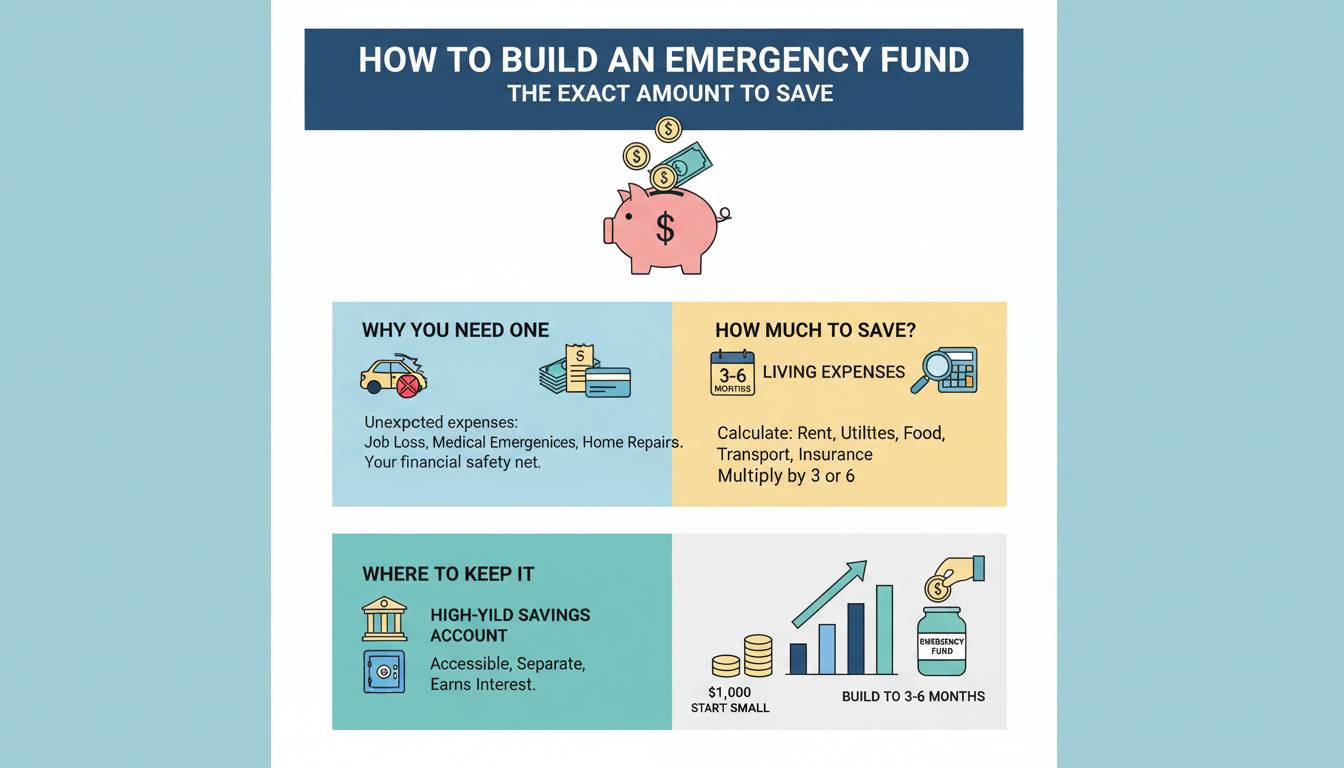
How to Build an Emergency Fund: The Exact Amount to Save
Financial security feels elusive for millions of Americans. A sudden job loss, unexpected medical bill, or car repair can derail even the most careful budgets. Yet the solution—building an emergency fund—remains one of the most powerful wealth-building tools available. This guide walks you through exactly how much you need to save, where to keep those funds, and the practical steps to build your safety net even on a tight budget.
What Is an Emergency Fund and Why It Matters
An emergency fund is money set aside specifically to cover unexpected expenses or financial hardships without relying on credit cards, loans, or selling assets. Unlike regular savings, an emergency fund exists purely for true emergencies—job loss, major medical expenses, essential home or vehicle repairs.
📊 KEY STATS
- 39% of Americans would struggle to pay a $1,000 emergency expense
- 56% of Americans have less than $1,000 in total savings
- $2,500 is the average emergency fund balance among those who have one
The absence of an emergency fund creates a dangerous cycle. When unexpected costs arise, individuals often turn to high-interest credit cards, averaging 24% APR, or predatory payday loans that can exceed 400% interest. This debt compounds, making it harder to save, which then leads to more debt when the next emergency arrives.
Having three to six months of expenses saved eliminates this cycle. It provides breathing room during job transitions, protects against medical debt, and removes the psychological stress of financial uncertainty. The peace of mind alone makes building this fund worthwhile.
The Exact Amount You Should Save: Breaking Down the Numbers
The classic recommendation is three to six months of living expenses. This range works because it balances accessibility with adequacy. However, the exact number depends on your specific situation.
Determining Your Target Number
Your emergency fund target equals your monthly essential expenses multiplied by your chosen timeframe. Essential expenses include housing, utilities, groceries, insurance, minimum debt payments, transportation to work, and necessary medical care.
| Profile | Recommended Months | Reasoning |
|---|---|---|
| Single income household | 6 months | Higher risk if one earner loses income |
| Dual income household | 3-6 months | Redundancy if one partner loses job |
| Freelancer/Variable income | 6-9 months | Income volatility requires larger buffer |
| Single earner with dependents | 6-9 months | More mouths to feed increases risk |
| Stable government employee | 3 months | Job security allows for smaller fund |
| High-risk industry | 6-12 months | Extra cushion for longer job searches |
For most employed Americans with stable incomes, three months represents the minimum safety net. This amount handles most unexpected expenses—a $3,000 car repair, two months of temporary unemployment, or a $5,000 medical deductible. Six months provides stronger protection against prolonged job searches or major financial disruptions.
Calculating Your Monthly Essential Expenses
Before setting a savings target, you need an accurate picture of your essential monthly costs. Add up these categories:
- Housing: Rent or mortgage, property taxes, home insurance
- Utilities: Electricity, gas, water, internet, phone
- Food: Groceries only (not dining out)
- Transportation: Car payment, gas, insurance, public transit
- Healthcare: Insurance premiums, medications, co-pays
- Minimum debt payments: Credit cards, student loans, auto loans
- Childcare: If applicable
- Insurance: Health, life, disability
The goal is your bare-bones budget—what you would spend if you lost your income tomorrow. Exclude discretionary spending like streaming services, dining out, entertainment, and vacations. These disappear during a true emergency.
How to Build Your Emergency Fund: A Step-by-Step Plan
Building an emergency fund requires strategy, not just intention. Follow these steps to create a realistic plan that fits your income and lifestyle.
Step 1: Open a Dedicated Savings Account
Never mix emergency savings with regular checking or other savings goals. Opening a separate high-yield savings account (HYSA) keeps these funds distinct, reduces temptation to spend, and earns better interest than traditional banks.
When comparing accounts, look for:
- High annual percentage yield (APY)—currently 4-5% for most online HYSPAs
- No minimum balance requirements
- No monthly maintenance fees
- FDIC insurance coverage
- Easy transfer access (typically 1-3 business days)
Popular options include Ally Bank, Marcus by Goldman Sachs, Discover Bank, and Synchrony Bank. All offer competitive rates and FDIC protection.
Step 2: Determine Your Monthly Contribution
Calculate how much you can realistically save each month without straining your budget. Use the 50/30/20 framework as a starting point: 50% to needs, 30% to wants, 20% to savings and debt repayment. If you’re starting from zero, even $50-100 per month builds significant momentum.
Example Case: Sarah earns $4,000 monthly after taxes. Her essential expenses total $2,200. Using the 50/30/20 rule, she has $800 available for savings and debt. She allocates $400 to emergency fund, $300 to retirement, and $100 to extra debt payments. At this rate, she’ll reach her $6,600 target (three months) in 16.5 months.
Step 3: Automate Your Savings
Automation is the secret weapon of successful savers. Set up automatic transfers from checking to your emergency fund on payday. This removes the decision fatigue of whether to save and ensures consistent progress.
Most employers allow splitting direct deposit between multiple accounts. If not, schedule automatic transfers one to two days after your paycheck clears.
Step 4: Find Extra Money Sources
Beyond regular contributions, accelerate your fund with these strategies:
- Tax refunds: Direct all or most refund to emergency savings
- Side income: Freelance work, selling items, gig economy jobs
- Expense reductions: Cancel subscriptions, negotiate bills, switch to cheaper providers
- Windfalls: Bonuses, inheritance, lawsuit settlements
- Cash gifts: Birthdays, holidays—ask for money instead of items
Every unexpected influx of cash represents an opportunity to strengthen your safety net.
Step 5: Build to Minimum, Then Expand
Don’t wait until you reach six months. Hit three months first—this milestone handles most emergencies. Then decide whether to continue to six months or redirect funds to other goals like retirement contributions or paying down high-interest debt.
The exception: If your job is unstable or you’re the sole earner, push to six months before reducing contributions. The psychological and financial security outweighs the opportunity cost of delayed investing.
Best Places to Keep Your Emergency Fund
Location matters as much as amount. Your emergency fund needs three qualities: accessibility, safety, and growth.
High-Yield Savings Accounts (Recommended)
Online high-yield savings accounts offer the best combination of accessibility and returns. Your money remains liquid (available within one to three business days), FDIC insured, and earns 4-5% interest—significantly better than the 0.01% offered by traditional brick-and-mortar banks.
| Account | APY (as of 2024) | Key Features |
|---|---|---|
| Marcus by Goldman Sachs | 4.50% | No fees, no minimums |
| Ally Bank | 4.25% | 24/7 customer service |
| Discover Bank | 4.30% | Cashback rewards |
| Synchrony Bank | 4.75% | Large ATM network |
Money Market Accounts
Money market accounts (MMAs) offer similar rates to HYSAs with check-writing privileges. These work well if you want slightly more liquidity, though rates are comparable to HYSAs currently.
What NOT to Use
Avoid these locations for emergency funds:
- Checking accounts: Too easy to spend accidentally
- Certificates of Deposit (CDs): Penalties for early withdrawal defeat emergency access
- Investments (stocks/bonds): Volatility means you might sell at a loss when emergencies strike
- Physical cash: Loses value to inflation, insecure, hard to track
- Crypto: Extreme volatility makes it unsuitable for emergencies
When to Use Your Emergency Fund (And When Not To)
Knowing when to tap your emergency fund prevents premature depletion while ensuring you’re not deprivation during genuine crises.
Legitimate Emergency Uses
- Job loss: Using fund for living expenses during unemployment
- Medical emergencies: Insurance deductibles, unexpected procedures, urgent care
- Essential home repairs: Roof leak, furnace failure, plumbing emergency
- Critical vehicle repairs: Brakes, transmission, engine problems that prevent commuting
- Family emergencies: Funeral expenses, emergency travel
Non-Emergency Uses That Shouldn’t Deplete Your Fund
- Vacations: Not emergencies, even if unexpected deals arise
- Holiday gifts: Budget throughout the year instead
- Wants vs. needs: That new phone or furniture isn’t an emergency
- Investment opportunities: Never invest emergency money
- Debt repayment beyond minimums: Use other extra funds, not emergency reserves
- Income reduction: If you voluntarily take a lower-paying job, adjust your budget rather than drain the fund
Replenishing After Use
After any emergency withdrawal, prioritize rebuilding the fund before resuming other savings goals. If you used three months of savings, treat this as a new goal to reach again.
Common Mistakes That Derail Emergency Fund Progress
Understanding these pitfalls helps you avoid them.
Mistake #1: Setting Unrealistic Targets
Saving $10,000 seems impossible when you’re starting from zero. Breaking this into monthly goals of $200-300 makes it achievable. Start smaller if needed—$1,000 covers most minor emergencies and builds the habit.
Mistake #2: Keeping Fund in Low-Yield Accounts
Letting money sit in traditional savings earning 0.01% costs you hundreds or thousands in lost interest over years. The move to high-yield accounts takes 10 minutes and compounds significantly.
Mistake #3: Not Tracking Progress
Without tracking, momentum stalls. Use spreadsheets, apps, or simple pen-and-paper to log contributions and celebrate milestones.
Mistake #4: Treating Emergency Fund as “Extra” Money
Once the fund reaches your target, it’s not permission to spend. It remains dedicated to emergencies only. Redirect excess contributions to other goals.
Mistake #5: Ignoring Insurance
An emergency fund complements insurance—it doesn’t replace it. Health, auto, renter’s, and disability insurance protect against catastrophic losses that would overwhelm even a healthy emergency fund.
Frequently Asked Questions
How long does it typically take to build an emergency fund?
The time varies based on your income, expenses, and contribution amount. On average, saving $200-300 monthly reaches a $6,000 fund (three months for many households) in 20-30 months. Increasing contributions, using windfalls, or reducing expenses accelerates this timeline significantly.
Should I pay off debt first or build an emergency fund first?
Financial experts generally recommend building a small starter fund of $1,000-2,000 before aggressively paying debt. This prevents adding more debt when emergencies arise while paying off high-interest credit cards. After reaching this baseline, you can split extra funds between debt payoff and expanding your emergency fund.
What if I can’t afford to save anything right now?
Start microscopic if needed—even $25 per paycheck creates momentum. Review your budget for hidden subscriptions to cut, sell unused items, or pick up temporary side work. If income is genuinely insufficient, focus on increasing earning potential through skill development or additional employment before aggressive saving.
Is three months enough, or should I aim for six?
Three months serves as the minimum recommendation for most stable households. Six months provides stronger protection and is recommended for single-income households, freelancers, those in volatile industries, or anyone supporting dependents. The right number depends on your job security, income stability, risk tolerance, and household composition.
Conclusion
Building an emergency fund transforms your financial life. That three-to-six-month buffer eliminates the fear of unexpected expenses, removes the debt cycle, and provides genuine freedom to make choices based on opportunity, not desperation.
Start today, regardless of your current savings. Open that high-yield account, set up automatic transfers, and commit to consistent contributions. Even starting with $50 per paycheck builds meaningful protection within a year.
Your future self will thank you for the security you’ve built—one contribution at a time.