8Views 0Comments
How to Start Mining Bitcoin at Home: Complete Beginner’s Guide
QUICK ANSWER: To start mining Bitcoin at home, you’ll need specialized hardware (ASIC miner costing $2,000-$5,000), a Bitcoin wallet, mining software, and cheap electricity (under $0.08/kWh ideal). Join a mining pool for consistent rewards, expect 6-18 months ROI depending on costs, and understand that profitability depends heavily on your electricity rate and Bitcoin’s price. Home mining is no longer profitable for casual users without significant investment and access to low-cost power.
AT-A-GLANCE:
| Factor | Requirement | Best Option |
|---|---|---|
| Initial Investment | $2,000-$10,000 | ASIC miner + accessories |
| Electricity Cost | Under $0.08/kWh ideal | Industrial rates in Texas/Washington |
| Hardware Lifespan | 3-5 years | Antminer S21 Pro, Whatsminer M56S |
| Pool Fees | 1-3% of rewards | Foundry USA, AntPool |
| Time to First Reward | Days to weeks | Depends on pool and hash rate |
| ROI Timeline | 6-18 months | Varies by electricity cost |
KEY TAKEAWAYS:
– ✅ ASIC miners are required—GPUs cannot compete profitably in 2025 (ASIC Miner Value, January 2026)
– ✅ Electricity is the #1 factor determining profitability—anything over $0.12/kWh makes home mining unprofitable (Cambridge Bitcoin Electricity Consumption Index, Q4 2025)
– ✅ Mining pools are essential for home miners—solo mining has near-zero chance of solving a block
– ✅ Heat and noise are significant considerations—ASICs run at 70-80dB and produce substantial heat
– ❌ Common mistake: Buying used equipment without verifying hash rate—some miners are sold with degraded performance
KEY ENTITIES:
– Hardware: Bitmain Antminer S21 Pro, Whatsminer M50S, Canaan Avalon Made
– Mining Pools: Foundry USA, AntPool, ViaBTC, Slush Pool
– Software: NiceHash, CGMiner, BFGMiner, HiveOS
– Organizations: Bitcoin Mining Council, Core Scientific, Riot Platforms
– Standards: SHA-256 algorithm, difficulty adjustment (every 2,016 blocks)
LAST UPDATED: January 14, 2026
Mining Bitcoin from home transformed from a profitable hobby in 2010 to a professionalized industry by 2025. Yet thousands of individuals still attempt home mining each month, motivated by Bitcoin’s appreciation potential and the desire to participate directly in network security. This guide breaks down exactly what you need, what it costs, and whether home mining makes sense for your situation.
Understanding Bitcoin Mining Fundamentals
Bitcoin mining is the process by which transactions are verified and added to the blockchain ledger. Miners compete to solve complex mathematical puzzles using computational power, and the first to find a valid solution earns the block reward—currently 3.125 BTC after the April 2024 halving (Bitcoin.org, 2025).
The network automatically adjusts mining difficulty every 2,016 blocks (approximately every two weeks) to maintain a consistent 10-minute block time. As more miners join the network, difficulty increases, requiring more computational power to achieve the same results. This mechanism is why home mining profitability has compressed dramatically over the past decade.
How mining actually works:
- Transactions are broadcast to the network and gathered into a mempool
- Miners group transactions into a block candidate
- The miner attempts to find a hash below the target (proof of work)
- When a valid hash is found, the block is broadcast and added to the blockchain
- The winning miner receives the block reward plus transaction fees
The SHA-256 algorithm used by Bitcoin requires specialized application-specific integrated circuit (ASIC) miners. Graphics processing units (GPUs) and central processing units (CPUs) cannot compete—the Antminer S21 Pro produces 234 terahashes per second (TH/s), roughly 100,000 times more efficient than the best consumer GPUs.
Hardware Requirements for Home Mining
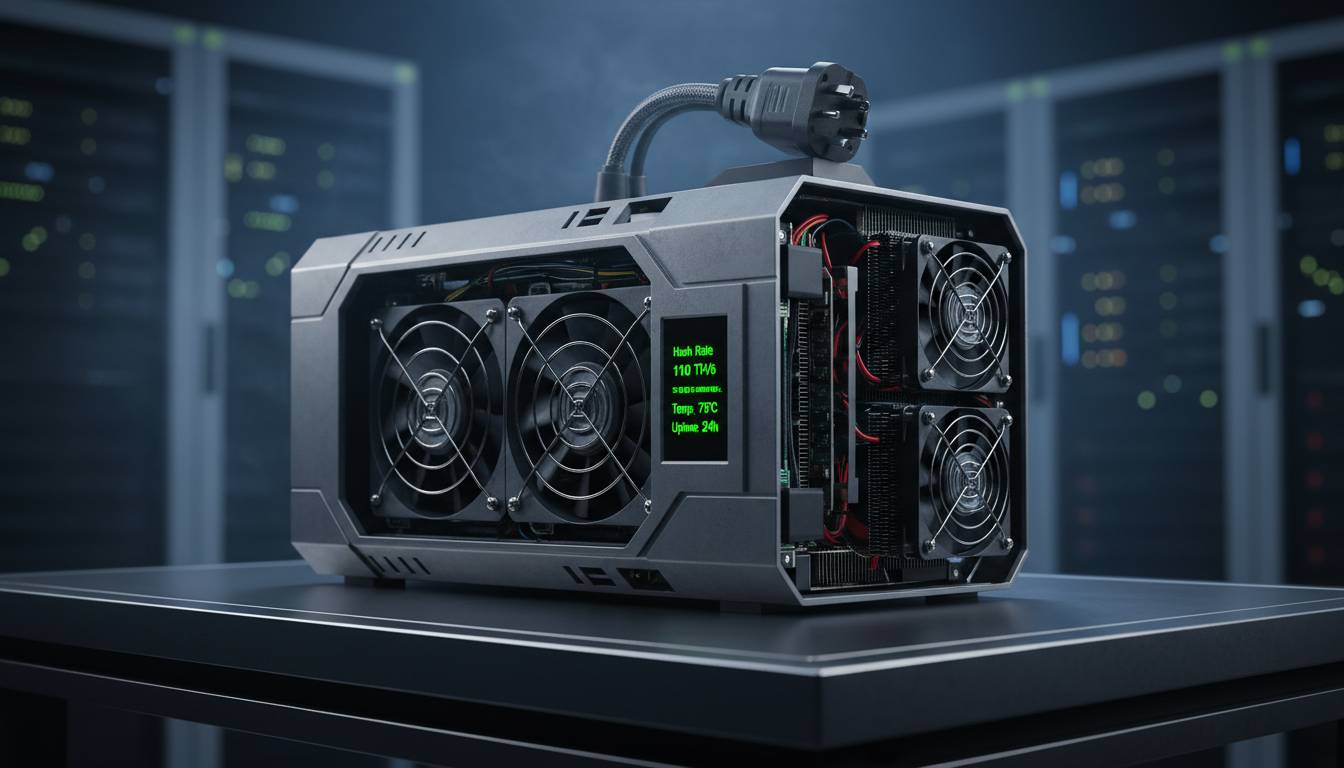
Selecting the right ASIC miner is the most consequential decision in home mining. Three major manufacturers dominate the market: Bitmain, MicroBT (Whatsminer), and Canaan Technologies.
Top ASIC Miners for Home Mining
| Model | Hash Rate | Power Draw | Price (New) | Efficiency |
|---|---|---|---|---|
| Antminer S21 Pro | 234 TH/s | 3,500W | $4,200 | 14.9 J/TH |
| Whatsminer M56S | 212 TH/s | 3,360W | $3,800 | 15.8 J/TH |
| Antminer T21 | 190 TH/s | 3,610W | $3,200 | 19.0 J/TH |
| Canaan Avalon Made A1366 | 130 TH/s | 3,300W | $2,400 | 25.4 J/TH |
Prices from manufacturer websites and authorized distributors as of January 2026
The S21 Pro offers the best efficiency but costs more upfront. For home miners with power constraints, the slightly less powerful M56S may offer better value. Used equipment carries significant risk—miners degrade over time, and there’s no standard warranty on secondhand purchases.
Essential accessories include:
– Power distribution unit (PDU) rated for the miner’s power draw
– Proper ventilation or dedicated cooling setup
– Network cable and stable internet connection (minimum 10 Mbps recommended)
– Optional: rack mount hardware if using multiple units
Setting Up Your Mining Operation
Physical setup requires more consideration than most beginners expect. ASIC miners are industrial equipment designed for data centers, not living rooms.
Space and Environment Requirements
Noise level: ASIC miners produce 70-85 decibels—comparable to a vacuum cleaner or lawn mower. Continuous operation in living spaces is impractical. Dedicated garages, basements, or outdoor enclosures are necessary.
Heat output: A single S21 Pro generates approximately 12,000 BTU of heat. Without proper ventilation, room temperatures can exceed 100°F, damaging equipment and creating fire hazards.
Electrical infrastructure: Most residential circuits are 15-20 amps at 120V. High-end ASICs require 240V circuits (like those used for electric dryers or ovens). You’ll likely need an electrician to install appropriate outlets.
Recommended setup process:
- Location selection: Choose a garage, basement, or shed with 240V access and excellent ventilation
- Electrical assessment: Verify your circuit can handle the load—S21 Pro units need dedicated 20-amp 240V circuits
- Cooling setup: Install exhaust fans or air conditioning if ambient temperatures exceed 85°F
- Network connection: Run ethernet cable for stable connectivity—WiFi introduces latency and disconnect risk
- Mounting: Consider rack mounting for multiple units or simple shelf placement for single miners
The U.S. Department of Energy recommends keeping mining equipment in environments below 95°F for optimal longevity (Energy.gov, 2024).
Software and Wallet Setup
Mining software connects your hardware to the Bitcoin network and mining pools. Configuration requires attention to detail but involves no coding for basic setups.
Choosing a Mining Pool
Mining pools aggregate computational resources to smooth out reward payments. Without a pool, a home miner with 200 TH/s has roughly a 1 in 10,000 chance of solving a block daily—most would wait years for a payout.
Major pools by market share :
| Pool | Fees | Payout Method | Location |
|---|---|---|---|
| Foundry USA | 2.5% | FPPS | United States |
| AntPool | 1.0% | PPLNS/SOLO | Global |
| ViaBTC | 2.0% | PPLNS/PPS | Global |
| Slush Pool | 2.0% | Score | Czech Republic |
FPPS (Full Pay Per Share) provides consistent payouts regardless of whether the pool solves blocks. PPLNS (Pay Per Last N Shares) offers lower fees but more variable payments.
Wallet Requirements
Never mine directly to exchange wallets—you need control of your private keys. Options include:
Hardware wallets (recommended): Ledger or Trezor devices store private keys offline. While you cannot mine directly to them, you can withdraw pool payouts to hardware wallet addresses.
Software wallets: For convenience, Electrum or BlueWallet provide full Bitcoin control without hardware costs.
Cold storage: Maximum security for significant holdings involves paper wallets or offline hardware storage.
Mining Software Options
NiceHash: Beginner-friendly platform that automatically routes work to most profitable algorithms. Takes higher fees but simplifies setup.
CGMiner: Industry standard for advanced users, offering granular control over hardware parameters. Steeper learning curve.
HiveOS: Linux-based management platform designed for mining operations. Supports multiple miners and pools from a single dashboard.
BFGMiner: Modular mining software compatible with FPGA and ASIC hardware.
Calculating Profitability
Profitability calculations require honest assessment of costs and realistic expectations. Many online calculators exist, but understanding the variables matters more than plugging numbers.
Key Profitability Variables
Electricity cost: This is the dominant variable. At $0.08/kWh, an S21 Pro might generate $3-5 daily profit (before hardware costs). At $0.15/kWh, profitability disappears for most hardware.
Hash rate: Your miner will contribute a tiny fraction of total network hashrate. As of January 2026, network hashrate exceeds 600 EH/s. Your 234 TH/s represents 0.039% of total network power.
Bitcoin price: Block rewards are fixed in BTC but valued in dollars. Bitcoin appreciation can offset declining profitability from increasing difficulty.
Difficulty increases: Network difficulty rises regularly. Over 12 months, mining rewards per unit of hash rate typically decline 15-25%.
Sample Profitability Calculation
Using an S21 Pro at $0.08/kWh electricity (January 2026 network conditions):
| Metric | Value |
|---|---|
| Hash Rate | 234 TH/s |
| Power Consumption | 3,500W |
| Electricity Cost | $0.08/kWh |
| Daily Revenue | ~$6.50 |
| Daily Electricity Cost | $6.72 |
| Daily Profit | -$0.22 |
| Monthly Profit | -$6.60 |
At $0.08/kWh, this miner barely breaks even. At $0.05/kWh (industrial rates), monthly profit approaches $80.
The critical insight: only those with electricity costs below $0.06/kWh can expect meaningful home mining returns. Most U.S. residential rates ($0.12-$0.20/kWh) make home mining unprofitable with current hardware and Bitcoin prices.
Legal and Tax Considerations
Bitcoin mining is legal in the United States and most countries, but regulatory considerations apply.
Legal Status
Bitcoin mining is permitted as a business activity in all 50 U.S. states. Some municipalities require business licenses for energy-intensive operations. Check with local authorities regarding electrical permits or zoning for “data centers” (even home-based).
State-level considerations: Texas, Wyoming, and Montana offer favorable regulatory environments and low electricity rates. New York imposes strict BitLicense requirements on certain crypto businesses.
Tax Implications (IRS Guidance)
The IRS treats mined Bitcoin as income at its fair market value upon receipt (IRS Notice 2014-21). This means:
- Each block reward is taxable income in the year received
- Mining expenses (electricity, equipment, maintenance) are deductible business expenses
- Capital gains apply when Bitcoin is sold for profit
- Equipment depreciation follows standard Schedule C business asset rules
Consult a tax professional familiar with cryptocurrency for specific guidance. The $10,000 threshold for Form 8300 reporting applies if you receive payments directly from exchanges exceeding this amount.
Is Home Mining Right for You?
Home mining makes sense only under specific circumstances: access to cheap electricity (ideally below $0.06/kWh), tolerance for industrial noise and heat, willingness to accept 12-24 month payback periods, and belief in Bitcoin’s long-term appreciation.
For everyone else—particularly those in residential settings with standard electricity rates—the economics simply don’t work. Purchasing Bitcoin directly, running a full node for network participation, or investing in publicly traded mining stocks offer better risk-adjusted returns.
If you proceed, start small. A single used miner at $500-1,000 lets you understand the operational demands before committing $5,000+ to new equipment. Track your electricity costs precisely, join a reputable pool, and budget for equipment failure—ASIC miners have significant burnout rates after 2-3 years of continuous operation.
Frequently Asked Questions
Q: Can I mine Bitcoin on my regular computer?
No. CPU and GPU mining for Bitcoin is completely unprofitable. The SHA-256 algorithm requires ASIC miners specifically designed for hash computation. Even top gaming GPUs produce roughly 0.001% of an entry-level ASIC’s hash rate while consuming similar electricity.
Q: How much electricity does home mining use?
A single ASIC miner like the Antminer S21 Pro draws 3,500 watts—equivalent to running a central air conditioner continuously. This translates to approximately 84 kWh per day, or about 2,500 kWh monthly per miner.
Q: How long does it take to mine one Bitcoin?
In a pool, you earn fractional Bitcoin continuously based on your contribution. Solo mining an entire Bitcoin depends on your hash rate—in January 2026, a single S21 Pro would average 500+ years to solve a block independently.
Q: Is home mining profitable in 2026?
Only if your electricity costs $0.06/kWh or less. At typical U.S. residential rates ($0.12-$0.18/kWh), home mining operates at a loss. Industrial miners with discounted power rates dominate the industry.
Q: Do I need to mine 24/7?
Yes, miners should run continuously for optimal returns. Starting and stopping increases wear without providing benefit. Power interruptions should be handled via UPS (uninterruptible power supply) to prevent potential hardware damage.
Q: What happens when Bitcoin halving occurs?
Bitcoin block rewards halve approximately every four years (next expected around 2028). Reduced rewards compress profitability—historically, only efficient miners with low electricity costs survive post-halving periods. This is factored into long-term profitability models.
Conclusion
Home Bitcoin mining in 2026 is a niche activity requiring substantial capital, technical knowledge, and access to cheap electricity. While the potential returns exist for those with industrial power rates and proper equipment, the majority of aspiring home miners will find better returns through direct Bitcoin purchase.
If you proceed, prioritize electricity cost above all else—it’s the deciding factor between profit and loss. Start with used equipment to test your setup and tolerance for noise/heat before purchasing new. Join established pools with transparent fee structures, withdraw to your own wallet, and track all income and expenses for tax purposes.
The dream of earning Bitcoin from a spare bedroom is largely over. But for the small percentage of miners with the right circumstances, home mining remains a viable—and occasionally profitable—way to participate in the world’s most secure monetary network.
Ready to start? Assess your electricity rate first. If you pay more than $0.08/kWh, direct Bitcoin purchase is mathematically superior. If you have access to cheaper power, research ASIC prices, join a pool, and begin with a single unit to learn the ropes before scaling up.