14Views 0Comments
How to Store Cryptocurrency Securely: Best Practices Guide
Cryptocurrency holdings have become prime targets for hackers, scammers, and malicious actors. In 2023 alone, crypto-related hacks resulted in approximately $1.8 billion in stolen funds across 600+ incidents worldwide . For individual investors holding digital assets, the question is no longer whether security matters—it’s whether your current storage method can withstand increasingly sophisticated threats.
This guide provides comprehensive, actionable strategies for securing your cryptocurrency holdings, whether you’re a novice holder or an experienced trader managing significant assets.
Understanding Cryptocurrency Storage Risks
The Threat Landscape
Unlike traditional bank accounts, cryptocurrency wallets are not protected by federal deposit insurance. When your crypto is stolen, recovery is exceptionally difficult—often impossible. The decentralized nature that makes cryptocurrency powerful also means there’s no bank or central authority to reverse fraudulent transactions.
Key risk categories include:
| Risk Type | Description | Impact |
|---|---|---|
| Exchange Hacks | Centralized exchanges compromised by attackers | Full account balance loss |
| Phishing Attacks | Fake websites/emails stealing private keys | Complete wallet drainage |
| Malware | Keyloggers and clipboard hijackers | Credential theft |
| Social Engineering | Scams manipulating users into sending funds | Direct financial loss |
| Physical Theft | Hardware wallet or seed phrase theft | Loss of physical assets |
Why Self-Custody Matters
Keeping your cryptocurrency on exchanges creates counterparty risk—the exchange itself could be hacked, go bankrupt, or freeze your assets. Self-custody (holding your own keys) eliminates these third-party risks but places the full security burden on you.
According to a 2023 survey by CoinGecko, approximately 68% of cryptocurrency holders store their assets on exchanges, despite industry recommendations favoring self-custody for long-term holdings . This mismatch between best practices and actual behavior represents significant unnecessary risk.
Types of Cryptocurrency Wallets
Choosing the right wallet type is the foundation of security. Each category offers different trade-offs between security, convenience, and accessibility.
Hot Wallets vs. Cold Wallets
| Feature | Hot Wallet | Cold Wallet |
|---|---|---|
| Connection | Internet-connected | Offline storage |
| Security | Lower | Higher |
| Convenience | Higher | Lower |
| Best For | Active trading | Long-term storage |
| Hack Risk | Exposed to online threats | Minimal remote attack surface |
Wallet Categories Breakdown
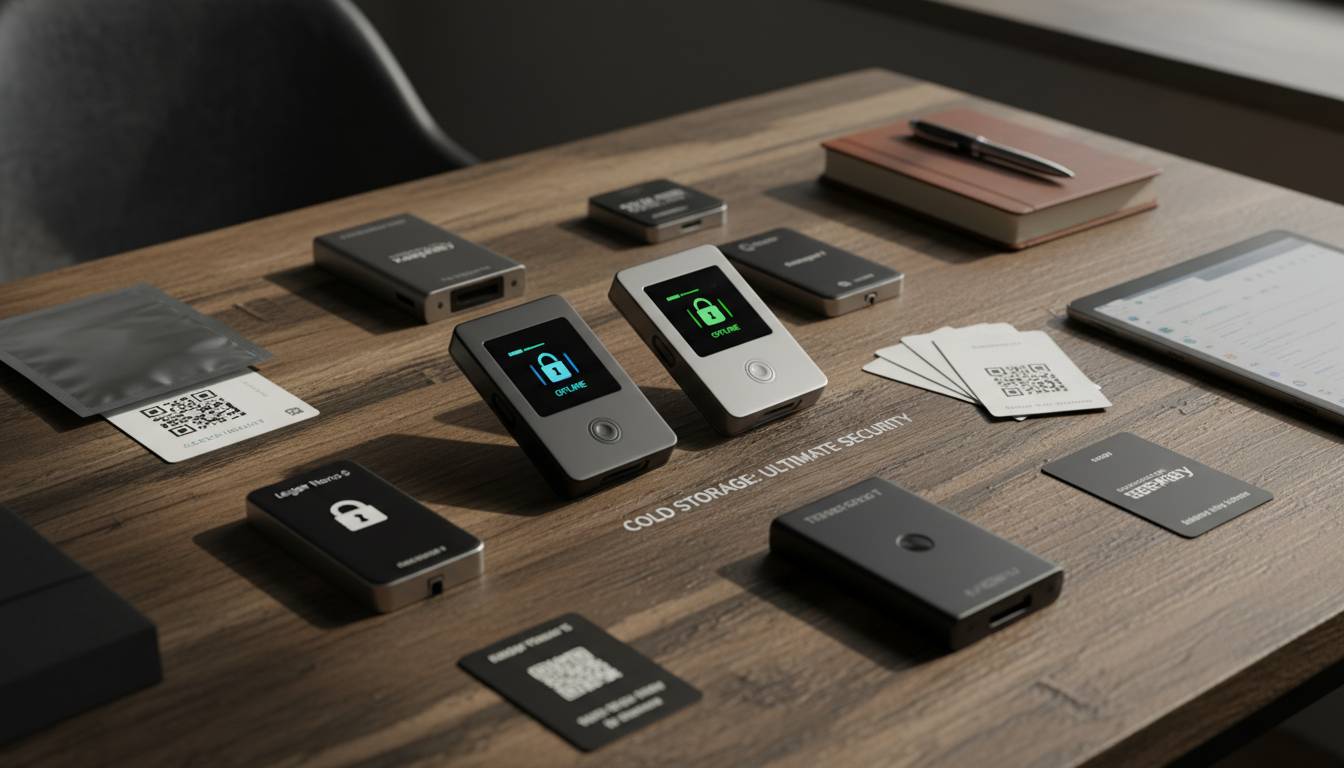
Hardware Wallets (Cold)
– Physical devices that store private keys offline
– Examples: Ledger, Trezor, Coldcard
– Cost: $50-$300
– Security rating: ⭐⭐⭐⭐⭐
Software Wallets (Hot)
– Applications installed on computers or mobile devices
– Examples: MetaMask, Exodus, Electrum
– Cost: Free
– Security rating: ⭐⭐⭐
Paper Wallets (Cold)
– Physical document containing keys and QR codes
– Cost: Free (printing costs)
– Security rating: ⭐⭐⭐⭐ (if generated securely)
Custodial Wallets (Exchange-held)
– Keys held by third-party exchanges
– Examples: Coinbase, Binance, Kraken accounts
– Security rating: ⭐⭐
Hardware Wallets: The Gold Standard
For storing significant cryptocurrency amounts, hardware wallets provide the strongest security posture. These devices store private keys in secure enclaves that never expose the keys to your computer or the internet.
How Hardware Wallets Work
Hardware wallets generate and store private keys within specialized secure elements—dedicated chips designed to resist physical and logical attacks. When you need to sign a transaction, the transaction data is sent to the device, signed internally, and only the signature is returned. Your private keys never leave the device.
Recommended Hardware Wallet Practices
Best practices include:
-
Purchase directly from manufacturers — Buy only from official websites or authorized resellers. Avoid secondary marketplaces where devices could be tampered with.
-
Verify package integrity — Check for signs of tampering before opening. Manufacturers often include security seals.
-
Initialize with clean devices — Always set up new devices yourself in secure environments.
-
Record seed phrases properly — Write down your 12 or 24-word recovery seed on paper. Consider steel backup solutions for fire/water resistance.
-
Never enter seed phrases into computers — Legitimate hardware wallets will never ask you to input your seed phrase into connected software.
Top Hardware Wallet Options (2024)
| Wallet | Price | Key Features | Security Certification |
|---|---|---|---|
| Ledger Nano X | $149 | Bluetooth, 100+ coins, mobile support | Secure Element (CC EAL5+) |
| Trezor Model T | $219 | Touchscreen, open-source, Shamir backup | Secure Element |
| Coldcard Mk4 | $174 | Bitcoin-only, PSBT support, air-gapped | Secure Element |
| Ledger Nano S Plus | $79 | Budget-friendly, 5,500+ coins | Secure Element (CC EAL5+) |
Software Wallets: Convenience With Trade-offs
Software wallets offer unmatched convenience for frequent transactions but require rigorous security practices.
Desktop Wallets
Desktop wallets install on your computer, providing good security when your machine is free from malware. However, they remain vulnerable to any compromises affecting your operating system.
Security essentials for desktop wallets:
– Use dedicated computers for crypto activities
– Keep operating systems and software updated
– Enable disk encryption
– Install reputable antivirus software
– Use hardware wallets for large holdings
Mobile Wallets
Mobile wallets provide accessibility but introduce additional attack vectors through app stores, operating system vulnerabilities, and device loss or theft.
Essential mobile wallet security:
– Enable biometric authentication (fingerprint/Face ID)
– Use strong device passcodes
– Enable remote wipe capabilities
– Avoid connecting to public WiFi when transacting
– Consider using separate devices for large holdings
Browser Extension Wallets
Browser extensions like MetaMask have become essential for interacting with decentralized applications (dApps), DeFi platforms, and NFTs. However, their browser integration creates significant attack surface.
Critical browser wallet protections:
– Always verify website URLs before connecting
– Review and revoke unused token approvals regularly
– Use hardware wallets for signing transactions when possible
– Be extremely cautious withairdrops and suspicious links
– Enable transaction simulation features when available
Essential Security Practices
Private Key and Seed Phrase Management
Your seed phrase is the master key to your cryptocurrency. If someone obtains it, they control your funds regardless of other security measures.
Seed phrase best practices:
-
Write it down by hand — Never store digitally. Photos, screenshots, and cloud storage are hackable.
-
Use multiple secure locations — Store copies in geographically separate locations (home safe, bank safe, trusted family).
-
Consider steel backups — Products like Billfodl or CryptoSteel survive fires and floods.
-
Never share with anyone — No legitimate service will ever ask for your seed phrase.
-
Verify in offline environments — When recovering wallets, use air-gapped devices or manual entry.
Multi-Layer Security Architecture
Professional cryptocurrency holders implement defense-in-depth strategies:
| Layer | Security Measure | Purpose |
|---|---|---|
| 1. Cold Storage | Hardware wallet, offline keys | Primary protection for bulk holdings |
| 2. Warm Wallet | Hardware wallet connected via USB | Smaller amounts for transactions |
| 3. Hot Wallet | Mobile/browser extension | Minimal daily spending amounts |
| 4. Exchange | Only when actively trading | Immediate liquidity needs |
Two-Factor Authentication (2FA)
Enable 2FA on every exchange and wallet service that supports it. Prioritize:
– Hardware security keys (YubiKey, Google Titan) — Strongest option
– Authenticator apps (Google Authenticator, Authy) — Better than SMS
– Avoid SMS-based 2FA — SIM swapping attacks bypass this
Network Security
- Use hardware wallets for signing transactions
- Access financial accounts only through trusted networks
- Consider using VPN services for added privacy
- Verify SSL certificates on all crypto websites
- Bookmark frequently used exchange URLs to avoid phishing
Common Cryptocurrency Storage Mistakes
Mistake #1: Keeping All Crypto on Exchanges
Impact: Complete loss if exchange is hacked, insolvent, or freezes your account.
Solution: Only keep trading amounts on exchanges. Move long-term holdings to personal wallets.
Mistake #2: Inadequate Seed Phrase Backup
Impact: Permanent loss if single copy is destroyed (fire, flood, misplacement).
Solution: Create multiple geographically-distributed backups using fireproof steel storage.
Mistake #3: Ignoring Software Updates
Impact: Vulnerabilities in outdated wallet software can be exploited.
Solution: Enable automatic updates or regularly check for new versions from official sources.
Mistake #4: Falling for Phishing Scams
Impact: Complete wallet drainage through malicious links or fake support.
Solution: Never click links in unsolicited emails. Always navigate directly to websites. Verify sender addresses carefully.
Mistake #5: Reusing Addresses
Impact: Blockchain analysis can link transactions, reducing privacy.
Solution: Use new addresses for each transaction when possible. Many wallets automate this.
Mistake #6: Insufficient Access Controls
Impact: Stolen devices lead to compromised accounts.
Solution: Enable full device encryption, strong biometrics, and remote wipe capabilities.
What to Do If Your Cryptocurrency Is Stolen
Despite best practices, security incidents can occur. Knowing how to respond quickly is critical.
Immediate Response Steps
- Disconnect affected devices from the internet — Prevents further unauthorized access
- Transfer remaining assets — If possible, send undamaged funds to secure wallet
- Document everything — Save transaction IDs, communications, timestamps
- Report to exchanges — Provide details to freeze associated accounts if possible
Reporting Channels
- IC3 (Internet Crime Complaint Center): FBI’s cyber crime reporting portal
- Local law enforcement: File police reports with documentation
- Chainalysis (for exchanges): Blockchain forensics firms can trace funds
- Project-specific teams: Contact the cryptocurrency project’s security team
Recovery Realities
Unfortunately, cryptocurrency recovery is often unsuccessful. According to Chainalysis, only about 20% of stolen cryptocurrency is ever recovered . Prevention remains the most effective strategy.
Conclusion
Securing cryptocurrency requires understanding the unique risks of digital assets and implementing appropriate protections. The most effective approach combines self-custody through hardware wallets for significant holdings, careful seed phrase management, layered security through 2FA and network protections, and ongoing vigilance against evolving threats.
Start by assessing your current storage methods. If you’re holding significant cryptocurrency on exchanges, prioritize moving to hardware wallets. Implement seed phrase backups today. Enable two-factor authentication on every account. These foundational steps dramatically reduce your risk profile.
Remember: in cryptocurrency security, you are your own bank—and your own security team.
Frequently Asked Questions
Is it safe to keep cryptocurrency on exchanges?
Keeping cryptocurrency on exchanges creates counterparty risk. While major exchanges implement strong security measures, they remain attractive targets for hackers. For long-term holdings exceeding amounts you need for immediate trading, self-custody with personal wallets is significantly safer.
What is the safest way to store cryptocurrency?
Hardware wallets provide the strongest security for most users. They store private keys offline in secure elements resistant to both physical and digital attacks. Pair hardware wallets with proper seed phrase backups stored in multiple secure locations.
How do I recover my cryptocurrency if I lose my hardware wallet?
Your 12 or 24-word seed phrase allows complete wallet recovery. Purchase a new hardware wallet (or use compatible software), select the recovery option, and enter your seed phrase in the correct order. Your funds and transaction history will be restored.
Can someone steal my cryptocurrency with just my public address?
No. Your public address is designed to be shared for receiving payments. Only your private key (or seed phrase) controls access to funds. However, sharing addresses publicly reduces privacy, as anyone can view your transaction history on the blockchain.
Should I use a paper wallet?
Paper wallets are secure when generated correctly using offline, audited tools—however, they present practical challenges including vulnerability to physical damage, loss, and human error during import. Most users find hardware wallets more practical while maintaining strong security.
How often should I review my crypto security setup?
Review your security setup at minimum annually, or after any significant life change (new devices, moving, changes in household). Additionally, monitor for exchange compromises and update passwords/2FA methods if services you use experience security incidents.