3Views 0Comments
Index Funds Explained: How to Invest & Build Wealth
Index funds have transformed how millions of Americans invest for retirement and build long-term wealth. Unlike actively managed funds that try to beat the market, index funds simply track a market benchmark—like the S&P 500—delivering solid returns with remarkably low fees. This guide explains everything you need to know about index funds, from how they work to opening your first account.
What Are Index Funds?
An index fund is a type of mutual fund or exchange-traded fund (ETF) designed to replicate the performance of a specific market index. When you invest in an index fund, your money is spread across hundreds or thousands of stocks or bonds that comprise the index it’s tracking.
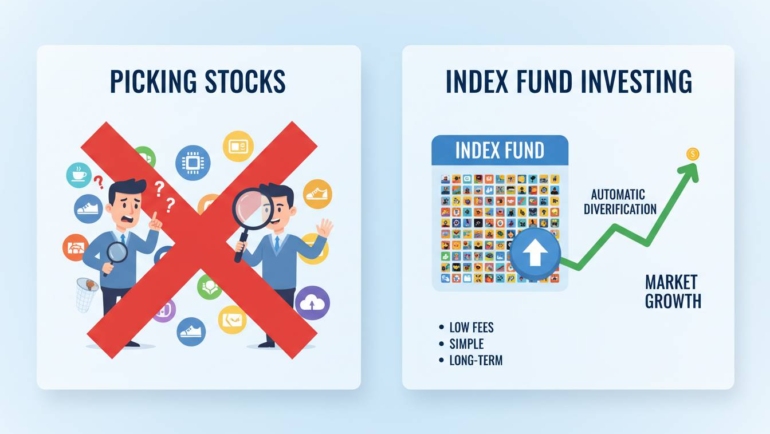
The core concept is simple: Instead of trying to pick winning stocks—which research shows even professional investors struggle to do consistently—you own a slice of the entire market.
Index funds operate on a passive management philosophy. The fund manager doesn’t research individual companies or decide when to buy and sell. Instead, they automatically adjust the portfolio whenever the underlying index changes. If a company is added to the S&P 500, the fund buys it. If a company is removed, the fund sells it.
The first index fund was launched in 1975 by John Bogle, founder of Vanguard. His goal was democratizing access to diversified investing for ordinary Americans. Today, index funds hold over $15 trillion in assets globally.
Mutual Funds vs. ETFs
Index funds come in two main structures:
| Feature | Mutual Fund | ETF |
|---|---|---|
| Minimum investment | Often $3,000+ | None (unlike mutual funds, you can buy single shares) |
| Trading | Once per day at close | Anytime during market hours |
| Tax efficiency | Lower | Higher (due to in-kind creation) |
| Fees | Generally low | Often slightly lower |
Both options can be excellent choices. Many investors prefer ETFs for their flexibility and tax advantages, while others like the automatic investment features of mutual funds.
Types of Index Funds
Not all index funds track the same benchmarks. Understanding the different types helps you build an appropriate portfolio.
Total Stock Market Index Funds
These funds track the entire U.S. stock market—thousands of companies of all sizes. They offer the broadest diversification and slightly higher returns than S&P 500 funds over very long periods because they include small growth stocks.
Popular examples: Vanguard Total Stock Market ETF (VTI), Fidelity Total Market Index Fund (FSKAX)
S&P 500 Index Funds
The S&P 500 includes 500 of the largest U.S. companies, representing about 80% of total U.S. market value. These funds are the most popular index funds for a reason—they deliver reliable exposure to America’s largest, most established companies.
Popular examples: Vanguard S&P 500 ETF (VOO), SPY (SPDR S&P 500 ETF), Fidelity 500 Index Fund (FXAIX)
Bond Index Funds
These track indexes of U.S. Treasury bonds, corporate bonds, or municipal bonds. They provide income and stability, balancing the volatility of stock investments.
Popular examples: Vanguard Total Bond Market ETF (BND), iShares Core U.S. Aggregate Bond ETF (AGG)
International Index Funds
These funds invest in stocks outside the United States, providing geographic diversification. Some track developed markets only; others include emerging markets with higher growth potential but more volatility.
Popular examples: Vanguard Total International Stock ETF (VXUS), iShares Core MSCI Total International ETF (IXUS)
Target-Date Funds
A target-date fund is a “fund of funds” that holds multiple index funds and automatically adjusts its allocation over time. If you’re 30 and plan to retire around 2060, a 2060 target-date fund gradually shifts from all-stock to more conservative holdings as you approach retirement.
Benefits of Index Fund Investing
Index funds offer several compelling advantages that make them ideal for most individual investors.
Low Fees
The biggest advantage is cost. Actively managed mutual funds typically charge 0.5% to 1.5% annually in management fees. Index funds often charge 0.03% to 0.15%—a fraction of the cost.
This matters enormously over time. Consider $100,000 invested for 30 years with 7% annual returns:
- With a 0.05% fee: $761,226
- With a 1.0% fee: $574,849
The fee difference alone costs you $186,377.
Diversification
A single index fund provides instant diversification across hundreds of companies. If one stock crashes, it barely moves your portfolio. This reduces risk without requiring you to research individual companies.
According to the Investment Company Institute, index funds averaged just 0.16% in annual expenses in 2024, compared to 0.64% for actively managed equity funds.
Consistent Performance
Here’s a uncomfortable truth: most active fund managers fail to beat their benchmark over time. The S&P SPIVA U.S. Persistence Scorecard consistently shows that over 90% of actively managed funds underperform their benchmark over 10-year periods.
Index funds guarantee market-matching returns—no better, no worse. That certainty outperforms the majority of active managers.
Simplicity
Building a portfolio of 3-5 index funds takes minutes, not hours. Once established, index funds require minimal maintenance. You don’t need to monitor company earnings, track industry trends, or stress over daily market movements.
How to Invest in Index Funds
Ready to start? Here’s a step-by-step guide to building your index fund portfolio.
Step 1: Open a Brokerage Account
You’ll need a brokerage account to buy index funds. Popular options include:
- Fidelity: Excellent index fund selection, no minimums on many funds
- Vanguard: Pioneer of index funds, owned by fund shareholders
- Schwab: Strong zero-commission ETF selection
- Robinhood: Simple interface, but limited mutual fund options
Choose a tax-advantaged account first. If you’re investing for retirement, max out your 401(k) employer match, then contribute to an IRA or Roth IRA before using a taxable brokerage account.
Step 2: Fund Your Account
Transfer money from your bank account. Most brokerages allow automated transfers—set up recurring contributions to automate your investing.
Pro tip: Even small amounts matter. Investing $200 monthly starting at age 25 grows to over $400,000 by age 65 assuming 7% returns.
Step 3: Choose Your Index Funds
Select funds matching your investment goals and risk tolerance. A common three-fund portfolio includes:
| Fund Type | Example | Allocation (Age 30) |
|---|---|---|
| U.S. Total Market | VTI | 50% |
| International | VXUS | 30% |
| Bonds | BND | 20% |
The younger you are, the more aggressive (stock-heavy) your allocation can be. Reduce stock exposure as you approach retirement.
Step 4: Make Your Purchase
Search for your chosen fund, enter the dollar amount or number of shares, and execute the trade. ETFs trade like stocks; mutual funds execute at the end-of-day price.
Dollar-cost averaging—investing fixed amounts at regular intervals—reduces timing risk and builds discipline.
Step 5: Rebalance Periodically
Once per year, review your allocation. If stocks boom and your portfolio drifts to 70% stocks when you want 60%, sell some stocks and buy bonds to rebalance. This forces you to “buy low, sell high.”
Common Index Fund Investing Mistakes
Even experienced investors trip up on these pitfalls.
Timing the Market
Waiting for the “right moment” to invest is tempting but destructive. Missing the market’s 10 best days between 1995 and 2014 cuts returns by nearly half, according to JP Morgan Asset Management.
Start investing immediately, even with small amounts. Time in the market beats timing the market.
Ignoring Expense Ratios
All index funds aren’t equally cheap. Some carry 0.20% or higher fees—still low, but four times more expensive than the cheapest options. Check the expense ratio before buying.
Overlooking International Exposure
Many Americans invest almost entirely in U.S. stocks. But international diversification reduces volatility and captures growth in emerging economies. A reasonable target is 20-40% international.
Chasing Recent Performance
Index funds don’t have “performance” to chase—they track an index. If something outperformed recently, it’s already priced in. Don’t react to recent returns when selecting index funds.
Frequently Asked Questions
Q: Are index funds safe?
Index funds are not risk-free—they’re subject to market downturns. However, they’re considered safer than individual stocks because diversification reduces the impact of any single company’s failure. Bond index funds carry interest rate and credit risk. Your overall portfolio risk depends on your stock/bond allocation.
Q: How much money do I need to start?
One major advantage: you can start with $1 in most cases. ETFs trade like stocks, so you buy a single share. Some index mutual funds require $1,000 or $3,000 minimums—choose ETFs if you’re starting small.
Q: What happens if the stock market crashes?
Index funds track the market down just as they track it up. In a crash, your portfolio loses value—but you’re not forced to sell. Historically, markets recover and reach new highs. The 2008 financial crisis, 2020 pandemic crash, and 2022 downturn all reversed within months to years.
Q: Can I lose all my money in index funds?
In practical terms, no. For an index fund to go to zero, every company in that index would have to fail—every S&P 500 company, every U.S. company, etc. This would represent a complete collapse of the global economy. Even in the worst historical scenarios, markets have recovered.
Q: Are index funds better than mutual funds?
For most investors, yes. Index funds consistently outperform most actively managed mutual funds after fees, require less maintenance, and carry lower costs. However, some specialized mutual funds in niche markets may provide genuine active management advantages.
Q: When should I sell my index funds?
Ideally, never. Selling during downturns locks in losses. Most successful investors hold for decades, only adjusting allocation as they approach retirement. Rebalance within your portfolio rather than cashing out entirely.
Conclusion
Index funds represent one of the most powerful wealth-building tools available to individual investors. They offer instant diversification, rock-bottom fees, and consistent market returns—all through a simple, set-it-and-forget-it approach.
The path forward is straightforward: Open a brokerage account, fund it regularly, invest in 3-5 low-cost index funds matching your goals, and stay the course through market ups and downs.
Time is your greatest ally. A 25-year-old contributing $500 monthly to index funds can accumulate over $1 million by age 65. That same strategy started at 45 reaches only about $250,000.
Start now. Your future self will thank you.
This article is for educational purposes only and does not constitute financial advice. Consult with a qualified financial advisor before making investment decisions. All investments carry risk, including potential loss of principal.