15Views 0Comments
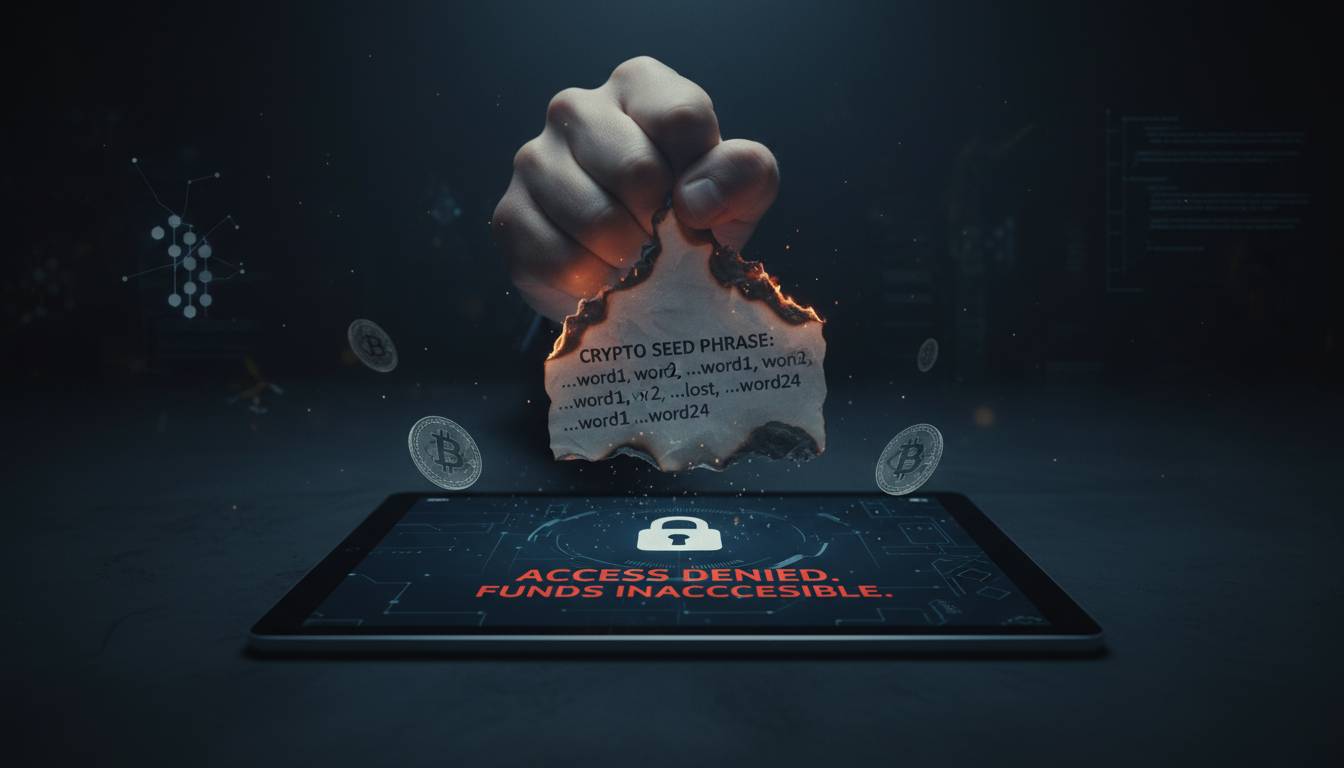
Lost Your Crypto Seed Phrase? Here’s What Happens
Losing your cryptocurrency wallet seed phrase is one of the most terrifying moments for any crypto holder. Unlike traditional bank accounts where you can reset passwords or verify your identity, the cryptocurrency ecosystem operates on a fundamental principle: you are your own bank. When that seed phrase disappears, your access to your funds may disappear with it—permanently.
This article explains exactly what happens when you lose your seed phrase, the technical reasons behind this immutability, your limited recovery options, and most importantly, how to prevent this catastrophe from happening in the first place.
What Exactly Is a Seed Phrase?
A seed phrase, also known as a recovery phrase or mnemonic phrase, is typically a sequence of 12 or 24 words generated by your cryptocurrency wallet. This phrase is the master key that derives all your private keys for different cryptocurrencies and accounts within that wallet.
When you set up a new wallet—whether a hardware wallet like Ledger or Trezor, a software wallet like MetaMask, or a mobile wallet like Trust Wallet—the device generates a cryptographically secure random number and converts it into these words. The BIP39 standard, adopted by most wallet manufacturers, uses a specific list of 2048 words, and the mathematical relationship between your seed phrase and your private keys is deterministic.
This means your seed phrase can regenerate every single private key associated with your wallet, regardless of which cryptocurrency you hold or how many transactions you’ve made. The 12-word version provides approximately 128 bits of security, while the 24-word version offers 256 bits—both considered practically unbreakable with current computing technology.
What Actually Happens When You Lose Your Seed Phrase
When you lose your seed phrase, several scenarios can unfold depending on your specific circumstances.
The Most Common Outcome: Total Loss of Access
If you have lost your seed phrase and do not have any backup, your cryptocurrency becomes inaccessible. There is no customer service number to call, no identity verification process, and no “forgot password” functionality. The decentralized nature of cryptocurrency means no central authority can reset or recover your keys. Your funds remain on the blockchain, visible to everyone, but completely untouchable by anyone—including you.
This isn’t a glitch or oversight. It’s by design. The same cryptographic principles that make your wallet secure against hackers also make it impossible to recover without the original seed phrase. If someone could somehow recover your wallet without the seed phrase, that would represent a fundamental security vulnerability that would undermine the entire cryptocurrency ecosystem.
Partial Recovery Scenarios
In some cases, you might retain partial access to your funds. If you only use one wallet and have lost the seed phrase but still have access to the device itself (for example, a hardware wallet that’s still functional), you may be able to extract the private key directly from the device and import it into a new wallet. However, this only works if the device is accessible and functional—if it’s damaged, lost, or locked, you’re back to square one.
Some users maintain multiple copies of their wallet or have set up multi-signature arrangements, which can provide alternative recovery paths. Multi-signature wallets require multiple private keys to authorize transactions, so losing one seed phrase doesn’t necessarily lock you out completely, depending on the specific configuration.
Can You Recover a Lost Seed Phrase?
This is the question everyone asks immediately, and the answer requires nuance.
Professional Recovery Services: Proceed with Extreme Caution
Several companies advertise cryptocurrency recovery services, and some legitimate operations do exist. These services typically employ cryptographic experts who may be able to recover wallets under specific circumstances—for example, if you remember portions of your seed phrase, if the loss was due to physical damage to storage media, or if there were implementation errors in the original wallet software.
However, you should approach these services with significant skepticism. The cryptocurrency space is rife with scams, and “recovery services” are a common vector for fraud. Legitimate recovery is extremely expensive (often costing thousands of dollars), takes considerable time, and has no guaranteed success. Many supposed recovery services are simply advance-fee scams, taking your money without providing any actual recovery.
Brute Force: Technically Possible, Practically Impossible
In theory, if you remember even a few words of your 12 or 24-word seed phrase, you could attempt to brute force the remaining words. The mathematical probability of guessing a complete 12-word seed phrase is 1 in 2^128—that’s approximately 340 undecillion (340 billion trillion trillion), a number so large it exceeds the estimated number of atoms in the observable universe.
Even if you remember 11 of 12 words, the remaining word requires checking 2048 possibilities, which is technically feasible but still requires specialized software and significant computational resources. However, most wallet software includes BIP39 checksum verification, making simple dictionary attacks less effective.
If You Still Have Access to the Wallet
If your seed phrase is lost but you still have access to your wallet (the device or app), you may be able to extract your private keys directly. Hardware wallets typically allow you to export raw private keys or seed phrases directly from the device, though this often requires PIN entry and may have security limitations. Software wallets might store the seed phrase in encrypted form on your device or cloud backup.
Real-World Examples of Seed Phrase Loss
The cryptocurrency ecosystem has witnessed numerous high-profile cases of seed phrase loss resulting in massive value destruction.
In 2013, James Howells, an IT worker from Wales, accidentally threw away a hard drive containing 7,500 bitcoins (worth approximately $275 million at Bitcoin’s November 2021 peak). Despite extensive negotiations with local authorities, the landfill was never excavated, and the bitcoins remain buried to this day. This case illustrates both the permanence of loss and the psychological toll it takes.
Mt. Gox, the once-dominant Bitcoin exchange, lost approximately 850,000 bitcoins (worth billions at various points) due to a combination of security breaches and operational failures. While some of this was due to external hacking rather than seed phrase loss alone, the collapse demonstrated how catastrophic key management failures can be.
On a smaller scale, cryptocurrency forums and social media are filled with stories from individuals who have lost access to wallets containing meaningful sums—ranging from hundreds to hundreds of thousands of dollars—all due to lost seed phrases, failed hardware devices, or corrupted backup files.
The Psychology of Seed Phrase Loss
Beyond the financial implications, losing a seed phrase often causes significant psychological distress. Cryptocurrency holders frequently describe feelings of panic, shame, and regret. Some have compared it to losing a significant amount of cash, but worse—because the loss is entirely their own fault and completely irreversible.
This psychological aspect is important because it affects how people respond to the situation. Victims of seed phrase loss are vulnerable to scams, hasty decisions, and emotional reasoning. Understanding that a lost seed phrase is a permanent loss can help people accept the reality more quickly and avoid falling prey to recovery scams.
Prevention: How to Never Lose Your Seed Phrase
Given the permanence of seed phrase loss, prevention is absolutely essential. Here are the strategies that security experts recommend.
Physical Backup Best Practices
Never store your seed phrase digitally. This means no photos, no cloud storage, no computer files, and no screenshots. Malware can scan for seed phrase patterns and exfiltrate them. Instead, write your seed phrase on paper or engrave it on metal.
Paper has obvious vulnerabilities—it can burn, get wet, tear, or fade. Metal backups, using products like Cryptosteel, Billfodl, or custom-etched steel plates, resist fire, water, and physical degradation. Regardless of the medium, create multiple copies stored in separate, secure locations—your home safe, a bank safe deposit box, or with trusted family members in different geographic locations.
Avoid Common Mistakes
Never share your seed phrase with anyone, ever. No legitimate service, exchange, or support team will ever ask for your seed phrase. Treat it like the keys to your safe deposit box combined with the PIN to your bank account—extremely sensitive information that never leaves your possession.
Don’t store your seed phrase in locations that might be accessed by others—under your mattress if you have roommates, in a desk drawer at work, or anywhere with regular visitor traffic. Consider the physical security of each location equally as important as the digital security of your wallet.
Consider Multi-Signature and Inheritance Solutions
For large holdings, multi-signature arrangements provide redundancy. These wallets require multiple keys to authorize transactions, so losing one seed phrase doesn’t result in total loss. Services like Casa or Unchained Capital offer multi-signature setups specifically designed for long-term Bitcoin storage.
Some companies also offer cryptocurrency inheritance planning, allowing you to set up arrangements where your funds can be accessed by designated beneficiaries under specific conditions. This addresses not only loss prevention but also the uncomfortable reality that death or incapacity can create similar access problems.
What Wallets and Exchanges Provide for Recovery
It’s worth noting that some cryptocurrency services provide account recovery options that differ from traditional self-custody wallets.
Custodial services like Coinbase, Binance, or Kraken hold your cryptocurrency on your behalf and provide traditional account recovery options—password resets, identity verification, and customer support. These services use internal records to maintain access to your funds, meaning you don’t need to manage a seed phrase. However, this introduces counterparty risk: if the exchange is hacked, goes bankrupt, or freezes your account, you lose access to your funds regardless of your own security practices.
The trade-off between self-custody (full control, full responsibility) and custodial services (convenience, some protection against self-loss) is one of the fundamental decisions every cryptocurrency holder must make.
Frequently Asked Questions
Can I recover my crypto if I lost my seed phrase but still have the device?
If you still have access to the original device—whether a hardware wallet, phone, or computer—you may be able to extract your private keys or seed phrase directly. Hardware wallets often allow you to view the seed phrase while the device is connected and unlocked. Software wallets may store the seed phrase locally or offer export options. However, if the device is locked, damaged, or reset, this option disappears.
Is there any way to reset or recover my seed phrase through the wallet provider?
No. Self-custody cryptocurrency wallets do not store your seed phrase on their servers—by design. There is no “reset” function because the wallet provider literally cannot see or access your seed phrase. If they could, that would represent a catastrophic security failure. Only services where the provider holds your funds (custodial services) can offer account recovery.
What happens to the crypto in a lost wallet? Does it disappear?
The cryptocurrency remains on the blockchain permanently. It’s not deleted or destroyed—it becomes permanently inaccessible. The tokens exist in wallet addresses that can be seen by anyone, but without the private keys, no one can move them. This is sometimes described as “burned” or “locked,” but technically the funds are simply unreachable.
How common is seed phrase loss?
Exact statistics are difficult to obtain, but cryptocurrency researchers estimate that 2-3 million bitcoins (worth tens of billions at current prices) are permanently lost due to various forms of key management failures, including lost seed phrases, deceased owners without inheritance plans, and hardware failures. Chainalysis data suggests approximately 20% of all bitcoins may be permanently lost.
Can someone guess my seed phrase and steal my funds?
The mathematical probability of randomly guessing a seed phrase is infinitesimally small. With 2^128 possible combinations for a 12-word phrase, no computer currently existing could brute force the entire space within the lifetime of the universe. However, seed phrases can be stolen through phishing, malware, social engineering, or physical theft—so while random guessing is impossible, targeted theft is a real threat.
Should I use a 12-word or 24-word seed phrase?
Both are currently considered secure. The 12-word version provides 128 bits of security, while 24 words provides 256 bits. For practical purposes, both are unbreakable with current technology. The main advantage of 24 words is protection against certain types of implementation flaws and providing additional margin for error if part of the phrase becomes corrupted or illegible.
Conclusion
Losing your cryptocurrency seed phrase is a permanent, irreversible loss of access to your funds. The decentralized nature of cryptocurrency, which provides unprecedented security and autonomy, also means there’s no safety net—no password reset, no customer service intervention, no identity verification that can restore your access.
The only real defense is prevention: create physical backups using durable materials, store them in secure separate locations, never share your seed phrase with anyone, and consider advanced solutions like multi-signature wallets for significant holdings. Accept from the beginning that managing your own cryptocurrency means accepting full responsibility for its security.
If you’ve already lost your seed phrase and don’t have access to the original device, the unfortunate reality is that your cryptocurrency is likely gone forever. Be wary of anyone promising recovery—they’re either scamming you or offering extremely expensive, uncertain services with minimal success rates. The best time to secure your seed phrase was when you created your wallet. The second-best time is now.