15Views 0Comments
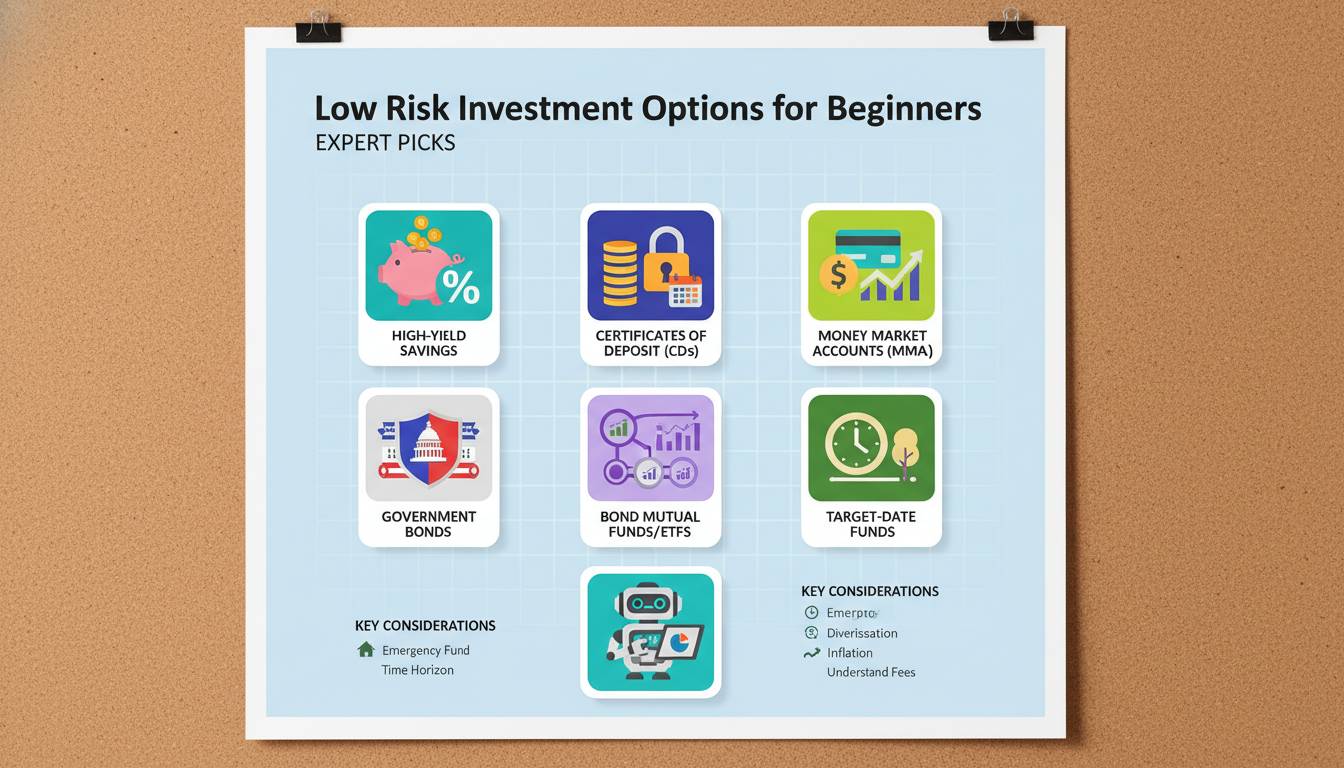
Low Risk Investment Options for Beginners – Expert Picks
If you’re new to investing and worried about losing money, low-risk investment options offer a way to grow your wealth without the rollercoaster volatility of the stock market. While these investments typically deliver lower returns than riskier alternatives, they provide stability, capital preservation, and peace of mind—making them ideal for emergency funds, near-term financial goals, or anyone building a foundation before exploring higher-return opportunities.
Understanding What “Low Risk” Really Means in Investing
Before exploring specific options, understanding what low-risk actually means in investing is essential. Risk in investing refers to the possibility of losing some or all of your principal investment. Low-risk investments are those with minimal probability of capital loss and relatively stable returns over time.
The relationship between risk and return is fundamental to investing: lower risk typically means lower potential returns. A Treasury bond issued by the U.S. government carries minimal default risk but historically yields less than corporate stocks over long periods. This trade-off isn’t a flaw—it’s how markets price different levels of uncertainty.
Several factors determine investment risk:
Inflation risk affects investments that don’t keep pace with rising prices. If your returns fail to exceed inflation, your purchasing power actually decreases over time. Many low-risk investments, particularly CDs and savings accounts, face this challenge in low-interest-rate environments.
Liquidity risk refers to how easily you can convert your investment to cash without significant loss. Some low-risk investments, like certificates of deposit, penalize early withdrawal.
Interest rate risk impacts bond prices inversely—when rates rise, existing bonds with lower fixed rates become less valuable. This matters for investors holding bonds rather than holding to maturity.
For beginners, prioritizing capital preservation while earning modest returns that outpace inflation represents a sensible starting point. As your financial knowledge grows and you build an emergency fund, you can gradually allocate portions of your portfolio to higher-risk, higher-reward investments.
Top Low-Risk Investment Options for Beginners
Several investment vehicles offer beginners a combination of safety, accessibility, and reasonable returns. Each serves different purposes depending on your timeline and financial goals.
| Investment Type | Risk Level | Typical Return | Liquidity | Best For |
|---|---|---|---|---|
| High-Yield Savings Accounts | Very Low | 4-5% APY | Excellent | Emergency funds |
| Treasury Securities | Very Low | 4-5% | Good | Conservative investors |
| Certificates of Deposit | Very Low | 4-5% APY | Limited | Fixed timelines |
| Money Market Funds | Very Low | 4-5% | Good | Short-term goals |
| Municipal Bonds | Low | 3-4% | Moderate | Tax-advantaged investing |
| Index Funds (Bond) | Low | 3-5% | Good | Long-term growth |
High-Yield Savings Accounts: Your First Investment Home
High-yield savings accounts represent the simplest low-risk investment available. These FDIC-insured accounts at online banks offer interest rates significantly higher than traditional brick-and-mortar banks—often 10 to 20 times more.
The Federal Deposit Insurance Corporation protects up to $250,000 per depositor, per bank, making these accounts among the safest places to store money. Your principal is guaranteed, and you earn interest monthly.
The current annual percentage yield (APY) on high-yield savings accounts sits around 4-5%, which outpaces inflation while keeping your money accessible. Unlike investments that fluctuate daily, your balance grows steadily without any market volatility.
Best for: Emergency funds, money you’re saving for near-term goals (within 1-3 years), or money you want accessible without notice.
Considerations: These accounts don’t come with check-writing privileges typically, and some banks limit monthly transactions. Interest rates are variable, meaning they change as the Federal Reserve adjusts rates.
Treasury Securities: The Gold Standard of Safety
U.S. Treasury securities represent loans to the federal government. Because the U.S. government has never defaulted on its debt, Treasuries are considered virtually risk-free regarding default risk. These include Treasury bills (short-term, up to 52 weeks), Treasury notes (2-10 years), and Treasury bonds (20-30 years).
Treasury yields currently range from roughly 4% for short-term bills to around 4.5% for longer-term notes. Interest is subject to federal income tax but exempt from state and local taxes, providing a tax advantage for investors in higher tax brackets.
You can purchase Treasuries directly through TreasuryDirect.gov, through a broker, or via Treasury exchange-traded funds (ETFs). The direct purchase method requires patience—funds take time to settle—but eliminates intermediary fees.
Best for: Conservative investors seeking guaranteed returns, those in high tax brackets benefiting from state tax exemption, and anyone wanting a stable foundation for their portfolio.
Considerations: If you sell Treasuries before maturity, you may receive less than face value if interest rates have risen. Longer-term Treasuries are more sensitive to rate changes.
Certificates of Deposit: Lock In Your Rate
Certificates of deposit (CDs) are time deposits offered by banks and credit unions. You deposit money for a fixed period—ranging from three months to five years—and receive a fixed interest rate in return. Early withdrawal typically results in substantial penalties, often several months of interest.
CD rates currently match or slightly exceed high-yield savings account rates, with some institutions offering promotional rates above 5% for certain terms. The fixed return eliminates uncertainty, and FDIC insurance protects your principal up to limits.
Many financial experts recommend using the “CD ladder” strategy—buying CDs with staggered maturity dates. As each CD matures, you can reinvest in new CDs at current rates or access your money if needed.
Best for: Money you won’t need immediately, savers who want to avoid temptation, and those who prefer knowing exactly what they’ll earn.
Considerations: Your money is locked away. If inflation rises significantly, your fixed rate may fail to keep pace. Consider shorter-term CDs (6-12 months) if you think rates might rise further.
Money Market Funds: Stability Meets Accessibility
Money market funds are investment vehicles that pool investor money to purchase short-term, high-quality debt instruments like Treasury bills, commercial paper, and bank certificates of deposit. They aim to maintain a stable $1 share price while paying dividends that fluctuate with interest rates.
Unlike savings accounts, money market funds aren’t FDIC-insured (though many invest in FDIC-insured instruments). However, they historically maintain their value and are considered extremely low risk. Current yields hover around 4-5%, comparable to high-yield savings accounts.
Money market funds offer check-writing privileges and ATM card access at many brokerage firms, making them nearly as liquid as savings accounts. They’re particularly popular at investment firms like Vanguard, Fidelity, and Schwab.
Best for: Investors wanting to earn interest on cash they’re actively trading or using for investments, short-term parking of funds between investment moves.
Considerations: These aren’t guaranteed by the government, though failures are extremely rare. Yields fluctuate, not fixed like CDs.
Municipal Bonds: Tax-Free Income for Beginners
Municipal bonds finance public projects like schools, highways, and water systems. They typically offer lower interest rates than corporate bonds because of their tax advantages—interest from most municipal bonds is exempt from federal taxes and often state and local taxes as well.
For investors in higher tax brackets, the tax-equivalent yield can make munis attractive despite their lower nominal rates. A municipal bond yielding 3.5% might equal a taxable bond yielding 5% or more for someone in the 35% federal bracket.
You can purchase individual municipal bonds through brokers, but this requires research into credit ratings and specific issuance details. Municipal bond ETFs provide diversified exposure with professional management, making them more accessible for beginners.
Best for: Investors in higher tax brackets seeking after-tax returns, those holding investments in taxable accounts, and conservative investors focused on income generation.
Considerations: Some municipal bonds carry credit risk if the issuer struggles financially. “General obligation” bonds are backed by the full faith of the issuer, while “revenue bonds” are paid from specific project revenues.
Bond Index Funds: Diversified Low-Risk Exposure
Bond index funds hold hundreds of individual bonds, spreading risk across many issuers and sectors. Unlike picking individual bonds, which requires significant research, index funds provide instant diversification.
Total bond market index funds, like Vanguard’s Total Bond Market ETF (BND), hold thousands of U.S. bonds across investment-grade corporate and government issuers. These funds aim to match the performance of broad bond indexes rather than beat them, resulting in very low fees.
The biggest advantage for beginners is simplicity—you own a slice of the entire bond market with a single purchase. Returns typically run 3-5% annually, though they fluctuate with interest rate changes and economic conditions.
Best for: Beginners wanting broad diversification, those building a long-term portfolio, investors seeking professional management at low cost.
Considerations: Bond funds don’t have a fixed maturity date—you can hold them indefinitely. When interest rates rise, fund values temporarily decline, though this recovers as bonds mature and are replaced with higher-yielding securities.
How to Choose the Right Low-Risk Investment
Selecting among these options depends on your specific financial situation, timeline, and goals. Answering these questions helps narrow your choices:
When will you need this money? Money needed within 1-3 years belongs in high-yield savings, money market funds, or short-term CDs. Longer time horizons allow for longer CDs, Treasuries, or bond funds that can ride out interest rate fluctuations.
How important is liquidity? If you need immediate access without penalties, high-yield savings and money market funds work best. CDs and individual bonds require more planning.
What’s your tax situation? If you’re in a high tax bracket, municipal bonds or municipal bond funds provide tax-advantaged income. Treasury securities are state-tax-free but not tax-advantaged at the federal level.
Are you comfortable with any volatility? Savings accounts and CDs have zero volatility—your balance never decreases. Bond funds can fluctuate daily, though historically recover over time.
Common Mistakes Beginners Should Avoid
Many new investors make predictable errors when entering low-risk investments. Avoiding these traps protects your capital and maximizes returns.
Chasing the highest yield blindly: A slightly higher rate isn’t worth sacrificing FDIC insurance or dealing with an unfamiliar institution. Stick with reputable banks and brokers, even if rates are marginally lower.
Ignoring inflation: If your returns don’t exceed inflation, you’re losing purchasing power. In historically low-rate environments, this was a serious concern—though current rates above 4% largely solve this problem for now.
Locking all money in long-term CDs: While long-term CDs often pay higher rates, tying up all your money prevents flexibility. Maintain accessible emergency funds separately.
Overlooking fees: Some investments carry hidden costs—purchase fees, expense ratios, or sales loads. Even small fees compound significantly over time.
Neglecting to compare rates: Banks frequently adjust rates, and online banks consistently offer better rates than traditional banks. Checking rates periodically ensures you’re not settling for below-market returns.
Getting Started: Your First Steps
Beginning your low-risk investment journey requires only a few straightforward steps:
-
Build an emergency fund first. Before investing, accumulate 3-6 months of living expenses in a high-yield savings account. This protects you from needing to sell investments during downturns.
-
Choose your account type. Decide between a taxable brokerage account, individual retirement account (IRA), or 401(k) if available through your employer. Retirement accounts offer tax advantages but restrict access to funds until certain ages.
-
Open an account. Major online brokers like Fidelity, Schwab, Vanguard, and Charles Schwab offer excellent options with no minimum investments for most account types.
-
Start with one or two investments. Don’t overwhelm yourself researching dozens of options. A high-yield savings account and a bond index fund provide excellent starting diversification.
-
Contribute regularly. Automating monthly contributions, even small amounts, builds wealth through compound interest over time.
Frequently Asked Questions
What’s the safest investment for a beginner with little money?
High-yield savings accounts are the safest option for beginners with limited funds. They require no minimum investment, are FDIC-insured, and provide easy access to your money. You can start with even $1 at most online banks.
Can you lose money in low-risk investments?
While rare, losses are possible. Money market funds can theoretically “break the buck” (drop below $1 per share), though this has only happened a handful of times in decades. Individual bonds can lose value if sold before maturity during rising rate environments. However, if held to maturity, government bonds and CDs return your full principal.
How much should a beginner invest in low-risk options?
A good rule is keeping 3-6 months of expenses in emergency funds (high-yield savings), then deciding on additional investments based on your timeline. Younger investors might allocate a smaller percentage to low-risk options as they have time to recover from market downturns. Those closer to retirement or risk-averse should keep more in low-risk investments.
Are low-risk investments better than stocks for beginners?
Neither is universally better—it depends on your goals, timeline, and risk tolerance. Stocks offer higher potential returns but more volatility. Low-risk investments provide stability and peace of mind. Many financial experts recommend starting with low-risk options to build an emergency fund, then gradually adding stocks for long-term growth.
How do I open a low-risk investment account?
You can open a high-yield savings account directly with an online bank through their website. For brokerage accounts to buy Treasuries, bond funds, or other securities, you’ll need to complete an application with a broker like Fidelity, Vanguard, or Charles Schwab. The process typically takes 10-15 minutes and requires basic personal information and ID verification.
What’s the difference between a CD and a savings account?
The main difference is liquidity. Savings accounts allow unlimited withdrawals (within monthly limits) without penalties. CDs require you to lock your money for a fixed term—you’ll pay substantial penalties if you withdraw early. In exchange for this restriction, CDs typically offer slightly higher interest rates.