17Views 0Comments
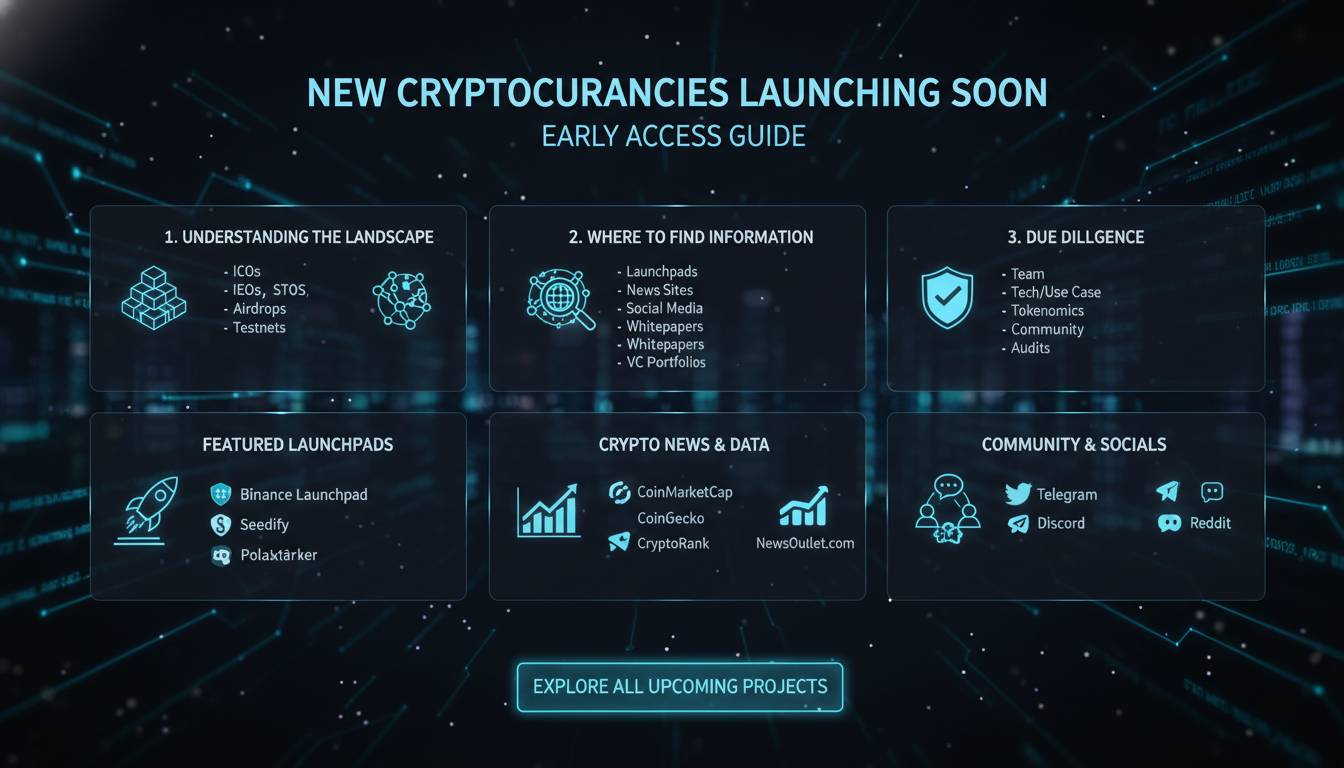
New Cryptocurrencies Launching Soon – Early Access Guide
The cryptocurrency market continues its rapid evolution, with new digital assets launching regularly to address gaps in functionality, scalability, and user experience. For investors and enthusiasts seeking early access to the next generation of crypto projects, understanding how to identify promising launches and navigate the risks involved is essential for success in this dynamic space.
This guide provides a comprehensive framework for evaluating upcoming cryptocurrency launches, understanding the launch mechanisms available, and implementing strategies to gain early access to projects with strong fundamentals. The information presented here reflects the current landscape of crypto launches as of early 2025, though the market remains inherently volatile and subject to rapid change.
Understanding the Cryptocurrency Launch Landscape
New cryptocurrencies launch for various reasons, ranging from solving technical limitations of existing blockchains to creating entirely new use cases within decentralized finance (DeFi), gaming, and supply chain management. Understanding why projects launch helps investors distinguish between genuine innovation and opportunistic cash-grabs.
The primary motivations behind new cryptocurrency launches include addressing scalability issues prevalent in earlier-generation blockchains, introducing novel consensus mechanisms that improve energy efficiency and transaction speeds, creating specialized tokens for specific industries or applications, and enabling new economic models within decentralized autonomous organizations (DAOs). Projects may also launch to fund development of underlying protocols, with token sales providing necessary capital for research and implementation.
The cryptocurrency launch ecosystem has matured significantly since the early days of Bitcoin, when mining was the only pathway to acquiring new tokens. Modern launches employ sophisticated mechanisms designed to distribute tokens fairly while raising funds for development. These mechanisms include initial exchange offerings (IEOs), where tokens are sold through cryptocurrency exchanges; fair launches, where no pre-mined tokens exist and everyone has equal opportunity to participate; airdrops, which distribute free tokens to early adopters or existing holders of particular wallets; and token generation events (TGEs), which mark the official creation and distribution of tokens on a blockchain.
How to Find Upcoming Cryptocurrency Launches
Discovering promising cryptocurrency launches before they reach the broader market requires combining multiple information sources and staying connected to the crypto community’s pulse. Several reliable methods exist for identifying upcoming projects, each with distinct advantages.
Crypto Launchpad Platforms
Launchpad platforms have emerged as primary venues for identifying legitimate upcoming cryptocurrency projects. These platforms typically conduct due diligence on projects before listing them, providing investors with a layer of verification. Prominent launchpads include Binance Launchpad, which has facilitated numerous high-profile token launches; Polkastarter, specializing in cross-chain token pools; and TrustPad, which focuses on security and transparency. These platforms usually require users to register and complete verification processes before participating in token sales.
Developer Communities and Documentation
GitHub repositories and technical documentation often reveal projects in development before official announcements. Active development communities on platforms like Discord and Telegram frequently discuss upcoming features and token launches. Following the social media accounts of established blockchain developers and projects can provide early visibility into new ventures these developers may be supporting.
Crypto News Aggregators and Publications
Dedicated cryptocurrency news outlets maintain calendars and coverage of upcoming token launches. Sites like CoinDesk, CoinTelegraph, and The Block regularly announce launch dates and provide analysis of new projects. These publications also offer critical analysis that can help investors evaluate the legitimacy and potential of new offerings.
Decentralized Finance Monitoring Tools
Platforms like DappRadar and DeFi Pulse track activity across decentralized applications, often highlighting new projects gaining traction within the DeFi ecosystem. Unusual activity patterns, such as rapid growth in total value locked (TVL), can indicate promising upcoming launches.
Evaluating New Cryptocurrency Projects
Not all new cryptocurrencies deserve investment attention, and thorough evaluation separates successful early investments from costly mistakes. Several factors warrant careful examination before committing funds to any new cryptocurrency launch.
Team Background and Credibility
The cryptocurrency space has seen numerous projects launched by anonymous teams, some of which have proven legitimate while others have turned out to be scams. Examining the backgrounds of founding teams provides insight into their capability to execute on ambitious roadmaps. Verified team members with track records in relevant technology companies, academic institutions, or successful previous projects generally indicate lower risk. Transparency about team identity, including LinkedIn profiles and professional history, represents a positive sign that the project intends to build lasting value.
Technical Whitepaper Quality
A project’s whitepaper should clearly articulate the problem being solved, the proposed technical solution, tokenomics (the economic model governing the cryptocurrency), and a realistic timeline for development. Whitepapers that lack technical detail, make unrealistic claims, or copy substantial portions from other projects warrant skepticism. The best whitepapers are accompanied by detailed technical documentation, code repositories that show actual development progress, and clear explanations of how the token integrates with the broader ecosystem.
Tokenomics and Distribution
Understanding how tokens are distributed helps investors assess potential value and risks. Questions to examine include: What percentage of tokens is allocated to the founding team versus community and investors? Are there vesting schedules that prevent immediate dumping of tokens? What is the total supply, and is there any mechanism for inflation or deflation? Fair distribution models that avoid excessive concentration among early investors typically create healthier long-term price dynamics.
Community Health and Engagement
Genuine projects build engaged communities that actively participate in governance and development discussions. Discord servers, Telegram groups, and Reddit communities with thousands of active members suggest legitimate interest. However, purchased followers and fake engagement exist, so evaluating the quality of engagement matters more than raw numbers. Helpful responses to technical questions, substantive discussions about roadmap progress, and transparent communication from team members indicate healthy communities.
Launch Mechanisms and How to Participate
Different launch mechanisms create varying opportunities and risks for early participants. Understanding these mechanisms helps investors choose appropriate strategies.
Initial Exchange Offerings (IEOs)
IEOs represent one of the more accessible pathways for retail investors to participate in new token launches. In an IEO, a cryptocurrency exchange conducts the sale on behalf of the project, providing some level of due diligence and security. Participants typically need accounts on the hosting exchange and often must complete identity verification. Allocation systems vary—some exchanges use lottery systems while others employ first-come-first-served approaches or tiered systems based on holdings of the exchange’s native token.
Fair Launches
Fair launches distribute tokens without any pre-mined allocation or early investor advantage. Everyone participates under the same conditions, typically by providing liquidity to decentralized exchanges or by farming rewards through staking. While fair launches aim for equity, they often involve substantial risk since no institutional due diligence occurs. Investors participating in fair launches should expect high volatility and should only commit capital they can afford to lose entirely.
Airdrops
Airdrops distribute free tokens to wallet addresses meeting certain criteria, such as holding specific cryptocurrencies or completing social media tasks. While airdrops require minimal effort to receive, the value of received tokens varies dramatically—some airdrops have yielded significant value while others prove worthless. Staying updated on potential airdrops requires monitoring official project announcements and maintaining wallets with popular tokens that frequently trigger eligibility.
Private Sales and Seed Rounds
Private sales occur before public launches and typically involve substantial minimum investments, making them inaccessible to most retail participants. However, some projects later redistribute unsold private sale allocations to public participants. Understanding the timeline between private sales and public launches helps investors anticipate potential selling pressure from early investors seeking liquidity.
Risk Management Strategies
Investing in new cryptocurrencies carries substantial risk, and implementing proper risk management strategies protects capital while allowing participation in potential upside.
Position Sizing and Diversification
No individual new cryptocurrency investment should represent more than a small percentage of total cryptocurrency holdings. Even promising projects can fail due to execution issues, regulatory action, or market conditions. Maintaining diversification across multiple new projects spreads risk while capturing potential outliers that deliver exceptional returns.
Due Diligence Time Investment
The time invested researching new projects before committing funds directly correlates with investment success. Reviewing whitepapers, analyzing tokenomics, engaging with community discussions, and understanding technical architecture takes effort but provides critical insights unavailable through surface-level review. Investors who skip due diligence often fall victim to well-coordinated pump-and-dump schemes.
Exit Strategies and Profit-Taking
Establishing clear exit strategies before participating in any launch prevents emotional decision-making during volatile price movements. Strategies might include taking partial profits at predetermined price multiples, setting stop-loss orders to limit downside, or establishing time-based exit plans regardless of performance. New cryptocurrency prices often experience dramatic initial volatility before finding equilibrium, making predefined exit plans particularly valuable.
Security Best Practices
New cryptocurrency launches attract scammers attempting to steal funds through phishing attacks, fake token sales, and malicious links. Only use official project websites and verified social media accounts when accessing token sales. Never share private keys or seed phrases under any circumstances. Using hardware wallets for significant holdings and considering separate wallets specifically for new token participation reduces exposure to security breaches.
The Future of Cryptocurrency Launches
The cryptocurrency launch landscape continues evolving, with regulatory scrutiny increasing globally while technical innovations enable new distribution models. Several trends are shaping how new cryptocurrencies reach market.
Regulatory frameworks are becoming more defined in major markets, with the Securities and Exchange Commission in the United States and similar bodies internationally increasingly treating many token offerings as securities. This regulatory clarity may reduce the number of new cryptocurrencies launching while increasing compliance costs and requirements for legitimate projects.
Technical innovations continue improving launch mechanisms. Layer-2 scaling solutions on Ethereum and competing blockchains enable faster and cheaper token distributions. Decentralized launchpads are reducing the power concentration seen in centralized exchange-run offerings. Chain-agnostic platforms are making it easier for projects to launch across multiple blockchains simultaneously, increasing accessibility but also complicating evaluation.
The distinction between utility tokens and security tokens is becoming clearer, with projects increasingly structured to provide clear utility within ecosystems rather than representing investment contracts. This structural evolution may lead to more sustainable token economies that create genuine value for holders rather than relying purely on speculative demand.
Frequently Asked Questions
How do I know if a new cryptocurrency launch is legitimate?
Legitimate projects typically have verifiable team members with established professional backgrounds, detailed technical whitepapers explaining their solutions, active and engaged communities discussing development progress, and transparent tokenomics with reasonable allocation distributions. Be wary of projects promising guaranteed returns, lacking technical documentation, or operated by completely anonymous teams with no track record.
What’s the difference between an IEO and an ICO?
An Initial Exchange Offering (IEO) is conducted through a cryptocurrency exchange, which performs due diligence and hosts the sale on its platform. An Initial Coin Offering (ICO) is conducted directly by the project team, often through their own website. IEOs offer somewhat more security since exchanges vet projects before listing, while ICOs typically allow earlier access but require more personal due diligence.
Should I participate in airdrops to get new cryptocurrencies free?
Airdrops can be worthwhile if you understand the risks. The cryptocurrency itself may have no lasting value, and scam airdrops sometimes attempt to phish private keys or trick participants into connecting wallets to malicious sites. Only participate in airdrops officially announced through verified project channels, and never enter seed phrases or private keys on any airdrop-related website.
How much should I invest in new cryptocurrency launches?
Due to the high-risk nature of new cryptocurrency investments, only allocate capital you can afford to lose entirely. Many financial advisors recommend limiting speculative cryptocurrency holdings to 5-10% of total cryptocurrency portfolios, with individual new launch positions representing a small fraction of that allocation.
What happens to my money if a cryptocurrency launch fails?
Unlike traditional investments, cryptocurrency investments offer limited legal recourse if projects fail. If a project team abandons development or exits with investor funds, recovery is unlikely. This reality underscores the importance of thorough due diligence and appropriate position sizing before participating in any token launch.
When is the best time to sell new cryptocurrencies after launch?
There’s no universal answer, as each project behaves differently. Many new tokens experience “opening excitement” followed by significant corrections as early investors sell. Establishing predetermined profit-taking levels before participating helps avoid emotional decisions. Some investors hold for longer timeframes if they believe in the project’s fundamental value proposition, while others prefer capturing quick gains during initial volatility.