13Views 0Comments
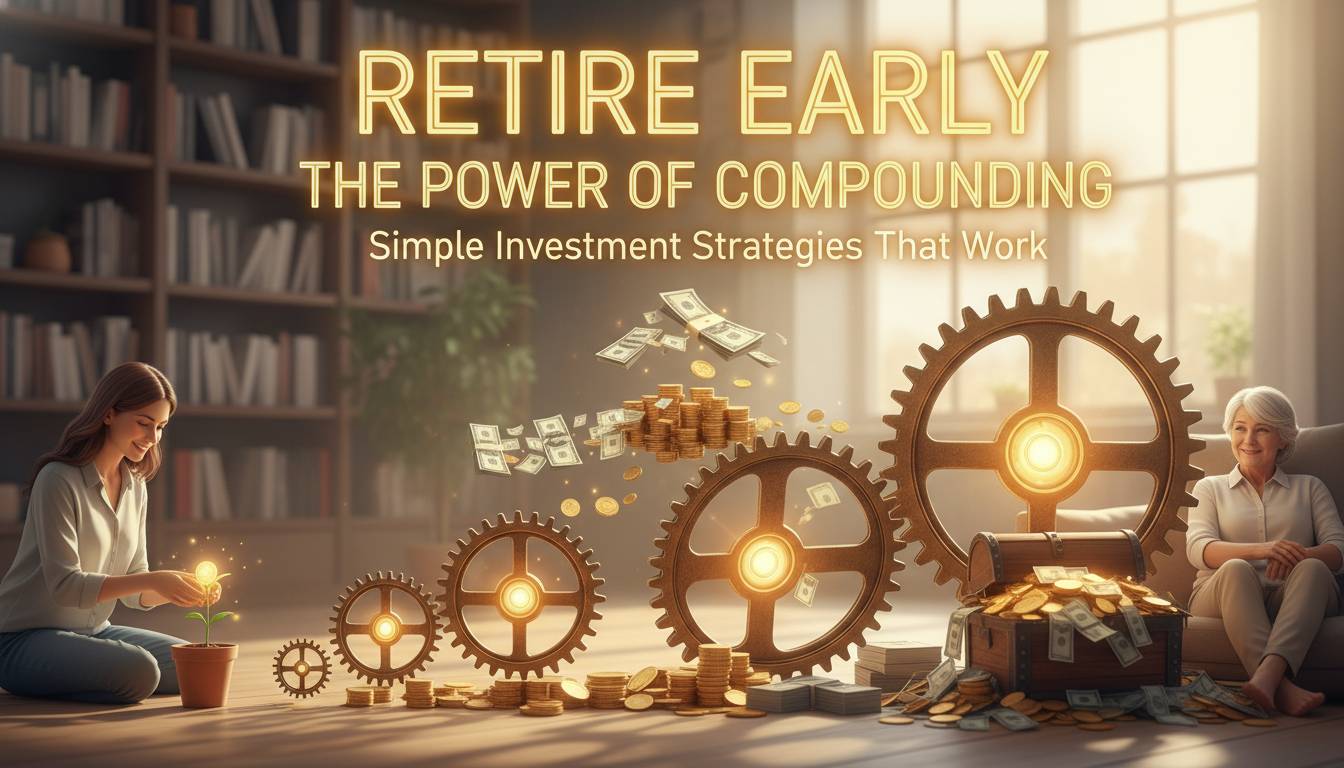
Retire Early Using Simple Investment Strategies That Work
Retiring early isn’t about earning an exceptionally high income or taking extreme financial risks. It’s about following proven, uncomplicated investment strategies that build wealth systematically over time. The average FIRE (Financial Independence, Retire Early) practitioner achieves financial independence in 10-15 years by consistently investing 50-70% of their income through low-cost index funds, maintaining a lean budget, and letting compound growth do the heavy lifting.
The mathematics behind early retirement is remarkably straightforward: accumulate assets equal to 25-30 times your annual expenses, then withdraw 3-4% per year. This “4% rule” withdrawal rate has historically provided a 95%+ success rate over 30-year retirements. What makes this achievable isn’t complexity—it’s consistency and simplicity working together over time.
The Mathematical Foundation of Early Retirement
Understanding the math behind early retirement eliminates guesswork and sets realistic expectations. The FIRE movement’s core formula involves calculating your “FIRE number”—the total investable assets needed to sustain your lifestyle indefinitely.
Calculating Your FIRE Number
Your FIRE number derives directly from your annual expenses multiplied by 25 (for a 4% withdrawal rate). If you spend $40,000 annually, your target becomes $1,000,000. Spending $60,000 means aiming for $1.5 million. This inverse relationship between spending and retirement timeline is why budget optimization often matters more than income increases for early retirement seekers.
The compound growth formula accelerates this process dramatically. Assuming a 7% average annual return (adjusted for inflation), $10,000 invested annually accumulates to approximately $200,000 in 14 years, $400,000 in 20 years, and nearly $800,000 in 30 years. The exponential curve means later years produce larger gains than early years—a phenomenon FIRE practitioners call “the snowball effect.”
The Role of Savings Rate
Research from Mr. Money Mustache, a leading FIRE community voice, demonstrates that your savings rate determines your time to financial independence more than investment returns. Someone saving 50% of income reaches FIRE in approximately 17 years, regardless of income level. Saving 75% compresses this to just 7 years. This principle applies universally because higher savings rates simultaneously reduce the FIRE number (through lower expenses) and accelerate asset accumulation.
| Annual Spending | FIRE Number | Years to FIRE (10k/yr investing) | Years to FIRE (20k/yr investing) |
|---|---|---|---|
| $30,000 | $750,000 | 24 | 16 |
| $40,000 | $1,000,000 | 28 | 19 |
| $50,000 | $1,250,000 | 31 | 21 |
| $60,000 | $1,500,000 | 34 | 23 |
Simple Investment Strategies That Actually Work
Complex investment strategies rarely outperform simple approaches over long time horizons. Nobel laureate William Sharpe’s research indicates that selecting low-cost index funds explains more than 90% of the difference between portfolio performance outcomes. This finding, combined with decades of data from the Bogleheads community, points toward three straightforward strategies.
Strategy One: Index Fund Investing
Passive index fund investing involves purchasing low-cost mutual funds or ETFs that track broad market segments. The S&P 500 (tracking 500 largest US companies), Total Stock Market (tracking entire US market), and Total International Stock Market (tracking non-US companies) provide diversification across thousands of companies with minimal expense ratios.
The case for index funds rests on three pillars. First, historical data shows the S&P 500 has returned approximately 10% annually over long periods, significantly beating most actively managed funds. Second, expense ratios as low as 0.03% annually versus 0.75-1.5% for actively managed funds save investors thousands in fees over decades. Third, simplicity reduces behavioral errors—buying and holding through market downturns becomes easier when your strategy requires no decisions.
Vanguard founder Jack Bogle started the index fund revolution in 1976, and his philosophy remains relevant: “Don’t look for the needle in the haystack. Just buy the haystack.” This approach eliminates the impossible task of predicting which individual stocks will outperform.
Strategy Two: Asset Allocation Based on Age
A simple age-based allocation rule provides an easy starting framework. Hold your age (or age minus 10-20) in bonds, with the remainder in stocks. A 30-year-old might hold 70-80% stocks and 20-30% bonds. A 50-year-old might shift to 50-60% stocks and 40-50% bonds. This allocation automatically becomes more conservative as you approach retirement.
The reasoning is straightforward: stocks provide growth over long periods but fluctuate significantly in the short term; bonds provide stability but lower returns. Younger investors have time to recover from market downturns, so they can tolerate more stock exposure. Older investors need stability for near-term expenses.
Rebalancing annually maintains your target allocation. When stocks grow to exceed your target percentage, selling some and buying bonds restores balance. This “buy low, sell high” discipline during rebalancing systematically improves returns.
Strategy Three: Tax-Advantaged Account Maximization
The US tax system provides significant advantages for retirement investors that compound over decades. Maximizing contributions to 401(k) plans (especially employer matches, which represent immediate 100% returns), Traditional IRAs, Roth IRAs, and HSAs creates tax-free or tax-deferred growth space.
For 2024, you can contribute $23,000 to a 401(k), $7,000 to IRAs, and $4,150 to HSAs (individual coverage). Those 50 and older gain additional catch-up contributions. The strategic sequencing typically involves: first, maximizing 401(k) employer match; second, maxing out HSA if eligible; third, maxing Roth IRA; fourth, returning to 401(k) up to limits.
The Roth conversion ladder—a strategy where you convert traditional retirement funds to Roth in lower tax brackets during early retirement—provides flexibility for accessing funds before age 59½ without penalties.
Common Investment Mistakes That Delay Retirement
Understanding what not to do proves as important as knowing correct strategies. Several well-documented mistakes consistently derail early retirement efforts.
Mistake #1: Chasing Hot Performers
Investors frequently buy recently successful investments, only to see them underperform subsequently. Research from Dalbar Associates shows individual investor returns lag market returns by 1.5-3% annually, primarily due to buying high and selling low during emotional reactions to market movements.
Mistake #2: High Expense Ratios and Advisory Fees
Fees compound silently but substantially. A 1% annual fee reduces a 30-year portfolio’s value by approximately 25% compared to a 0.1% fee. Over a lifetime of investing, high fees can cost hundreds of thousands of dollars.
Mistake #3: Market Timing Attempts
Trying to predict market tops and bottoms rarely succeeds. Missing just the 10 best trading days over 20 years cuts portfolio returns nearly in half. The strategy that works is staying invested through all market conditions.
Mistake #4: Underestimating Healthcare Costs
Early retirees often overlook healthcare as the largest non-discretionary expense before Medicare eligibility at 65. ACA subsidies through Healthcare.gov can make coverage affordable with low income, but planning for this expense is essential.
| Mistake | Impact | Solution |
|---|---|---|
| Chasing performance | -3-5% annual returns | Buy diversified index funds |
| High fees | -25% portfolio value | Choose funds under 0.20% expense ratio |
| Market timing | -40-50% potential returns | Stay fully invested |
| Ignoring healthcare | $500-1000+/month in early retirement | Budget for ACA or employer coverage |
Building Your Early Retirement Roadmap
Creating a practical implementation plan transforms theory into action. The following framework provides a step-by-step approach.
Step One: Calculate Your Numbers
Determine your current net worth, annual expenses, and savings rate. Calculate your FIRE number using the 25x annual expenses formula. Estimate years to FIRE using compound growth calculators available through sites like Net Worthify or the Mad Fientist’s FI calculator.
Step Two: Optimize Your Spending
Examine your expenses for optimization opportunities. Housing typically offers the largest savings potential—downsizing or relocating can reduce costs by 30-50%. Transportation, food, and entertainment also frequently contain significant reduction potential without lifestyle sacrifice.
Step Three: Maximize Tax-Advantaged Accounts
Contribute maximum amounts to tax-advantaged accounts in the optimal sequence. Employer 401(k) matches represent free money—always capture these first. Roth accounts provide tax-free growth and flexibility, making them particularly valuable for early retirees.
Step Four: Invest in Simple Portfolios
Construct a three-fund portfolio using total stock market, total international stock, and total bond market funds. Allocate based on your risk tolerance and timeline. Set up automatic investments to maintain consistency regardless of market conditions.
Step Five: Monitor and Adjust Annually
Review your progress annually, adjusting contributions and allocation as life circumstances change. Market downturns provide opportunities to maintain contributions and potentially rebalance into stocks at lower prices.
Frequently Asked Questions
How much money do I need to retire early?
Multiply your expected annual expenses by 25. If you need $40,000 yearly, target $1 million. This provides a 4% withdrawal rate that has historically sustained 30-year retirements. Adjust for different withdrawal rates—3% for more conservative projections requires 33x expenses.
Can I retire early with just a 401(k)?
Yes, but access before age 59½ requires planning. Substantially equal periodic payments (SEPP) allow penalty-free withdrawals, or you can use Roth conversion ladders to access funds early. The rule of 55 allows 401(k) withdrawals at 55 from employer plans in certain circumstances.
What is the safest investment strategy for early retirement?
A diversified portfolio of low-cost index funds with bond allocation appropriate for your timeline provides the best balance of growth and safety. During early retirement, maintaining 2-3 years of expenses in cash or stable value prevents selling depressed assets during market downturns.
How do I handle healthcare before Medicare?
Options include: maintaining employer coverage through COBRA (expensive but comprehensive), purchasing ACA marketplace insurance with income-based subsidies, or spouse coverage through employment. Healthcare costs typically range from $500-1,500 monthly per person before subsidies in the ACA marketplace.
Is $500,000 enough to retire early?
$500,000 can support $20,000 in annual spending using the 4% rule. Whether this suffices depends entirely on your expenses, location, health, and lifestyle. Many early retirees achieve FI on $500,000 by reducing costs dramatically, while others need $2 million or more.
How do taxes work in early retirement?
Traditional 401(k) and IRA withdrawals count as ordinary income. Roth withdrawals are tax-free. Managing your withdrawal sequence to stay in lower tax brackets, utilizing the standard deduction, and strategically converting traditional funds to Roth can minimize lifetime tax burden significantly.
Conclusion
Retiring early through simple investment strategies is entirely achievable for those willing to optimize spending, maximize savings, and maintain discipline through market fluctuations. The core principles—accumulating 25x annual expenses in low-cost diversified index funds, maintaining appropriate asset allocation, and utilizing tax-advantaged accounts—require neither sophisticated financial knowledge nor exceptional income.
What distinguishes those who achieve early retirement from those who don’t is consistency rather than complexity. The compound growth that builds wealth over decades responds reliably to simple, persistent actions. Start where you are, contribute consistently, minimize fees, and let time work in your favor. Financial independence becomes not a distant dream but an achievable timeline measured in years rather than decades.
The path to early retirement is straightforward. The challenge lies in maintaining the discipline to follow through when results take years to materialize. Those who understand the math and embrace simplicity consistently succeed where complexity-seekers struggle. Your future self will thank you for starting today.