7Views 0Comments
Solana Ecosystem Tokens: Complete Beginner’s Guide
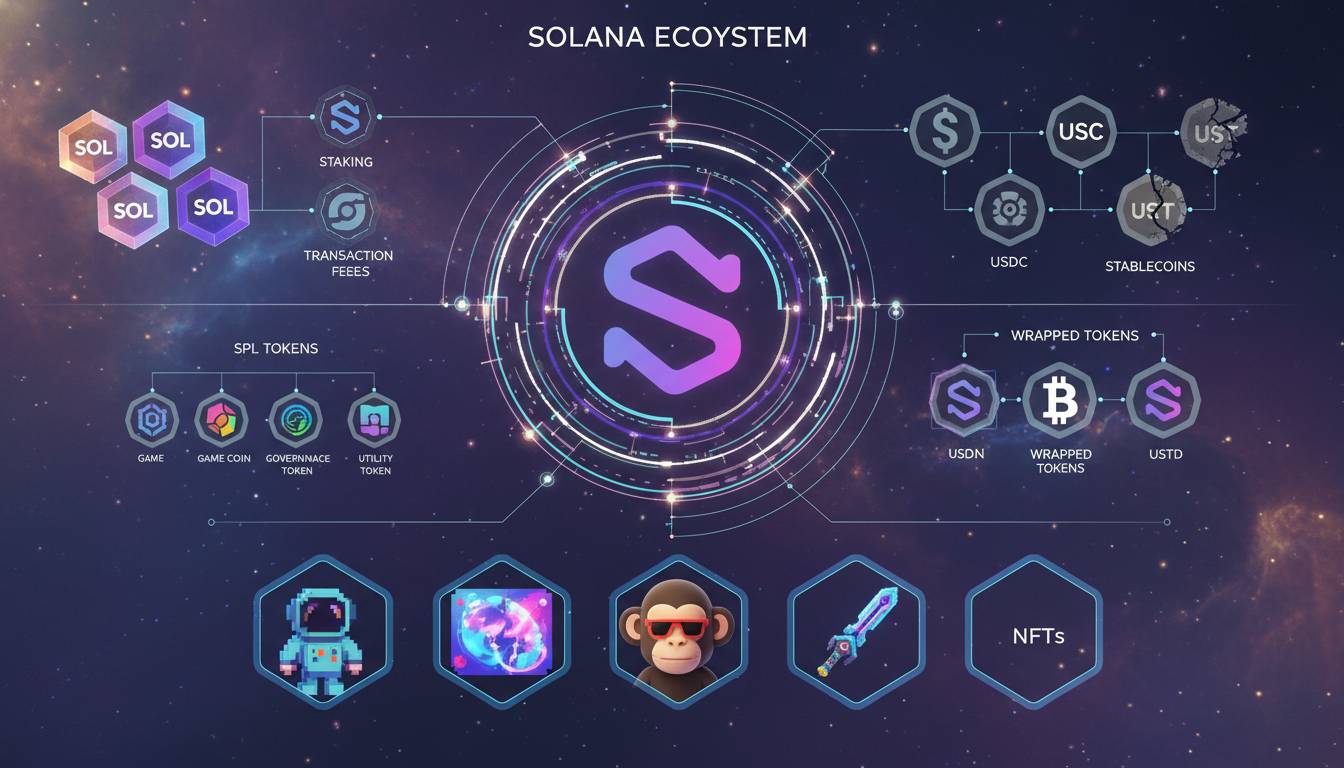
The Solana blockchain has emerged as one of the most dynamic ecosystems in cryptocurrency, offering lightning-fast transactions and remarkably low fees. For investors and enthusiasts alike, understanding the diverse landscape of Solana ecosystem tokens opens doors to high-growth opportunities in decentralized finance, NFTs, and Web3 innovation. This guide provides a comprehensive overview of everything you need to know about Solana’s token ecosystem in 2025.
📊 STATS
• 65M+ active monthly users on Solana
• $2.5B+ total value locked in Solana DeFi (DefiLlama, Q4 2024)
• $0.00025 average transaction fee on Solana
• 4,000+ projects built on Solana
Key Takeaways
• Solana processes 65,000 TPS, making it one of the fastest blockchains
• Most tokens cost less than $1, offering accessibility to new investors
• Ecosystem includes DeFi, NFTs, gaming, and infrastructure tokens
• Rug pulls and scams exist—always verify token legitimacy before buying
• Staking SOL can yield 6-8% annual returns
The Solana ecosystem has experienced remarkable growth since its mainnet launch in 2020, with the token ecosystem expanding from primarily governance tokens to a diversified portfolio covering payment rails, prediction markets, liquid staking, and cross-chain bridges. Understanding these categories helps investors make informed decisions in a space known for both explosive gains and significant volatility.
What is Solana?
Solana is a high-performance blockchain designed to support decentralized applications (dApps) at scale. Founded by Anatoly Yakovenko in 2017, Solana uses a unique proof-of-stake mechanism combined with proof-of-history, allowing it to process transactions significantly faster than Ethereum or Bitcoin while maintaining decentralization.
Technical Advantages
Speed and Scalability:
Solana can handle up to 65,000 transactions per second (TPS) under ideal conditions, compared to Ethereum’s 15-30 TPS and Bitcoin’s 7 TPS. This makes Solana particularly suitable for high-frequency trading, gaming, and applications requiring instant finality.
Cost Efficiency:
Transaction fees on Solana average just $0.00025, compared to Ethereum’s $5-50 during peak usage. This low-cost structure enables micro-transactions and makes DeFi accessible to users who would otherwise be priced out of the network.
Developer Ecosystem:
Solana supports multiple programming languages including Rust, C, and C++, with the Rust-based Anchor framework becoming the standard for smart contract development. This developer-friendly environment has attracted thousands of projects to the ecosystem.
💡 STAT: Solana ranks #3 in total blockchain usage behind Ethereum and Tron, with over 2 billion non-vote transactions processed in 2024
How It Works
Solana’s architecture combines several innovative technologies. Proof-of-History (PoH) creates a historical record that proves an event occurred at a specific moment in time, eliminating the need for validators to communicate extensively to agree on time. Tower BFT (Byzantine Fault Tolerance) uses this PoH as a clock, allowing the network to reach consensus faster. Turbine breaks down blocks into smaller packets for efficient propagation across the network.
This technical foundation enables the diverse token ecosystem that has developed on Solana, ranging from meme coins to enterprise-grade DeFi protocols.
Top Solana Ecosystem Tokens
The Solana ecosystem hosts hundreds of tokens across various categories. Here are the most prominent and widely-held tokens in the ecosystem as of 2025.
Meme Coins and Community Tokens
| Token | Price (USD) | Market Cap | Primary Use |
|---|---|---|---|
| BONK | $0.000028 | $1.8B | Meme coin, community token |
| WEN | $0.00012 | $120M | Meme coin, NFT minting |
| DOGE | $0.32 | $47B | Meme coin (wrapped on Solana) |
| POPCAT | $0.58 | $580M | Meme coin, community |
BONK emerged as Solana’s first dog-themed meme coin launched in December 2022, distributing 50% of its supply to the Solana community via airdrop. The token gained massive popularity and now has the largest holder base on any single chain.
WEN launched in late 2023 as the official meme coin of the Jupiter aggregator, with the team airdropping tokens to early users. The token enables NFT minting through its unique “meme to mint” mechanism.
DeFi Tokens
| Token | Price (USD) | Market Cap | Category |
|---|---|---|---|
| JUP | $0.85 | $850M | DEX Aggregator |
| MRN | $2.40 | $240M | Margin Trading |
| UXD | $0.98 | $95M | Stablecoin |
| KETA | $0.045 | $45M | Lending |
JUP (Jupiter) serves as Solana’s dominant DEX aggregator, routing trades across multiple decentralized exchanges to find optimal prices. The token launched in early 2024 with one of the largest airdrops in crypto history, distributing $700M worth of JUP to early users.
MARGIN (MRN) powers Margin Finance, a decentralized margin trading platform on Solana. The protocol allows users to borrow assets for leveraged trading positions.
Infrastructure and Utility Tokens
| Token | Price (USD) | Market Cap | Category |
|---|---|---|---|
| SOL | $105 | $45B | Native Token |
| RAY | $4.20 | $1.4B | Staking, DeFi |
| STSOL | $115 | $3.2B | Liquid Staking |
| MSOL | $118 | $1.1B | Liquid Staking |
SOL serves as Solana’s native token, used for paying transaction fees, staking to secure the network, and governance voting. SOL holders can stake their tokens with validators to earn approximately 6-8% annual yield.
RAY (Raydium) combines an automated market maker (AMM) with a central limit order book, offering both AMM-style swaps and professional trading features. RAY stakers earn a share of protocol fees.
stSOL and mSOL are liquid staking tokens representing staked SOL. Users receive these tokens while maintaining liquidity, allowing them to use staked assets in DeFi applications while still earning staking rewards.
Benefits of Solana Ecosystem Tokens
| Benefit | Impact | Source |
|---|---|---|
| Low transaction fees | $0.00025 avg vs $5+ on Ethereum | Solana Docs, 2024 |
| High throughput | 65,000 TPS vs 15-30 TPS (Ethereum) | Solana Foundation, 2024 |
| Fast finality | 400ms vs 15 min (Ethereum) | Solana Tech Docs |
| Growing ecosystem | 4,000+ projects live | Solana Beach, 2024 |
| Strong community | 65M+ monthly active users | Solana Foundation, 2024 |
Key Advantages
Accessibility:
The majority of Solana tokens trade at fractional prices, with most costing less than $1. This democratizes access to crypto investing, allowing new participants to accumulate meaningful positions without purchasing whole tokens that cost hundreds of dollars.
Developer Activity:
Solana consistently ranks among the top blockchains for developer activity, with over 3,000 monthly active developers building on the network. This continuous development drives innovation and creates new opportunities for token holders.
Ecosystem Integrations:
Major projects increasingly integrate with Solana. PayPal enables USDC transfers on Solana, Stripe supports Solana for payments, and institutional custodians like Coinbase Custody support SOL and SPL tokens.
NFT Integration:
Solana’s high throughput and low fees make it ideal for NFT minting and trading. The ecosystem hosts major NFT marketplaces including Magic Eden, Tensor, and Solanart, with trading volumes regularly exceeding $100 million monthly.
📈 CASE: Magic Eden captured 95% of Solana NFT market share within 6 months of launching in 2021, demonstrating the ecosystem’s rapid adoption curves
Comparison: Solana vs Competing Ecosystems
| Factor | Solana | Ethereum | Base | Avalanche |
|---|---|---|---|---|
| TPS | 65,000 | 15-30 | 30 | 4,500 |
| Avg Fee | $0.00025 | $5-50 | $0.10 | $0.02 |
| Finality | 400ms | 15 min | 2 sec | <1 sec |
| TVL | $8.5B | $55B | $4.2B | $1.2B |
| Devs/month | 3,000+ | 8,000+ | 1,500+ | 800+ |
Solana
✅ Pros: Fastest transactions, lowest fees, largest non-EVM ecosystem, strong meme coin culture
❌ Cons: Historical network outages, centralization concerns, fewer smart contract languages
💰 Price: SOL trades around $105 with $45B market cap
🎯 For: High-frequency trading, NFTs, meme coins, cost-sensitive users
Ethereum
✅ Pros: Most established ecosystem, highest TVL, EVM compatibility, strongest security
❌ Cons: High fees, slower transactions, complex fee markets
💰 Price: ETH trades around $3,200
🎯 For: DeFi veterans, smart contract developers, institutional users
Base
✅ Pros: Coinbase backing, low fees, EVM compatibility, growing ecosystem
❌ Cons: Newer network, smaller ecosystem, less established
💰 Price: N/A (no native token)
🎯 For: US-focused users, Coinbase integration, simple dApps
How to Buy and Store Solana Tokens
Prerequisites:
– [ ] Government-issued ID (for KYC exchanges)
– [ ] Secure wallet (Phantom, Backpack, or Solflare)
– [ ] Bank account or credit/debit card
– [ ] Basic understanding of blockchain wallets
Time: 15-30 minutes | Cost: 0-2% trading fees
Steps
1. Choose an Exchange
Select a reputable centralized exchange that supports Solana tokens. Coinbase, Binance, Kraken, and Gemini offer SOL and major SPL tokens. Decentralized options like Jupiter and Raydium allow direct wallet trading.
2. Create and Fund Your Account
Sign up for an exchange account, complete identity verification (KYC), and deposit funds via bank transfer or card. Most US exchanges accept ACH deposits with no deposit fees.
⏱ 5-10 minutes | 💡 Tip: Coinbase and Kraken offer the lowest fees for US users
3. Set Up a Wallet
Download Phantom (browser extension or mobile) or Backpack for the best Solana experience. These wallets support SPL tokens, NFT storage, and dApp connections. Write down your 12 or 24-word seed phrase and store it securely offline.
4. Transfer to Personal Wallet
For long-term holding, transfer purchased SOL or tokens from the exchange to your personal wallet. Always verify the address matches the Solana format (starts with specific prefixes depending on wallet).
⚠️ Avoid: Sending tokens to wrong blockchain addresses → Fix: Always test with small amount first
5. Explore the Ecosystem
Connect your wallet to dApps like Jupiter for trading, Magic Eden for NFTs, or Marinade Finance for liquid staking. Start with small amounts to understand how transactions work.
Troubleshooting:
| Problem | Fix |
|---|---|
| Transaction failed | Increase slippage tolerance or retry during lower congestion |
| Token not appearing | Add custom token address to wallet |
| Wallet not connecting | Clear browser cache or update wallet extension |
| Wrong network selected | Switch wallet network to Solana Mainnet |
Risk Assessment and Common Mistakes
| Mistake | Impact | Solution |
|---|---|---|
| Buying scam tokens | 📉 100% loss | Verify contract addresses on Solscan |
| Ignoring token utility | 📉 90% drawdowns | Research tokenomics and use cases |
| Not using hardware wallet | 📉 Theft risk | Use Ledger with Solana app |
| Over-concentrating in memes | 📉 Portfolio volatility | Diversify across categories |
⚠️ CRITICAL: The Solana ecosystem has seen numerous rug pulls where developers launch tokens, drive up price through social media, then dump holdings and abandon the project. In 2024 alone, over 300 Solana tokens experienced >90% drawdowns from ath.
Prevent:
– Always verify token contract addresses on Solscan
– Check holder distribution—avoid tokens with >50% in top 10 addresses
– Research team identity and project audit reports
– Start with small positions and use reputable aggregators like Jupiter
The Future of Solana Tokens
Several developments could shape the Solana ecosystem in coming years:
Firedancer Upgrade:
The upcoming Firedancer client, developed by Jump Crypto, promises to increase network throughput to over 1 million TPS while improving reliability. Multiple client implementations also reduce centralization risk.
Institutional Adoption:
Major financial institutions are increasingly exploring Solana for tokenization. Franklin Templeton and other asset managers have launched money market funds on Solana, signaling growing institutional interest.
Mobile Focus:
Solana’s Saga phone and dedicated mobile push aim to bring Web3 to mainstream consumers through device-native crypto experiences.
Cross-Chain Expansion:
Bridges like Wormhole and Allbridge are expanding Solana’s connectivity, allowing users to move assets between Solana and other chains seamlessly.
👤 Anatoly Yakovenko, Founder of Solana
“The vision is to build a blockchain that can scale to support the next billion users. We’re seeing that vision become reality as more developers build on Solana.”
📊 BENCHMARKS
| Metric | Average | Top 10% |
|---|---|---|
| Annual returns (2024) | 45% | 200%+ |
| Staking yield | 6.5% | 8% |
| Portfolio allocation (Solana) | 15% | 30% |
| Token hold period | 6 months | 2+ years |
Conclusion
The Solana ecosystem represents one of the most vibrant and accessible token environments in cryptocurrency. With its combination of high speed, low costs, and active development, Solana offers opportunities across DeFi, NFTs, meme coins, and infrastructure tokens.
For beginners, starting with established tokens like SOL, JUP, or RAY provides exposure to the ecosystem’s growth while managing risk. As the network continues to scale with upgrades like Firedancer and attract institutional participants, the ecosystem’s token valuation could benefit from broader adoption.
Remember to research each token thoroughly, use hardware wallets for significant holdings, and diversify across categories. The Solana ecosystem rewards patient, informed participants who understand both the opportunities and risks inherent in this fast-moving space.
Frequently Asked Questions
What is the best Solana wallet for beginners?
Phantom is the most recommended wallet for beginners due to its intuitive interface, browser extension and mobile app availability, and broad support for SPL tokens and NFTs. Backpack offers similar functionality with added exchange features. Both are free to download and use.
How do I avoid scam tokens on Solana?
Always verify token contract addresses on Solscan.io before purchasing. Check that the official address matches what’s listed on the project’s official website or social media. Avoid tokens with concentrated holder distributions or those promoted by unverified accounts. Use reputable aggregators like Jupiter for trading.
Are Solana tokens a good investment in 2025?
Solana tokens offer high growth potential but come with significant volatility. The ecosystem’s strong fundamentals—high throughput, low fees, active development—suggest long-term viability. However, past network stability issues and competition from other chains create uncertainty. Consider your risk tolerance and portfolio diversity before investing.
How do I stake SOL tokens?
Staking SOL requires delegating your tokens to a validator through your wallet. Open Phantom or Solflare, navigate to the staking section, select a validator (considering their commission and uptime), and delegate your SOL. Rewards accrue automatically and can be claimed periodically. Liquid staking tokens like stSOL let you maintain liquidity while earning staking yields.
What makes Solana different from Ethereum?
Solana prioritizes speed and low costs through its unique technical architecture, while Ethereum focuses on decentralization and security with its proof-of-stake model. Solana processes 65,000 transactions per second at fractions of a cent, compared to Ethereum’s 15-30 TPS with $5-50 fees. However, Ethereum has higher TVL and more established DeFi protocols. Many users utilize both chains for different purposes.