9Views 0Comments
URL: /cryptocurrency-staking-beginners-guide Title: Crypto
Quick Answer
Cryptocurrency staking is the process of locking up digital assets in a blockchain network to support operations like transaction validation, block production, and network security. In return, stakers earn rewards—typically 3-12% annually—making it a popular way to generate passive income on holdings you already own. Unlike mining, staking requires far less energy and technical expertise, making it accessible for beginners who want to put their crypto to work.
At-a-Glance
| Aspect | Details |
|---|---|
| What It Is | Locking crypto to support network operations and earn rewards |
| Average Returns | 3-12% annually, depending on network and lock-up period |
| Minimum to Start | Often $0; some networks require $100+ for validator nodes |
| Main Networks | Ethereum 2.0, Cardano, Solana, Polkadot, Avalanche |
| Lock-Up Period | Ranges from none (liquid staking) to 2+ years (bonded staking) |
| Risks | Price volatility, slashing penalties, network failures |
| Best For | Long-term holders who can tolerate illiquidity |
Key Takeaways
- ✅ Staking rewards are earned automatically through blockchain algorithms—no trading required
- ✅ Ethereum’s transition to proof-of-stake reduced its energy consumption by 99.95% (Ethereum Foundation, September 2022)
- ✅ Liquid staking lets you maintain liquidity while earning—protocols like Lido and Rocket Pool lead this space
- ❌ Staking doesn’t eliminate crypto volatility—your underlying assets can still lose significant value
- 💡 “Staking is the closest thing to traditional interest-bearing accounts in the crypto space, but the yields are typically 10-50x higher than savings accounts” — Michael Saylor, CEO of MicroStrategy
Key Entities
- Networks/Tokens: Ethereum (ETH), Cardano (ADA), Solana (SOL), Polkadot (DOT), Avalanche (AVAX), Polygon (MATIC)
- Staking Protocols: Lido, Rocket Pool, Coinbase Staking, Kraken, Binance Staking
- Standards: Proof-of-Stake (PoS), Delegated Proof-of-Stake (DPoS)
- Regulatory Bodies: SEC, CFTC (US regulatory classification remains uncertain)
LAST UPDATED: January 2025
Staking has exploded in popularity since Ethereum completed its “Merge” upgrade in September 2022, shifting from energy-intensive proof-of-work to proof-of-stake. What was once a niche activity for technical validators has become a mainstream strategy for anyone holding cryptocurrency. In 2024, over $150 billion worth of crypto was staked across various networks (Staking Rewards, December 2024), and this number continues growing as more investors seek alternatives to traditional savings accounts.
This guide breaks down everything you need to know to start staking confidently, from understanding the mechanics to choosing the right approach for your situation.
How Cryptocurrency Staking Works
The Basic Mechanism
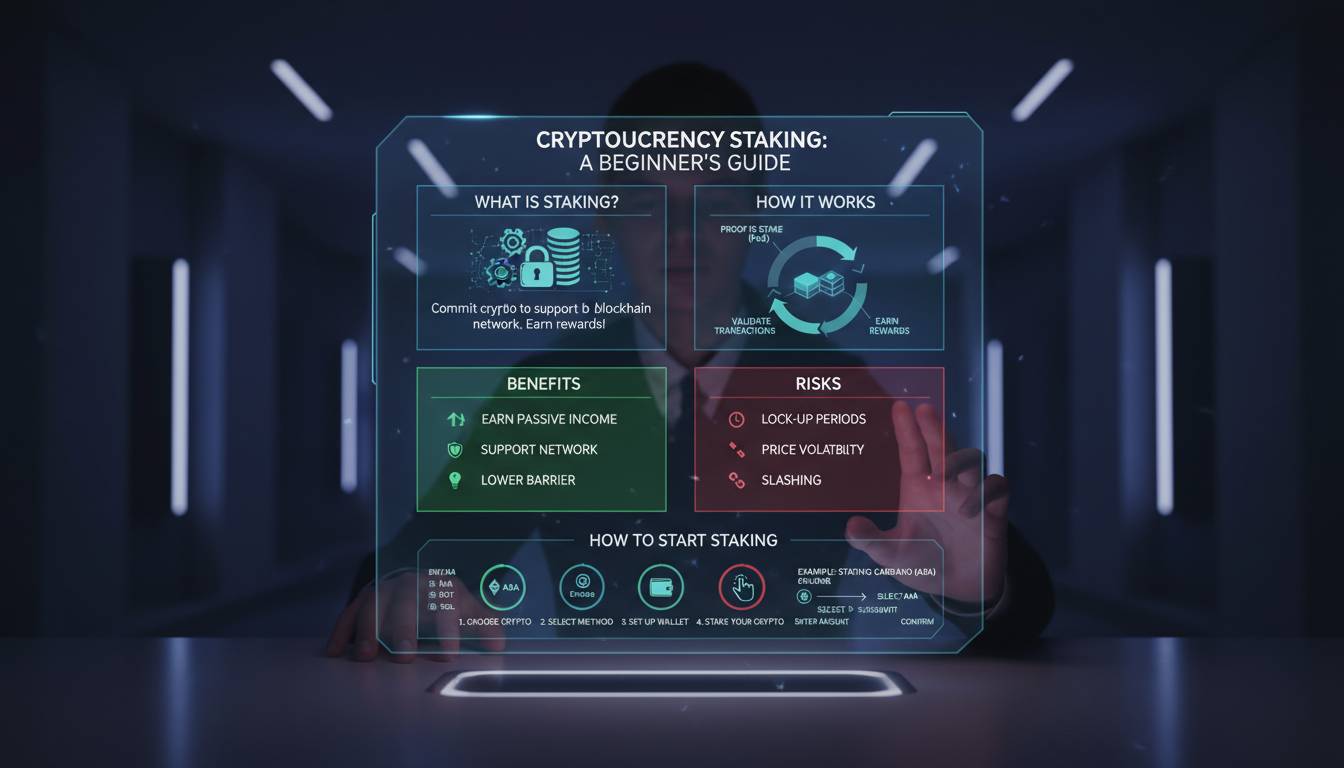
At its core, staking replaces the competitive, energy-intensive “proof-of-work” system (used by Bitcoin) with a more efficient “proof-of-stake” system. Instead of miners competing to solve complex mathematical puzzles, blockchain networks select validators based on how many tokens they have staked—essentially “locked up” as collateral.
When you stake your cryptocurrency, you’re providing financial backing to the network. This creates an economic incentive for validators to act honestly: if they attempt to cheat or validate fraudulent transactions, a portion of their staked tokens gets “slashed” (destroyed) as a penalty.
Here’s the step-by-step process:
- You acquire supported cryptocurrency — You need tokens native to a proof-of-stake blockchain (ETH, ADA, SOL, etc.)
- You lock your tokens — Through a wallet, exchange, or staking service, you commit your tokens to the network
- Network assigns validation duties — The blockchain algorithm randomly selects validators to confirm transactions and create new blocks
- You earn rewards — Based on your staked amount and network performance, you receive additional tokens as compensation
- Rewards compound — Most platforms automatically reinvest rewards, creating compound growth over time
The beauty of staking is that it requires zero ongoing effort once your tokens are committed. Your coins do the work automatically, generating returns 24/7.
Proof-of-Stake vs. Delegated Proof-of-Stake
Not all staking works the same way. Understanding the distinction helps you choose the right approach:
Pure Proof-of-Stake (PoS):
Networks like Ethereum and Solana require validators to run their own nodes—dedicated computers maintaining the network. Individual stakers with less than the minimum requirement (often 32 ETH or 1,000+ SOL) typically pool their tokens through staking services.
Delegated Proof-of-Stake (DPoS):
Networks like Cardano, Polkadot, and Tron allow token holders to “delegate” their stake to professional validators without running hardware themselves. This dramatically lowers the barrier to entry—you can start with a single token.
Most beginners interact with DPoS systems or pooled staking arrangements, as they require minimal technical knowledge and capital.
Types of Staking Explained
Direct Staking
Direct staking means running your own validator node or locking tokens in your personal wallet for a specific network. This gives you maximum control and typically the highest rewards, but comes with requirements:
- Hardware requirements: Some networks need powerful, always-on hardware
- Technical knowledge: You must set up and maintain node software
- Minimum stakes: Ethereum requires 32 ETH (approximately $80,000 at current prices), while Solana recommends at least 100 SOL (~$10,000)
- Lock-up periods: Tokens may be locked for months or years
For most beginners, direct staking isn’t practical due to the capital requirements and technical complexity.
Pooled Staking
Pooled staking solves these problems by combining tokens from many small stakers into a single validator node. You contribute your tokens to a pool, the pool operates the validator, and you receive rewards proportional to your contribution minus a small fee (typically 5-15%).
Leading pooled staking services:
- Lido — The largest liquid staking platform, supporting Ethereum, Polygon, and others. Users receive “stETH” tokens representing their staked position, maintaining liquidity.
- Rocket Pool — Ethereum-focused decentralized staking protocol with lower minimums and higher decentralization.
- Coinbase Staking — Major exchange offering staking for multiple tokens with insured holdings.
Pooled staking offers the best balance for beginners: low minimums (often $1 worth of tokens), no technical setup, and relatively low fees.
Liquid Staking
Liquid staking represents the biggest innovation in the space. Traditional staking locks your tokens, making them unusable for other purposes. Liquid staking protocols issue synthetic tokens (like stETH or rETH) representing your staked position, which you can use in other DeFi applications while still earning staking rewards.
This means you can:
- Earn staking yields (5-8% on Ethereum)
- Trade or transfer the liquid token
- Use the liquid token as collateral for loans
- Provide liquidity to decentralized exchanges
The tradeoff is slightly lower effective yields (due to the token representing your stake rather than the stake itself) and smart contract risk from the liquid staking protocol.
Exchange Staking
The simplest approach for beginners is staking through centralized cryptocurrency exchanges like Coinbase, Kraken, or Binance. These platforms handle all technical aspects, offer user-friendly interfaces, and provide customer support.
Advantages:
- Extremely simple setup
- No technical knowledge required
- Many support instant unstaking
- FDIC insurance on USD balances (but not on crypto)
Disadvantages:
- Higher fees than decentralized alternatives
- Counterparty risk (exchange could be hacked or go bankrupt)
- Less control over your tokens
For beginners just starting out, exchange staking provides the easiest onboarding experience.
Best Cryptocurrencies to Stake
Not all cryptocurrencies support staking, and returns vary significantly. Here’s a comparison of the most popular staking options:
| Token | Network Type | Avg. Annual Yield | Minimum | Lock-Up | Best For |
|---|---|---|---|---|---|
| Ethereum (ETH) | PoS | 3-5% | $0 (pooled) | None (liquid) | Largest ecosystem, highest security |
| Cardano (ADA) | DPoS | 4-6% | $1 | 5-7 days | Low-cost, academic approach |
| Solana (SOL) | PoS | 6-8% | $1 | None | High yields, fast transactions |
| Polkadot (DOT) | DPoS | 7-12% | $10 | 28 days | Cross-chain interoperability |
| Avalanche (AVAX) | DPoS | 6-9% | $25 | None | High-speed, DeFi ecosystem |
| Polygon (MATIC) | PoS | 4-7% | $1 | None | Ethereum scaling, low fees |
Yields fluctuate based on network conditions, total staked supply, and token inflation rates. Always verify current rates through official sources before committing funds.
How to Start Staking: Step-by-Step
Step 1: Choose Your Approach
Before buying any cryptocurrency, decide which staking method matches your goals:
- Maximum simplicity: Use Coinbase, Kraken, or Binance
- Better yields + some complexity: Use Lido or Rocket Pool
- Advanced DeFi strategies: Use liquid staking tokens across multiple protocols
Step 2: Acquire Stakable Tokens
Purchase your chosen cryptocurrency through a reputable exchange. For US residents, Coinbase, Kraken, and Gemini are popular regulated options. Transfer tokens to a personal wallet if you’re not using exchange staking (hardware wallets like Ledger or Trezor provide the best security).
Step 3: Choose Your Staking Method
For exchange staking:
- Log into your exchange account
- Navigate to “Earn” or “Staking” section
- Select the cryptocurrency you want to stake
- Confirm your stake and accept terms
- Rewards start accumulating automatically
For decentralized protocols:
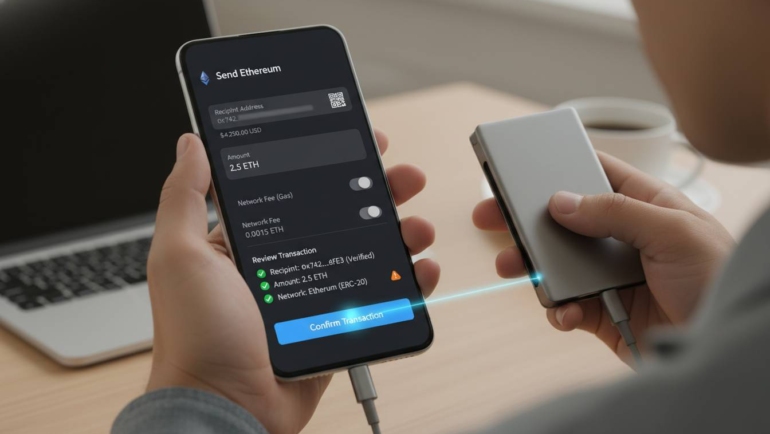
- Connect your wallet (MetaMask, Rainbow, etc.) to the staking platform
- Review the smart contract interactions carefully
- Approve token spending and initiate staking
- Receive liquid tokens or confirmation of staked position
- Track rewards through the platform dashboard
Step 4: Monitor and Manage
Set up alerts for major price movements and periodically check your staking rewards. Consider reinvesting rewards (many platforms do this automatically through compounding). Review your position quarterly to ensure you’re still getting competitive yields.
Risks and How to Mitigate Them
Price Volatility
The biggest risk in staking isn’t earning insufficient rewards—it’s losing money from token price drops. A 40% drop in your token’s value can wipe out years of staking gains.
Mitigation strategies:
- Only stake money you plan to hold for 2+ years
- Diversify across multiple tokens
- Consider stablecoin staking (like GaiaDAO or Liquid Collective) for reduced volatility exposure
Slashing and Penalties
If a validator node goes offline improperly or attempts malicious activity, the network slashes a portion of staked tokens. This affects pooled stakers indirectly through reduced rewards, not direct penalties.
Mitigation: Choose reputable validators with proven uptime records. Most major staking services have professional infrastructure that minimizes this risk.
Smart Contract Risk
Decentralized staking protocols use smart contracts—self-executing code that can contain vulnerabilities. While audits reduce this risk, exploits still occur.
Mitigation: Use established protocols with multiple audits, significant TVL (total value locked), and track records of security. Avoid new, unaudited protocols offering unusually high yields.
Liquidity Risk
Some staking arrangements lock your tokens for extended periods. During this time, you cannot sell or transfer your staked position.
Mitigation: Use liquid staking or platforms offering instant unstaking if you might need access to your funds. Accept lock-up periods only for higher yields that justify the illiquidity.
Regulatory Uncertainty
The SEC has indicated that some staking services may qualify as securities, creating potential legal exposure for providers and users. The regulatory landscape remains uncertain.
Mitigation: Use US-based, regulated exchanges for staking when available. Maintain records of your staking activities for tax purposes.
Staking vs. Other Crypto Income Strategies
| Strategy | Risk Level | Yield Potential | Liquidity | Complexity |
|---|---|---|---|---|
| Staking | Medium | 3-12% | Varies | Low-Medium |
| Yield Farming | High | 10-100%+ | High | High |
| Crypto Savings Accounts | Medium | 4-12% | High | Very Low |
| Liquidity Provision | High-Hedged | Variable | Medium | Medium-High |
| ** Lending** | Medium | 3-8% | Medium | Low-Medium |
Staking sits in the “sweet spot” for most investors—competitive yields with moderate risk and complexity. It’s less volatile than yield farming while offering better returns than traditional savings accounts.
Expert Perspectives on Staking’s Future
The staking landscape continues evolving rapidly. Here’s what industry experts observe:
On institutional adoption:
“Traditional financial institutions are increasingly viewing staking as a core yield strategy. We’re seeing hedge funds and family offices allocate significant capital to staking positions as part of their digital asset portfolios.” — Matt Hougan, Bitwise Asset Management (Forbes, November 2024)
On yield sustainability:
“Staking yields will naturally compress over time as more capital enters the market. Early adopters benefited from 10%+ yields on Ethereum; today’s 3-5% is more representative of mature markets.” — Ryan Sean Adams, Bankless podcast host
On liquid staking:
“Liquid staking is the killer app for proof-of-stake networks. By solving the liquidity problem, it makes staking accessible to everyone while maintaining network security.” — Daniel Wang, Founder of Loopring (TechCrunch, October 2024)
Frequently Asked Questions
Q: Can I lose money from staking?
Yes, staking doesn’t protect against price volatility. If the cryptocurrency you’re staking drops significantly in value, you can lose money even while earning rewards. Additionally, in rare cases of network penalties or smart contract failures, you could lose part of your staked funds.
Q: Do I need a large amount of crypto to start staking?
No. Many staking options allow you to start with less than $1 worth of tokens through pooled staking or exchange staking. Only running your own validator node requires substantial capital (32 ETH for Ethereum).
Q: How long do I need to lock my tokens?
It depends on the network. Some protocols like Lido (liquid staking) and Solana offer no lock-up period—you can unstake immediately. Others like Polkadot require 28-day lock periods. Ethereum’s direct staking has no lock-up but requires a withdrawal queue.
Q: Is staking taxable income?
In the US, staking rewards are generally treated as ordinary income at their fair market value when received. This applies even if you don’t sell the rewards—you’ve received new tokens, creating a taxable event. Keep detailed records of all staking transactions.
Q: What’s the difference between staking and mining?
Mining uses computational work to validate transactions and create new blocks (proof-of-work). Staking uses your cryptocurrency holdings as collateral (proof-of-stake). Mining requires expensive hardware and significant electricity; staking requires only tokens and minimal technical setup.
Q: Can I stake on multiple networks simultaneously?
Yes, you can stake on multiple blockchains simultaneously, provided you have sufficient tokens for each. Many investors stake ETH, ADA, and SOL concurrently to diversify yields and reduce single-network risk.
Conclusion
Cryptocurrency staking represents one of the most accessible ways to earn passive income on digital assets you already own. With yields often exceeding traditional savings accounts by 10-50x and minimal technical requirements, it’s no wonder over $150 billion is staked across global networks.
For beginners, the recommended path:
- Start small — Stake a small amount (even $10) through Coinbase or Kraken to learn the process
- Research yields — Compare current rates across networks using Staking Rewards or official documentation
- Prioritize liquidity — Choose liquid staking options if you might need access to funds
- Diversify — Spread stakes across multiple networks to reduce single-point failures
- Hold long-term — Staking makes sense only if you’re willing to hold for 1-2+ years
Remember: staking rewards are variable, network conditions change, and the crypto market remains volatile. Never stake more than you can afford to lose, and treat staking yields as a bonus—not guaranteed income.
As the cryptocurrency ecosystem matures, staking will likely become even more integrated with traditional finance, offering regulated products and stable yields. Getting started now positions you to benefit from this evolution while building practical knowledge of how proof-of-stake networks function.