16Views 0Comments
Web3 Explained: What It Is and Why It Matters for You
The internet is evolving. Again. After more than two decades of Web2 platforms dominating how we communicate, shop, and create content, a new technological paradigm is emerging that could fundamentally reshape digital ownership, finance, and online identity. Understanding what Web3 is and why it matters isn’t just for cryptocurrency enthusiasts anymore—it’s becoming essential knowledge for anyone who uses the internet.
What Exactly Is Web3?
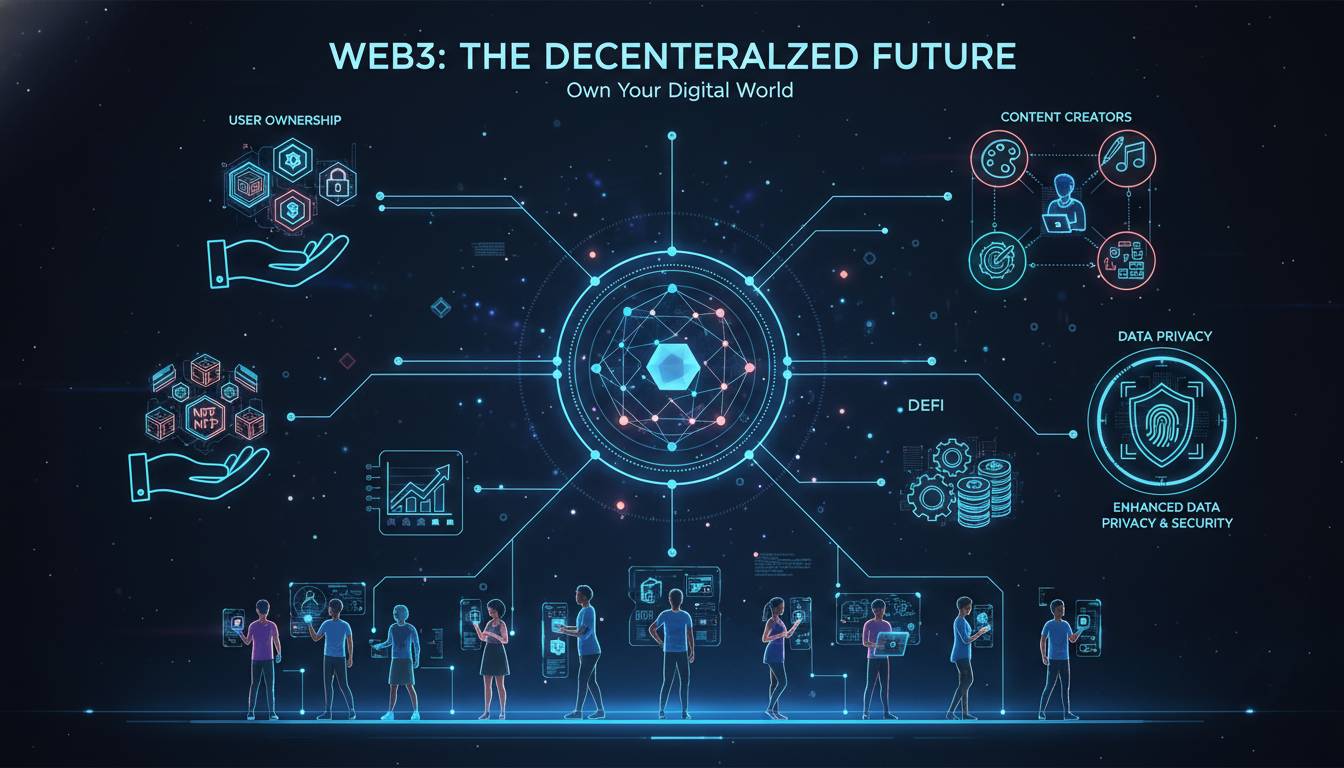
Web3 represents the third generation of internet services and applications, built on blockchain technology, decentralized protocols, and token-based economics. At its core, Web3 aims to return control of the internet to its users rather than centralized corporations.
📊 KEY STATS
– 73% of Gen Z consumers express interest in decentralized platforms
– $27 billion was invested in Web3 startups in 2023 (Crunchbase)
– 1.2 billion people globally have interacted with blockchain apps
The fundamental shift Web3 represents is architectural. Where Web1 was read-only (static websites) and Web2 introduced interactivity but also centralized data collection (social media platforms, cloud services), Web3 introduces true digital ownership through three foundational principles: decentralization, blockchain technology, and token economics.
Key Insights
– Web3 enables direct peer-to-peer transactions without intermediaries
– Users own their data and can monetize it if they choose
– Blockchain provides transparent, immutable records of ownership and transactions
– Smart contracts automate agreements without needing lawyers or notaries
– Decentralized applications (dApps) run on distributed networks rather than company servers
The Evolution: From Web1 to Web3
To understand why Web3 matters, you need to understand what came before it.
Web1: The Read-Only Internet (1990-2005)
The early internet consisted mainly of static web pages. Users consumed content created by organizations, with minimal interaction. Think of early websites as digital brochures—informative but passive. Technologies like HTML and HTTP dominated this era, and internet usage remained primarily among academics, researchers, and early adopters.
Web2: The Social Revolution (2005-2020)
The introduction of social media, mobile computing, and cloud services transformed the internet into a two-way communication platform. Users could now create and share content themselves. However, this came with a significant trade-off: platform ownership of user data.
Companies like Facebook (now Meta), Google, and Amazon built trillion-dollar businesses by aggregating user data, selling advertising, and controlling the infrastructure upon which digital life operates. The saying “if you’re not paying for the product, you are the product” became the defining criticism of Web2.
Web3: Reclaiming Digital Ownership (2020-Present)
Web3 emerged as a response to the centralized control of Web2. By leveraging blockchain technology—the same distributed ledger system that powers cryptocurrencies—Web3 enables:
Decentralization: No single company or entity controls the network. Instead, distributed nodes around the world maintain the infrastructure collectively.
Ownership: Digital assets, from domain names to artwork to financial instruments, can be owned directly by individuals through cryptographic keys.
Transparency: All transactions and code are publicly verifiable on the blockchain, creating unprecedented accountability.
Interoperability: Assets and identity can move across different platforms and applications without friction.
Why Web3 Matters: The Core Benefits
Financial Inclusion and Access
Traditional banking excludes approximately 1.4 billion adults globally who lack access to basic financial services. Web3 financial protocols—known as Decentralized Finance or DeFi—can operate 24/7 with anyone possessing a smartphone and internet connection.
👤 Michael Novogratz, Founder of Galaxy Digital
“Web3 has the potential to bring financial services to the unbanked in ways that traditional banking never could. It’s not about replacing banks—it’s about creating options for those who were never served.”
Creator Economy Transformation
Content creators currently surrender 30-50% of revenue to platforms and face arbitrary account suspensions with no recourse. Web3’s non-fungible tokens (NFTs) and tokenized ownership models allow creators to maintain permanent ownership of their work, set their own royalty terms, and interact directly with audiences.
📈 CASE: Musician RAC achieved over $1 million in NFT sales within 24 hours of releasing his first collection in 2021, retaining 90% of proceeds compared to the 10-15% he’d receive from traditional streaming platforms.
Data Privacy and Sovereignty
Data breaches affected over 353 million individuals in the United States alone in 2023. Web3 gives users control over their personal information through self-sovereign identity systems. Instead of handing over sensitive data to every service you use, you can prove your identity or credentials without revealing the underlying information.
Innovation Velocity
The open-source nature of Web3 protocols means developers can build upon each other’s work without permission or licensing fees. This composability—the ability to stack different protocols like financial legos—accelerates innovation at a pace impossible in closed Web2 ecosystems.
Web2 vs Web3: A Direct Comparison
| Factor | Web2 | Web3 |
|---|---|---|
| Data Storage | Centralized servers owned by companies | Distributed across global nodes |
| Identity | Username/password tied to platforms | Cryptographic wallets (wallet address) |
| Ownership | Platforms own user data and accounts | Users own assets through private keys |
| Monetization | Platforms control advertising revenue | Creators set own terms, keep more earnings |
| Payments | Banks, credit cards, processing fees | Cryptocurrency, near-instant, lower fees |
| Governance | Corporate executives make decisions | Token holders vote on protocol changes |
| Censorship | Platforms can ban accounts/content | Content lives on decentralized networks |
When to Choose Web3:
– You need to send money internationally without delay
– You want true ownership of digital purchases
– You prefer privacy in your transactions
– You’re building applications requiring transparent, tamper-proof records
When Web2 Still Dominates:
– User-friendly interfaces remain critical
– Customer support matters significantly
– Regulatory clarity is essential
– Mass-market adoption is the priority
How Web3 Actually Works
Blockchain Basics
A blockchain is a distributed database that maintains a continuously growing list of records called blocks. Each block contains a cryptographic hash of the previous block, a timestamp, and transaction data. This structure makes altering historical records practically impossible—a single change would invalidate every subsequent block.
Wallets and Keys
Your entry point to Web3 is a cryptocurrency wallet—software that stores your private keys (long alphanumeric strings that prove ownership of digital assets). These wallets come in two forms:
Hot Wallets: Connected to the internet for convenience (like MetaMask, Coinbase Wallet). Better for frequent transactions but more vulnerable to hacking.
Cold Wallets: Offline storage devices (like Ledger, Trezor). Superior security for long-term holdings but less convenient for daily use.
Smart Contracts
Smart contracts are self-executing programs stored on the blockchain that automatically enforce terms when predetermined conditions are met. They eliminate the need for intermediaries in countless scenarios:
- DeFi lending: Users can lend cryptocurrency directly to others, earning interest automatically paid by smart contract
- NFT sales: Royalties are automatically sent to creators every time an NFT changes hands
- Insurance: Claims are verified and paid instantly when flight data confirms delays
Layer 2 Solutions
Early blockchain networks like Ethereum faced significant congestion and high fees during peak usage. Layer 2 solutions—protocols built on top of existing blockchains—solve this by processing transactions off the main chain while maintaining security guarantees. Polygon, Arbitrum, and Optimism have reduced transaction costs by over 90% while maintaining security.
Common Misconceptions About Web3
❌ MYTH: Web3 is only about cryptocurrency
✅ REALITY: While cryptocurrency enables Web3’s economic layer, the technology encompasses decentralized identity, governance, storage, computing, and more. Cryptocurrency is the fuel, not the entire vehicle.
❌ MYTH: Blockchain is inherently bad for the environment
✅ REALITY: Modern blockchains consume significantly less energy than traditional financial systems. Ethereum’s 2022 “Merge” upgrade reduced its energy consumption by approximately 99.95%. Many networks now use renewable energy for mining operations.
❌ MYTH: Web3 eliminates all regulation
✅ REALITY: Regulatory frameworks are evolving. Most legitimate Web3 projects comply with existing securities laws, and compliance-focused chains are emerging to meet institutional requirements.
❌ MYTH: You need technical expertise to use Web3
✅ REALITY: User interfaces have matured dramatically. Services like Rainbow, Coinbase Wallet, and Phantom make blockchain interactions as simple as using Venmo or PayPal.
Real-World Web3 Applications Today
Decentralized Finance (DeFi)
Platforms like Uniswap, Aave, and Compound allow users to trade, borrow, and lend cryptocurrency without traditional financial institutions. Total value locked in DeFi protocols exceeds $90 billion .
Gaming and Virtual Worlds
Games like Axie Infinity, Decentraland, and The Sandbox enable players to truly own in-game assets that can be sold for real money—a $180 billion gaming industry first.
Supply Chain Tracking
Walmart uses blockchain to track food products from farm to shelf, reducing contamination tracing time from 7 days to 2.2 seconds.
Digital Identity
Projects like Spruce and Polygon ID enable users to prove credentials (like “I am over 21” or “I have a college degree”) without revealing sensitive documents.
Getting Started with Web3
For Beginners:
– Download a user-friendly wallet like Coinbase Wallet or MetaMask
– Start with small amounts you can afford to lose
– Research before clicking any links—phishing attacks are common
– Explore NFT marketplaces like OpenSea or Foundation to understand digital ownership
For Businesses:
– Identify specific use cases where decentralization provides clear advantages
– Start with low-risk applications like supply chain verification or loyalty tokens
– Engage Web3 consulting firms experienced in regulatory compliance
– Monitor enterprise adoption by competitors and partners
Essential Tools:
| Tool | Function | Type |
|——|———-|——|
| MetaMask | Crypto wallet & gateway to dApps | Essential |
| Etherscan | Blockchain explorer | Essential |
| Uniswap | Decentralized token exchange | DeFi |
| Rainbow | Mobile wallet interface | Beginner-friendly |
| Ledger | Hardware wallet | Security |
The Future of Web3
The trajectory suggests continued integration into everyday digital life. Major technology companies—including Google, Amazon, and Microsoft—have all launched Web3-focused initiatives, signaling institutional validation.
Trends Shaping 2025 and Beyond:
- Account Abstraction: Wallets will become as easy to use as email accounts, eliminating the need to manage complex private keys
- Interoperability: Cross-chain bridges will enable seamless movement between different blockchain networks
- Enterprise Adoption: Major corporations will increasingly use blockchain for supply chain, identity, and settlement
- Regulatory Clarity: Clearer frameworks will emerge, enabling traditional financial institutions to participate
Conclusion
Web3 represents a fundamental philosophical shift in how we think about the internet—not as a collection of platforms serving users, but as infrastructure where users own their digital lives. Whether you’re a creator seeking fair compensation, an investor exploring new asset classes, or simply someone concerned about data privacy, understanding Web3 provides insight into where digital society is heading.
The technology remains imperfect. Scalability challenges, user experience hurdles, and regulatory uncertainty persist. However, the core promise—returning ownership and control to individuals—addresses genuine problems that Web2 created but cannot solve within its current architecture.
The question isn’t whether Web3 will matter, but how quickly its benefits will become accessible to mainstream users. The foundation is built. The applications are launching. The future of the internet is being written now, and it belongs to those who understand it.
Frequently Asked Questions
Is Web3 the same as cryptocurrency?
No, cryptocurrency is just one component of Web3. While cryptocurrency (like Bitcoin and Ethereum) provides the payment infrastructure and token economics for Web3, the broader ecosystem includes decentralized applications, self-sovereign identity systems, NFT marketplaces, decentralized storage networks, and more. Think of cryptocurrency as the fuel, not the entire vehicle.
Do I need technical knowledge to use Web3?
Not anymore. While early Web3 required understanding cryptographic keys and blockchain architecture, modern wallet applications like Rainbow, Coinbase Wallet, and MetaMask have created user interfaces similar to traditional banking apps. However, you should understand that losing your private keys means losing access to your assets permanently—there is no “forgot password” option.
Is Web3 environmentally sustainable?
Modern Web3 is significantly more sustainable than its early reputation suggested. Ethereum’s 2022 upgrade reduced energy consumption by approximately 99.95%, and many blockchain networks now operate on renewable energy. Additionally, blockchain can improve environmental tracking in supply chains and enable carbon credit markets, potentially contributing to sustainability goals.
Can Web3 work without internet access?
Currently, most Web3 activities require internet connectivity to interact with blockchain networks. However, innovations in satellite internet, mesh networks, and offline transaction capabilities are expanding access. Some mobile wallet apps now support Bluetooth-based peer-to-peer transfers that don’t require internet connectivity.
What happens if I lose my wallet password?
Unlike traditional banks, there is no central authority that can reset your password. This is both a security feature and a risk. If you lose access to your wallet and don’t have your recovery phrase (seed phrase), your assets become permanently inaccessible. This is why Web3 users are encouraged to store recovery phrases securely offline—many use safe deposit boxes or metal recovery cards designed for long-term preservation.
Is Web3 regulated by governments?
Yes, Web3 operates within existing regulatory frameworks, and regulations are evolving rapidly. Most countries apply existing securities, money transmission, and tax laws to cryptocurrency and Web3 activities. The U.S. SEC, CFTC, and FinCEN have all issued guidance, though enforcement remains inconsistent. Compliance-focused Web3 projects are emerging to meet institutional requirements, and clearer regulatory frameworks are expected to emerge in the coming years.