11Views 0Comments
What Is Cryptocurrency? Simple Explanation for Beginners
Cryptocurrency is a digital form of money that exists online without being controlled by any government, bank, or company. Unlike the dollars in your bank account or the coins in your pocket, cryptocurrency operates on a technology called blockchain—a decentralized system that records all transactions across many computers simultaneously. This means no single authority can manipulate or control it. As of 2024, there are over 14,000 different cryptocurrencies in existence, with Bitcoin being the first and most well-known. More than 420 million people worldwide use some form of cryptocurrency, whether for investment, online purchases, or sending money across borders.
Key Insights
– Cryptocurrency runs on decentralized networks, removing middlemen like banks
– Transactions are secured through advanced cryptography, making them extremely difficult to fake or reverse
– You can send cryptocurrency anywhere in the world within minutes, often with lower fees than traditional methods
– The total cryptocurrency market is worth over $2 trillion
– Most cryptocurrencies can be purchased on online platforms called exchanges
Understanding the Basics of Cryptocurrency
To grasp cryptocurrency, you first need to understand what makes it different from traditional money. Regular currency—called fiat currency—is issued and controlled by governments and central banks. When you deposit money in a bank, you trust that institution to keep your funds safe and process your transactions. Cryptocurrency removes this middleman entirely.
Think of cryptocurrency as digital cash that you control directly. Instead of a bank verifying that you have money before you spend it, the cryptocurrency network verifies this through complex mathematical equations solved by powerful computers. This system is called “proof of work” on networks like Bitcoin, though some newer cryptocurrencies use different methods.
The word “crypto” refers to cryptography—the science of securing information. Every cryptocurrency transaction is encrypted and distributed across thousands of computers worldwide. Once a transaction is recorded on the blockchain, changing it becomes virtually impossible. This transparency and security are what make cryptocurrency revolutionary.
How Blockchain Technology Works
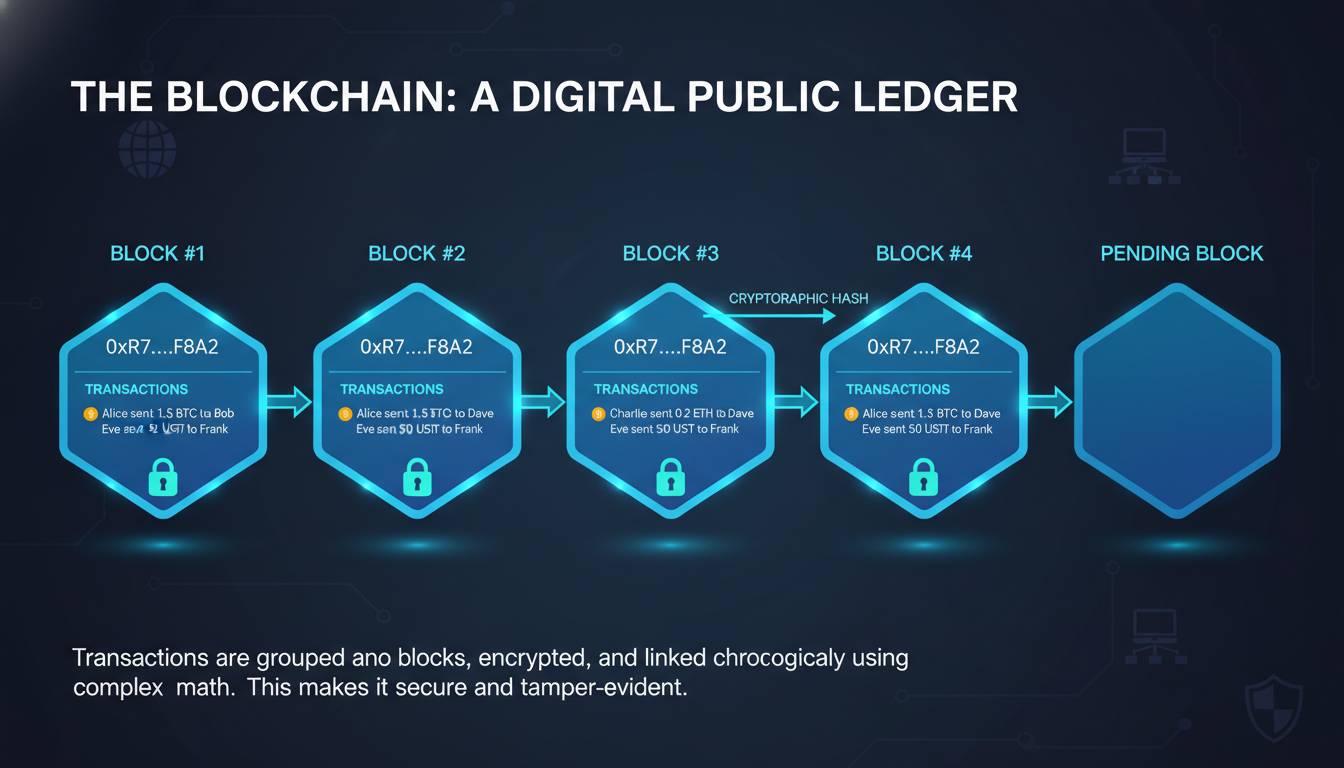
Blockchain serves as the foundation for all cryptocurrency. Imagine a shared digital ledger that records every transaction ever made, visible to everyone using the network. Each “block” contains a group of transactions, and these blocks connect together in a chain—hence the name blockchain.
When someone sends cryptocurrency, the transaction broadcasts to the network. Computers called “nodes” verify the transaction is legitimate by checking that the sender actually has the funds. Once verified, the transaction gets grouped with other recent transactions into a new block. This block then attaches to the previous block, creating an unbroken chain of transaction history.
What makes this revolutionary is the decentralization. Instead of one company or bank holding all the records, thousands of computers (called nodes) around the world each hold a complete copy of the blockchain. If someone tries to hack one computer, the others still have the correct records. To successfully manipulate the blockchain, someone would need to control more than half of all the computers in the network—an attack so expensive and complicated that it’s never happened to major cryptocurrencies.
Key Concepts Every Beginner Should Know
Before exploring cryptocurrency further, you need to understand several fundamental terms that will appear repeatedly in your crypto journey.
Wallets: Just as you need a wallet to hold physical cash, you need a cryptocurrency wallet to store your digital coins. These wallets come in two forms: “hot” wallets connected to the internet (convenient but slightly vulnerable) and “cold” wallets stored offline (more secure but less convenient). Each wallet has a public address—a long string of numbers and letters you share with others so they can send you crypto—and a private key that acts like your password. Never share your private key with anyone.
Mining: Some cryptocurrencies, including Bitcoin, create new coins through a process called mining. Powerful computers compete to solve complex mathematical puzzles, and whoever solves first gets to add the next block of transactions and receives newly created cryptocurrency as a reward. This process secures the network and introduces new coins into circulation. However, mining consumes significant electricity and requires expensive equipment.
Halving: Bitcoin specifically has a “halving” event approximately every four years, where the reward for mining new blocks gets cut in half. This gradually reduces how many new bitcoins enter circulation, making the cryptocurrency more scarce over time. Historically, halving events have influenced Bitcoin’s price.
Tokens vs. Coins: While people often use these terms interchangeably, they differ technically. Coins (like Bitcoin or Litecoin) have their own independent blockchain network. Tokens (like Ethereum-based USDC or Chainlink) exist on top of existing blockchains and represent assets or utilities within specific applications.
Major Cryptocurrencies Beyond Bitcoin
While Bitcoin dominates the market as the most valuable cryptocurrency, thousands of alternatives exist with different purposes and features.
| Cryptocurrency | Market Cap (2024) | Primary Use | Distinctive Feature |
|---|---|---|---|
| Bitcoin (BTC) | ~$1.2 trillion | Digital gold, store of value | First cryptocurrency, most recognized |
| Ethereum (ETH) | ~$400 billion | Smart contracts, apps | Enables decentralized applications |
| USD Coin (USDC) | ~$40 billion | Stable payments | Pegged to US dollar value |
| Solana (SOL) | ~$60 billion | Fast, cheap transactions | Processes thousands of transactions per second |
Ethereum deserves special attention because it introduced “smart contracts”—self-executing programs that automatically enforce agreements when conditions are met. This innovation opened the door to decentralized finance (DeFi), non-fungible tokens (NFTs), and thousands of applications running without traditional intermediaries.
Stablecoins like USDC and USDT maintain fixed values by pegging themselves to real-world currencies, typically the US dollar. They offer the speed and security of cryptocurrency while avoiding the extreme price volatility that makes Bitcoin and Ethereum risky for everyday transactions.
Why People Use Cryptocurrency
People gravitate toward cryptocurrency for various reasons, and understanding these motivations helps explain its growing adoption.
Financial Control: Many users appreciate that cryptocurrency puts them in complete control of their money. Without banks or governments involved, adults can send and receive funds without needing permission or providing extensive personal information. This appeals particularly to people in countries with unstable currencies or limited banking infrastructure.
Lower Transaction Fees: Traditional wire transfers, especially international ones, often cost $20-50 or more and take days to complete. Cryptocurrency transfers typically cost a few dollars or less and complete within minutes to hours, regardless of geographic boundaries.
Investment Opportunities: The dramatic price movements of cryptocurrencies have created millionaire success stories—and also significant losses. Investors treat Bitcoin and other cryptocurrencies as speculative assets, hoping to buy low and sell high. However, this volatility works both ways, and many people have lost substantial money.
Privacy: While not completely anonymous, cryptocurrency transactions don’t require revealing your identity like bank transfers do. Users maintain pseudonymous addresses rather than linking transactions to their real names, though this privacy has both legitimate uses and concerning ones.
Important Risks and Considerations
Before investing in or using cryptocurrency, you must understand the significant risks involved.
Volatility: Cryptocurrency prices can swing 20% or more in a single day. Bitcoin dropped from nearly $69,000 in November 2021 to around $16,000 by late 2022—a devastating 77% loss that wiped out millions in investor wealth. If you’re considering cryptocurrency as an investment, only use money you can afford to lose entirely.
Security Threats: While blockchain itself is secure, cryptocurrency exchanges and wallets remain attractive targets for hackers. Major exchanges have suffered breaches resulting in billions of dollars in stolen funds. Using reputable exchanges, enabling two-factor authentication, and considering cold storage for large holdings helps mitigate this risk.
Regulatory Uncertainty: Governments worldwide continue debating how to regulate cryptocurrency. Some nations have banned it entirely, while others embrace it. Sudden regulatory changes could impact your ability to access or use your funds.
No Consumer Protections: Unlike bank accounts insured by the FDIC or credit card purchases with fraud protection, cryptocurrency transactions are generally irreversible. If you send funds to the wrong address or fall for a scam, recovering your money is nearly impossible.
Environmental Concerns: Bitcoin mining consumes electricity comparable to some small countries. This energy consumption primarily comes from fossil fuels in some regions, raising serious environmental concerns that critics frequently raise.
How to Get Started with Cryptocurrency Safely
If you’ve decided to explore cryptocurrency, following a careful, measured approach protects you from common pitfalls.
Start by researching and selecting a reputable exchange. Coinbase, Kraken, and Gemini are among the most established US-based platforms with strong security records and regulatory compliance. These exchanges make it relatively simple to convert US dollars into cryptocurrency and provide educational resources for beginners.
Begin with a small investment—perhaps $50-100—rather than committing significant money initially. This allows you to experience how transactions work, how prices move, and how the technology feels without risking substantial losses while learning.
Consider starting with Bitcoin or Ethereum rather than obscure altcoins. The largest cryptocurrencies have the most established track records, deepest trading markets, and greatest liquidity. Many newer cryptocurrencies eventually fail, so diversification among unknown assets carries amplified risk.
Never share your private keys or recovery phrases with anyone—anyone who asks is attempting to scam you. Write down your recovery phrase on paper and store it somewhere secure, not on your computer or phone where hackers might find it.
Frequently Asked Questions
Is cryptocurrency legal in the United States?
Yes, cryptocurrency is legal in the United States. You can legally buy, sell, hold, and use cryptocurrency in all 50 states. However, the IRS treats cryptocurrency as property for tax purposes, meaning you may owe capital gains taxes when you sell at a profit. The regulatory landscape continues evolving, with new rules potentially emerging around stablecoins and other specific areas.
How do I know if a cryptocurrency is legitimate?
Research thoroughly before investing. Legitimate cryptocurrencies typically have established teams, whitepapers explaining their technology, active communities, and trading volume on reputable exchanges. Be extremely skeptical of cryptocurrencies promising guaranteed returns, those with anonymous teams, or ones that appear only on obscure platforms. Scammers create new tokens constantly to defraud investors.
Can I lose all my money in cryptocurrency?
Yes, you can lose your entire investment in cryptocurrency. Prices are extremely volatile, and many cryptocurrencies eventually become worthless after failing to gain adoption. Beyond price risk, you could also lose access to your funds through forgotten passwords, lost recovery phrases, hacks, or scams. Never invest more than you can afford to lose completely.
How do I protect my cryptocurrency from hackers?
Use strong, unique passwords for every exchange and wallet account. Enable two-factor authentication using an authenticator app rather than SMS texts, which can be intercepted. Consider using a hardware wallet (cold storage) for significant holdings. Keep your recovery phrases written down in secure physical locations. Avoid accessing cryptocurrency accounts on public WiFi networks.
What happens when I buy cryptocurrency?
When you purchase cryptocurrency on an exchange, the transaction records your ownership on the blockchain associated with that cryptocurrency. Your exchange balance shows your holdings, but technically the exchange holds the cryptocurrency on your behalf through its wallets. For maximum security, you can transfer your purchased cryptocurrency to a personal wallet where you control the private keys directly.
Is cryptocurrency a good investment?
This depends entirely on your individual financial situation, risk tolerance, and investment goals. Cryptocurrency remains highly speculative with extreme volatility. Many financial advisors recommend treating any cryptocurrency investment as high-risk “fun money” rather than a core portfolio holding—amounts you wouldn’t lose sleep over. Past performance doesn’t guarantee future results, and the market remains largely unpredictable.