13Views 0Comments
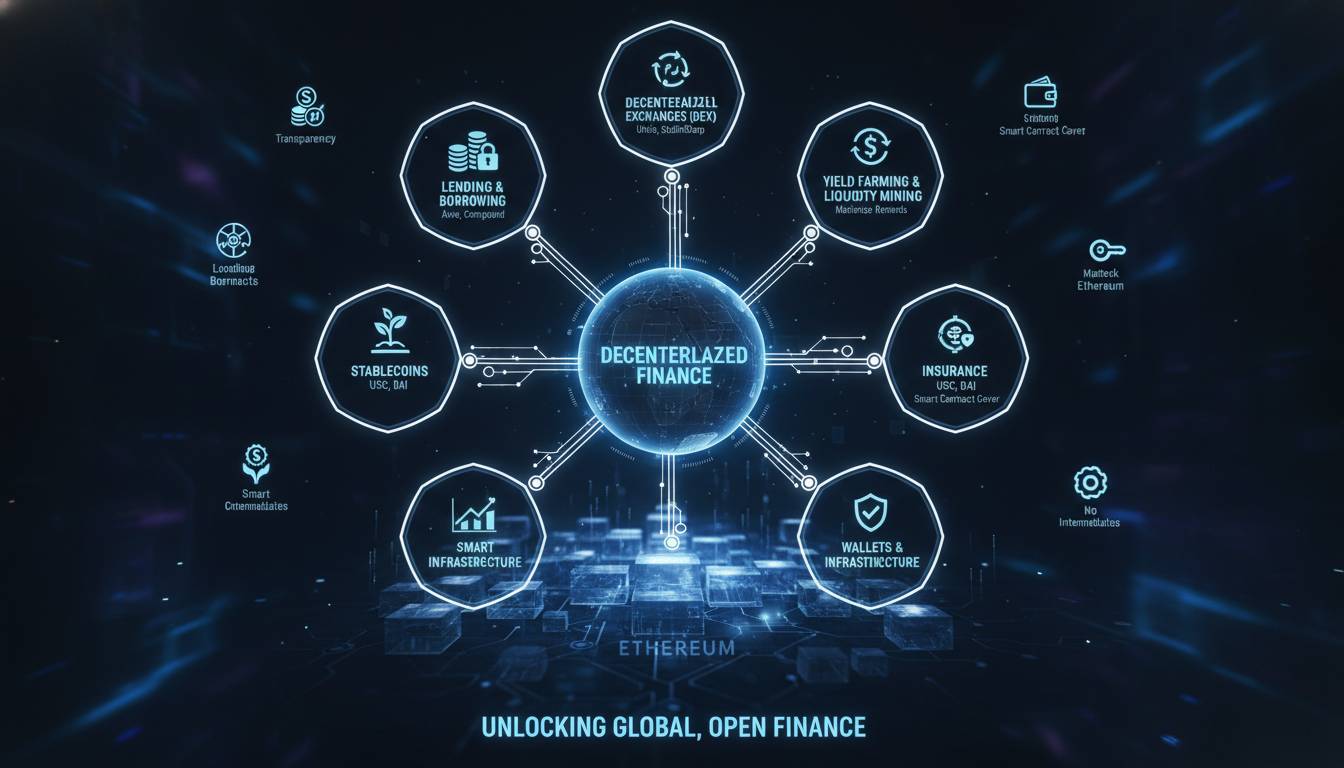
What Is DeFi? A Beginner’s Guide to Decentralized Finance
Decentralized Finance (DeFi) represents a fundamental shift in how financial services operate—replacing traditional intermediaries like banks and brokerage firms with code-driven protocols that anyone with an internet connection can access. In 2024, the DeFi ecosystem holds over $100 billion in total value locked, serving millions of users globally who trade, lend, borrow, and earn interest without centralized gatekeepers. This guide breaks down what DeFi is, how it works, and why it matters for the future of finance.
Key Insights
– DeFi eliminates intermediaries by using smart contracts on blockchain networks
– The total value locked in DeFi protocols exceeded $100 billion at peak markets
– Major use cases include lending, borrowing, trading, and earning yield
– Risks include smart contract vulnerabilities, regulatory uncertainty, and extreme volatility
Understanding the Core Concept
DeFi refers to a collection of financial applications built on public blockchains—primarily Ethereum—that replicate traditional financial instruments without relying on centralized institutions. These protocols operate through smart contracts, which are self-executing programs that automatically enforce agreements when predetermined conditions are met. When you lend money through a DeFi platform, the smart contract manages the entire process: tracking your deposit, calculating interest, and distributing returns automatically.
The philosophy behind DeFi centers on financial inclusivity and permissionless innovation. Traditional banking requires extensive documentation, credit checks, and geographic proximity to physical branches. DeFi protocols, by contrast, require only a cryptocurrency wallet and internet access. A person in an underbanked region can access the same interest rates and financial products as someone in Manhattan, assuming they have the digital assets to participate.
This architectural difference fundamentally changes how financial infrastructure functions. Instead of trust placed in institutions, DeFi places trust in code. The transparency of blockchain networks means anyone can audit how these protocols operate, though this transparency also exposes vulnerabilities that bad actors may attempt to exploit.
How DeFi Works: The Technical Foundation
Smart Contracts as Financial Infrastructure
Smart contracts serve as the building blocks of all DeFi applications. Unlike traditional contracts that require lawyers, notaries, and courts to enforce agreements, smart contracts enforce themselves through code. When a user deposits cryptocurrency into a lending protocol like Aave, the smart contract records the transaction, calculates the applicable interest rate in real-time, and distributes earned interest to the user’s wallet without human intervention.
Ethereum remains the dominant platform for DeFi development, hosting approximately 60% of total value locked across all blockchain networks. Its Turing-complete programming language, Solidity, enables developers to create complex financial instruments that can interact with each other in what’s called “composability”—the ability to stack multiple protocols together to create new financial products.
Key Components Enabling DeFi
Oracles provide external data to smart contracts, connecting blockchain networks to real-world information like asset prices, interest rates, and weather data. Without oracles, DeFi protocols would be unable to determine collateral values or settle derivative contracts. Chainlink is the dominant oracle provider, securing billions of dollars in value across numerous protocols.
Wallets serve as the user’s interface with DeFi applications. MetaMask remains the most popular choice, though hardware wallets like Ledger provide enhanced security for larger holdings. These wallets store the private keys that authorize transactions on the blockchain, meaning users maintain complete control over their assets without relying on a bank to hold funds.
Decentralized Exchanges (DEXs) facilitate cryptocurrency trading without intermediaries. Unlike centralized exchanges that hold user funds, DEX protocols like Uniswap use automated market makers (AMMs)—algorithms that pool liquidity from users and price assets based on mathematical formulas. This eliminates the need for order books and matching buyers with sellers through a central operator.
Major Use Cases and Applications
Lending and Borrowing
DeFi lending protocols have experienced explosive growth, with platforms like Aave, Compound, and MakerDAO facilitating billions in loans. The process works differently than traditional banking: borrowers deposit cryptocurrency as collateral and receive other assets as loans, typically stablecoins pegged to the US dollar. Interest rates adjust algorithmically based on supply and demand within each protocol.
The collateralization requirements in DeFi tend to exceed those of traditional loans—most protocols require borrowers to maintain 150-200% of the loan value in collateral to protect against price volatility. When the value of collateral falls below the required threshold, automated liquidation processes sell the collateral to repay the lender, preventing defaults that would destabilize the system.
Decentralized Exchanges and Trading
Uniswap processes billions in daily trading volume, making it one of the most active cryptocurrency venues globally. The platform’s automated market maker model allows anyone to provide liquidity by depositing equal values of two tokens into a liquidity pool. In return, liquidity providers earn a share of trading fees—typically 0.3% per trade—which accumulates proportionally based on their contribution to the pool.
This model has proven remarkably resilient, handling market stress during extreme volatility periods better than many anticipated. However, liquidity providers face “impermanent loss”—a phenomenon where providing liquidity to automated markets can result in holding fewer assets than if they had simply held their tokens. Understanding this risk is crucial for anyone participating in DeFi liquidity provision.
Yield Farming and Staking
Yield farming involves moving assets across different DeFi protocols to maximize returns, often chasing the highest available yield. This practice became mainstream in 2020 when compound users started receiving COMP governance tokens as incentives, leading to a yield farming boom where users sought double-digit and sometimes triple-digit annual percentage yields.
Staking, particularly in proof-of-stake networks like Ethereum following its 2022 merge, allows users to lock up cryptocurrency to support network operations and earn rewards. Ethereum stakers currently earn approximately 3-5% annually, with additional rewards available through liquid staking derivatives that allow users to maintain liquidity while earning staking returns.
Advantages Over Traditional Finance
DeFi offers several compelling advantages that distinguish it from traditional financial systems. Programmable money enables financial agreements that would be impossible through traditional institutions—insurance contracts that pay automatically when flight data confirms a delay, for example, or savings accounts with interest rates that adjust based on external data feeds.
Transparency in DeFi means anyone can examine how protocols operate, view all transactions on public blockchains, and verify that rules are applied uniformly to all participants. This stands in stark contrast to traditional finance, where internal operations remain opaque and settlements often depend on institutional intermediaries with their own interests.
Global accessibility removes geographic and demographic barriers to financial services. An unbanked individual in a developing nation with a smartphone and internet connection can access the same lending rates, trading venues, and yield opportunities as institutional investors. This democratization of finance represents perhaps the most significant long-term promise of DeFi technology.
Speed and efficiency characterize DeFi transactions, particularly for cross-border payments and settlement. While traditional international wire transfers may take days and involve multiple intermediary banks, DeFi transactions settle within minutes or seconds, with costs that often remain a fraction of traditional banking fees.
Risks, Challenges, and Limitations
Despite its promise, DeFi carries significant risks that participants must understand. Smart contract vulnerabilities have resulted in hundreds of millions of dollars in losses across the ecosystem. Code bugs, even in extensively audited protocols, can be exploited by sophisticated attackers. The Wormhole bridge hack in 2022 saw approximately $320 million stolen, illustrating the sophisticated threat landscape facing DeFi users.
Regulatory uncertainty creates additional risk for DeFi participants. Securities laws were written decades before blockchain technology emerged, and regulators worldwide are still determining how existing frameworks apply to decentralized protocols. Users may face unexpected legal exposure depending on their jurisdiction and the specific activities they pursue.
Extreme volatility characterizes cryptocurrency markets, and DeFi amplifies this through leverage mechanisms and liquidation risks. During the market correction in May 2022, cascading liquidations across multiple protocols contributed to billions in losses. The interconnected nature of DeFi protocols means that failures in one area can quickly cascade throughout the ecosystem.
User error represents another significant risk category. Losing access to private keys means permanent loss of funds with no recovery mechanism—no bank to call, no customer service representative to help. Phishing attacks, fraudulent protocols, and accidental transactions to wrong addresses have resulted in billions in permanent losses.
Getting Started with DeFi
For those interested in exploring DeFi, starting small and prioritizing security is essential. Setting up a hardware wallet and funding it with only what you can afford to lose provides the safest environment for learning. MetaMask offers an excellent starting point for browser and mobile interaction with DeFi protocols, with extensive documentation available for newcomers.
Recommended first steps:
– Create a hardware wallet for significant holdings
– Practice with small amounts on test networks first
– Research protocols thoroughly before depositing funds
– Never share private keys or seed phrases with anyone
– Verify all website URLs carefully—phishing sites are common
– Start with established protocols with strong track records
Understanding gas fees is crucial for Ethereum-based DeFi—transaction costs vary significantly depending on network congestion. During periods of high activity, simple transactions may cost tens of dollars, while complex interactions like providing liquidity can cost much more. Layer 2 scaling solutions like Arbitrum and Optimism offer significantly lower fees while maintaining compatibility with Ethereum’s DeFi ecosystem.
The Future of Decentralized Finance
DeFi continues evolving rapidly, with institutional players increasingly entering the space. Major financial institutions have begun exploring DeFi infrastructure for cross-border payments and settlement, while regulated entities are developing compliant on-ramps that bridge traditional finance with decentralized protocols.
Interoperability between different blockchain networks is improving, allowing assets and information to flow more seamlessly across ecosystems. This connectivity creates opportunities for more sophisticated financial products while also introducing new systemic risks that the industry continues learning to manage.
The regulatory landscape will likely crystallize over the coming years, potentially bringing both compliance requirements and legitimacy that could accelerate institutional adoption. How regulators balance innovation with consumer protection will significantly influence DeFi’s trajectory.
Frequently Asked Questions
What exactly is DeFi in simple terms?
DeFi is financial services—like lending, borrowing, trading, and earning interest—that run on blockchain networks without traditional intermediaries like banks. Instead of trusting a company to handle your money, you trust code that anyone can verify and inspect.
Is DeFi safe to use?
DeFi carries significant risks including potential loss from smart contract bugs, hacking, scams, and extreme market volatility. Never invest more than you can afford to lose, use hardware wallets for significant holdings, research protocols thoroughly, and start with small amounts to learn the system.
How do you make money with DeFi?
You can earn money through DeFi by lending assets to earn interest, providing liquidity to trading pools, staking cryptocurrency to support network operations, or participating in governance by holding and voting with protocol tokens. Returns vary widely and fluctuate based on market conditions.
What is the biggest risk in DeFi?
Smart contract vulnerabilities represent the biggest technical risk, as exploited bugs have resulted in billions in losses. Regulatory uncertainty and market volatility also present significant challenges. The interconnected nature of DeFi protocols means problems in one area can quickly spread throughout the ecosystem.