4Views 0Comments
When Is Ethereum Merge 2025? Everything You Need to Know
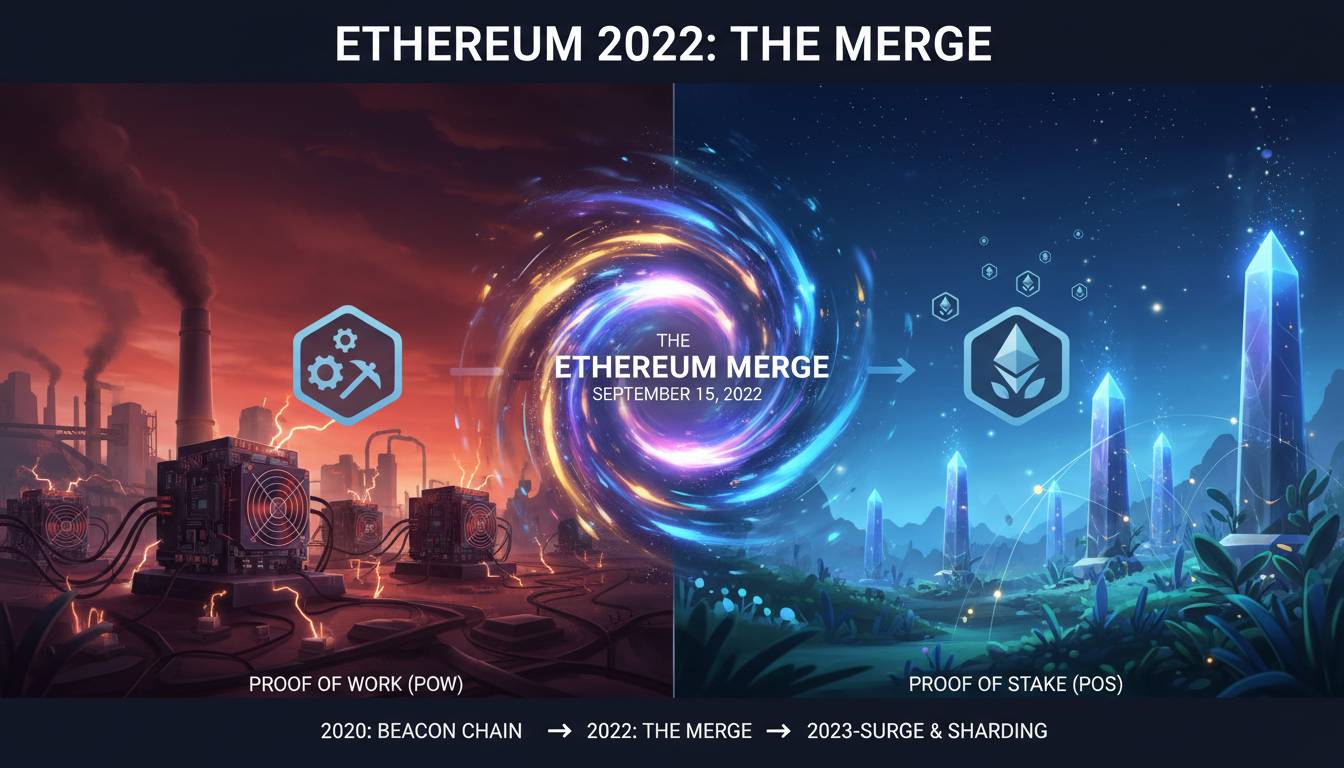
The Ethereum Merge already happened—and it wasn’t in 2025. If you’re searching for when the Ethereum Merge will occur in 2025, you might be working with outdated information. The historic transition from Ethereum’s proof-of-work (PoW) to proof-of-stake (PoS) consensus mechanism was successfully completed on September 15, 2022, at 6:42:42 AM UTC, marking one of the most significant events in blockchain history.
📊 STATS
• September 15, 2022 — Date Ethereum completed its transition to proof-of-stake
• 99.9%+ — Energy reduction achieved post-Merge
• ~$20 billion — Value locked in Ethereum Beacon Chain at Merge completion
• 2025 — Year of the upcoming Pectra upgrade, not the Merge
Key Takeaways
• The Merge already happened on September 15, 2022
• No second Merge is planned — the transition was a one-time event
• Pectra is the major Ethereum upgrade scheduled for 2025
• Ethereum’s future upgrades include continued scalability improvements
• The transition reduced Ethereum’s energy consumption by approximately 99.9%
This article will clarify exactly when the Merge occurred, explain what it accomplished, and detail the Ethereum upgrades actually planned for 2025 and beyond.
What Was the Ethereum Merge?
The Ethereum Merge was the moment Ethereum officially transitioned its mainnet from proof-of-work to proof-of-stake consensus. This event had been in development since 2014 when Ethereum founder Vitalik Buterin first proposed the transition.
Background and Timeline
Ethereum’s journey toward proof-of-stake began years before the actual Merge. The Beacon Chain, Ethereum’s proof-of-stake chain, launched on December 1, 2020, operating in parallel with the main proof-of-work chain. This allowed developers to test the new consensus mechanism without disrupting the existing network.
The Merge was originally scheduled for 2022 after multiple delays. The “Paris” upgrade (formerly known as the Merge) was triggered at block height 15,537,393, officially transitioning Ethereum to proof-of-stake. This event eliminated the need for energy-intensive mining operations and fundamentally changed how Ethereum validates transactions.
Timeline of Key Events:
• December 1, 2020 — Beacon Chain launches
• April 2021 — Alchemy reports 100,000 validators on testnet
• September 15, 2022 — The Merge completes successfully
• April 2023 — Shanghai upgrade enables ETH staking withdrawals
• March 2024 — Dencun upgrade introduces blob transactions
Why Did It Take So Long?
The Merge was delayed multiple times because of its technical complexity. Changing Ethereum’s consensus mechanism while maintaining network continuity required years of testing and development. The upgrade affected every aspect of the Ethereum ecosystem—from smart contracts to wallet interfaces to mining operations.
💡 FACT: Ethereum’s proof-of-stake transition reduced the network’s energy consumption by approximately 99.9%, making it one of the most energy-efficient major blockchains globally.
What the Merge Accomplished
The Ethereum Merge was not merely a technical upgrade—it fundamentally transformed Ethereum’s economic model, security mechanism, and environmental footprint.
Energy Efficiency
Perhaps the most immediately visible change was the dramatic reduction in energy consumption. Proof-of-work mining required massive amounts of electricity to power specialized mining hardware. After the Merge, Ethereum’s energy usage dropped by approximately 99.9%, comparable to the energy footprint of a small database server rather than a small country.
This environmental improvement made Ethereum significantly more attractive to institutional investors and environmentally conscious participants. Companies that previously avoided cryptocurrency due to sustainability concerns became more willing to engage with Ethereum-based applications.
Economic Changes
The Merge also transformed Ethereum’s issuance model. Under proof-of-work, miners received block rewards for creating new blocks. Under proof-of-stake, validators receive rewards based on their staked ETH holdings and network participation. This shift reduced new ETH issuance by approximately 90%, making Ethereum more deflationary over time.
The transition also introduced the concept of “max extractable value” (MEV), where validators can reorder transactions within blocks for profit. This created new economic dynamics and opportunities for validator operators.
| Metric | Pre-Merge (PoW) | Post-Merge (PoS) |
|---|---|---|
| Annual ETH Issuance | ~5% | ~0.5-1% |
| Energy Consumption | ~150 TWh/year | ~0.01 TWh/year |
| Block Time | ~13-14 seconds | ~12 seconds |
| Validator Set | N/A | ~900,000+ validators |
Network Security
Proof-of-stake provides security through economic incentives rather than computational work. Validators must stake 32 ETH (approximately $80,000 at current prices) to participate in block production. Malicious behavior results in “slashing”—the partial or complete destruction of the validator’s staked ETH.
This economic model makes attacking Ethereum prohibitively expensive. An attacker would need to control 51% of the total staked ETH, which would cost billions of dollars and would result in the attacker’s stake being destroyed.
What Ethereum Upgrades Are Coming in 2025?
While there is no “second Merge” scheduled, Ethereum has a robust roadmap of upgrades planned for 2025 and beyond. The most significant upcoming change is the Pectra upgrade.
Pectra Upgrade
The Pectra upgrade combines two previously planned upgrades—Prague (execution layer) and Electra (consensus layer)—into a single major upgrade. This is currently the most anticipated Ethereum upgrade and is expected to arrive in late 2025 or early 2026.
Key Features Expected in Pectra:
• Enhanced account abstraction capabilities
• Improved validator economics and flexibility
• New opcode capabilities for developers
• Further improvements to Ethereum’s scaling infrastructure
Account abstraction improvements will make it easier for users to interact with Ethereum by enabling smart contract wallets that can pay gas fees in tokens other than ETH, recover accounts without seed phrases, and implement social recovery mechanisms.
Beyond Pectra
Ethereum’s long-term roadmap includes continued focus on scaling through Layer 2 solutions, improved data availability, and further reductions in transaction costs. The “Surge” phase of Ethereum’s roadmap aims to achieve 100,000 transactions per second through rollup technology and data sharding.
📈 FUTURE ROADMAP: Ethereum plans to continue scaling through Layer 2 networks, with major players like Arbitrum, Optimism, and Base handling the majority of transactions while Ethereum mainnet serves as the settlement layer.
Common Misconceptions About the Merge
| Misconception | Reality |
|---|---|
| “The Merge will happen in 2025” | Already completed September 15, 2022 |
| “There will be a second Merge” | The transition was a one-time event |
| “ETH became deflationary after Merge” | ETH became more deflationary but issuance continues |
| “Staking rewards are guaranteed” | Validators can be slashed for misbehavior |
| “Mining is coming back” | Proof-of-work was permanently deprecated |
⚠️ CRITICAL: Anyone claiming there will be an “Ethereum Merge 2025” is either misinformed or attempting to spread misinformation. Always verify upgrade announcements through official Ethereum channels like the Ethereum Foundation or Ethereum.org.
Expert Insights on Ethereum’s Evolution
👤 Vitalik Buterin, Ethereum Founder
“Ethereum’s transition to proof-of-stake is not the end of the journey—it’s the beginning of a new phase where we can finally focus on scaling and usability.”
👤 Danny Ryan, Ethereum Foundation
“The Merge showed the world that a major blockchain can successfully upgrade its consensus mechanism without disrupting the network. This sets a precedent for future upgrades.”
The successful completion of the Merge demonstrated that Ethereum could undergo radical changes while maintaining network continuity. This technical achievement has implications for all blockchain platforms considering major upgrades.
How to Participate in Ethereum’s Future
Whether you’re a developer, validator, or user, Ethereum offers multiple ways to participate in its ecosystem.
For Validators
Running an Ethereum validator requires:
– Minimum 32 ETH for full validator node
– Dedicated hardware (CPU, RAM, storage)
– Continuous internet connectivity
– Technical knowledge for node operation
For those without 32 ETH, liquid staking solutions like Lido, Rocket Pool, and Coinbase Staking allow users to stake smaller amounts while receiving liquid tokens representing their staked position.
For Developers
Ethereum’s upgrade roadmap creates opportunities for developers to build on new capabilities. The Pectra upgrade’s account abstraction features will enable new wallet designs and user experiences. Staying informed about Ethereum Improvement Proposals (EIPs) helps developers prepare for upcoming changes.
For Users
Regular Ethereum users benefit from:
– Lower gas fees on Layer 2 networks
– Improved wallet security through account abstraction
– Faster transaction finality
– Greater DeFi and NFT ecosystem accessibility
Conclusion
The Ethereum Merge was a historic achievement that completed in September 2022—not 2025. This transition transformed Ethereum from a proof-of-work to a proof-of-stake network, reducing energy consumption by approximately 99.9% and fundamentally changing the network’s economic model.
If you’re looking for Ethereum upgrades in 2025, the Pectra upgrade is the most significant event on the horizon. Expected in late 2025 or early 2026, Pectra will bring enhanced account abstraction, validator improvements, and new developer capabilities.
Ethereum’s evolution continues through Layer 2 scaling solutions and future upgrades. The successful Merge demonstrated that Ethereum can implement major changes while maintaining network stability—a capability that will serve the platform well as it pursues its ambitious roadmap toward greater scalability and usability.
Frequently Asked Questions
Q: When exactly did the Ethereum Merge happen?
A: The Ethereum Merge completed on September 15, 2022, at 6:42:42 AM UTC, at block height 15,537,393.
Q: Will there be another Ethereum Merge in 2025?
A: No. The Merge was a one-time transition from proof-of-work to proof-of-stake that has already been completed. There is no “second Merge” planned.
Q: What Ethereum upgrade is coming in 2025?
A: The Pectra upgrade (combining Prague and Electra) is expected in late 2025 or early 2026. This will include account abstraction improvements and validator enhancements.
Q: How much energy did the Merge save?
A: The Merge reduced Ethereum’s energy consumption by approximately 99.9%, from roughly 150 TWh annually to about 0.01 TWh.
Q: Can I still mine Ethereum?
A: No. Ethereum mining was deprecated when the Merge completed in September 2022. The network now uses proof-of-stake consensus exclusively.
Q: What happened to Ethereum after the Merge?
A: Post-Merge, Ethereum became significantly more energy-efficient, reduced new ETH issuance, and enabled staking withdrawals with the April 2023 Shanghai upgrade. The network continues to scale through Layer 2 solutions.